Digital Marketing

SEO Campaign: What It Is and How to Start

Mohit Chaudhary
August 16, 2023
8 min read
SEO Campaign: What It Is and How to Start

How Important is SEO?

Are you considering launching an SEO campaign? To succeed in today’s digital landscape, it’s essential to recognize that the landscape of Search Engine Optimization has evolved significantly since 2012. SEO serves as a potent tool for building brand awareness, fostering customer relationships, and establishing authority within your industry. Its capabilities extend to achieving diverse objectives such as boosting brand visibility, driving conversions, increasing website traffic, enhancing customer experience, and much more. As the demand for SEO continues to surge, its significance has never been more pronounced.

Step 1: Define KPIs & Goals

Before delving into any SEO strategy, setting clear goals and tracking methods is paramount. Without a defined yardstick for measuring success, evaluating the effectiveness of your strategies becomes nearly impossible. While keyword rankings might seem like an obvious metric, relying solely on them can be misleading due to personalized search results. Google tailors search outcomes based on individual search history, rendering uniform keyword rankings less meaningful.

For comprehensive measurement, focus on analyzing user behavior once they land on your website. Metrics such as sessions, users, landing page engagement, clicks, impressions, and overall engagement levels provide deeper insights. Utilize tools like Google Analytics, Google Search Console, and possibly Google Tag Manager for more intricate tracking. Additionally, platforms like Google Data Studio and HubSpot can help consolidate data into informative dashboards. HubSpot Marketing Platform now offers topic cluster analytics to monitor the performance of your pillar content strategy.

Key Performance Indicators (KPIs) and goals could encompass objectives like:

  • Achieving a 100% YoY increase in organic sessions.
  • Realizing a 25% month-on-month growth in organic homepage sessions.
  • Generating 10 Marketing Qualified Leads (MQLs) through organic traffic.

In case of local businesses, remember that Google customizes search outcomes based on location, necessitating the optimization of your Google My Business profile. Tools like SEMRush and BrightLocal help track local keyword rankings and local pack placement.

Step 2: Evaluate Your Website Infrastructure

Once your KPIs and goals are established, assess your website’s foundational aspects:

  • Identify the platform your website operates on.
  • Distinguish between modern and outdated platforms.
  • Consider migrating to modern platforms like HubSpot, WordPress, or Marketo.
  • Modern platforms offer better optimization, security, and design flexibility.

By scrutinizing your website’s foundation, you can make informed decisions regarding optimization efforts and consider transitioning to a more adaptable platform.

Also Read-What Content writing strategies should you follow while writing as a professional?

Do You Need to Change Your Website Platform?

Understanding your website’s platform is crucial when considering an SEO campaign. Modern platforms like HubSpot offer speed, security, and enhanced optimization capabilities. They also provide greater flexibility in terms of design changes and updates. If your current platform is outdated and challenging to optimize, it’s advisable to transition to a more modern platform such as HubSpot, WordPress, or Marketo. Sometimes, migrating platforms proves more cost-effective than optimizing an outdated and cumbersome one. While the decision rests with you, the long-term benefits of migration often make it a worthwhile investment.

Assessing the Need for Design Changes

Deciding whether to alter your website’s design can be a complex decision. While you may have an emotional attachment to your current design, it might not be the most conducive design for SEO purposes, mobile-friendliness, and overall user experience. Several reasons might necessitate a new design, and it’s essential not to become overly attached to your current one. If you’re switching to a new platform, the process can be simpler as you can choose a new theme and customize it to your liking.

Addressing Website Issues

Before diving into the optimization stage, addressing any existing website issues is imperative. Addressing these concerns is crucial if your website is outdated, poorly designed, or not user-friendly. These issues can hinder the effectiveness of your SEO campaign. To achieve success, your strategy should extend beyond keyword optimization, encompassing an improved user experience and overall website quality.

Step 3: Topic Creation & Keyword Research

While focusing on topics rather than singular keywords is essential, conducting keyword research remains fundamental. To begin, brainstorm topics during a collaborative session. There are no wrong answers at this stage; the goal is to generate a comprehensive list of potential topics. These could range from concise topics like “Digital Marketing” to more detailed queries like “What is digital marketing?” or “About Us.” Key considerations during brainstorming include understanding customer needs, highlighting your offerings, conveying your message, and aligning with existing content.

After brainstorming, streamline the list by removing duplicates and irrelevant topics, narrowing it down to the most essential subjects. This list can be revisited and refined later as needed. Subsequently, use keyword research tools like SEMRush, Moz, or Rank Tracker to analyze potential keywords within each chosen topic. You can better structure your content strategy by categorizing and organizing researched keywords.

Examine your current rankings and analyze competitor keywords to identify gaps in your content strategy. Utilize keyword research tools like SEMRush’s keyword magic tool to generate additional keyword ideas. As you gather information, organize keywords by topic and select those with higher search volume and attainable ranking potential.

Step 4: Implement a Pillar Content Strategy

Content lies at the heart of your website and plays a pivotal role in search engine rankings. Crafting a well-executed content strategy is vital to capitalize on SEO opportunities. The approach to content creation has evolved much like Google’s algorithm.

Once topics and keywords are chosen, perform long-tail keyword research to structure your content strategy. These keywords will shape both your blog article titles and your pillar content pieces. Pillar content, also known as 10x content, involves creating comprehensive long-form content pieces around your chosen topics. These pages, whether existing content or new creations, serve as in-depth resources to enhance your rankings and user engagement.

Support your pillar content with topic clusters—relevant blog articles linked back to your pillar content. These clusters establish the significance of your pillar content in the eyes of search engines like Google. By linking to your pillar content, you convey its importance and relevance to your website’s users. This approach fosters higher rankings and increased organic traffic through improved user engagement and content relevance.

Step 5: Perform an SEO Audit

An SEO audit is the foundation of any successful campaign. It provides insights into areas requiring improvement for both on-page and off-page SEO. Tools like SEMRush, Moz, or Ahrefs are used for comprehensive audits, helping to identify strengths and weaknesses in your website’s optimization. Although methods may vary, a blend of on-site optimization and technical analysis is typically employed.

Audit Step 1: Get Page Inventory

Use tools like ScreamingFrog to obtain a comprehensive inventory of essential elements such as URLs, metadata, status codes, and redirects. This initial analysis helps identify optimization opportunities. Ensure URLs are logically structured for effective crawling by search engines. Evaluate Meta Titles and Descriptions, optimizing them to align with best practices.

Audit Step 2: Address Accessibility Issues

Assess website accessibility issues using Google Search Console. Examine the Robots.txt file, essential for guiding search engine crawlers and preventing indexation of specific content. Ensure it’s not blocking critical pages. Similarly, analyze the Sitemap.xml file, a roadmap for search engine crawlers. Submit the sitemap to Google Search Console for efficient indexing. Additionally, identify and rectify 404 errors, which hinder user experience and search engine indexing.

Audit Step 3: On-site Optimization Overview

Leverage all-in-one SEO tools like SEMRush, Moz, Ahrefs, DeepCrawl, or Netpeak Spider to assess on-site optimization. These tools identify optimization errors, including missing alt-text, Meta Title and Description issues, and URL structure problems. Collate the identified issues to guide on-site optimization efforts.

Configure the site audit settings properly, specifying the number of URLs, the crawler type, and other parameters. Schedule regular crawls to track progress over time.

Step 6: Implement Audit Findings

After creating a strategy and establishing goals, it’s time to put the audit findings into action.

Begin by prioritizing high-impact and top-priority items identified during the audit. Address accessibility issues, fixing the Robots.txt and Sitemap files, as well as implementing 301 redirects for 404 errors found in Google Search Console.

Plan implementation timelines for each action item. Focus on optimizing your website by resolving errors and enhancing its structure.

Refer back to the all-in-one SEO tool for optimization suggestions based on target keywords. Leverage these insights to fine-tune your optimization strategy.

With your website error-free and optimized, shift your focus to on-site content optimization. For pillar pages, link back to closely related articles, optimizing them for the corresponding target keywords. This process ensures that your on-site strategy is cohesive and aligned with your overall optimization goals.

Step 7: Work on Local SEO

Local SEO is crucial for businesses targeting local customers. It leverages search engines and business directories to enhance local online visibility. Here’s how to proceed:

Start by setting up accurate Bing and Google My Business listings. Ensure address consistency with your website. Optimize these listings with images, descriptions, services, and more. Verify ownership to gain control and influence over the listings. Verification boosts rankings in local packs.

Expand beyond Bing and Google listings to platforms like Yelp and Yellow Pages. Use tools like BrightLocal or Citation Builder Pro to streamline citation creation. These listings reinforce your Google and Bing listings, driving more local traffic.

Step 8: Work on Backlinks

Backlinks play a pivotal role in domain authority. Focus on quality over quantity to avoid penalties from poor-quality backlinks. Begin by evaluating your current backlinks and disavow toxic links through tools like Google Search Console.

Create authoritative and relevant backlinks through the following methods:

  1. Unlinked Mentions: Set up Google Alerts for your brand, CEO, or key products. Approach authors to request backlinks for mentions.
  2. Competitive Link Building: Analyze competitor backlink profiles using tools like SEMRush. Aim for powerful, authoritative links similar to your competitors.
  3. Skyscraper Technique: Identify popular content in your industry and create superior versions. Reach out to sites linking to the original content, offering them a mutually beneficial link.
  4. Industry-Related Directory Link Building: Find high-authority, industry-specific directories for relevant backlinks.

Remember, building backlinks requires creativity. Leverage business relationships for link exchanges. Prioritize your efforts and adapt your strategy if needed.

Best Practices
  • Craft Meta Titles and Descriptions that incorporate keywords naturally and resonate with users.
  • Optimize URLs for hierarchy, keywords, and length (under 200 characters).
  • Optimize images by minimizing size, using the right format, adding alt text, structured data, and SEO-focused file names.
  • Align content with search intent to satisfy users and improve Google ranking.

To Wrap It All Up

Begin with a solid understanding of your strategy and goals. Implement both on-site and off-site optimizations according to your plan. Remember, effective SEO requires ongoing management and optimization. It’s a long-term commitment, and seeking assistance from an SEO company can be beneficial for sustained success. At Revenue River, we help businesses of all sizes and industries with their SEO efforts.


You May Also Like

10 Proven SEO Hacks for New Website
Digital Marketing

10 Proven SEO Hacks for New Website

Boost your website’s visibility with these actionable SEO strategies that deliver real results…

Read More
The Power of Digital PR in Branding
Digital Marketing

The Power of Digital PR in Branding

Explore how digital PR can amplify your brand’s reach and build lasting relationships with your audience…

Read More
Digital Marketing Strategies Employed by Online Casinos
Digital Marketing

Digital Marketing Strategies Employed by Online Casinos

Online casino businesses exist in a competitive, high-pressure environment where advertising is key to staying competitive. With a…

Read More

Ready to Transform Your Business with AI?

Explore how our AI-first solutions can help your business grow and innovate.

Digital Marketing

What Is an SEO Agency?

Mohit Chaudhary
August 16, 2023
8 min read
What Is an SEO Agency?

Enhancing Business Growth with the Right SEO Agency 

Unlocking Digital Success through Strategic SEO 

Key Takeaways: 

Business growth relies on hiring skilled professionals for various roles, including accountants, managers, and digital marketing experts. Consideration of an SEO agency can be pivotal for supporting business growth. Table of Contents:

Role of SEO Agencies: 

SEO agencies are pivotal in optimizing web pages to enhance search rankings, increase visibility, and attract relevant traffic from search engines like Google, Bing, and Yahoo. 

Ethical SEO: White Hat Practices: 

Reputable SEO agencies employ ethical, white hat SEO practices, aligning with search engine guidelines and focusing on sustainable strategies for long-term growth. 

The Functions of an SEO Agency: 

Comprehensive SEO includes on-page, off-page, technical, and semantic strategies. Expert agencies analyze and optimize website components, such as schema, metadata, internal links, and content. 

Benefits of Hiring an SEO Agency: 

Utilizing an experienced SEO agency enables business owners to concentrate on daily operations while experts work to elevate digital visibility and attract target audiences. 

Also Read-8 SEO Tips to Get on the First Page of Google

Crafting a Tailored SEO Strategy: 

Customized SEO strategies consider industry nuances, audience preferences, and business goals, ensuring effective optimization efforts. 

Recognizing Red Flags with SEO Agencies: 

Being vigilant about signs of trouble, such as unethical tactics or lack of transparency, helps businesses avoid detrimental partnerships. 

Commitment to Ongoing Improvement: 

Top-tier SEO agencies emphasize continuous enhancement, adapting strategies based on evolving search algorithms and performance metrics. 

SMA Marketing’s SEO Agency Services: 

SMA Marketing offers comprehensive SEO services, exemplified by the SEO Intensive program, delivering tangible results through holistic optimization. 

Exploring the SEO Intensive Program: 

The SEO Intensive covers crucial aspects, including semantic SEO, technical SEO, on-page SEO, off-page SEO, and strategic keyword research. 

Semantic SEO: Unveiling Meaningful Content: 

Semantic SEO focuses on crafting content that aligns with user intent, providing valuable insights and enhancing user engagement. 

Technical SEO: Enhancing Site Structure: 

Technical SEO optimizes website architecture, load times, mobile responsiveness, and other technical elements crucial for user experience and search ranking. 

On-Page SEO: Optimizing Page Elements: 

On-page SEO optimizes page elements like titles, meta descriptions, headers, and content to align with target keywords and improve search visibility. 

Off-Page SEO: Building External Authority: 

Off-page SEO involves building authoritative backlinks and establishing a strong online presence through reputable sources, boosting credibility. 

Keyword Research & Content Strategy: Targeting Relevance: 

Strategic keyword research and content planning ensure alignment with audience interests, driving organic traffic and engagement. 

Delivering Results: SEO Intensive Deliverables: 

The SEO Intensive program delivers comprehensive reports, highlighting progress in rankings, traffic, conversions, and overall digital impact. 

Next Steps after the SEO Intensive:

Following the SEO Intensive, businesses reap benefits through sustained growth, adapting strategies based on ongoing insights. 

Key Takeaways for Your Business Growth: 

SEO agencies play a vital role in boosting online visibility and driving relevant traffic. Optimal SEO encompasses diverse strategies, enhancing user experience and search ranking. Hiring a proficient SEO agency enables businesses to focus on core operations while experts optimize digital presence for growth.

The Benefits of Hiring an SEO Agency for Your Business Growth

In the fast-paced world of digital marketing, achieving business growth requires expertise and strategic execution. While handling some aspects of your marketing in-house might work well, enlisting the services of a professional SEO agency can significantly amplify your success. Here’s why hiring an SEO agency could be the best decision for your business:

Expertise Beyond Your Team’s Scope: 

Search engine optimization (SEO) is intricate and multifaceted. A reputable SEO agency boasts specialists well-versed in various aspects of SEO that might be beyond the skill set of your internal marketing team. Their expertise covers the intricacies of on-page optimization, off-page strategies, technical improvements, and semantic SEO.

Navigating Complexity and Algorithm Changes: 

SEO is a dynamic field with ever-evolving algorithms and ranking factors. Staying up-to-date with these changes can be challenging. An experienced SEO agency stays ahead of the curve, adapting strategies to match the latest trends and algorithms. This ensures your website maintains its visibility and relevance in search engine results.

Better Return on Investment (ROI): 

Investing in an SEO agency typically provides a more substantial return on investment than attempting SEO in-house. SEO agencies have refined strategies and a deep understanding of what drives results. Their comprehensive approach, backed by years of experience, translates to improved rankings, increased organic traffic, and enhanced conversions.

Customized SEO Strategy: 

A reputable SEO agency doesn’t offer one-size-fits-all solutions. Instead, they tailor their strategies to your specific business goals and target audience. While their processes may be standardized, their plans are customized to ensure your company’s unique objectives are met effectively.

Collaboration with Marketing and Sales Teams: 

An effective SEO agency collaborates seamlessly with your marketing and sales teams. They align efforts to ensure a consistent flow of leads into your marketing funnel and sales pipeline. By working together, all aspects of your growth strategy are synchronized for optimal results.

Monitoring Performance and Data Transparency: 

A trustworthy SEO agency maintains open communication and regularly reviews your website’s performance. They provide transparent access to crucial data, such as organic traffic, keyword rankings, and conversion rates. This data-driven approach allows for continuous optimization and measurement of their impact on your business.

Proactive Improvement and Adaptation: 

Successful SEO agencies don’t rest on their laurels. They continuously analyze data and make informed adjustments to their strategies. If something isn’t yielding the expected results, they proactively address it, optimizing your website’s performance and ensuring your long-term growth trajectory.

Unlocking the Potential of the SEO Intensive: 

One such agency that exemplifies these principles is SMA Marketing. Their SEO Intensive program is a comprehensive approach to SEO that goes beyond surface-level tactics. It delves into semantic SEO, technical optimizations, on-page strategies, off-page authority building, and strategic keyword research.

Driving Semantic SEO Excellence:

Semantic SEO, a cornerstone of SMA Marketing’s approach, focuses on structured content that aligns with user intent and search engine algorithms. By leveraging NLP content optimization, entity-based content modeling, structured data mapping, and content enhancement, they ensure your content resonates with both search engines and users.

Meticulous Technical SEO Optimization: 

A robust online presence begins with technical excellence. SMA Marketing delves into server optimization, crawling optimization, code optimization, indexing, speed, and mobile responsiveness. These factors ensure your website meets search engine standards and provides an optimal user experience.

Empowering On-Page SEO Strategies: 

The agency elevates your on-page SEO game by optimizing site structure, implementing topic clusters, fine-tuning titles, header tags, meta descriptions, and image optimization. This ensures your pages effectively convey their content and purpose to both users and search engines.

Building Off-Page Authority and Trust: 

SMA Marketing recognizes that being perceived as an authoritative and trustworthy source by search engines is crucial. Their deep off-page analysis uncovers optimization opportunities and growth possibilities. By analyzing backlinks, competitive link profiles, traffic patterns, and algorithmic impacts, they shape a holistic off-page strategy.

Strategizing Keyword Research and Content Excellence: 

With years of experience, SMA Marketing grasps the importance of relevant and engaging content. Their keyword research covers your existing rankings, identifies new opportunities, and guides content improvements. This strategy ensures your pages align with searcher preferences while strategically targeting keywords for maximum impact.

Delivering a Comprehensive SEO Blueprint: 

At the culmination of their SEO Intensive, SMA Marketing presents an SEO Blueprint tailored to your business. This blueprint includes an in-depth audit, actionable tasks for site enhancement, content modeling strategies, keyword optimization plans, and content marketing strategies.

A Commitment to Continuous Growth: 

Beyond the SEO Intensive, SMA Marketing’s commitment doesn’t waver. They offer clients the opportunity to continue with their services, addressing errors, optimizing technical aspects, and ensuring your website is primed for sustainable success.

In the world of business growth, the decision to hire an SEO agency can be transformative. By leveraging the expertise, strategic insights, and comprehensive strategies of an agency like SMA Marketing, you unlock your business’s potential for enhanced online visibility, increased traffic, and sustainable growth.


You May Also Like

10 Proven SEO Hacks for New Website
Digital Marketing

10 Proven SEO Hacks for New Website

Boost your website’s visibility with these actionable SEO strategies that deliver real results…

Read More
The Power of Digital PR in Branding
Digital Marketing

The Power of Digital PR in Branding

Explore how digital PR can amplify your brand’s reach and build lasting relationships with your audience…

Read More
Digital Marketing Strategies Employed by Online Casinos
Digital Marketing

Digital Marketing Strategies Employed by Online Casinos

Online casino businesses exist in a competitive, high-pressure environment where advertising is key to staying competitive. With a…

Read More

Ready to Transform Your Business with AI?

Explore how our AI-first solutions can help your business grow and innovate.

Digital Marketing

What is an SEO Company: Definition & Functions Explained

Mohit Chaudhary
August 16, 2023
8 min read
What is an SEO Company: Definition & Functions Explained

What is an SEO Company? 

Your Efficient Solution for Boosting Traffic. Search engine optimization companies, commonly called SEO agencies, play a pivotal role in enhancing a business’s online presence by elevating its visibility within organic search results on platforms such as Google, Bing, and other search engines.

Exploring SEO Companies: Unveiling Their Role and Impact

Unlocking the Potential of SEO Agencies.

SEO companies act as catalysts for businesses, facilitating increased traffic and optimal outcomes. They achieve this by refining the visibility of enterprises in organic search outcomes on Google, Bing, and analogous search engines. If you’re eager to delve into the world of SEO companies, read further to gain insights into:

  • The Essence of an SEO Company
  • The Functions of an SEO Company
  • Financial Considerations for Hiring an SEO Firm
  • Integral Components of SEO Services
  • Optimal Timing for Enlisting the Services of an SEO Agency
  • Strategies for Identifying a Premier SEO Agency

Understanding SEO: A Primer 

Decoding the Dynamics of SEO.

SEO encompasses the fine-tuning of a website to heighten its prominence in organic search engine outcomes. Proficient SEO companies provide professional assistance in conceptualizing, implementing, and optimizing SEO campaigns that drive visibility, traffic, and revenue.

Deciphering the Mechanics of SEO 

Unraveling the Intricacies of SEO Operations.

In excess of 200 variables contribute to the formulation of search engine results pages. Here’s a brief overview of the process:

  1. Search engine crawlers (or spiders) scrutinize your website.
  2. The content of your website gets indexed by search engines, rendering it eligible for inclusion in search results.
  3. Your website surfaces in pertinent search engine result pages, with the placement determined by over 200 ranking factors.

Collaborating with an SEO agency entails their commitment to optimizing SEO in your favor, which includes:

  • Ensuring that search engines can access and index your website
  • Targeting relevant keywords to attract qualified web traffic
  • Enhancing on-site SEO through content optimization for improved search engine rankings
  • Adapting SEO strategies in response to algorithmic updates
  • Offering recommendations to refine and expand your SEO approach

Ultimately, search engine companies employ numerous strategies to help your business enhance:

  • On-page, off-page, and technical SEO elements
  • Keyword rankings
  • Organic traffic
  • Conversion rates of organic traffic

Unveiling the Role of an SEO Company 

Championing Search Engine Optimization.

An SEO company provides search engine optimization (SEO) services. Typically, such companies leverage on-page, off-page, and technical enhancements to augment a website’s visibility, traffic, and earnings stemming from organic search results.

Functionality of an SEO Company 

Empowering Business Growth through SEO Expertise.

SEO companies contribute to elevating rankings, traffic, and revenue from organic searches. Their multifaceted role encompasses various activities, including SEO audits, on-page refinements, content creation, link establishment, keyword analysis, and technical enhancements.

Cost Considerations for an SEO Firm 

Understanding the Financial Aspects.

Pricing for SEO companies generally ranges between $2500 and $7,500 per month.

The precise cost of an SEO firm hinges on your business and the chosen company. A ballpark figure is typically between $2500 and $7,500 monthly. While more economical options exist, caution against falling for SEO scams that promise budget-friendly services is advised. Factors affecting pricing include:

  • Location
  • Experience
  • Deliverables
  • Payment structure

Business-related factors include:

  • Timeline
  • Project scope
  • Objectives

For accurate cost estimates, request a personalized quote. The agency will evaluate your needs and furnish customized pricing and deliverables, aiding your decision-making process.

Assessing the Value of Hiring an SEO Agency 

Weighing the Pros and Cons.

The decision to hire an SEO agency hinges on several considerations:

  1. Your ability to conduct proficient self-led SEO efforts
  2. Budget allocation for outsourcing SEO tasks
  3. Evaluation of your current SEO strategy’s performance
  4. Assessment of your personal SEO skills

Typically, enlisting an SEO agency is advisable when:

  • Time, resources, and skills for autonomous SEO are lacking
  • Budget permits the engagement of an SEO company
  • Your SEO endeavors fail to meet management’s expectations

On the other hand, retaining in-house SEO experts is preferable when:

  • You possess the time, resources, SEO tools, and skills for independent SEO efforts
  • Budget constraints prohibit hiring a proficient SEO firm
  • Your current SEO efforts satisfy management’s expectations

Note that not all criteria need to be met to hire an SEO agency. Many businesses proactively choose this route. For instance, if your available time for SEO tasks is diminishing, preemptively seeking an SEO agency’s assistance can prevent a decline in results.

Scope of SEO Services Comprehensive Offerings from SEO Companies. An SEO company serves as a comprehensive source for various SEO services, including:

  • Traditional SEO, catering to broad, non-localized searches
  • Local SEO, targeting localized search audiences
  • Ecommerce SEO, optimizing online stores for search visibility
  • Enterprise SEO, elevating rankings for competitive, high-volume keywords
  • Voice SEO, enhancing site compatibility with voice-based searches
  • SEO audits, pinpointing issues affecting rankings
  • SEO consulting services, aiding projects like website redesigns

What Should an SEO Company Do? 

Crucial Responsibilities for Optimal SEO Results.

When considering the role of an SEO company, there are key tasks that they should undertake, which can be summarized as follows:

Audit Your Website 

Unveiling Site Potential through Comprehensive Analysis.

An essential initial step for an SEO company involves conducting a thorough audit of your website. This process enables the company to:

  • Assess the website’s structure, indexing status, and optimization level
  • Identify significant issues, such as crawling or indexing challenges
  • Establish priorities, such as addressing indexing problems versus enhancing on-page aspects
  • Formulate a robust SEO strategy tailored to your objectives
  • And more

To execute this, SEO agencies often employ tools like Google Analytics, Google Search Console, and Screaming Frog for search engine optimization analysis. Expect the agency to request access to your analytics. Depending on their approach, they might also employ premium SEO tools like Ahrefs or Semrush.

Upon completing the audit, the agency should furnish you with:

  • A summary of their findings
  • Recommendations for actionable steps

Notably, top-tier SEO firms will also provide a rationale behind their recommendations. This transparency demonstrates their commitment to your satisfaction, similar to how reputable service providers in other domains elucidate problems and solutions to bolster your confidence in decision-making.

Enhance On-Page, Off-Page, and Technical SEO 

Elevating Every Aspect of Your SEO.

A significant portion of an SEO company’s role involves advancing on-page, off-page, and technical aspects of SEO.

These categories encompass various projects and duties, as highlighted below:

On-Page Optimization Examples:

  • Enhancing title tags and meta descriptions
  • Conducting keyword research
  • Proposing new content concepts

Off-Page Optimization Examples:

  • Establishing directory listings
  • Engaging in link outreach efforts
  • Formulating ideas for content creation

Technical Optimization Examples:

  • Optimizing the robots.txt file
  • Improving page loading speed
  • Streamlining internal linking structures

By providing access to your website, an SEO company can implement technical and on-page optimizations, relieving you of a significant workload. However, depending on your circumstances, you might not be able to grant site access. In such cases, the SEO agency will serve as a consultant, offering recommendations for you or another team member to enact. This approach necessitates more time from your team and can impact the speed of SEO results if you’re unable to implement the agency’s suggestions promptly.

Report Progress 

Insights into Ongoing Advancements.

SEO companies regularly provide progress reports, typically on a monthly basis. These reports tend to focus on:

  • Keyword rankings
  • Website traffic
  • Conversions

Based on the agency’s approach, your designated point of contact will walk you through the report’s contents.

Distinguished SEO firms tailor these reports to align with your business priorities, emphasizing the metrics most relevant to your leadership. For instance, some agencies, such as foreignerds, can offer insights into the number of qualified leads generated through SEO and the conversion rate of those leads into sales. Such metrics highlight SEO’s tangible impact on the bottom line.

It’s crucial to recognize that while keyword rankings and organic traffic are significant, they can sometimes be vanity metrics. Even if your business ranks first for a high-traffic keyword, if the resultant traffic lacks relevance to your offerings, the actual impact on your business could be minimal. Therefore, engaging in a discussion with an SEO agency about their success measurement strategies before hiring is paramount. This ensures that the metrics align with your business goals and objectives.

What Should the Best SEO Agencies Do? 

Excellence in SEO Services Defined.

Distinguishing the best SEO agencies involves recognizing specific tasks and attributes that set them apart, as highlighted below:

Research Your Market 

Understanding Your Environment for Targeted Success.

Premier SEO agencies undertake thorough market research, encompassing:

  • Industry dynamics
  • Target audience specifics
  • Competitive landscape

This information enables them to:

  • Identify optimal keywords for targeting
  • Uncover opportunities for link building, content creation, and more
  • Offer recommendations for navigating market fluctuations

Some agencies, such as Foreignerds, go a step further by assigning a dedicated SEO expert with industry-specific expertise. This streamlines communication, reduces onboarding times and enhances SEO outcomes.

Develop Your Strategy 

Crafting a Holistic Approach for Maximum Impact.

Top SEO agencies excel in crafting strategies that align with your broader business objectives. They consider long-term goals, like potential expansions, to formulate comprehensive strategies. Expect them to:

  • Tailor strategies to industry, audience, and objectives
  • Adapt strategies in response to market changes
  • Incorporate the latest SEO tactics
  • Deliver customized plans for maximum effectiveness

If you prefer a hands-off approach, leading SEO agencies can handle the complete development, implementation, and management of your SEO strategy. However, collaborating with seasoned SEO experts can be beneficial even if you prefer more involvement.

Fill Your Skill Gaps Providing Expertise Beyond the Basics. Effective SEO entails diverse skill sets, spanning from web development to copywriting. The best SEO companies recognize these gaps and maintain teams with the following:

  • SEO specialists
  • Content marketing experts
  • Web developers
  • Website designers
  • And more

For instance, Foreignerds boasts a team of professionals covering an array of roles, from SEO specialists to data analysts. This diversified team facilitates quicker execution of tasks like content creation, technical enhancements, and strategy adaptations.

A/B Test Your SEO 

Elevating Optimization through Rigorous Testing.

Leading SEO agencies transcend standard optimization by conducting A/B testing on your SEO elements. This testing might involve:

  • Variations in title tags
  • Alterations in meta descriptions

Comprehensive SEO firms can also assist with Conversion Rate Optimization (CRO), which focuses on maximizing conversions among your existing traffic.

Improve Your Analytics 

Enhanced Insights for Informed Decision-Making. H

igh-quality SEO agencies invest in advanced analytics software, offering better insights into rankings, traffic, and conversions. Although this software incurs costs, its benefits include:

  • Dedicated dashboards for tracking results
  • Ranking monitoring for key URLs
  • Long-term tracking of SEO conversions

Exceptional agencies might even develop their own comprehensive analytics platforms, providing features like ROI measurement, AI-driven insights, competitor monitoring, and more.

Re-purpose Your SEO Data 

Strategically, Leveraging Organic Traffic Data.

The best SEO agencies aim to maximize the value of your organic traffic data. They recognize the significance of first-party data strategies, assisting you in:

  • Generating and activating first-party data
  • Repurposing data for ad campaigns and personalization

By employing such strategies, they contribute to increased digital marketing ROI. When considering SEO service providers, inquire about their approach to first-party data to gauge their strategic capabilities.

Top-tier SEO agencies encompass a multifaceted approach, combining exceptional optimization, adaptive services, and strategic innovation to deliver meaningful results in the ever-evolving digital landscape.

Also Read-17 Tips to Improve SEO Rankings in 2023

How to Choose an SEO Company 

Guidelines for Selecting the Right SEO Service Provider.

When it comes to hiring an SEO company, a thoughtful approach can yield the best results. Educate yourself on the selection process to identify your business’s ideal SEO service provider. Here are some valuable tips:

Outline Your Expectations 

Defining Your Goals for Effective Collaboration.

Collaborate with stakeholders to clarify your expectations from an SEO agency. Determine whether you need comprehensive strategy development and execution or assistance with specific projects. Also, establish the metrics by which you will measure the agency’s performance.

Determine Your Budget 

Financial Alignment for Optimal Investment.

Set your budget before engaging in discussions with potential SEO companies. Understand the management’s willingness to invest in SEO services and ascertain what services should be included within the budget to make it worthwhile.

Ask for Recommendations 

Utilize Your Network for Valuable Insights.

Seek recommendations from your professional network to compile a list of potential agencies. Insights from your connections can save you valuable time and help you filter out unsuitable options.

Review Case Studies 

Evaluating Success Through Real-world Examples.

Study case studies provided by the SEO candidates on your list. Understand their approach to measuring success, the strategies employed to achieve results, and the level of client satisfaction. These insights can provide valuable context.

Meet with Top Candidates 

In-person Interaction for Deeper Insight.

Arrange meetings with your top SEO candidates. Gain insights into their project management processes, SEO frameworks, and how they stay abreast of industry trends. Discuss pricing, timelines, and deliverables during these interactions.

Request Custom Proposals 

Tailored Proposals for Informed Decision-making.

Once you’ve narrowed down your favorite SEO companies, request custom proposals. These proposals should include detailed information on pricing, deliverables, and any specifics discussed during your meetings.

Don’t Settle for Less 

Pursuing Excellence in Your Selection.

If you haven’t found an agency that aligns with your expectations, don’t compromise. Continue your search until you find an SEO company you trust with your business’s online presence.

FAQs about SEO Companies 

Additional Insights into SEO Companies.

Address common questions related to SEO companies to enhance your understanding:

How Do SEO Companies Charge for Services?

  • SEO companies offer various payment structures, including flat rate, performance-based, hourly, and project-based pricing.
  • Preferred models are flat-rate, hourly, or project-based.

What Metrics Do SEO Companies Improve?

  • SEO companies focus on enhancing search engine rankings, organic traffic, organic conversions, engagement metrics like time on page, and more based on your business needs.

What Do SEO Services Include?

  • SEO services include an audit, on-page and off-page optimizations, technical optimizations, and reporting.
  • Some agencies offer additional services like strategy development, A/B testing, and advanced analytics tracking.

How Do SEO Companies Work?

  • SEO companies learn about your industry, target audience, and business goals.
  • They build, implement, and manage strategies to impact key metrics.
  • They communicate site updates and report on SEO initiatives’ impact.

What Is an Example of Working with an SEO Company?

  • Suppose you operate a house painting company. A reputable SEO company helps your website rank higher on search engines.
  • As a result, potential customers seeking painting services in your area can easily find your business online.
  • This partnership generates self-qualified leads from people actively searching for your services.

Discover the Benefits of an SEO Company

  • An SEO company enhances your online visibility, driving traffic and revenue.
  • With over 25 years of experience and over $3 billion in revenue generated for clients, Foreignerds offers custom strategies, expert teams, and cutting-edge technology for your digital marketing needs.

By following these guidelines and considering these FAQs, you can confidently select an SEO company that aligns with your business goals and objectives.

You May Also Like

10 Proven SEO Hacks for New Website
Digital Marketing

10 Proven SEO Hacks for New Website

Boost your website’s visibility with these actionable SEO strategies that deliver real results…

Read More
The Power of Digital PR in Branding
Digital Marketing

The Power of Digital PR in Branding

Explore how digital PR can amplify your brand’s reach and build lasting relationships with your audience…

Read More
Digital Marketing Strategies Employed by Online Casinos
Digital Marketing

Digital Marketing Strategies Employed by Online Casinos

Online casino businesses exist in a competitive, high-pressure environment where advertising is key to staying competitive. With a…

Read More

Ready to Transform Your Business with AI?

Explore how our AI-first solutions can help your business grow and innovate.

Digital Marketing

How to Choose a Digital Marketing Agency

Mohit Chaudhary
August 11, 2023
8 min read
How to Choose a Digital Marketing Agency

In the contemporary age of digital transformation, where virtually every facet of life is undergoing digitization, brands and enterprises find themselves compelled to establish a distinct digital footprint. However, merely existing in the online realm is insufficient in a landscape characterized by rapid technological advancement and an ever-expanding pool of competitors.

The imperative of securing a lasting virtual presence is growing in significance by the day. Yet, it is concurrently growing more complex. This complexity arises from the diverse spectrum encompassed within the domain of digital marketing. Ranging from SEO and eCommerce-oriented PPC to content and email marketing, this spectrum poses multifaceted challenges.

Selecting the optimal digital marketing strategy to foster brand engagement is far from straightforward. This challenge underscores the value of enlisting the expertise of proficient professionals, such as a digital marketing agency. Such an agency assumes the pivotal role of not only crafting a bespoke online niche for your brand but also facilitating direct connections with your customer base and intended audience, thereby amplifying brand visibility.

Central to the purview of digital marketing agencies is the cultivation of a company’s digital brand identity. These agencies proactively enhance online visibility and bolster credibility. The discerning factor, however, lies in aligning your needs with the right agency. With each agency specializing in a distinct facet, the task rests in identifying the agency that resonates with your requisites.

Unveiling the Essence of Digital Marketing Agencies

Merging contemporary marketing methodologies encompassing SEO, social media outreach, content curation, and digital strategy, digital marketing agencies emerge as architects of your online brand evolution amid an arena teeming with competitors.

An intrinsic facet of digital marketing lies in generating tangible returns through meticulously orchestrated strategies and campaigns (a comprehensive campaign checklist is at your disposal for deeper insights). This outcome effectively propels the digital presence of your brand toward an elevated echelon.

Yet, identifying digital agencies that furnish precisely tailored strategies is a pursuit fraught with complexities. Despite the profusion of digitally adept agencies, aligning your needs with an agency that resonates proves to be a nuanced undertaking that defies facile expectations.

Choosing the Ideal Digital Marketing Agency: A Comprehensive Guide

In the contemporary landscape, selecting the most fitting digital marketing agency involves a meticulous evaluation of distinctive factors. A crucial aspect for any digital marketing agency is its capacity to delve into the ethos and offerings of the companies it collaborates with. Presented below are key considerations to bear in mind before engaging a digital marketing agency:

1. Defining Clear Objectives and Goals

Prior to enlisting the services of a digital marketing agency, it is imperative to outline your brand’s requisites. Establishing your desired outcomes allows for precise communication and the realization of expected results. This step is pivotal as it aids in streamlining your search for an agency, aligning your budget, and elucidating the reasons behind your decision to partner with them. Whether it’s launching a new product or cultivating an online community, identifying these purposes and forming an in-house strategy will expedite the agency selection process.

2. Thorough Research is Key

The digital landscape harbors a plethora of agencies, yet not all can cater to your specific needs. Conducting thorough research becomes paramount to ensure compatibility between your aspirations and the agency’s capabilities. Ascertaining this alignment safeguards time and financial resources in the long run by identifying trustworthy and accomplished agencies.

3. Review Their Recent Projects and Achievements

Requesting a portfolio showcasing the agency’s recent endeavors provides tangible evidence of their competencies. Opt for agencies that willingly share their work and outcomes, as this transparency serves as a critical factor in decision-making. Choosing an agency that devises tailored strategies, precise plans, and targeted results in alignment with your objectives is pivotal.

4. Embrace Current Trends

In the dynamic realm of digital marketing, staying abreast of evolving trends is imperative. The agency you collaborate with should consistently stay updated, integrating emerging developments and popular themes into their strategies. Adaptability and the capacity to navigate change are crucial attributes, especially for long-term partnerships.

5. Beware of Unrealistic Promises

Agencies that offer all-encompassing success across all sectors typically provide mediocre service. Opt instead for agencies specializing in specific domains. This approach contributes substantially to brand growth, both financially and in terms of authenticity. Prefer working with agencies focusing on your unique requirements rather than those attempting to cover every conceivable aspect.

Also Read-Top 7 AI SEO Tools To Boost Your Website Ranking

6. Specialization Matters

Digital marketing encompasses intricate elements such as content creation, competitor analysis, and targeted audience engagement. While it might appear straightforward to outsiders, the reality is intricate and ever-changing. Collaborate with agencies specializing in your specific needs rather than those offering general solutions. A successful digital marketing strategy necessitates focused expertise.

7. The Burden of Staying Current

Digital marketing’s multifaceted nature can entail a substantial workload. While outsourcing content creators or social media specialists is expected, a comprehensive approach is often essential. Successful digital agencies aid brands in achieving prominence on search engines and social platforms. Deciding where and how to seek such support is a strategic choice.

8. Educate Yourself

A key to identifying the optimal agency lies in grasping digital marketing fundamentals. DMI’s Professional Diploma in Digital Marketing empowers you with essential skills ranging from social media marketing and PPC to email marketing and SEO. Equipping yourself with contemporary digital skills positions you at the helm of your brand’s digital trajectory.

In the dynamic expanse of digital marketing, the judicious selection of a digital marketing agency hinges on an informed approach. The synergy between your brand’s objectives and the agency’s expertise will pave the way for enduring success in the digital realm.

You May Also Like

10 Proven SEO Hacks for New Website
Digital Marketing

10 Proven SEO Hacks for New Website

Boost your website’s visibility with these actionable SEO strategies that deliver real results…

Read More
The Power of Digital PR in Branding
Digital Marketing

The Power of Digital PR in Branding

Explore how digital PR can amplify your brand’s reach and build lasting relationships with your audience…

Read More
Digital Marketing Strategies Employed by Online Casinos
Digital Marketing

Digital Marketing Strategies Employed by Online Casinos

Online casino businesses exist in a competitive, high-pressure environment where advertising is key to staying competitive. With a…

Read More

Ready to Transform Your Business with AI?

Explore how our AI-first solutions can help your business grow and innovate.

Digital Marketing

What is a Digital Agency & What Can They Do For My Business?

Mohit Chaudhary
August 11, 2023
8 min read
What is a Digital Agency & What Can They Do For My Business?

A digital agency functions as a hired entity that handles your digital marketing endeavors externally, rather than internally. This entails a range of digital solutions designed to promote your product or service online, fostering the achievement of your marketing objectives and facilitating business growth.

Such agencies typically cater to various clients, dedicating themselves to comprehending each company’s business goals. They offer customized services and recommendations tailored to unique requirements.

Comprehensive Services Offered by Digital Agencies

A digital agency houses a team of specialists proficient in contemporary digital marketing techniques. These services are geared towards leveraging technology for direct global engagement and interaction with your target audience. Some of the digital services commonly offered include:

  • Strategy services
  • Market and competitive research
  • CRM & sales funnel strategy
  • UX consulting
  • Marketing strategy
  • Brand positioning & messaging
  • Automation
  • Marketing services
  • Content creation
  • Digital marketing campaigns
  • Branding
  • Marketing personas
  • Paid media
  • Lead nurturing
  • SEO
  • Design services
  • User testing & personas
  • UI design
  • UX design
  • Wireframing and prototyping
  • Graphic print design
  • Website design
  • Animations
  • Development services
  • Website building
  • Website maintenance and hosting
  • Platform and data migration
  • CRM implementation

It’s noteworthy that some digital agencies offer “full-service digital marketing,” encompassing a holistic approach to a company’s online presence. Others may specialize in specific services like SEO or website development. Evaluating the services offered by a digital agency is vital to ensure alignment with your business vision.

Qualities of a Strong Digital Agency Partnership

An effective digital agency partnership transcends the role of a mere contractor, evolving into a collaborative partner. Beyond amiable interactions, a robust partnership hinges on mutual comprehension. Successful traits of a digital agency partnership encompass:

  • Open communication & collaboration: Your agency should involve you throughout the process, while also providing expert insights into key performance indicators (KPIs).
  • Trust: A reliable agency partner maintains confidentiality and meets deadlines.
  • Adaptability: Encourage exploration of innovative ideas, while ensuring your input remains influential.
  • Conflict resolution: Clear expectations, consistent feedback, and suggestions foster goal attainment.
  • Quality time: Regular meetings facilitate alignment and surpassing of expectations.

Advantages of Outsourcing to a Digital Agency

While the potential of managing digital marketing in-house might arise, the decision to outsource is driven by the prospect of enhanced profitability, as highlighted by digital expert Neil Patel. Digital agencies are dedicated to elevating business growth and achieving marketing objectives. Several reasons underscore the benefits of outsourcing:

  • Cost savings
  • Efficient use of time and resources
  • Focus on core competencies
  • Access to a team of industry experts
  • Insights into emerging trends and resources
  • Project flexibility (long-term, short-term, varying scales)
  • Fresh external perspective
  • Business discovery and recommendations
  • Facilitation of growth and scalability
  • Data-driven results

Selecting the Ideal Digital Agency for Your Business

Transitioning from in-house digital marketing to enlisting a digital agency is a significant decision. Various concerns often hinder small and medium-sized businesses from embracing a digital marketing partner, ranging from apprehensions about increased expenditures to reservations about trusting a third party. By this point, you likely recognize the value of engaging a digital agency. Now, let’s address the question: “How can I choose the right digital agency for my business?”

Steps to Choose the Best Digital Agency:
  1. Initial Research: Begin by exploring digital agency review platforms like Clutch.co. Utilize filters to narrow your search based on factors such as hourly rates, project sizes, and locations. Peruse reviews to ascertain if their client experiences resonate with your needs. Alternatively, seek recommendations from individuals who have previously engaged digital agencies.
  2. Evaluate Services: Examine the services provided by shortlisted agencies. While you may not require every service immediately, it’s advantageous to partner with an agency that can meet your present and future requirements.
  3. Review Recent Work: Visit the “Our Work” section on their website. This segment typically showcases client projects, highlighting challenges faced, services rendered, and achieved outcomes. This offers insight into the agency’s approach and the potential results they can deliver.
  4. Schedule a Discovery Call: Overcome any apprehension and initiate a brief discovery call. Engaging in conversation with a representative allows you to discuss your needs and pose questions. This interaction provides a glimpse into their problem-solving approach and how it might align with your business.

Also Read-Foreignerds INC. Recognized as the “Best Company to Work With” by GoodFirms

Discover the Ideal Digital Agency with Pyxl:

Begin your search with Pyxl, and here’s why:

  • Client Reviews: Our reviews on Clutch.co reflect a commendable score of 4.9/5, attesting to our client satisfaction.
  • Our Approach: We emphasize understanding your unique business needs and collaborate to realize solutions that resonate with your brand’s vision and objectives. Our success is interlinked with yours.
  • Comprehensive Services: Leveraging our expertise in strategy, design, web development, and marketing, we offer holistic solutions tailored to your project’s lifecycle.
  • Noteworthy Projects: Explore our award-winning partner projects, showcasing our ability to deliver exceptional results for clients across diverse domains.
  • Discovery Call: Reach out to us for a prompt consultation, where we can explore how to elevate your digital presence and business growth.
Guidance for Choosing the Right Agency:

For assistance selecting the right agency partner, download our “Guide to Hiring a Digital Agency.” This interactive workbook features exercises that help you identify your needs, compare options, and make an informed choice.

Embarking on the journey to find the perfect digital agency can yield transformative outcomes for your business. The right partner can propel your digital presence to new heights, positioning your brand for success.

You May Also Like

10 Proven SEO Hacks for New Website
Digital Marketing

10 Proven SEO Hacks for New Website

Boost your website’s visibility with these actionable SEO strategies that deliver real results…

Read More
The Power of Digital PR in Branding
Digital Marketing

The Power of Digital PR in Branding

Explore how digital PR can amplify your brand’s reach and build lasting relationships with your audience…

Read More
Digital Marketing Strategies Employed by Online Casinos
Digital Marketing

Digital Marketing Strategies Employed by Online Casinos

Online casino businesses exist in a competitive, high-pressure environment where advertising is key to staying competitive. With a…

Read More

Ready to Transform Your Business with AI?

Explore how our AI-first solutions can help your business grow and innovate.

Digital Marketing

How do Digital Marketing Agencies work?

Mohit Chaudhary
August 11, 2023
8 min read
How do Digital Marketing Agencies work?

For certain brands, digital marketing remains a relatively novel concept. This uncharted territory may appear as an overwhelming investment, juxtaposed against the familiar haven of traditional marketing practices. To budding digital marketers, this world can be both daunting and a far cry from the established procedures of conventional advertising agencies.

To acquaint a wider audience with the intricacies of this not-so-new realm of digital media, we aspire to present an in-depth exploration into the mechanics of a digital marketing agency.

A Glimpse into the Project Lifecycle within a Digital Agency

Digital marketing agencies deviate substantially from traditional advertising agencies due to their expedited processes that align with real-time consumer behavior online. The environment is characterized by its remarkable dynamism and innovation.

To grasp the functioning of a digital marketing agency, it is essential to comprehend the distinct departments that comprise its structure:

Sales / Business Development Team:

Like its counterparts in other enterprises, this team is responsible for establishing connections with potential clientele, onboarding new businesses, and overseeing the execution and management of contracts and Service Level Agreements (SLAs).

Account Managers/Client Servicing Team:

Tasked with handling the agency’s clients, this team’s role comes into play after the sales team secures a client. Account managers and client servicing executives coordinate daily client requirements. They subsequently formulate strategies based on these needs and oversee their implementation by various teams within the agency.

Also Read-7 Essential Services Provided by Foreignerds

Copywriting Team:

The primary step in executing a client’s strategy involves generating content or copy, encompassing blog posts, website content, nurturing emails, social media posts, digital advertisements, and more. This team typically collaborates with the SEO team to craft content enriched with targeted keywords.

SEO Team (Search Engine Optimization):

The SEO team endeavors to enhance the visibility of the client’s website in search engine results. The objective is to secure organic or unpaid visibility, attracting a larger website audience. Optionally, the team can procure paid links to augment the client’s website ranking.

Design Team:

Responsible for visual elements across diverse mediums—from blog posts to social media content and advertisements—this team ensures a user-friendly and aesthetically pleasing User Interface (UI) design for websites, bolstering lead generation.

Development Team:

The development team specializes in programming, crafting websites that boast seamless navigation, user-friendliness, and optimal returns on marketing investments for clients.

Paid Media/Pay Per Click (PPC) Team:

Paid marketing provides clients with heightened prominence across the digital landscape, encompassing search engine results pages (SERPs) and platforms like Facebook, LinkedIn, and publisher websites through Google and content marketing platforms. This avenue yields swift returns on marketing expenditure.

Social Media Team:

Charged with managing various social media platforms to promote brands and facilitate personalized interactions with clients, potential customers, and influencers. The team devises strategies, implements them, analyzes brand engagement across platforms, and engages in social media monitoring and listening.

QA or Quality Analysis Team:

Every client-generated requirement is subject to rigorous quality analysis before going live. The QA team scrutinizes content, design, navigation, image visibility, and load times, among other factors.

Accounts Team:

Providing vital financial support to the organization, the accounts team undertakes tasks such as preparing and scrutinizing financial records and managing company transactions.

Unlike the conventional agency model, where writers, designers, and account executives collaborate on individual accounts, digital marketing agencies foster an environment of interconnectedness. In such agencies, each team is interdependent, with the performance of one team invariably influencing the outcomes of others.

You May Also Like

10 Proven SEO Hacks for New Website
Digital Marketing

10 Proven SEO Hacks for New Website

Boost your website’s visibility with these actionable SEO strategies that deliver real results…

Read More
The Power of Digital PR in Branding
Digital Marketing

The Power of Digital PR in Branding

Explore how digital PR can amplify your brand’s reach and build lasting relationships with your audience…

Read More
Digital Marketing Strategies Employed by Online Casinos
Digital Marketing

Digital Marketing Strategies Employed by Online Casinos

Online casino businesses exist in a competitive, high-pressure environment where advertising is key to staying competitive. With a…

Read More

Ready to Transform Your Business with AI?

Explore how our AI-first solutions can help your business grow and innovate.

Digital Marketing

SEO Agency Vs. In-House SEO: Which Is Right for Your Company?

Mohit Chaudhary
August 11, 2023
8 min read
SEO Agency Vs. In-House SEO: Which Is Right for Your Company?

In today’s business landscape, adhering to SEO best practices is vital for success. An effectively optimized website can achieve organic rankings for valuable keywords, attract organic search traffic, and convert leads into paying customers. The importance of search engine optimization is evident, but the question arises: who will handle the SEO work? Marketing teams are presented with two primary options—building an in-house team of SEO professionals or enlisting the services of an SEO agency. In this blog post, we delve into the distinctions between these choices, the pros and cons of each, and ultimately guide you towards the most suitable option.

Defining In-House SEO and SEO Agency

  1. In-House SEO: In-house SEO involves an internal team of marketing professionals employed by your organization to execute daily marketing and SEO activities. This team handles tasks such as internal SEO audits, on-page optimization, resolving technical SEO issues, content creation, link building, competitor analysis, and keyword research. Titles within an in-house SEO team may include SEO Specialist, SEO Manager, and SEO Director. The size of the team and its members’ titles depend on your company’s size and industry.
  2. SEO Agency: An SEO agency is a team of experts providing search engine optimization services to diverse organizations across industries. These agencies collaborate with clients to conduct SEO audits, formulate comprehensive SEO strategies, and resolve technical and on-page issues. Agency experts possess extensive training and experience in various dimensions of SEO, often specializing in specific areas like link building or technical SEO. The agency’s team works within their specialties for each client, ensuring adherence to SEO best practices. Some organizations also choose to partner with an agency through a white label SEO service, which allows them to scale efficiently by outsourcing SEO execution while maintaining their own brand identity.

Distinguishing Between In-House SEO and SEO Agency

The primary distinction lies in the fact that an in-house team focuses exclusively on SEO work for your company, while an SEO agency offers its services to multiple clients in different industries. Choosing the in-house route involves hiring employees dedicated to marketing and SEO for your organization. On the other hand, hiring an agency might entail entrusting them with complete responsibility for your organization’s SEO, contingent on the scope of work outlined in the contract.

Pros and Cons of In-House SEO

Pros:
  1. Enhanced visibility into the work being done, facilitating swift changes.
  2. In-house staff solely concentrate on your company’s website.
  3. Internal team members possess a deep understanding of your organization’s culture, values, and business goals.
  4. Collaboration with other teams, such as public relations, web development, and sales, is seamless.
Cons:
  1. Hiring and training qualified employees can be a time-consuming and expensive process.
  2. Maintaining a full-time employee or team incurs substantial costs.
  3. In-house employees might not be experts in specific SEO areas due to multiple responsibilities.
  4. Work progress might be slower due to competing tasks and responsibilities.

Also Read-The Art of Search Engine Advertising in Digital Marketing

Pros and Cons of Hiring an SEO Agency

Pros:
  1. Time and money are saved by bypassing the internal hiring process; an experienced team is provided instantly.
  2. Agencies possess industry expertise that can shed light on SEO issues beyond your team’s knowledge.
  3. Hiring an agency is often more cost-effective than building an in-house team.
  4. Agency experts specialize in distinct SEO areas, ensuring comprehensive coverage of all aspects.
  5. Deliverable turnaround times are shorter due to the efficiency and expertise of agency employees.
Cons:
  1. Agencies manage various clients.
  2. Internal communication can sometimes be more efficient, despite good agency-client communication.
  3. Finding the right agency for your organization can be challenging.
  4. Hiring an agency requires significant trust, emphasizing the importance of a likable and trustworthy team.

Choosing Between In-House SEO and SEO Agency

The decision to hire an in-house SEO team or an SEO agency hinges on factors such as your organization’s size, industry, and business objectives. Often, hiring an agency proves a superior investment, as it generally costs less than hiring a full-time staff and yields a higher return on investment. To decide, set your SEO goals, assess the work volume and difficulty, and consider your budget. If you’re unsure about the required SEO work, consider an SEO audit with a reputable agency for a comprehensive evaluation of your website’s health, aiding your decision-making process.

Conclusion

Navigating the dynamic world of SEO demands thoughtful consideration of the options at hand. The decision between an in-house team and an SEO agency ultimately shapes the trajectory of your digital presence. While in-house SEO teams offer direct control and alignment with your company culture, they can be hindered by resource limitations and competing responsibilities. Conversely, SEO agencies bring a wealth of specialized expertise and efficiency, freeing your team to focus on core competencies.

Before making your decision, take these steps:

  1. Assess Your Needs: Determine the scope of your SEO needs, considering tasks like audits, content creation, technical optimization, and link building.
  2. Evaluate Resources: Gauge the availability of internal resources, budget constraints, and the expertise needed to execute a comprehensive SEO strategy.
  3. Analyze Goals: Align your SEO goals with your business objectives. Consider factors like lead generation, brand visibility, and overall growth.
  4. Consider Specialization: Contemplate the benefits of specialized expertise. SEO agencies bring seasoned professionals who are well-versed in the nuances of the field.
  5. Budget Wisely: Weigh the costs associated with building an in-house team against the cost-effectiveness of hiring an agency.
  6. Long-Term Strategy: Consider the sustainability of your chosen approach. Will your in-house team adapt to evolving SEO trends? Will an agency provide consistent results over time?
  7. Consult Experts: Seek advice from experienced professionals in the SEO industry. A well-informed perspective can shed light on potential challenges and opportunities.

Remember, the decision is not one-size-fits-all. Your organization’s unique goals, capabilities, and circumstances will determine which path aligns best with your aspirations. Whether you opt for an in-house team or an SEO agency, the goal remains the same: optimizing your online presence to drive growth, engagement, and success. By making a well-informed choice, you set the stage for a future of enhanced visibility, increased traffic, and thriving digital endeavors.

In the fast-paced realm of SEO, every decision matters. The journey to elevated search rankings and expanded brand recognition starts with the choice you make today. As you embark on this journey, remember that both in-house teams and SEO agencies have proven their effectiveness in different contexts. Embrace the path that harmonizes with your organization’s mission, and watch as your online presence flourishes in the hands of dedicated experts.

You May Also Like

10 Proven SEO Hacks for New Website
Digital Marketing

10 Proven SEO Hacks for New Website

Boost your website’s visibility with these actionable SEO strategies that deliver real results…

Read More
The Power of Digital PR in Branding
Digital Marketing

The Power of Digital PR in Branding

Explore how digital PR can amplify your brand’s reach and build lasting relationships with your audience…

Read More
Digital Marketing Strategies Employed by Online Casinos
Digital Marketing

Digital Marketing Strategies Employed by Online Casinos

Online casino businesses exist in a competitive, high-pressure environment where advertising is key to staying competitive. With a…

Read More

Ready to Transform Your Business with AI?

Explore how our AI-first solutions can help your business grow and innovate.

Digital Marketing

The Art of Search Engine Advertising in Digital Marketing

Mohit Chaudhary
August 2, 2023
8 min read
The Art of Search Engine Advertising in Digital Marketing

SEA Search engine advertising has become an essential tool for businesses to gain visibility, drive traffic, and ultimately boost conversions. With millions of websites competing for attention, it is crucial to understand the art behind this powerful marketing strategy. In this guide, we will delve into the intricacies of search engine advertising, exploring how to effectively navigate platforms like Google Ads and Bing Ads to maximize your return on investment. From crafting compelling ad copy to targeting the right keywords and optimizing landing pages, we will walk you through the step-by-step process of creating successful search engine ad campaigns. 

Whether you are a seasoned marketer looking to refine your skills or a business owner eager to tap into the potential of SEA digital marketing, this guide will provide you with the knowledge and techniques needed to drive targeted traffic and skyrocket your conversions. Get ready to unlock the true power of search engine advertising and take your online presence to new heights.

Understanding the basics of search engine advertising

SEA search engine advertising, also known as paid search or pay-per-click (PPC) advertising, is a form of online advertising that allows businesses to bid on keywords related to their products or services. When a user searches for those keywords on a search engine, the ads appear at the top or bottom of the search results page. The advertiser only pays when someone clicks on their ad, hence the name “pay-per-click.”

One of the key benefits of search engine advertising is its ability to target specific audiences. By selecting the right keywords and demographics, businesses can ensure that their ads are shown to people who are most likely to be interested in their offerings. This targeted approach not only increases the chances of attracting qualified leads but also helps to optimize ad spend.

However, it’s important to note that SEA digital marketing is a highly competitive landscape. To stand out from the crowd, businesses need to create compelling ad copy, choose the right keywords, and optimize their landing pages for conversions. In the next sections, we will explore these aspects in more detail.

Benefits of Search Engine Advertising

benefits of sea

Search engine advertising offers several benefits that make it an attractive marketing strategy for businesses of all sizes.

First and foremost, it provides instant visibility. Unlike organic search, where it may take time to rank on the first page, search engine advertising allows businesses to appear at the top of the search results almost immediately. This instant visibility can be especially beneficial for new businesses or those launching new products or services.

Secondly, search engine advertising allows businesses to target specific audiences. With advanced targeting options, advertisers can choose the demographics, locations, and even the time of day when their ads are shown. This level of control ensures that the ads reach the right people at the right time, maximizing the chances of driving conversions.

Another advantage of search engine advertising is the ability to track and measure results. With comprehensive analytics and reporting tools, businesses can easily monitor the performance of their ad campaigns. This data provides valuable insights into which ads and keywords are driving the most traffic and conversions, allowing advertisers to optimize their campaigns for better results.

Key metrics to measure the success of search engine advertising campaigns

Measuring the success of SEA marketing campaigns is crucial to understanding the return on investment and making informed decisions for optimization. Here are some key metrics to consider:

  1. Click-Through Rate (CTR): This metric measures the percentage of people who click on your ad after seeing it. A high CTR indicates that your ad is relevant and compelling to the target audience. Aim for a CTR above the industry average to ensure your ads are effectively attracting clicks. 
  2. Conversion Rate: The conversion rate measures the percentage of people who take the desired action after clicking on your ad. This action could be making a purchase, filling out a form, or subscribing to a newsletter. A high conversion rate indicates that your landing page and ad copy are effectively persuading users to take action. 
  3. Cost Per Conversion (CPC): This metric calculates the average cost of acquiring a single conversion. By tracking the CPC, you can determine the efficiency of your ad spend. Aim for a low CPC to maximize your budget and ensure a positive return on investment. 
  4. Return on Ad Spend (ROAS): ROAS measures the revenue generated for every dollar spent on advertising. It gives you an idea of how effective your ad campaigns are in driving revenue. A high ROAS indicates that your campaigns are profitable, while a low ROAS may require adjustments in targeting, ad copy, or landing page optimization. 
  5. Quality Score: Quality Score is a metric used by search engines to measure the relevance and quality of your ads and keywords. It considers factors such as click-through rate, ad relevance, and landing page experience. A high-quality score can lower your cost per click and improve your ad positioning.

By regularly monitoring these metrics and making data-driven optimizations, you can ensure that your search engine advertising campaigns are delivering the desired results and maximizing your return on investment.

Creating Effective Search Engine Advertising Campaigns

sea targeting

Creating effective search engine advertising campaigns requires careful planning and execution. Here are the key steps involved:

  1. Keyword research and selection for search engine advertising

Keyword research is the foundation of any successful SEA digital marketing campaign. Start by brainstorming a list of relevant keywords that your target audience is likely to search for. Use keyword research tools like Google Keyword Planner or SEMrush to expand your list and identify high-volume, low-competition keywords.

Next, prioritize your keywords based on relevance and search volume. Focus on long-tail keywords that are more specific and have higher intent. These keywords often convert better and have lower competition, allowing you to get more value from your ad spend.

  1. Writing compelling ad copy for search engine advertising

Crafting compelling ad copy is essential to grab the attention of potential customers and entice them to click on your ads. Keep the following tips in mind:

– Include a strong call-to-action (CTA) that encourages users to take the desired action.

– Highlight the unique selling points of your product or service to differentiate yourself from competitors.

– Use language that resonates with your target audience and addresses their pain points.

– Test different ad variations to see which ones perform best and iterate based on the results.

  1. Optimizing landing pages for better conversions

Once users click on your ads, it’s crucial to provide them with a seamless and optimized landing page experience. Here are some best practices for landing page optimization:

– Ensure that the landing page is relevant to the ad copy and keywords.

– Keep the design clean and visually appealing, with a clear focus on the call-to-action.

– Use concise and persuasive copy to highlight the benefits of your product or service.

– Include trust signals such as customer testimonials or security badges to instill confidence.

– Optimize page load speed to minimize bounce rates and improve user experience.

  1. Monitoring and optimizing search engine advertising campaigns

Regular monitoring and optimization are key to ensuring the success of your search engine advertising campaigns. Here’s what you should do:

– Review your campaign performance regularly, analyzing the key metrics discussed earlier.

– Identify underperforming keywords or ads and make data-driven adjustments.

– Experiment with different bidding strategies, ad placements, or targeting options to improve results.

– A/B test different variations of your ads and landing pages to identify what resonates best with your audience.

– Stay up-to-date with industry trends and changes in search engine advertising platforms to adapt your strategies accordingly.

By continuously refining your campaigns based on data and insights, you can optimize your search engine advertising efforts and drive even better results.

Advanced strategies for search engine advertising

Once you have mastered the basics of search engine advertising, you can explore advanced strategies to further enhance your campaigns. Here are a few techniques to consider:

  1. Remarketing: Remarketing allows you to target users who have previously visited your website or interacted with your ads. By showing tailored ads to these users, you can increase brand recall and encourage them to convert.
  2. Ad extensions: Ad extensions provide additional information and links within your ads, making them more informative and compelling. Utilize extensions like sitelinks, call extensions, or review extensions to enhance the visibility and effectiveness of your ads.
  3. Audience targeting: In addition to keyword targeting, consider leveraging audience targeting options to reach specific groups of users. This includes demographic targeting, affinity audiences, or custom audiences based on user behavior or interests.
  4. Ad scheduling: Analyze the performance of your campaigns at different times of the day or week and adjust your ad scheduling accordingly. By showing your ads during peak times or when your target audience is most active, you can maximize your chances of driving conversions.

Remember to test and track the effectiveness of these advanced strategies to ensure they align with your marketing goals and provide a positive return on investment.

Tools and Resources for Search Engine Advertising

To streamline your SEA search engine advertising efforts, numerous tools and resources are available. Here are some popular ones to consider:

  1. Google Ads: Google Ads is the leading search engine advertising platform, offering a wide range of tools and features to manage and optimize your campaigns.
  2. Bing Ads: Bing Ads is Microsoft’s advertising platform, providing access to a significant portion of the search engine market. It offers similar functionalities to Google Ads and can be a valuable addition to your advertising strategy.
  3. SEMrush: SEMrush is a comprehensive digital marketing toolkit that includes keyword research, competitor analysis, and campaign management tools. It provides valuable insights to optimize your search engine advertising efforts.
  4. Google Analytics: Google Analytics is a powerful tool for tracking and analyzing website traffic and conversions. By integrating Google Analytics with your search engine advertising campaigns, you can gain deeper insights into user behavior and make informed optimization decisions.
  5. A/B testing tools: A/B testing tools like Optimizely or Google Optimize allow you to test different variations of your ads and landing pages to determine which ones perform best. These tools help you make data-driven decisions and improve your campaign performance.

Google Ads vs. Bing Ads: Which Platform Should Your Business Invest In?

bing vs adword

Google Ads and Bing Ads have emerged as the top contenders in the world of online advertising. Both platforms offer unique features and benefits that can help drive traffic and boost sales. However, choosing the right platform that aligns with your business goals and target audience can be a daunting task. That’s why we’re here to help! In this article, we will compare and contrast Google Ads and Bing Ads, giving you all the information you need to make an informed decision. Whether you’re a small business owner or a marketing professional, understanding the strengths and weaknesses of each platform will empower you to maximize your advertising budget and achieve your desired results. So, let’s dive in and discover which advertising platform is the perfect fit for your business!

Key Differences between Google Ads and Bing Ads

When it comes to advertising platforms, Google Ads and Bing Ads have distinct differences. The first major difference lies in their search engine market share. Google is the undisputed leader, with over 90% of the global search market share, while Bing holds around 3%. This means that Google Ads has the potential to reach a larger audience, but Bing Ads shouldn’t be overlooked, especially if your target audience aligns with Bing’s user demographic.

Another significant difference is the cost per click (CPC). Google Ads generally has higher CPCs compared to Bing Ads. This is because Google’s larger user base and higher competition drive up the bid prices. However, it’s important to note that while Bing Ads may have lower CPCs, they also have lower search volumes. Therefore, you need to carefully consider your budget and target audience when deciding which platform to invest in.

In terms of ad formats, Google Ads offers a wide range of options, including text ads, display ads, video ads, shopping ads, and app promotions. Bing Ads, on the other hand, has fewer ad formats available. While they offer text ads, display ads, and shopping ads, they don’t have video or app promotion options. Therefore, if your business heavily relies on video or app promotion, Google Ads might be the better choice for you.

Target Audience and Market Share of Google Ads and Bing Ads

ad spent

Understanding your target audience is crucial when deciding which platform to invest in. As mentioned earlier, Google dominates the search engine market, making it a go-to platform for businesses looking to reach a broader audience. Google’s users tend to be tech-savvy, younger, and more diverse. If your product or service caters to this demographic, Google Ads is likely to yield better results.

Bing Ads, on the other hand, attracts a slightly older and more affluent audience. Their users are often more focused on shopping and have a higher average income. If your business caters to an older or more specific demographic, Bing Ads can offer a more targeted approach. Additionally, Bing Ads can be particularly effective for businesses in niche industries where there is less competition.

It’s worth noting that while Google Ads has a larger market share, Bing Ads can still be a valuable platform. Bing’s integration with Microsoft products, such as Windows and Office, means that their ads reach users across various devices and platforms. This can be advantageous if your target audience heavily uses Microsoft products.

Cost and Budget Considerations

One of the most important factors to consider when choosing a SEA search engine advertising platform is your budget. As mentioned earlier, Google Ads generally has higher CPCs compared to Bing Ads. This means that if you have a limited budget, Bing Ads might be a more cost-effective option. With lower CPCs, you can potentially achieve more clicks and conversions for the same budget.

However, it’s essential to consider the search volume and potential reach of each platform. Google’s massive user base means that even with higher CPCs, you have the potential to reach a significantly larger audience. This can translate into more conversions and a higher return on investment (ROI). So, while Bing Ads may have lower CPCs, you need to evaluate whether the trade-off in reach is worth it for your business.

Another cost consideration is competition. Due to Google’s larger user base and higher competition, bidding for keywords can become more expensive. This can make it challenging for smaller businesses with limited budgets to compete effectively. On the other hand, Bing Ads has less competition, giving smaller businesses a better chance to rank higher and reach their target audience without breaking the bank.

Ad Formats and Features

The ad formats and features offered by each platform are essential factors to consider when deciding between Google Ads and Bing Ads. Google Ads provides a wide range of ad formats, allowing you to create engaging and visually appealing ads. Text ads are the most common form of advertising on Google, but they also offer display ads, video ads, shopping ads, and app promotions.

Display ads on Google Ads can help you reach a wider audience by displaying your ads on relevant websites across the internet. Video ads are ideal for businesses looking to capture the attention of users on platforms like YouTube. Shopping ads allow e-commerce businesses to showcase their products directly in search results. Lastly, app promotion ads help drive downloads and engagement for mobile apps.

On the other hand, Bing Ads offers text ads, display ads, and shopping ads. While they may have fewer options compared to Google Ads, these formats can still be highly effective. Bing Ads’ text ads are similar to Google’s, appearing at the top or side of search results. Display ads on Bing can help you reach your target audience on partner websites, while shopping ads allow you to showcase your products directly within Bing search results.

Keyword Research and Match Types

Keyword research is a critical aspect of any pay-per-click (PPC) SEA marketing campaign. Both Google Ads and Bing Ads offer keyword planning tools that can help you identify relevant keywords for your business. However, there are some differences in the way they handle match types.

Google Ads offers a range of match types, including broad match, broad match modifier, phrase match, and exact match. Broad match allows your ad to appear for variations of your keywords, while broad match modifier gives you more control over which variations trigger your ads. Phrase match ensures that your ad appears when the search query includes your keyword phrase, while exact match ensures that your ad only appears when the search query exactly matches your keyword.

Bing Ads also offers similar match types, such as broad match, broad match modifier, phrase match, and exact match. However, it’s worth noting that Bing’s exact match is not as strict as Google’s. This means that your ad may still appear for variations of your keyword, even with the exact match setting. Therefore, it’s important to monitor your campaigns closely and adjust your match types accordingly to ensure your ads are being shown to the right audience.

Ad Placement and Ad Extensions

Ad placement plays a crucial role in the success of your advertising campaigns. Both Google Ads and Bing Ads offer various options for ad placement, allowing you to reach your target audience at different stages of their online journey.

Google Ads’ ad placement options include search network, display network, video network, and app network. The search network displays your ads on Google search results pages, while the display network shows your ads on relevant websites across the internet. The video network allows your ads to be displayed on YouTube and other video platforms, while the app network promotes your app across various mobile apps.

Bing Ads also provides ad placement options, including search network and syndicated search partners. The search network displays your ads on Bing search results pages, while syndicated search partners extend your reach by displaying your ads on partner websites.

Both platforms also offer ad extensions, which enhance your ads and provide additional information to users. Google Ads offers a wide range of ad extensions, including sitelink extensions, call extensions, location extensions, and review extensions. These extensions help make your ads more prominent and increase the chances of users clicking on them.

Bing Ads also offers ad extensions, such as sitelink extensions, call extensions, location extensions, and review extensions. While Bing’s ad extensions may not be as extensive as Google’s, they still provide valuable additional information to users and can improve the performance of your ads.

Conversion Tracking and Analytics

Tracking conversions and analyzing campaign performance is crucial for optimizing your advertising efforts. Both Google Ads and Bing Ads offer conversion tracking and analytics tools to help you measure the success of your campaigns.

Google Ads provides a robust set of conversion tracking options, allowing you to track various actions, such as form submissions, purchases, and phone calls. Their analytics tool, Google Analytics, provides in-depth insights into your website’s performance, allowing you to analyze user behavior and make data-driven decisions.

Bing Ads also offers conversion tracking capabilities, allowing you to track actions such as purchases and form submissions. Their analytics tool, Bing Webmaster Tools, provides data on keyword performance, search queries, and user demographics. While Bing’s analytics may not be as comprehensive as Google’s, they still offer valuable insights that can help you optimize your SEA digital marketing campaigns.

Choosing the Right Platform for Your Business

Choosing the right advertising platform for your business ultimately depends on your unique goals, target audience, and budget. Here are a few key points to consider when making your decision:

  1. Target audience: Evaluate the demographic and preferences of your target audience. Consider which platform aligns better with their characteristics and behaviors.
  2. Budget: Determine your advertising budget and assess the potential reach and cost per click on each platform. Consider whether the trade-offs in reach and competition are worth it for your business.
  3. Ad formats and features: Determine which ad formats and features are essential for your business. Consider whether Google Ads’ extensive options or Bing Ads’ more streamlined approach better aligns with your advertising goals.
  4. Keyword research and match types: Consider the importance of keyword targeting and the match types offered by each platform. Evaluate the level of control and precision you require for your campaigns.
  5. Ad placement and ad extensions: Assess the placement options and ad extensions available on each platform. Consider which options can help you reach your target audience effectively and provide additional information to users.
  6. Conversion tracking and analytics: Evaluate the tracking and analytics capabilities of each platform. Consider which tools provide the insights and data you need to optimize your campaigns and measure success.

By carefully considering these factors, you can make an informed decision on whether to invest in Google Ads, Bing Ads, or even both platforms to maximize your online advertising efforts.

Invest in Search Engine Advertising with Foreignerds Digital Marketing Agency

SEA Search engine advertising offers businesses a powerful way to drive targeted traffic and boost conversions. By understanding the basics, measuring key metrics, and implementing effective strategies, you can tap into the true potential of search engine advertising. 

Google Ads and Bing Ads offer unique features and benefits that can help businesses drive traffic and boost sales. Understanding the differences between the two platforms is crucial for making an informed decision on where to invest your advertising budget. While Google Ads dominates the search engine market and offers extensive ad formats and features, Bing Ads can provide a more cost-effective option with a targeted audience. 

By evaluating your business goals, target audience, and budget, you can choose the platform that aligns best with your specific needs. So, whether you’re targeting a broad audience or a niche market, Google Ads and Bing Ads can both be powerful tools to help you achieve your advertising goals with Foreignerds digital marketing agency.  Foreignerds is a leading digital marketing agency in USA that has helped various businesses achieve their goals of achieving digital marketing. 

Continuously monitor and optimize your campaigns, keeping up with industry trends and leveraging advanced techniques. With the right tools and resources at your disposal, you can take your online presence to new heights and achieve remarkable results. So, embrace the art of search engine advertising with Foreignerds and unlock the door to success in the digital landscape.  Let’s talk and discuss!

You May Also Like

10 Proven SEO Hacks for New Website
Digital Marketing

10 Proven SEO Hacks for New Website

Boost your website’s visibility with these actionable SEO strategies that deliver real results…

Read More
The Power of Digital PR in Branding
Digital Marketing

The Power of Digital PR in Branding

Explore how digital PR can amplify your brand’s reach and build lasting relationships with your audience…

Read More
Digital Marketing Strategies Employed by Online Casinos
Digital Marketing

Digital Marketing Strategies Employed by Online Casinos

Online casino businesses exist in a competitive, high-pressure environment where advertising is key to staying competitive. With a…

Read More

Ready to Transform Your Business with AI?

Explore how our AI-first solutions can help your business grow and innovate.

Digital Marketing

The Distinction Between Push and Pull Marketing Strategies

Mohit Chaudhary
July 27, 2023
8 min read
The Distinction Between Push and Pull Marketing Strategies

In the ever-changing world of online business, we find ourselves faced with numerous requirements that demand careful consideration when crafting an effective marketing strategy. It’s crucial to strike a delicate balance between budget, time, and effort. Moreover, businesses worldwide often grapple with the challenge of choosing between organic and paid strategies. The decision of whether to adopt push or pull marketing strategies becomes a pivotal factor in shaping our approach.

To truly grasp the essence of these strategies and determine the most suitable path for achieving our business goals, it is imperative that we delve into the intricacies and distinctions between them. This blog post aims to go beyond the surface and explore the advantages and disadvantages of push and pull marketing, offering valuable insights into the wide array of marketing methods encompassed by each category.
Defining Push and Pull Marketing

Push marketing is about passionately showcasing your brand or products to specific audiences, employing paid advertising and promotional endeavors. It involves actively reaching out to potential customers, compelling them to take notice. Conversely, pull marketing aims to ignite a genuine interest among consumers by employing tactics that nurture organic growth through captivating and meaningful content. While this simplified explanation provides a broad understanding, it overlooks the vast range of strategies embedded within these categories. Push-and-pull marketing techniques encompass diverse approaches, including search engine optimization, search engine ads, content marketing, and social media advertising.

Push Marketing: Proactive and Results-Driven

Push marketing is all about actively reaching out to potential customers with your brand or products. It’s a proactive approach that sets it apart from other marketing methods. Businesses often prefer push marketing when they want quick sales or immediate revenue. It can be really helpful in different situations, like when you’re starting a new business or website and don’t have an established reputation yet. It’s also great for introducing new products, running targeted campaigns during holidays or special events, or when you want to boost customer acquisition through sales promotions. Push marketing is also useful when you’re expanding into new niche markets or need immediate cash flow. It can even help increase brand recognition when you’re up against tough competitors or when you’re supporting a multi-channel marketing strategy. Push marketing is all about making your brand visible and getting quick sales, but it usually requires a financial investment. One popular push marketing method is pay-per-click (PPC) advertising, where you can display banners, ads, and shopping listings across different platforms. You pay a small fee each time someone clicks on your ad. Another push marketing tactic is paid social media marketing, which works similarly to PPC or cost-per-thousand-impressions models.

Pull Marketing: Naturally Engaging Consumers

Pull marketing focuses on attracting organic traffic by creating high-value content tailored to specific target audiences. This strategy recognizes the existence of users actively seeking the products, services, or information offered by your business. The aim of pull marketing is to facilitate easy discovery and engagement, simplifying the customer journey towards their desired goal. Prominent pull marketing methods include search engine optimization (SEO), where efforts are directed towards optimizing website content to improve visibility and search engine rankings. Additionally, creative social media content creation and leveraging customer reviews are valuable pull marketing techniques. Social media platforms are leveraged to produce engaging and shareable content, fostering audience interaction and retention. Meanwhile, customer reviews play a vital role in building trust and attracting new customers.

Pull marketing aims to make it easier for them to find and engage with your brand, facilitating their journey toward their ultimate goal. The most prominent forms of pull marketing include search engine optimization (SEO), creative social media content, and customer reviews. SEO has long been recognized as a marketing method with a reliable return on investment, while social media has recently emerged as a powerful business channel. Pull marketing is often the primary strategy for companies aiming to ensure long-term business growth, establish dominance in a specific niche or industry, build a loyal customer base, promote brand recognition through customer engagement, increase social media traffic and sharing, drive organic, referral, and social traffic to their website, boost sales and revenue without a substantial ad budget, and engage with customers at the top of their shopping funnel. 

Push vs. Pull Marketing in Practice

Historically, consumers have shown a preference for pull marketing techniques, with around 71% expressing their inclination towards these strategies. As the online landscape evolves, businesses increasingly recognize the value of organically attracting customers. Content marketing, for instance, has been found to increase engagement by close to 3/4th of all marketers. Search engines alone account for 51% of website traffic, capturing over 40% of online revenue, according to BrightEdge. Furthermore, the number of global active social media users has surged to 3.724 billion by the end of the last decade, signaling a new normal in internet usage. These figures highlight the necessity of pull-focused marketing for future business growth.

However, the allure of push strategies should not be dismissed. In recent times, paid-search ads have outpaced regular search in terms of revenue, with PPC driving 33% of revenue in the retail channel, according to Wolfgang Digital. For online-only businesses, paid strategies contribute to as much as 46% of revenue. The reality is that businesses achieve the best results when they adopt a multi-channel, multi-strategy approach encompassing both push and pull marketing. Both strategies are too vital to focus on just one.

A Comprehensive Approach: Push and Pull Marketing Methods

To implement an effective marketing strategy, it is important to understand the specific methods that fall under push and pull marketing. Here are some of the most significant ones:

  1. Push Marketing Methods:

– Pay-per-click (PPC) advertising: Placing banners, display ads, search engine ads, and shopping ads across various platforms, paying per click.

– Paid social media marketing: Utilizing paid advertising on social media platforms, similar to PPC or cost-per-thousand impressions.

  1. Pull Marketing Methods:

– Search engine optimization (SEO): Optimizing your website and content to improve visibility and rankings on search engine result pages.

– Creative social media content: Developing engaging and shareable content on social media platforms to attract and retain audiences.

– Customer reviews: Encouraging satisfied customers to leave positive reviews and testimonials to build trust and attract new customers.

By combining these methods and tailoring them to your business goals, you can create a comprehensive marketing strategy that leverages both push and pull techniques.

The Power of Search Engine Optimization (SEO)

When it comes to long-term marketing strategies with a high return on investment (ROI), Search Engine Optimization (SEO) stands out as one of the most effective approaches. Although SEO falls under the pull marketing category, the distinction between push and pull becomes less significant when it comes to search engines, as the same tools are utilized.

The Importance of SEO in Driving Traffic

A significant portion of marketers prioritizes improving their SEO as a key element of their pull marketing strategy. Statistics show that the click-through rate (CTR) for websites ranking first on Google is around 19%, while the second position experiences a drop to 10%. This highlights the significance of implementing a strong SEO strategy to maximize website traffic and secure higher rankings.

Optimizing Websites for Search Engines

Advanced SEO services focus on optimizing websites according to the algorithms employed by search engines for indexing and ranking purposes. This involves meticulous adjustments to various on-site factors, such as code, design, content, meta-data, and site structure. By implementing these optimizations, websites can significantly enhance their search result rankings and attract a greater volume of organic traffic.

The Investment and Payoff of SEO

It’s important to note that SEO requires an initial investment, either in terms of dedicated efforts to optimize the website or through hiring professional SEO services. Additionally, the results of SEO efforts may not be immediately apparent, as search engines like Google and Bing take time to re-index and reshuffle rankings. However, the key advantage of SEO lies in its relatively low costs compared to paid advertising, coupled with the potential for substantial long-term benefits. Many businesses find that the advantages of SEO outweigh the associated costs.

Unlocking the Benefits of SEO

By optimizing their product and service pages for SEO, websites can significantly boost their organic traffic and achieve higher rankings on the first page of search engine results. A professionally optimized website can generate substantial and consistent revenue over extended periods, requiring only minimal maintenance.

Differentiating Push and Pull Strategies

As previously mentioned, the main differentiating factor between push and pull strategies lies in the timeframe for results. Pull methods like SEO tend to require more time to yield noticeable outcomes but ultimately deliver superior results in the long run.

Social Media Marketing: A Blend of Push and Pull Strategies

When considering marketing strategies, it’s crucial to address the role of social media. In reality, social media marketing encompasses opportunities in both push and pull approaches.
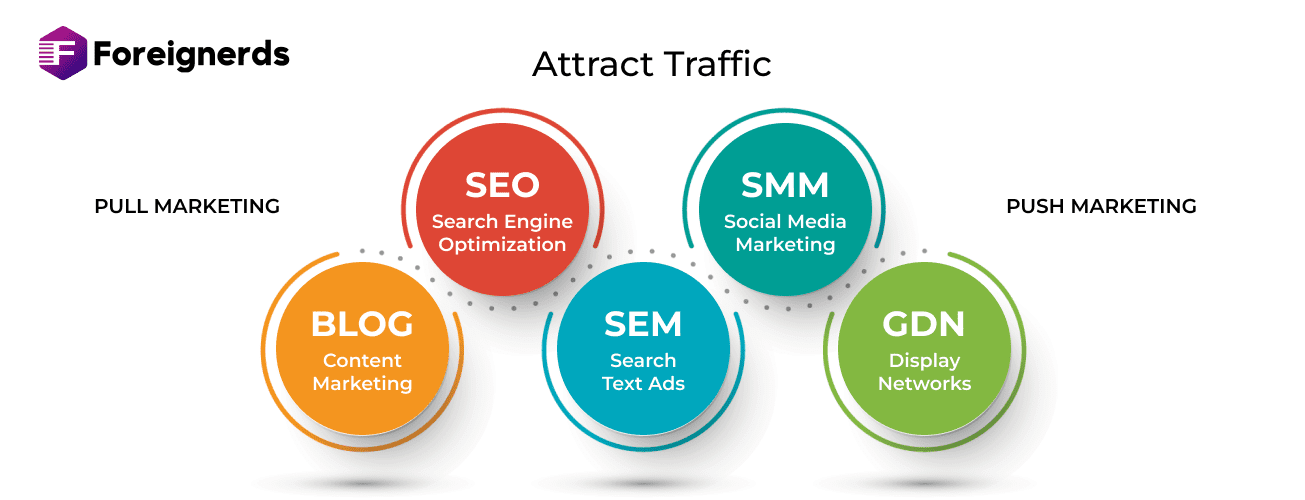
Attract Traffic

The Pull Appeal of Social Media

Social media platforms inherently offer the potential for creative content that can drive website referral traffic. This is the major appeal of social media as a “pull” strategy. With a strong brand, compelling content, and a loyal customer base, businesses can leverage organic interest in their products or services.

Surveys indicate that over 85% of respondents are more inclined to make a purchase if they see a friend or family member engaging with a brand on social media.

The Rise of Paid Advertising on Social Media

However, social media has also become an increasingly important channel for paid advertising. Platforms like Facebook, Instagram, LinkedIn, Snapchat, and Pinterest provide a plethora of ad formats, making them ideal for social media marketing.

The distinction between push and pull strategies on social media lies in the differentiation between organic and paid approaches. Businesses can use engaging content to naturally attract interest from their followers (pull), or they can utilize the vast advertising opportunities available on these platforms to push their brand to audiences that may not convert organically.

Advertisements on social media platforms often blend seamlessly with regular content, appearing as image ads in user feeds or videos within social media “stories.” Furthermore, social media sites are expanding their offerings to include on-platform transactions, product listings, and enhanced targeting capabilities to reach specific audiences more accurately.

Leveraging Data for Effective Targeting

One of the greatest strengths of social media lies in the wealth of data it provides. User data, including usage habits, interests, likes, demographic information, and geographical data, allows advertisers to optimize their return on ad spend (ROAS) by precisely targeting the most suitable audience for their business.

Social media platforms enable advertisers to leverage data-driven insights, such as cohorts and behavioral patterns, to identify and reach potential customers who are most likely to convert. This level of precision targeting maximizes the effectiveness of social media marketing campaigns and enhances overall advertising performance.

The Power of Paid Search Ads & Display Ads

Paid search advertising continues to hold its position as one of the leading and most widely used marketing methods, second only to traditional SEO. This push strategy involves paying to display customized ads alongside organic search results. In this section, we will delve into the world of paid search ads and highlight their significance in the marketing landscape.

paid advertising

The Dominance of Google in Paid Search

It comes as no surprise that Google reigns supreme in the realm of paid search advertising, holding a whopping 73% of the PPC market. In 2019 alone, this industry accounted for an impressive $55.17 billion. While Google takes the lion’s share, Microsoft’s Bing holds a notable third place in terms of market share, albeit on a smaller scale. With nearly half of all search clicks going to the top three paid ads in search results, marketers simply cannot resist the allure of paid search ads.

The Lucrative Returns of Paid Search Ads

According to estimated data from Google, businesses typically generate an average of $2 in revenue for every $1 they invest in Google Ads. Such results make professional PPC management an enticing prospect for businesses seeking to maximize their returns. However, it is important to note that the pay-to-play nature of search engine ads highlights a fundamental difference between push-and-pull marketing strategies on search engine results pages (SERPs). Both SEO and PPC offer pathways to success, but they operate on fundamentally different principles.

Expanding Horizons with Google Ads

Google Ads offers more than just placement within search results. PPC provides direct marketing opportunities and the chance to engage in remarketing campaigns across an extensive ad network. This network encompasses both the Search Network and the Display Network, which allows ads to be displayed on ad-supported websites as well as on popular platforms like YouTube. This broad reach ensures that businesses can connect with their target audience on multiple platforms and capture their attention through well-placed ads.

The Influence of Display Ads

Display ads play a crucial role in the realm of paid advertising. These visually appealing ads are designed to capture the attention of potential customers, and they can be displayed in a variety of formats, including banners, images, and videos. The Display Network offers an extensive reach, allowing businesses to showcase their ads on numerous websites within the network. This exposure helps to enhance brand visibility and attract potential customers who may not have been actively searching for specific products or services.

The Power of Remarketing

Remarketing, a key feature of PPC, allows businesses to target users who have previously interacted with their website or shown interest in their products or services. By strategically displaying ads to these users as they browse other websites or social media platforms, businesses can reinforce their brand message and entice potential customers to revisit their site or make a purchase. Remarketing serves as a powerful tool to re-engage with interested individuals and nurture them along the conversion funnel.

Exploring the Overlapping Realm of Content Marketing & Optimization

Content marketing serves as a crucial strategy for achieving sustained business growth and overall success. However, it is within this realm that the boundaries between push and pull marketing methods tend to blur. While content marketing is often regarded as a distinct approach, it is an area where the differences between push and pull strategies begin to intertwine.

content marketing

The Foundation of Push and Pull Marketing: Content

It is important to recognize that both push and pull marketing strategies heavily rely on content. In fact, many of the most fruitful digital marketing paths are built upon a foundation of compelling content. Nowadays, search engine optimization (SEO) and content are closely intertwined, with factors such as keyword density and Google’s emphasis on expertise, authority, and trustworthiness (EAT) playing significant roles. Demonstrating EAT to both search engines and website visitors is essential for attracting and retaining business.

User-Centric Approach: Content Marketing

Content marketing goes beyond merely driving sales—it entails tailoring the content itself to align with the needs and goals of your target audience. A user-focused website that offers valuable content in the form of guides, images, videos, blogs, and more is at the core of content marketing. Rather than focusing solely on sales, the primary objective is to assist visitors in finding what they need, ultimately leading to increased conversions.

Synergy Between Content Marketing and SEO/Search Ads

Determining the needs and goals of your audience is deeply intertwined with the keyword research associated with SEO and search ads. Once again, the differences between pull and push marketing strategies take a back seat as they work together in harmony. These strategies revolve around understanding searcher intent and providing content that meets those specific intentions. Moreover, Google’s algorithm actively pushes down websites with weak or duplicate content, further highlighting the importance of high-quality content.

The Impact of Content Marketing: Increased Engagement

In today’s digital landscape, nearly three-quarters of all marketers attest to the effectiveness of content marketing in increasing engagement—an essential key performance indicator (KPI) for pull marketing. It is worth noting that content marketing is not solely limited to retailers; data from OptinMonster reveals that 91% of B2B marketers utilize content marketing to reach potential customers.

The Power of Good Content: Guiding Customers Along the Conversion Funnel

High-quality content serves as an informative resource that facilitates customers’ journey along the conversion funnel. It plays a vital role in establishing trust, providing valuable information, and ultimately influencing purchasing decisions. By delivering valuable content, businesses can effectively nurture leads and guide them toward making informed choices.

Strategies for Boosting Sales Using Pull and Push Sales

Enhancing your business’s visibility and attracting customers is a crucial aspect of your daily operations. After all, without customers, making sales becomes challenging. To effectively promote your business, consider leveraging the proven strategies of “Push” and “Pull.” Whether you utilize coupons, giveaways, or incentives for your top-performing salesperson, these techniques will undoubtedly contribute to increasing your bottom line.

The Push Sales Strategy

The push sales strategy originates from manufacturers who push their products through the supply chain to reach the end consumer. Incentives are provided to each intermediary in the chain, motivating them to persuade the next party to purchase the product. This traditional approach often includes offering premiums, wholesale discounts, and buy-back guarantees.

However, the push strategy is not limited to large-scale players seeking to have their products carried by other retailers. Even if you operate a small retail outlet or own a service-based company, you can still benefit from this strategy. Implementing a “push” technique involves providing bonuses to your staff for successfully selling the product or service of the week. Additionally, you can offer customers a complimentary item for referring a friend to your business.

The Pull Sales Strategy

The pull strategy operates by generating consumer interest in a product, thereby creating demand. Once the demand is established, the supply chain pulls the product through. Retailers inquire with suppliers and distributors, who, in turn, approach the manufacturer to fulfill the demand. If your business has the necessary resources, you can launch a campaign to generate excitement among end consumers about your products. Television, print, and electronic advertising are effective mediums for implementing the pull strategy.

Example of Pull Marketing

Pull marketing campaigns are often characterized by a significant investment in advertising. Pull marketing requires substantial financial resources to establish a brand and make products a household name. An example of pull marketing is the promotion of children’s toys. Initially, the company advertises the product, capturing the attention of children and parents who develop a desire to purchase the toy. As demand increases, retailers strive to stock the product in their stores, creating a sense of urgency. Throughout this process, the company successfully pulls customers toward its brand.

Combining Push and Pull

To maximize sales, consider combining elements of both push and pull strategies. For instance, offer your customers enticing coupons, free gifts, or a loyalty program to attract them to your business. These activities align with the “pull” strategy, as they stimulate customer interest and demand.

Simultaneously, motivate your sales team by providing incentives such as vacation contests, additional commissions, or desirable perks for successfully selling specific products or achieving volume targets. This falls within the realm of the “push” strategy.

By integrating these two methods as part of a comprehensive promotion, you align motivated buyers with an enthusiastic sales team, ultimately driving sales growth and achieving your business objectives.

Collaborate with Foreignerds  for Push and Pull Marketing

When it comes to marketing strategies, the choice between push and pull is crucial for the success of your online business. While push marketing focuses on actively promoting your brand and products, pull marketing aims to naturally attract customers through high-value content. Both strategies offer distinct advantages and should be utilized in a balanced manner. Push marketing provides quick results and increased visibility at a cost while pulling marketing fosters organic growth and long-term customer engagement. By implementing a multi-channel, multi-strategy approach encompassing push-and-pull marketing methods, you can maximize your business’s potential and achieve sustainable growth in the dynamic world of online marketing.

Foreignerds, a leading digital marketing agency, understands the importance of utilizing both push and pull marketing strategies to help their clients achieve business growth. With their expertise in the field, Foreignerds recognizes that push marketing can effectively drive immediate results and increase brand visibility, especially in competitive markets. By leveraging paid advertising platforms and implementing targeted promotional campaigns, they assist clients in generating quick sales and establishing a strong market presence. Simultaneously, Foreignerds recognizes the long-term benefits of pull marketing. Through search engine optimization, creative social media content, and customer reviews, they help their clients attract organic traffic and foster customer engagement. By combining the power of push and pull marketing, Foreignerds ensures a comprehensive and tailored approach that maximizes their clients’ potential and facilitates sustainable business expansion in the ever-evolving digital landscape.

You May Also Like

10 Proven SEO Hacks for New Website
Digital Marketing

10 Proven SEO Hacks for New Website

Boost your website’s visibility with these actionable SEO strategies that deliver real results…

Read More
The Power of Digital PR in Branding
Digital Marketing

The Power of Digital PR in Branding

Explore how digital PR can amplify your brand’s reach and build lasting relationships with your audience…

Read More
Digital Marketing Strategies Employed by Online Casinos
Digital Marketing

Digital Marketing Strategies Employed by Online Casinos

Online casino businesses exist in a competitive, high-pressure environment where advertising is key to staying competitive. With a…

Read More

Ready to Transform Your Business with AI?

Explore how our AI-first solutions can help your business grow and innovate.

Digital Marketing

SEO Company in USA : Achieving Remarkable Sales Growth

Mohit Chaudhary
July 20, 2023
8 min read
SEO Company in USA : Achieving Remarkable Sales Growth

In the world of digital services, success is often measured by tangible results. For running your business and to achieve greater heights there are surely certain measures, and strategies that you need to follow. At Foreignerds INC. we have been helping our clients to achieve high ROI, generate leads and expand their business with strategic digital marketing efforts. As such, we are proud to share the incredible journey of one of our clients, who experienced phenomenal sales growth from $31,369 to an impressive $129,990 in just one quarter.

Unveiling the Success Story of a Leading SEO Company in USA

In this blog post, we will unveil the step-by-step process behind this remarkable achievement of a leading SEO company in USA, providing insights and strategies that can help businesses of all sizes reach new heights.

1: Understanding the Business Landscape

Before embarking on any growth journey, it is crucial for the SEO company in USA to gain a deep understanding of the business, its target audience, and its unique value proposition. In the case of our client, we conducted a comprehensive analysis, examining market trends, customer behavior, and competitors. This allowed us to identify untapped opportunities and develop a tailored strategy that would effectively position our client in the market.

 2: Crafting a Results-Driven Strategy

Armed with the insights gained from our analysis, we formulated a results-driven strategy. This involved aligning the client’s business goals with our digital expertise. Our team devised a multi-faceted approach that encompassed various digital channels, including social media, search engine optimization (SEO), content marketing, and paid advertising. By leveraging each channel strategically, we aimed to maximize visibility and reach the target audience effectively.

 3: Enhancing Online Presence

A robust online presence is crucial in today’s digital landscape. To increase visibility and attract the target audience, we focused on enhancing the client’s online presence. Our company is best SEO Company in usa optimized their website for SEO, ensuring it ranked higher in search engine results. Additionally, we leveraged social media platforms to create engaging content and run targeted advertising campaigns, expanding their reach and fostering meaningful connections with potential customers.

4: Implementing Data-Driven Campaigns

Data serves as the cornerstone of effective marketing campaigns. Utilizing analytics tools, we tracked and analyzed user behavior, campaign performance, and customer interactions. This valuable data allowed us to make data-driven decisions, optimize our strategies, and continuously improve our efforts to maximize results. By closely monitoring key metrics, we could identify trends, opportunities, and areas for refinement.

5: Conversion Optimization

Driving traffic to a website is just the beginning; converting visitors into paying customers is the ultimate goal. To achieve this, we employed meticulous conversion rate optimization techniques. By optimizing landing pages, improving user experience, and implementing persuasive call-to-actions, we streamlined the conversion process. These efforts resulted in an increase in sales and revenue, while also fostering customer loyalty and satisfaction.

6: Continuous Monitoring and Iteration

The digital landscape is ever-evolving, and to maintain a competitive edge, continuous monitoring and iteration are crucial. We closely monitored campaign performance, analyzed data, and identified areas of improvement. By staying abreast of industry trends and changes in consumer behavior, we could adapt our strategies proactively. Regular optimization and refinement ensured that our client’s growth trajectory remained on an upward path.

To sum up:

The exceptional sales growth achieved by our client stands as a testament to the power of a comprehensive digital strategy. By understanding the business landscape, crafting a tailored approach, enhancing online presence, implementing data-driven campaigns, optimizing conversions, and continuously iterating, we were able to propel our client’s sales from $31,369 to an impressive $129,990 in just one quarter.

If you are seeking remarkable growth for your business, our team at Foreignerds INC., the best SEO services company in the USA, is here to help. With our expertise and experience, we can unlock your business’s full potential and embark on a journey toward unprecedented success. Contact us today to discover how we can elevate your digital presence and drive exceptional results for your business.

You May Also Like

10 Proven SEO Hacks for New Website
Digital Marketing

10 Proven SEO Hacks for New Website

Boost your website’s visibility with these actionable SEO strategies that deliver real results…

Read More
The Power of Digital PR in Branding
Digital Marketing

The Power of Digital PR in Branding

Explore how digital PR can amplify your brand’s reach and build lasting relationships with your audience…

Read More
Digital Marketing Strategies Employed by Online Casinos
Digital Marketing

Digital Marketing Strategies Employed by Online Casinos

Online casino businesses exist in a competitive, high-pressure environment where advertising is key to staying competitive. With a…

Read More

Ready to Transform Your Business with AI?

Explore how our AI-first solutions can help your business grow and innovate.

Edit with