AI agent development builds systems that take real action inside a business's own tools and systems, not just answer questions. Most products marketed as AI agents are chatbots with a new name, requiring manual follow-up to complete anything. Foreignerds builds agents that complete the actual task end to end, with zero manual follow-up.
Tell us what it needs to do — a real person replies within 1 business day, not an autoresponder.
Guessing wrong wastes months of budget on the wrong project — and most vendors won't tell you that before they take your deposit. Our free AI Agent Opportunity Assessment maps your real workflows and shows exactly which one would pay off first, before you commit a dollar to building anything.
20 minutes. Zero cost. A real answer either way.
Get My Free Assessment →A chatbot answers questions within a conversation. An agent reasons through a problem, decides what to do next based on what it discovers, and takes real action in real systems — without a human doing the middle steps. This distinction changes what you're actually buying: a chatbot project ends when the script is written, while an agent project starts there.
Before talking about what we build, it's worth being direct about what you might not need to pay anyone to build at all. If your need is simple — a basic FAQ chatbot, a scheduling link, a Zapier automation between two apps you already use — those off-the-shelf tools already exist, cheaply, today. You don't need a custom agent for that.
This applies whether you hire us or another agency. Ask every agency these questions before signing anything:
The agent breaks a goal into steps and adapts based on what it learns along the way, instead of following a fixed decision tree written months in advance. This is what lets an agent handle the messy, non-linear conversations real customers actually have — instead of falling apart the moment someone deviates from an expected script.
The agent calls your CRM, calendar, internal APIs, and payment systems directly — not through a human relay. This is the single biggest gap between a chatbot and an agent: tool use is what turns "understood the request" into "task actually completed," without someone on your team finishing the job by hand.
The agent knows when it's out of its depth and hands off to a human cleanly, instead of guessing or failing silently — the safeguard that lets it operate without constant supervision.
Every agent is scoped to your actual workflow, including the exceptions your team currently handles manually — not a generic template retrofitted to fit. This is the difference between an agent that works in a demo and one that survives real customers doing unpredictable things.
Complex operations rarely fit one agent cleanly. We design systems where each agent specializes in one function and coordinates with the others — closer to how a well-run team divides labor than how one overloaded agent tries to do it all.
Qualify leads and book meetings live on the call — the pattern behind our AI Voice Outreach Platform, a real case study: 500 to 4,000+ AI-managed calls a day, in production, with better qualification.
Resolve tickets end to end, escalating only what genuinely needs a human. Internally, agents handle approvals, data entry, and cross-system workflows — the high-volume work that eats hours every week.
This isn't a future trend — it's the current state, backed by seven independent 2026 industry reports.
The market itself is moving faster than most vendor claims suggest, and the size of that move is now well-documented. Belitsoft's 2026 AI Agent Development Forecast puts the AI agent market at $8.03 billion in 2025, growing to $11.78 billion in 2026 — a 46.6% annual growth rate. Gartner's own spending data goes further: agentic AI spending is projected to reach $201.9 billion in 2026, a 141% increase over 2025, and by 2027, spending on agentic AI is expected to overtake spending on traditional chatbots and assistants entirely.
Production adoption is real, not theoretical. G2's 2025 Enterprise AI Agents research found 57% of companies already have agents running in production, not just piloting them. CrewAI's 2026 survey of 500 senior enterprise executives found 65% already using AI agents today, and 100% planning to expand adoption this year — with 75% reporting high or very high impact specifically on time savings.
The scale ahead is significant. IDC projects that by 2027, the number of AI agents in use among the world's 2,000 largest companies will grow tenfold, with token and API call volume growing a thousandfold. By 2029, IDC expects more than 1 billion AI agents in use globally — roughly 40 times the number active in 2025.
Tell us what you're working with in one line — we'll take it from there.
This is a composite, illustrative example — not a specific client — to make the process concrete rather than abstract.
Say a home services company loses jobs every time a call goes to voicemail after hours. Week 1-2 confirms the fit: call volume is high, the qualifying questions are consistent, and the calendar system has an API. Weeks 3-6 build a voice agent that answers, qualifies emergency versus routine requests, and books directly into the real calendar — tested against actual recorded call patterns, not a scripted demo. Week 7-8 launches to a portion of after-hours calls first, with a human immediately notified of every booking, before expanding to full coverage.
The shape — scope the real workflow, build against real scenarios, launch gradually with monitoring — is consistent whether the agent is answering calls, qualifying leads, or resolving support tickets.
Agents handle appointment scheduling, insurance pre-verification, and patient intake — reducing front-desk workload while keeping a human in the loop for anything clinical. The highest-value early deployments are the administrative layer around care, not care decisions themselves.
Voice and chat agents qualify buyer and renter leads instantly, answer property questions around the clock, and book showings without an agent's calendar becoming the bottleneck. In a business where the first responder often wins the deal, answering in seconds instead of hours is a direct revenue lever.
Agents handle intake, initial client screening, and document collection — the repetitive front-end work that eats hours before billable work even starts, freeing senior staff for the judgment-based work that actually requires their expertise.
Agents manage order status inquiries, returns processing, and personalized follow-up, escalating only complex disputes to a human. Given how repetitive and low-complexity most retail support volume is, this is often the fastest path to measurable ROI.
Agents answer calls 24/7, qualify emergency versus routine requests, and book appointments — critical for businesses that lose jobs every time a call goes to voicemail after hours or during a busy shift.
A recurring subscription isn't a strategy. Many businesses pay monthly for an AI agent platform they've never fully configured, with no idea whether it's actually delivering value.
Belitsoft's 2026 research found companies run 12 agents on average, but roughly half operate in isolation — sharply limiting what any single one can accomplish.
Deploying a system with no real tool access or decision logic, then being disappointed it can't complete tasks — because it was never built to.
An agent with no defined handoff point either gets stuck on edge cases, or worse, makes decisions it shouldn't be making alone.
Treating deployment as the finish line instead of the start. Agents need tuning as your systems, customers, and edge cases evolve over time.
Not sure if you're already making one of these?
That's Exactly What the Free Assessment Uncovers →Five honest signals — if two or more sound like you, an agent is worth scoping.
The real categories involved — not a build recipe, just enough to ask any agency the right questions.
Selected per project based on the task — not a fixed default stack.
Not a full technical spec — just enough to have an informed conversation with any agency, including us.
Still unsure what applies to your business?
That's Exactly What the Free Assessment Is For →Most agent projects die in the gap between a working demo and a system that survives real customers. We close that gap by scoping against your actual workflow from day one — not a synthetic example designed to look good in a sales call.
Real workflow mapping, every edge case a demo would skip.
Built and tested against real systems, not synthetic demo data.
Production launch with monitoring in place from day one.
Every stage ties back to the same AI SDLC framework we use across every project — build, launch, and grow, as one connected system.
Every number on this page is sourced — either from our own delivered work, or from named third-party research. Nothing here is invented to sound more impressive.
No pressure. The assessment and the first call are both free, with zero obligation.
15-20 minutes. Not an hour-long pitch. Here's exactly what we cover:
Your goals, your business, and the real problem you're solving — not a generic intake form.
Whether and where an agent fits your workflow, discussed honestly, including if it doesn't.
Realistic time saved, cost saved, and efficiency gained — so you have real numbers, not guesses.
A concrete next step either way. If it's not a fit, we'll say so directly, no pressure.
Not because it's hidden — because a fixed price would be a real number attached to a project we haven't scoped yet, which makes it a guess wearing a price tag. We're a service business, not a product with a SKU. A small business automating one workflow and an enterprise building out agents across a hundred internal processes are not buying the same thing, even though both start on this page.
That range is real, not a hedge. An enterprise client asking us to build agents across 100 different services is a fundamentally different engagement — in scope, integration complexity, and team involvement — than a single business automating its after-hours call handling. Pretending both fit one number would mean either overcharging the small project or underscoping the large one. Neither is honest.
This is the same standard most serious consulting and software engagements follow — not simplified to seem easier, not padded to seem more impressive.
Answer three quick questions and we'll walk into the call already understanding what you need — not starting from scratch.
From AI voice outreach platforms to custom software and full-funnel marketing programs — every case study comes with numbers you can verify.
⟷ Drag to explore, or auto-scrolls — 100+ case studies live here
-70% Search Time Reduction
View Case Study →
10x Screening Capacity Increase
View Case Study →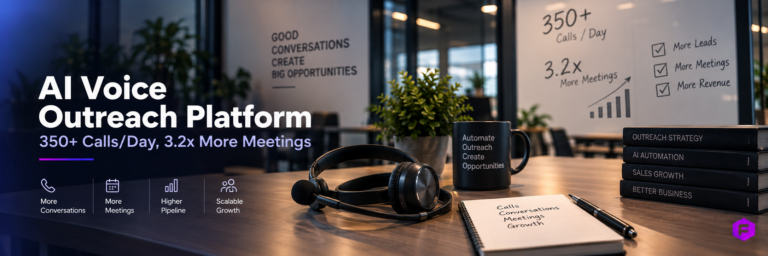
350+ Calls/Day Per Rep (vs. 45 manual)
View Case Study →+147% Organic Conversion Rate
View Case Study →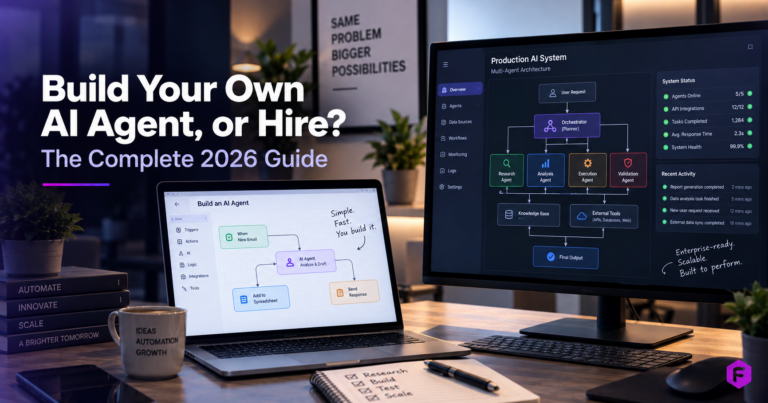
A chatbot answers questions within a single conversation. An AI agent reasons through a problem, decides what to do next, calls real tools and systems like your CRM or calendar, and completes the task end to end — without a human finishing the job by hand.
Most engagements run 6-8 weeks from initial scoping to production launch, depending on how many systems the agent needs to integrate with and how complex the workflow's edge cases are.
Yes. Our AI Voice Outreach Platform case study is real and named: a commercial real estate client went from roughly 500 manual calls a day to over 4,000 AI-managed calls, with better lead qualification, running in production — not a pilot that stalled.
Honestly, for simple, low-branching workflows, an off-the-shelf tool often already works, cheaply. Custom agent development earns its cost when the workflow needs real reasoning, multiple system integrations, or handling genuine edge cases simpler tools can't branch on.
Multiple specialized AI agents working together on one complex process instead of one agent trying to do everything. Most businesses start with a single agent and expand once it's proven.
CRMs, calendars, support ticketing systems, internal databases, payment processors, and most systems with an API. We scope exact integrations during the first phase.
Two, most often: subscribing to a tool monthly without fully understanding or configuring it, and building multiple agents that never share context with each other.
Most clients use agents to handle the repetitive, high-volume parts of a role — freeing the person for judgment calls the agent shouldn't make alone.
Every agent includes escalation logic — it hands off to a human when it hits something outside its scope, rather than guessing.
Both. Our AI Voice Outreach Platform is a live example of a voice agent handling qualification calls and booking meetings in real time.
Large language models for reasoning, orchestration frameworks for multi-agent coordination, tool-calling APIs to reach your real systems, and vector databases for memory — selected per project, not a fixed default stack.
Every agent we deploy includes production monitoring from day one — so you can see what it's actually doing, catch issues before they become customer-facing problems, and tune performance based on real usage rather than guessing.
Agents are scoped with the minimum system access needed to do their job, not blanket access to everything — and all integrations follow your existing security and access policies, not a workaround around them.
Claim the free AI Agent Opportunity Assessment, or skip straight to booking a strategy call if you already know what you need.