Accounting and CPA firm software with AI practice systems support compliance work, client advisory, and capacity planning for accounting firms. The accounting profession faces a projected shortage of 340,000 CPAs by 2030, and firms using AI report freeing 15-20 hours per accountant weekly. Foreignerds builds systems that redirect that time toward higher-billing advisory work.
Tell us what's going on — a real person replies within 1 business day, not an autoresponder.
That approach ignores the real, structural problem: a shrinking pool of CPAs facing rising client demand, where the firms winning aren't the ones automating the most tasks — they're the ones freeing enough capacity to shift toward advisory work before their talent pipeline runs out.
We build CPA firm systems around that specific capacity math — because Thomson Reuters Institute estimates AI saves individual CPAs 240 hours annually, worth approximately $19,000 in recovered capacity per professional at median billing rates, and $12 billion cumulatively across the US profession.
Get a Real Assessment of Your Project →This is built for CPA firm partners and practice leaders facing a genuine, dated talent shortage — the profession needs to close a projected 340,000-CPA gap by 2030 — who need AI to shift staff time from routine compliance work toward the higher-value advisory services now commanding 40-60% higher rates.
46% of accountants now use AI tools daily, up from just 18% in 2023 — a genuinely fast adoption curve. Organizational AI adoption jumped from 22% to 40% between Thomson Reuters' 2025 and 2026 surveys, and 69% of tax and accounting professionals now use AI in some form (Thomson Reuters 2026).
The productivity data is concrete and dated: a Stanford/MIT 2025 study of 277 accountants across 79 firms found AI adoption cut the monthly financial close by 7.5 days, shifted 8.5% of accountants' time from routine tasks to higher-value analysis, and improved financial report granularity by 12%. AI adopters recorded a 55% increase in weekly client support versus non-AI users. The economic case for shifting toward advisory work is explicit: advisory rates run 40-60% higher than compliance work, and early adopters report predictive analytics generating an average of $23,000 in additional advisory revenue per client annually. Firms using AI report 30% faster month-end close and 25% more advisory revenue overall (CPA.com) — but 78% of firms cite data quality as their primary implementation challenge.
It makes sense when: your staff capacity is genuinely constrained by the profession's talent shortage, and freeing hours from compliance work toward advisory services represents real, available revenue; your firm still relies on manual, monthly financial close processes when AI-driven approaches document real speed and accuracy gains; or your current digital presence isn't showing up when business owners research accounting and advisory firms through AI assistants.
It's equally worth being honest about when this is premature. A very small practice with simple, low-volume client work may get more value from foundational practice-management systems before investing in advanced AI advisory tooling built for larger client bases. A useful gut check: if your firm's data quality and system integration are inconsistent — the challenge 78% of firms report — AI layered on top will inherit that inconsistency, not fix it. What Happens If You Wait: There's no single dramatic failure point — most firms don't lose a specific client to a competitor's AI adoption in a visible way. The gap compounds quietly instead: with a documented 340,000-CPA shortage bearing down through 2030, firms not building AI-driven capacity now are entering a tightening labor market with less runway to adapt than firms that started already. The liability and compliance clock is now specific and dated, not abstract: the Heppner ruling landed in February 2026, and standard E&O policies added absolute AI exclusions from January 1, 2026 — meaning firms using AI without documented, defensible practices are carrying real, current insurance and liability exposure with every engagement, not a hypothetical future risk.
Client-advisory and predictive-analytics tooling built to capture the documented $23,000 average additional advisory revenue per client. Selected from Foreignerds' full service catalog based on genuine Accounting & Tax Advisory Firms (CPAs) relevance — not a generic list reused across every industry page.
Financial-close and bookkeeping automation targeting the documented 7.5-day close-cycle reduction, freeing staff capacity against the real talent shortage. Custom Software Development & CRM-ERP Integration — practice-management and client-portal platforms integrated with existing accounting systems, not disconnected point tools.
Documented, defensible AI-usage practices addressing AICPA competence obligations, PCAOB scrutiny, and post-Heppner privilege risk. System Integration Services — connecting fragmented client, engagement, and financial data into one coherent operating system, addressing the data-quality challenge 78% of firms report.
For accounting and tax advisory firms competing for both local and regional client search. Generative Engine Optimization (GEO) & Answer Engine Optimization (AEO) — positioning for business owners researching accounting and advisory firms through AI assistants.
A direct diagnostic of how your firm appears when potential clients ask AI assistants for accounting or advisory recommendations. Reputation Management — directly material given how heavily trust signals affect accounting-firm client acquisition.
Tell us what's going on in one line — we'll take it from there.
Practice-management and client-portal platform integrations. AI/ML platforms for financial-close automation and predictive client-advisory analytics. Documented AI-governance and audit-trail tooling aligned with AICPA and PCAOB expectations. Accounting-firm-specific SEO, GEO, AEO, and AI Visibility Audit tooling.
The capacity-freeing pattern is emerging as the real path to advisory growth: firms capturing the documented $23,000-per-client average additional advisory revenue do so by first freeing the staff capacity to deliver it — following the Stanford/MIT-documented 7.5-day close-cycle reduction — not by adding advisory services on top of an already-stretched team.
Business owners researching accounting and tax advisory firms increasingly use AI assistants during evaluation, following the same broader B2B and consumer research-behavior shift affecting professional-services selection generally. This changes what needs to be true about an accounting firm's online presence. Traditional SEO optimizes to rank in search results for accounting services. GEO and AEO optimize for being the source an AI system cites or recommends when a business owner asks about accounting or advisory firms with specific capabilities directly.
When AI makes an error in a financial statement, audit opinion, or tax filing, liability lands with the CPA who signed off — not the software vendor. AICPA has published competence guidance for AI in audit and advisory work, the PCAOB is actively examining AI use in audit engagements, and the SEC has issued guidance on AI in financial reporting contexts. A February 2026 federal ruling (United States v. Heppner, S.D.N.Y.) held that conversations with public AI chatbots carry no privilege protection — directly relevant to any CPA using consumer AI tools on client tax or advisory matters. Standard E&O insurance policies added absolute AI exclusions effective January 1, 2026, making documented, defensible AI usage a genuine liability question, not just a best practice.
This is a composite, illustrative example built from common, well-documented patterns in CPA-firm AI deployment, not a specific named client.
A mid-size regional firm had staff spending most billable hours on routine compliance work, with client demand for advisory services going largely unmet due to real capacity constraints tied to the broader talent shortage.
Building AI-assisted financial-close automation freed measurable staff hours, redirected toward a new predictive-analytics advisory offering — following the documented pattern where firms capturing the $23,000-per-client average additional advisory revenue do so by first freeing the capacity to deliver it, not by adding advisory services on top of an already-stretched team.
Real capacity and AI-governance auditing, a financial-close and client-advisory build with documented, defensible AI practices from the start, plus ongoing regulatory monitoring and marketing.
Honest evaluation of where staff time is currently consumed by routine work, current AI-governance posture, and realistic advisory-revenue opportunity.
Financial-close and client-advisory automation built with documented, defensible AI-governance practices from the architecture stage.
Continuous compliance monitoring as AICPA/PCAOB/SEC guidance evolves, plus client-acquisition marketing — including GEO/AEO.
Capacity-freeing automation matters most given the most acute talent-shortage exposure per practitioner.
Client-advisory platform development to capture the documented advisory-revenue opportunity at scale.
Portfolio-wide AI governance and documentation standards across many engagement teams.
A genuinely distinct sub-segment given lower per-engagement complexity but higher volume.
A distinct focus given the Heppner ruling's direct relevance to privileged tax-advisory communications.
Without governance, creating real post-Heppner privilege and E&O exposure on client matters.
Rather than capacity-freeing toward the higher-margin advisory work the talent shortage is pushing the profession toward.
Until an examination or client dispute forces the issue.
The primary implementation challenge for 78% of firms — AI layered on top inherits the inconsistency.
Organizational AI adoption nearly doubled in a single year among peer firms.
Even as this research pattern shifts broadly across professional services evaluating accountants, lawyers, and consultants.
Selected per project based on the task — not a fixed default stack.
Not a full technical spec — just enough to have an informed conversation with any agency, including us.
If two or more of these are true, this is very likely worth exploring.
These four questions are worth answering honestly before any AI investment — the audit will help you answer them with certainty.
We don't list a price here for the same reason across every page: a number before an assessment is a guess, and for CPA firms specifically, scope depends heavily on firm size and current data-system fragmentation. Your actual scope will determine cost after the audit.
Claim Your Free Accounting & Tax Advisory Firms (CPAs) AI Visibility Audit
Yes — real integration work is core to these projects. Scope depends on your specific platform.
The CPA who signs off, not the software vendor — which is exactly why we build documented, defensible AI workflows with clear human review built in, not autonomous decision-making on client filings.
Liability-and-capacity-first development, not standard bookkeeping automation with an AI label added without governance behind it.
Very common, and a real, current risk worth addressing directly — following the Heppner ruling and new E&O exclusions, we help formalize and govern that usage rather than leaving it ungoverned.
Depends heavily on firm size and current data-system fragmentation — the audit in Week 1 gives an honest, specific timeline.
Yes — the sub-vertical breakdown above reflects genuinely different needs we scope separately.
Yes, with real evidence — Thomson Reuters estimates AI saves individual CPAs 240 hours annually, worth roughly $19,000 in recovered capacity, directly addressing the documented 340,000-CPA shortage projected by 2030.
We build documented, defensible AI-usage practices with this directly in mind — the exclusions make governance a genuine liability question, not just a best practice, and we treat it accordingly.
A Stanford/MIT 2025 study of 277 accountants across 79 firms found AI adoption cut the monthly financial close by 7.5 days — a real, measured, dated result, not a vendor estimate.
Yes — it's AICPA's own projected shortage by 2030, the structural driver behind why capacity-freeing AI matters more in this profession than pure cost-cutting.
GEO is optimizing your content so AI systems cite or recommend your firm directly when a business owner researches accounting or advisory services.
AEO structures your content to be pulled as a direct answer by AI-driven search features during accounting-firm research.
A direct diagnostic of whether and how your firm currently appears when a business owner asks an AI assistant for accounting or advisory recommendations.
Increasingly yes, following the same broader professional-services research-behavior shift affecting how buyers evaluate accountants, lawyers, and consultants generally.
Directly — trust and credibility signals matter significantly in financial services, and AI systems weigh these signals when forming recommendations.
Yes — this shift is broad-based, and smaller practices invisible to AI discovery risk losing exactly the client consideration set larger firms are already capturing.
Through recurring AI Visibility Audits tracking citation and recommendation frequency, alongside traditional client-acquisition metrics.
Yes, under one roof — practice automation, AI governance, SEO, GEO/AEO, and AI Visibility auditing together.
Not anymore — accounting-firm research behavior is shifting broadly, following the same pattern seen across other professional services.
Book a call — the audit gives you an honest picture of your current capacity constraints, AI-governance posture, and AI search visibility.
Real projects. Real, sourced results.
Delivered accounting, professional-services, and broader AI work sits alongside our 1,250+ project history — verifiable, not invented, and available to discuss specifically on the call.
15-20 minutes, focused on your actual situation, not a generic pitch.
15-20 minutes, focused on your actual situation, not a generic pitch.
We tell you honestly if foundational work needs to happen before AI adds real value.
You leave with a specific, scoped next step — not a vague proposal.
100+ case studies live here

-90% Monitoring Time (15 hrs → 1.5 hrs)
View Case Study →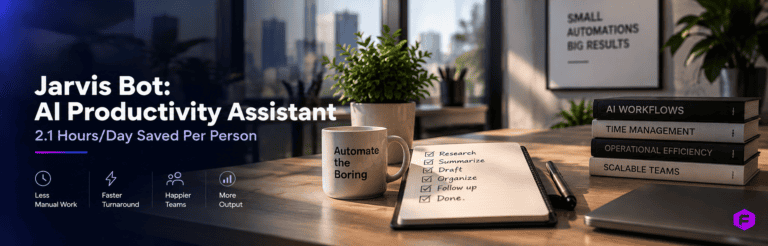
2.1 hrs Admin Time Saved Per Person/Day
View Case Study →
-70% Search Time Reduction
View Case Study →
10x Screening Capacity Increase
View Case Study →