
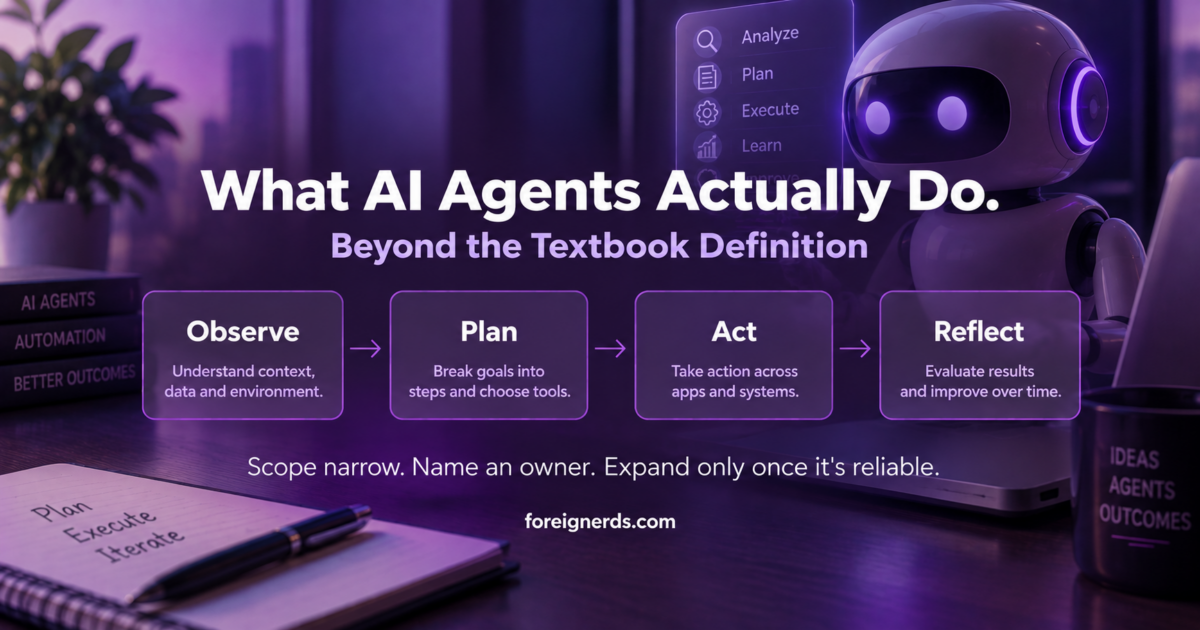
An AI agent is an autonomous software system powered by a language model that can use tools and run in a loop to accomplish multi-step goals without continuous human prompting. Unlike a chatbot that only replies with text, an agent observes its environment, plans a sequence of steps, takes action through connected tools, and reflects on the results before continuing — a cycle it repeats until the task is actually finished.
Why the Textbook Definition Isn’t the Hard Part
IBM, Google Cloud, and AWS all publish clear, accurate explanations of what an AI agent is, and there’s no reason to repeat that ground here. The definition isn’t where businesses actually get stuck. The hard part is what happens after a team understands the concept and tries to actually deploy one — and that’s the part almost nothing written about AI agents addresses honestly.
The Four Real Components, and Where They Actually Break
Every AI agent is built from the same four pieces, and understanding where each one tends to fail in practice matters more than understanding the architecture in the abstract:
- The foundation model — the language model handling comprehension and decisions. This is rarely where things break; current models are capable enough for most real business tasks.
- The harness — the application wrapper connecting the model to tools, files, and systems. This is where most real failures happen — a poorly scoped harness gives an agent either too much access (a genuine risk) or too little to actually complete its job.
- Memory — short and long-term context retention across steps. Agents that lose context mid-task produce the “it forgot what it was doing” failures that are the most common complaint from early deployments.
- The action loop — observe, plan, act, reflect, repeat. An agent with no meaningful reflection step will confidently repeat the same mistake in a loop rather than catching and correcting it.
Most public discussion of AI agents focuses on the foundation model, since that’s the most visible and most marketed piece. Most real deployment problems live in the other three.
What “Autonomous” Actually Means in Practice — and What It Doesn’t
The word “autonomous” gets used loosely, and it’s worth being precise about what current AI agents genuinely do without supervision versus what they don’t. A well-built agent can genuinely execute a multi-step task without a human approving each individual step — searching for information, calling an API, checking the result, adjusting its approach, and repeating until done. What it generally shouldn’t do without a defined checkpoint is take an irreversible, consequential action on its own: sending a customer communication, making a purchase, deleting data, or changing a production system. The businesses getting real value from agents right now draw this line deliberately — full autonomy for reversible, low-stakes steps; a human checkpoint before anything consequential.
The Five Types Worth Knowing, Briefly
AI agents aren’t one category with uniform capability. A few distinctions genuinely matter when evaluating what to deploy:
| Type | What it does | Typical use |
|---|---|---|
| Simple reflex agents | Reacts to current input only, no memory of past state | Basic automated responses, simple triggers |
| Model-based agents | Maintains an internal model of its environment to inform decisions | Tasks requiring context awareness across steps |
| Goal-based agents | Plans a sequence of actions toward a defined goal | Multi-step research or task completion |
| Utility-based agents | Weighs multiple possible outcomes and picks the best one, not just any workable path | Decisions with tradeoffs, not just a single correct answer |
| Learning agents | Improves its own performance over time from feedback | Long-running systems that need to adapt, not just execute a fixed process |
Most business use cases today genuinely need only a goal-based agent with solid memory — the more advanced categories matter less for practical adoption than the marketing around “advanced AI agents” sometimes implies.
Is ChatGPT an AI Agent?
Not by itself, and this distinction trips up a lot of early conversations about adoption. ChatGPT, used as a chat interface, is a conversational assistant — it responds to prompts but doesn’t independently observe an environment, plan multi-step actions, or loop until a goal is complete without a person driving each turn. The same underlying model becomes part of a genuine agent once it’s placed inside a harness that gives it tools, memory, and an action loop — which is exactly why “AI agent” describes a system architecture, not a specific product. This distinction matters practically: a business asking “should we use an AI agent” is usually really asking whether their task needs that full observe-plan-act-reflect loop, or whether a simpler conversational tool already solves the actual problem at hand.
What Realistic Deployment Actually Looks Like, Month by Month
Based on how the narrow-scope-first approach described above typically plays out, a realistic timeline for a business’s first genuine agent deployment looks less dramatic than most vendor pitches suggest. The first few weeks go into defining the single narrow task precisely enough that “done” is unambiguous — this step gets rushed constantly, and rushing it is the single biggest predictor of a failed first deployment. The following few weeks are spent building and testing the harness against real data, not a clean demo scenario, since real business data is messier than whatever the agent was tested against initially. Only once that narrow version runs reliably, unsupervised, for a meaningful stretch does it make sense to either expand its scope or hand off a second narrow task to a second agent. Businesses that skip straight to an ambitious, broad deployment on their first attempt are the ones most likely to end up disillusioned with the technology within a quarter, not because the technology failed, but because the scope was wrong from the start.
Where Businesses Actually Get Value Today
Stripped of the more speculative framing common in AI agent coverage, the genuinely proven use cases right now cluster around a handful of patterns: research and information-gathering tasks that would otherwise take a person an hour of manual searching and cross-referencing; repetitive multi-step workflows with clear success criteria (data entry across systems, structured report generation, first-pass customer support triage); and monitoring tasks where an agent watches for a condition and takes a defined action when it occurs, rather than requiring someone to check manually. The common thread across all three: a clearly defined “done” state. Agents perform well when success is checkable. They perform poorly on open-ended, judgment-heavy work with no clear finish line.
The Adoption Mistake Showing Up Most Often
Starting broad instead of narrow
The most common early mistake isn’t technical — it’s scope. Teams excited about agent capability often start with an ambitious, broad goal (“manage our entire customer onboarding process”) rather than a narrow, well-defined one (“check for incomplete onboarding forms daily and send a specific reminder email”). The narrow version ships in days, works reliably, and builds real trust in the technology. The ambitious version usually stalls in development for months and, even when it ships, fails unpredictably in ways that are hard to debug because too many decisions were left to the agent’s judgment at once.
The practical fix
Consistent with how the same principle plays out in agent governance: start with the narrowest version of the task that still delivers real value, get it running reliably, and only then expand its scope — not the reverse.
Build vs. Buy: The Decision Most Teams Face First
Before writing any code, most teams should genuinely ask whether an existing agent platform already solves their specific need, rather than defaulting to a custom build. This decision deserves its own careful evaluation — the full build-vs-hire breakdown covers the actual tradeoffs in depth, including when an off-the-shelf agent platform is genuinely sufficient and when the specific integration needs justify a custom build instead.
What This Means for a Business Evaluating Agents Right Now
The technology is real and the proven use cases are genuinely valuable, but the gap between “AI agents are transformative” (true, eventually, for the right tasks) and “deploy one for your entire operation this quarter” (usually a mistake) is where most disappointment comes from. The businesses seeing real results share a pattern: they picked one narrow, checkable task, defined exactly where human judgment stays in the loop, and expanded only after the narrow version proved reliable. That’s a less exciting story than the broader promise of autonomous AI, but it’s the one that actually produces working systems rather than abandoned pilots.
Named Entities Worth Understanding If You’re Evaluating Vendors
A handful of terms come up repeatedly in agent-platform conversations and are worth knowing precisely: an orchestration layer coordinates multiple agents working on related sub-tasks, relevant once a business moves beyond a single narrow agent to several working together. A tool call is the specific mechanism by which an agent invokes an external function — a search, an API request, a code execution — and is the actual point where most security and access-scope decisions live. Grounding refers to connecting an agent’s reasoning to real, current data rather than relying solely on what a model learned during training, which matters enormously for any task involving facts that change over time. None of these terms are marketing buzzwords on their own — they describe real architectural decisions that determine whether a given agent platform fits a specific need, and a vendor conversation that never touches any of them specifically is worth treating with some skepticism.
Security and Access: The Question Most Pitches Skip
Because an agent’s harness determines what it can actually touch, the access-scoping decision is arguably the single most consequential technical choice in any deployment, and it’s the one most vendor demos gloss over entirely. A narrowly scoped agent — read access to a specific data source, write access to exactly one downstream system, nothing more — fails safely even when something goes wrong; the worst case is a task that doesn’t complete. A broadly scoped agent with wide system access can fail in ways that are much harder to contain, precisely because the same flexibility that makes it capable also makes an error more consequential. This is the practical version of the same principle covered in more depth in agent governance: access should be granted deliberately, tied to the specific task, and reviewed periodically — not granted broadly upfront because it’s more convenient during initial setup.
How to Tell If Your Team Is Actually Ready
Before evaluating specific tools or platforms, a short internal check is more useful than any vendor comparison: Is there one specific, narrow task identified, with a clear definition of “done”? Is there a named person who will own the agent once it’s live, the same way any new system needs an owner? Has someone mapped exactly what data or systems the agent needs to touch, and confirmed that scope is as narrow as it can be while still completing the task? And is there a plan for what happens when the agent gets something wrong — not if, when, since even well-built agents make mistakes on real-world edge cases? A team that can answer all four concretely is genuinely ready to move forward. A team that can’t is better served spending another week on definition before writing any code or signing any contract.
Where This Connects to a Real Deployment
Everything above is the evaluation and planning layer. Once a team has a narrow task defined, an owner named, and access scope mapped, the actual build is where AI agent development work happens — and it’s worth bringing that expertise in at the planning stage rather than after a first attempt has already gone sideways from unclear scope. The access-scoping discipline described above also connects directly to how AI security thinking applies more broadly — an agent with excessive permissions is a security question as much as an architecture one, and the same principles that govern AI-driven threat detection apply to scoping what an agent is allowed to touch.
The pattern holds across all of it: definitions are cheap to find, and every major cloud provider has written a good one. What actually determines whether an agent deployment succeeds is the unglamorous work — scoping the task narrowly, naming an owner, mapping access deliberately, and testing against real conditions before expanding. That discipline, not the underlying model, is what separates a working agent from an abandoned pilot.
Key Takeaways
- An AI agent observes, plans, acts through tools, and reflects in a repeating loop until a task is done — different from a chatbot that only replies to prompts one turn at a time.
- Of the four components (foundation model, harness, memory, action loop), the foundation model is rarely where things break — most real failures happen in the harness (too much or too little access) and memory (losing context mid-task).
- “Autonomous” should mean full independence for reversible, low-stakes steps, with a human checkpoint before anything consequential — sending money, contacting a customer, changing a production system.
- The single most common adoption mistake is starting broad instead of narrow — a narrow, well-defined task ships in days and builds real trust; an ambitious first deployment usually stalls for months.
Frequently Asked Questions
What is an AI agent?
An autonomous software system powered by a language model that can use tools and run in a loop to accomplish multi-step goals without continuous human prompting, unlike a chatbot that only replies with text.
Is ChatGPT an AI agent?
Not by itself. ChatGPT as a chat interface is a conversational assistant. The same underlying model becomes part of a genuine agent once placed inside a harness that gives it tools, memory, and an independent action loop.
What are the main components of an AI agent?
Four core pieces: a foundation model for reasoning, a harness connecting it to tools and systems, memory for retaining context across steps, and an action loop of observing, planning, acting, and reflecting.
What are the 5 types of AI agents?
Simple reflex agents, model-based agents, goal-based agents, utility-based agents, and learning agents — ranging from basic reactive systems to agents that improve their own performance over time.
What tasks are AI agents actually good at today?
Tasks with a clearly checkable "done" state: research and information gathering, repetitive multi-step workflows with clear success criteria, and monitoring tasks that trigger a defined action. They perform poorly on open-ended, judgment-heavy work.
What is the most common mistake when adopting AI agents?
Starting with an overly broad, ambitious goal instead of a narrow, well-defined task. Narrow deployments ship faster, work more reliably, and build trust before scope expands.
Should AI agents be given full autonomy?
For reversible, low-stakes actions, yes. For consequential, irreversible actions like sending customer communications, making purchases, or changing production systems, a human checkpoint should remain in place.
Should I build a custom AI agent or use an existing platform?
Most teams should first evaluate whether an existing agent platform already solves their specific need before defaulting to a custom build — the right choice depends on the specific integration requirements involved.
How long does it take to deploy a first AI agent successfully?
A realistic timeline involves several weeks defining the narrow task precisely, followed by building and testing against real (not demo) data, before the agent runs reliably enough to expand its scope.
What does "autonomous" actually mean for an AI agent in practice?
It means the agent can execute a multi-step task without approval at every individual step, but well-designed systems still require a human checkpoint before any consequential, irreversible action.
Do I need a developer to build an AI agent, or can I use a no-code platform?
It depends on the integration complexity. Many no-code agent platforms handle straightforward, well-scoped tasks well. Custom development becomes worthwhile once the task requires connecting to internal systems that off-the-shelf platforms do not support natively.
How does AI agent security differ from traditional software security?
The core principle is the same — minimize access to only what is needed — but agents introduce a new consideration: the harness determines what the agent can actually touch, making access scoping during setup the single most consequential security decision in the deployment.