Legal technology and AI support case management, compliance tracking, and client intake for law firms and legal teams handling sensitive, privileged information. Generative AI adoption among legal professionals more than doubled between 2025 and 2026, from 31% to 69% of practitioners surveyed. Foreignerds builds systems for firms adopting purpose-built legal AI tools, not generic chatbots that were never designed to handle privileged data.
Tell us what's going on — a real person replies within 1 business day, not an autoresponder.
Generic case management with an AI chatbot bolted on. That approach misses what actually matters: accuracy, defensibility, and genuine workflow fit for how legal work actually happens.
We build legal technology around real accuracy and defensibility standards, not generic AI features — because in this profession, an AI tool that produces a hallucinated citation isn't a shortcut, it's a liability.
Get a Real Assessment of Your Project →This is built for law firm partners and legal operations leaders losing measurable business to slow client-intake response times, who need AI built with real accuracy and confidentiality safeguards, not autonomous tools that risk hallucinated citations.
The AI in legal market is projected to grow from $4.59 billion in 2025 to $5.59 billion in 2026, a 22.3% year-over-year increase, with AI projected to save the US legal industry approximately $20 billion annually. 80% of legal professionals expect AI to have a transformative or high impact on their work over the next five years, and 95% believe AI will be central to their workflows within five years.
The client-acquisition case is specific and underexploited: only 33% of law firms respond to prospective-client emails, even as consumers expect answers within minutes. Nearly 80% of prospective clients expect a response within 24 hours, yet 64% of firms currently can't deliver on that expectation. AI is also on track to free roughly 240 hours per lawyer per year. Adoption data across firm size tells a consistent story: solo practitioners (71%) and small firms (75%) report the highest AI adoption rates per Clio's 2026 survey, ahead of the 42% figure reported for firms overall by 8am's Legal Industry Report. Practice-area breakdown shows family law (14%), personal injury (12%), and immigration (12%) as leading current adopters. The American Bar Association's own Legal Technology Survey found lawyer AI tool usage nearly tripled from 11% in 2023 to 30% currently.
It makes sense when: your firm's client intake response time is losing prospective clients to faster-responding competitors; your attorneys are spending real hours on document review or drafting that AI-assisted tools can now genuinely accelerate; or your current digital presence isn't showing up when prospective clients research legal help through AI assistants.
It's equally worth being honest about when this is premature. A very small solo practice with minimal document or intake volume may get limited value from advanced AI infrastructure relative to simpler process fixes. A useful gut check: if your firm doesn't have basic formal AI policies or training in place, adding sophisticated tools on top of that gap creates risk before it creates value — 54% of firms currently provide no AI training at all. What Happens If You Wait: There's no single dramatic failure point — most firms don't lose a specific case to a competitor's AI adoption in a visible way. The gap compounds quietly instead: nearly seven in ten legal professionals (69%) now use generative AI for work, more than double the 31% from just a year earlier — firms without a coherent AI strategy are increasingly working alongside individual practitioners who've already adopted these tools informally, without institutional support or governance. The client-intake gap is a live, quantifiable cost every month it continues: with only 33% of firms responding to prospective-client emails despite consumers expecting rapid answers, firms comparison-shop for legal help the way they'd shop for insurance — contacting several firms and hiring whichever responds first and best. Every month without intake automation is measurable lost business, not a hypothetical risk. The upside case is equally concrete and dated: AI could save the US legal industry approximately $20 billion annually, and 95% of legal professionals believe AI will be central to their workflows within five years. Firms building genuine institutional AI capability now — not just informal individual use — are positioning for a real, compounding advantage over that same five-year window.
Client-intake automation with dynamic, conditional-logic forms that qualify leads and schedule consultations in real time, directly addressing the gap where 80% of clients expect a 24-hour response but 64% of firms can't currently deliver one. Selected from Foreignerds' full service catalog based on genuine Legal & Compliance relevance — not a generic list reused across every industry page.
AI-powered phone intake so after-hours and overflow calls are answered, qualified, and booked automatically rather than lost to voicemail. AI Integration Services & RAG Development — document review and legal-research assistance built with real accuracy safeguards, given the documented risk of AI-hallucinated citations in legal work.
Automated retainer generation, e-signature workflows, and document assembly that eliminate manual data entry from first contact through signed engagement. AI Governance Consulting — the policy and training infrastructure 54% of firms currently lack, built alongside any AI tooling we deploy.
Case management and internal workflow tools that connect intake, case management, and billing into one coherent operation, integrating with platforms like Clio. Generative Engine Optimization (GEO) & Answer Engine Optimization (AEO) — positioning for prospective clients researching legal help through AI assistants.
A direct diagnostic of how your firm appears when someone asks an AI assistant for legal help in your practice area. Reputation Management — directly material given how heavily trust signals affect legal-client decision-making.
Trust signals directly affect legal-client decision-making, a category built on credibility and professional standing. SEO & Local SEO — critical given how heavily local search drives legal-client acquisition.
Case management and legal practice management platform integrations built for real interoperability, not standalone tools disconnected from existing workflows. AI governance and audit-trail tooling addressing the 43%-of-firms-lack-formal-policy gap. GEO, AEO, and AI Visibility Audit tooling built specifically for how prospective clients research legal help now.
The client-acquisition case is specific and underexploited: only 33% of law firms respond to prospective-client emails, even as consumers expect answers within minutes. Nearly 80% of prospective clients expect a response within 24 hours, yet 64% of firms currently can't deliver on that expectation — making client intake automation one of the clearest, most measurable revenue levers currently available in legal operations. AI is also on track to free roughly 240 hours per lawyer per year, a genuinely material capacity shift.
Prospective clients increasingly research legal questions and compare firms through AI assistants before ever visiting a website directly, following the same broader shift affecting professional services generally. A firm's positioning in that layer of search is becoming as material as traditional legal directory presence. This changes what needs to be true about a firm's online presence. Traditional SEO optimizes to rank in legal directories and search results. GEO and AEO optimize for being the source an AI system cites or recommends when someone asks about a legal issue or searches for a firm in a specific practice area directly — genuinely different from how legal marketing has traditionally been built.
Adoption has moved from experimentation to infrastructure faster than almost any prior legal technology shift.
Adoption has moved from experimentation to infrastructure faster than almost any prior legal technology shift: 69% of legal professionals now use generative AI for work, more than doubling from 31% just a year earlier — a shift that took cloud computing nearly a decade happening in a fraction of that time. Solo practitioners and small firms show particularly high adoption (71% and 75% respectively) per Clio's 2026 survey.
But institutional readiness lags individual enthusiasm significantly: 54% of firms provide no formal AI training, and 43% lack any formal AI policy — meaning the defining challenge in legal tech right now isn't adoption, it's governance catching up to already-widespread informal use.
Tell us what's going on in one line — we'll take it from there.
Legal AI use intersects directly with attorney-client privilege and confidentiality obligations under state bar ethics rules, and the ABA's technology-competence standard (Model Rule 1.1, Comment 8) requires attorneys to understand the AI tools they deploy, not just adopt them. AI-hallucinated citations are a documented, serious risk — over 1,400 court decisions now involve AI-hallucination issues — making accuracy safeguards and human review a compliance necessity, not an optional feature, for any AI touching legal research or drafting.
This is a composite, illustrative example built from common, well-documented patterns in legal technology deployment, not a specific named client.
A mid-size firm was responding to fewer than half of prospective-client inquiries within a competitive timeframe, losing measurable business to faster-responding competitors.
Building conversational intake automation — with clear escalation to human attorneys, not autonomous legal advice — closed the response-time gap while maintaining the accuracy and defensibility standards legal work requires. The rollout included dynamic, conditional-logic intake forms that pre-qualified leads by practice area, automated retainer-document generation with e-signature capability, and a clear handoff protocol to a human attorney for any substantive legal question — directly addressing the documented gap where 64% of firms can't currently meet the 24-hour response expectation nearly 80% of prospective clients hold.
Real workflow and governance auditing, client-intake and document-review automation built with real accuracy safeguards, alongside the AI policy and training infrastructure most firms currently lack.
Honest evaluation of current AI usage (formal or informal), intake response gaps, and where automation would genuinely reduce burden without compromising accuracy.
Client-intake and document-review automation built with real accuracy safeguards, alongside the AI policy and training infrastructure most firms currently lack.
Managed IT appropriate for firms handling privileged information, plus client-acquisition marketing — including GEO/AEO — built around how prospective clients actually research and choose firms.
The highest documented AI adoption segment, often needing intake automation and basic AI governance most.
Document review at scale and formal AI policy/training infrastructure become the primary need.
Contract review and compliance automation, distinct needs from client-facing firms.
Building AI-native from the start, but need genuine accuracy safeguards built in.
Regulatory monitoring and reporting automation with their own distinct risk profile.
Without formal policy or training — the current default state for the majority of firms (54% no training, 43% no policy).
Risking the kind of AI-hallucinated citations already documented in over 1,400 court decisions involving AI errors.
Only 33% of firms respond to prospective-client emails despite consumers expecting rapid answers — a direct, measurable revenue loss.
Rather than also a governance and risk question requiring real institutional structure.
In marketing strategy, even as prospective clients increasingly research and compare firms through AI assistants.
Real value requires institutional integration, not just informal tool use by individual practitioners.
Selected per project based on the task — not a fixed default stack.
Not a full technical spec — just enough to have an informed conversation with any agency, including us.
If two or more of these are true, this is very likely worth exploring.
These four questions are worth answering honestly before any AI investment — the audit will help you answer them with certainty.
We don't list a price here for the same reason across every page: a number before an assessment is a guess, and in legal specifically, scope depends heavily on your current AI governance maturity and practice area. Your actual scope will determine cost after the audit.
Claim Your Free Legal & Compliance AI Visibility Audit
Yes — real integration work is core to these projects. Scope depends on your specific platform.
With real safeguards built in from the start — AI-hallucinated citations are a documented, serious risk we design around directly, not an afterthought.
Accuracy-and-governance-first development and real legal-workflow experience, not general competence applied to a profession with genuinely different defensibility requirements.
This is the current situation for 43% of firms — we help build real governance alongside any tools we deploy, not tools without the structure around them.
Depends heavily on your current AI governance maturity and practice area complexity — the audit in Week 1 gives an honest, specific timeline.
Yes — the sub-vertical breakdown above reflects genuinely different needs we scope separately.
Yes, directly — only 33% of firms currently respond to prospective-client emails, and intake automation is one of the clearest, most measurable levers available in legal operations right now.
Different needs, different scope — contract review and compliance automation are the primary levers, distinct from client-intake automation.
Yes, documented ones — a database of more than 1,400 court decisions now involves AI-hallucination issues, which is exactly why accuracy safeguards and human review are built into every AI feature we deploy for legal clients, not treated as optional.
AI is on track to free roughly 240 hours per lawyer per year according to current legal-tech research — a genuinely material capacity shift, though realizing it requires the workflow integration and governance most firms haven't built yet.
Because prospective clients comparison-shop legal help the way they'd shop insurance or real estate — contacting several firms and hiring whichever responds first and best. With only 33% of firms currently responding to prospective-client emails, this single lever is directly costing measurable business every month it goes unaddressed.
GEO is optimizing your content so AI systems cite or recommend your firm directly when someone asks a legal question or searches for help in your practice area.
AEO structures your content to be pulled as a direct answer by AI-driven search features, rather than only ranking in a legal directory.
A direct diagnostic of whether and how your firm currently appears when someone asks an AI assistant for legal help in your practice area.
Increasingly yes, following the same broader shift affecting professional services generally — prospective clients research legal questions and compare firms through AI assistants before visiting a website directly.
Directly — trust and credibility signals matter significantly in legal services, and AI systems weigh review sentiment and professional standing when forming answers about firms.
Yes — solo and small-firm segments already show the highest AI adoption rates, and clients researching legal help increasingly use the same tools.
Through recurring AI Visibility Audits tracking citation and recommendation frequency across AI assistants, alongside traditional local SEO and intake metrics.
Yes, under one roof — intake automation, AI governance, SEO, GEO/AEO, and AI Visibility auditing together.
Not anymore — legal-client research behavior is shifting broadly, following the same pattern seen across other professional services.
Book a call — the audit gives you an honest picture of your current AI governance maturity, intake performance, and AI search visibility.
Real projects. Real, sourced results.
Delivered legal and broader AI work sits alongside our 1,250+ project history — verifiable, not invented, and available to discuss specifically on the call.
15-20 minutes, focused on your actual situation, not a generic pitch.
15-20 minutes, focused on your actual situation, not a generic pitch.
We tell you honestly if foundational work needs to happen before AI adds real value.
You leave with a specific, scoped next step — not a vague proposal.
100+ case studies live here

-90% Monitoring Time (15 hrs → 1.5 hrs)
View Case Study →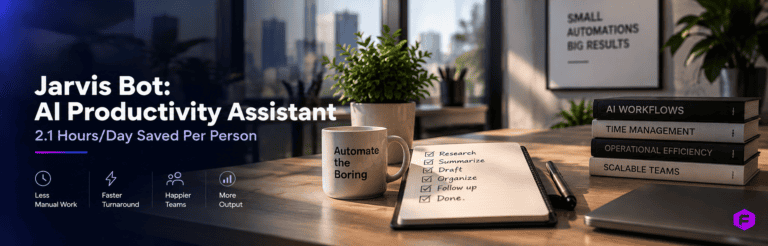
2.1 hrs Admin Time Saved Per Person/Day
View Case Study →
-70% Search Time Reduction
View Case Study →
10x Screening Capacity Increase
View Case Study →