
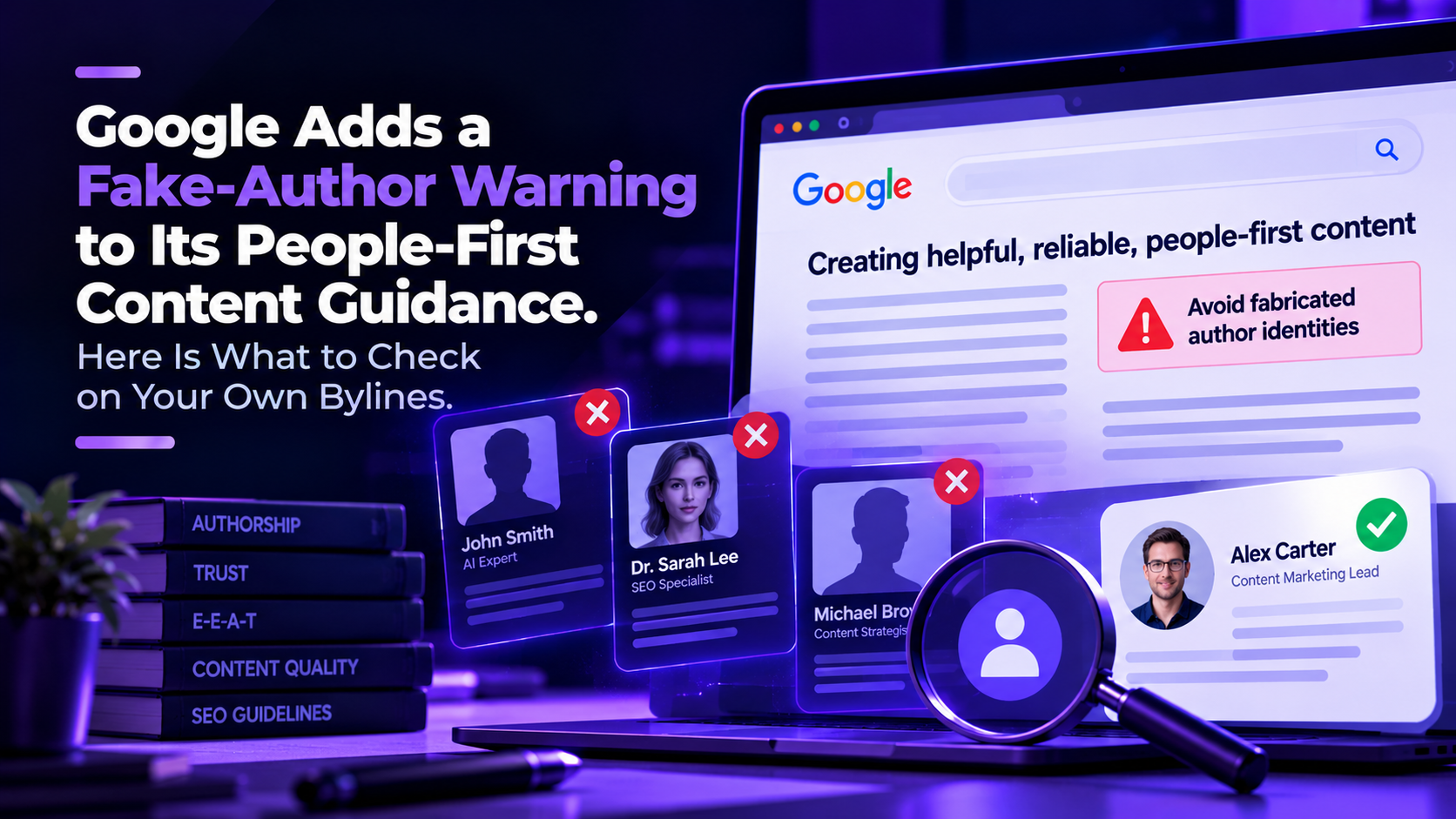
Google has added a paragraph to its “Creating helpful, reliable, people-first content” page warning site owners against fabricated author identities. It sits in the section on who created the content. Google’s page now shows a last-updated date of October 5, 2026 (UTC), and trade reports place the first appearance of the paragraph around October 1 to 2. Google announced no ranking update alongside it.
This piece sets out what the page says, what is new and what is not, and what the evidence does and does not show about bylines. It is written for teams responsible for search engine optimization and content marketing, and it ends with a short audit you can run on your own author pages.
What Google’s page says now
Read from Google’s documentation, the section on who created the content does three things in sequence. It encourages adding accurate authorship information, such as bylines, where readers might expect it. It tells site owners to avoid deceptive authorship information. And it says that fabricating creator profiles, for example with AI-generated headshots, made-up names or false credentials meant to make content look as if human experts wrote it, is a form of deception.
The consequence is stated plainly. Deception, Google says, “makes a page untrustworthy to both users and our automated quality systems.” The page adds that it is a signal of a low-quality page.
Two things about that wording matter. The target is fabrication: invented people, fake faces and false credentials. And the stated purpose is to make content appear human-expert written, which ties the problem to misleading readers about who is behind the content.
What is new, and what is not
The paragraph itself is new. Search Engine Journal’s Matt G. Southern reported on October 2 that an archived copy of the page from June 8 lacked it. The same revision added a definition of main content and four attributes that Google says its raters assess: effort, originality, talent or skill, and accuracy, with a higher bar for accuracy on topics that affect health, finances, safety or well-being.
The principle is not new. Google’s Search Quality Rater Guidelines already treat deception as grounds for the lowest rating. Section 4.5.3 of the September 11, 2025 edition covers deceptive information about a website or its content creators, and says pages using deception should be rated Lowest. Search Engine Journal adds that those guidelines already named fake creator profiles. Relevant Audience makes the useful point that what changed is where the statement appears: in public documentation aimed at site owners, not only in guidance for raters.
The date, checked at Google’s page
This is where care is needed. The date on Google’s page is the date of the latest revision, not necessarily the date the paragraph was added. Search Engine Journal described a version dated October 1 on October 2, and the page now says October 5, so it has been revised since. SEO consultant Marie Haynes said the change was made on October 2. Search Engine Journal also reported that Google’s documentation updates page did not list the edit, and we did not find an entry for it either.
The safest wording is that the paragraph appeared in early October 2026 and that Google has not published a dated announcement for it.
What it does not say
The guidance leaves several things open, and some readings going around go further than the page does.
It announces no ranking update, no system name and no penalty. It does not explain how Google would detect a fabricated profile. Google’s page also notes that its raters do not control how pages rank, so the rater attributes describe what quality evaluation looks for, not a published ranking formula.
It does not say bylines help you rank. Google’s Search Liaison said in January 2024 that “Just adding a byline doesn’t give a ranking boost.” The new paragraph does not contradict that. It says deception is a risk, not that honest authorship is a lever.
And it is not a ban on AI. The sentence concerns fabricated people presented as human experts. Our reading is that a clearly labeled editorial team, or AI assistance disclosed where readers would wonder, is a different situation from an invented doctor with a generated photo. Google’s page does suggest disclosing automation where readers would reasonably ask how content was made.
Bylines and AI citation: what the evidence shows
It is tempting to treat real authors as a way to win citations in AI answers. The evidence does not support that yet, so we would not frame it that way.
The most direct data we found comes from Discovered Labs, a vendor that sells answer engine services, so read it with that in mind. It tested Perplexity only, using 400 questions and 5,770 pages from Google’s first results page. Pages published by companies were cited more often than pages by individual authors: 39.5% against 27.1%. The study calls the gap an association, not proof of cause. It also classifies a staff byline on a company blog as company content, so it does not test bylines directly. It cites a separate study of 497 Google results across 30 queries that found no measurable effect from bylines and credentials on citation.
That is thin evidence in both directions. What it supports is modest: treat authorship as a trust and risk matter, not as a citation tactic. Real people behind your content protect you from the downside Google has now named, and they help readers judge whether to trust you. They are not a proven way to get cited.
What counts as a fabricated profile
Google’s sentence names three examples. In practice, a team should check for these:
An author who does not exist. A name invented to give content a face, with no real person who wrote, reviewed or answers for it.
A photo that is not the person. An AI-generated headshot or stock image presented as the author.
Credentials that cannot be verified. Titles, years of experience, degrees or licenses that the person does not hold.
A fourth case sits close to the line, and it is our reading, not Google’s. A real expert’s name placed on content they did not write or review. Google’s separate instruction to avoid deceptive authorship information is broader than the fabricated-profile sentence, so this is worth treating as a risk.
A byline audit you can run this week
Start with a list of every author name that appears on your site, including old posts and contributors who have left.
Check that each name belongs to a real person who can confirm they wrote or reviewed the content. If a byline is a pen name, replace it with a transparent label such as your editorial team, and say so.
Check the photo. Use a real photograph of that person, or no photo.
Check the credentials. Every claim should be something the person can document: a license, a publication, a role at a named employer.
Check the author page. Google’s page asks whether bylines lead to further information about the author and the topics they write about. Each byline should link to a page with a real bio, links to their professional profiles and a list of their work. A bio at the end of an article with no link to a profile page leaves that question half answered.
Check sensitive topics. Where content covers health, legal or financial decisions, the accuracy bar is higher. Name the expert reviewer and the review date. Teams in healthcare and legal fields should be the strictest.
Check AI disclosure. Where AI assisted the draft, decide what readers should be told, and make sure a named person is accountable for the final text.
Fix, do not delete by reflex. If an author profile cannot be verified, correct the byline, label it accurately, or have a qualified person review and sign off on the content. Removing posts without a plan can cost you pages that were working.
Why this matters for AI search visibility
AI assistants and answer engines draw on pages that readers and search systems already treat as credible. Our guide to how AI search works explains how a page can be cited without ranking at the top, and why clear answers, specific claims and self-contained sections matter more than decoration. For generative engine optimization, the practical lesson from Google’s change is to build content on accurate, attributable information so that no part of it depends on a fake face. Our full guide to generative engine optimization covers that groundwork.
The same logic applies to answer engine optimization. Answers drawn from your pages carry your name, so the people and claims behind them need to hold up. Our look at why third-party mentions matter in AI search makes a related point: independent credibility is earned, and it is hard to fake.
To see where your brand and its experts are actually mentioned, a free AI Visibility Audit checks real questions across platforms. Our complete guide to the AI Visibility Audit explains the method.
Where this leaves you
The confirmed facts are these. Google’s people-first content page now warns that fabricating creator profiles, such as with AI-generated headshots, made-up names or false credentials, is a form of deception that makes a page untrustworthy to users and automated quality systems. The page shows a last-updated date of October 5, 2026, and trade reports place the paragraph’s first appearance at October 1 to 2. Google announced no ranking update, penalty or detection method, and the page does not say bylines improve rankings.
The practical response is an audit, not a rewrite. Make sure every byline is a real person, every photo is that person, every credential can be verified and every author has a page that proves it. Whether the aim is generative engine optimization, answer engine optimization or plain search engine optimization, treat that as a baseline for trust, not as a trick.
Frequently Asked Questions
1. What did Google add to its people-first content guidance?
A paragraph in the section on who created the content saying that fabricating creator profiles, such as with AI-generated headshots, made-up names or false credentials to appear expert, is a form of deception.
2. When did Google add it?
Google’s page shows a last-updated date of October 5, 2026, which is the latest revision. Trade reports place the first appearance of the paragraph around October 1 to 2. Google has not published a dated announcement for it.
3. Is this a ranking update?
Nothing announced says so. Google named no update, system, penalty or detection method. The wording describes what quality evaluation looks for.
4. Do author bylines improve rankings?
Google’s Search Liaison said in January 2024 that adding a byline does not give a ranking boost. Google’s page encourages accurate bylines for readers, but does not call them a ranking factor.
5. Does this ban AI-generated content or AI headshots?
No. The sentence concerns fabricated profiles presented to make content seem expert-written. Google’s page does suggest disclosing automation where readers would wonder how content was made.
6. Will real authors help me get cited in AI answers?
There is no solid evidence that they do. One vendor study of Perplexity found company pages cited more often than individual-author pages, and a second study it cites reported no measurable byline effect. Treat authorship as trust, not a citation tactic.
7. What should I do first?
List every author on your site, confirm each is a real person with a real photo and verifiable credentials, and make sure each byline links to a genuine author page.
If you want to know how your brand and its experts appear across Google and AI answer engines today, that is exactly what we look at in a free AI Visibility Audit.

Related Reading
 Google’s Gemini Agent Gets Its Own Identity, an Audit Trail and Spend Caps. Is Your Agent Governance Ready?
 Anthropic’s New Usage Policy Bars Using Claude to Plant Fake Sources for AI Answers. What It Means for Brand Mentions.
 Google Appears to Be Serving Altered Results to Rank Trackers. How to Tell a Real Ranking Drop from a Fake One.
Recent Posts
 The UK Regulator Wants AI Assistants Like ChatGPT on Google’s Search Choice Screens, With One Condition for Publishers.
 96% of IT Leaders Say Their AI Agent Inventory Is Complete. Two in Three Had an Agent Incident Anyway.
 Google Is Testing AI Overviews Inside Local Business Profiles. What Local Businesses Should Check Now.