If your entire AI visibility plan is to publish better pages on your own site, the research says you are working on the smaller half of the problem. Two academic studies and one large industry analysis, each looking at a different slice of AI search, land on the same practical conclusion: what other people publish about you carries far more weight in AI answers than what you publish about yourself.
That is a strong claim, and it is also one that gets stretched in the retelling. The headline figure of 93% applies to specific engines in a specific kind of query, not to every AI platform in every situation. Here is what each source actually measured, where the numbers hold, where they do not, and what it means for how you spend a marketing budget.
Study one: a small group of outlets dominates news citations
The first paper is “News Source Citing Patterns in AI Search Systems” by Kai-Cheng Yang, posted to arXiv on July 7, 2025. It analyzed 366,087 citations across 12 AI search models from three providers: OpenAI, Perplexity, and Google. The data was collected over seven weeks between March and May 2025 from the AI Search Arena dataset.
A little over 9% of those citations, 32,865 in total, pointed to news outlets. That is worth stating up front, because it means the paper is not claiming that AI engines mostly cite journalism. It is examining the news slice of citations and finding that the slice is extremely concentrated.
The concentration differs sharply by provider. The paper reports that the 20 most frequently cited news sources account for 67.3% of citations for OpenAI models, compared with 31.9% for Google and 28.5% for Perplexity. Reuters and the Associated Press alone were cited at rates of 22.8% and 12.2% for OpenAI models. In other words, when ChatGPT-style models reach for a news source, they reach for a very short list.
One caution applies. The paper is a preprint posted on arXiv, so read it as a well-documented research finding rather than settled consensus, and note that it covers models tested in 2025.
The takeaway for marketers is narrower than the headline suggests. If you want news-based visibility in OpenAI-powered answers, the door is small, and the outlets standing in it are wire services and major national publishers. That does not make earned media pointless. It tells you that not all earned media is equal.
Study two: earned media versus your own site
The second paper is “Generative Engine Optimization: How to Dominate AI Search” by Mahe Chen, Xiaoxuan Wang, Kaiwen Chen, and Nick Koudas, submitted on September 10, 2025. The authors ran controlled experiments across ten consumer product verticals, with 100 queries each, and classified every cited source as earned media, brand-owned, or social content. Their abstract describes a systematic and overwhelming bias toward earned media, meaning third-party authoritative sources, over brand-owned and social content.
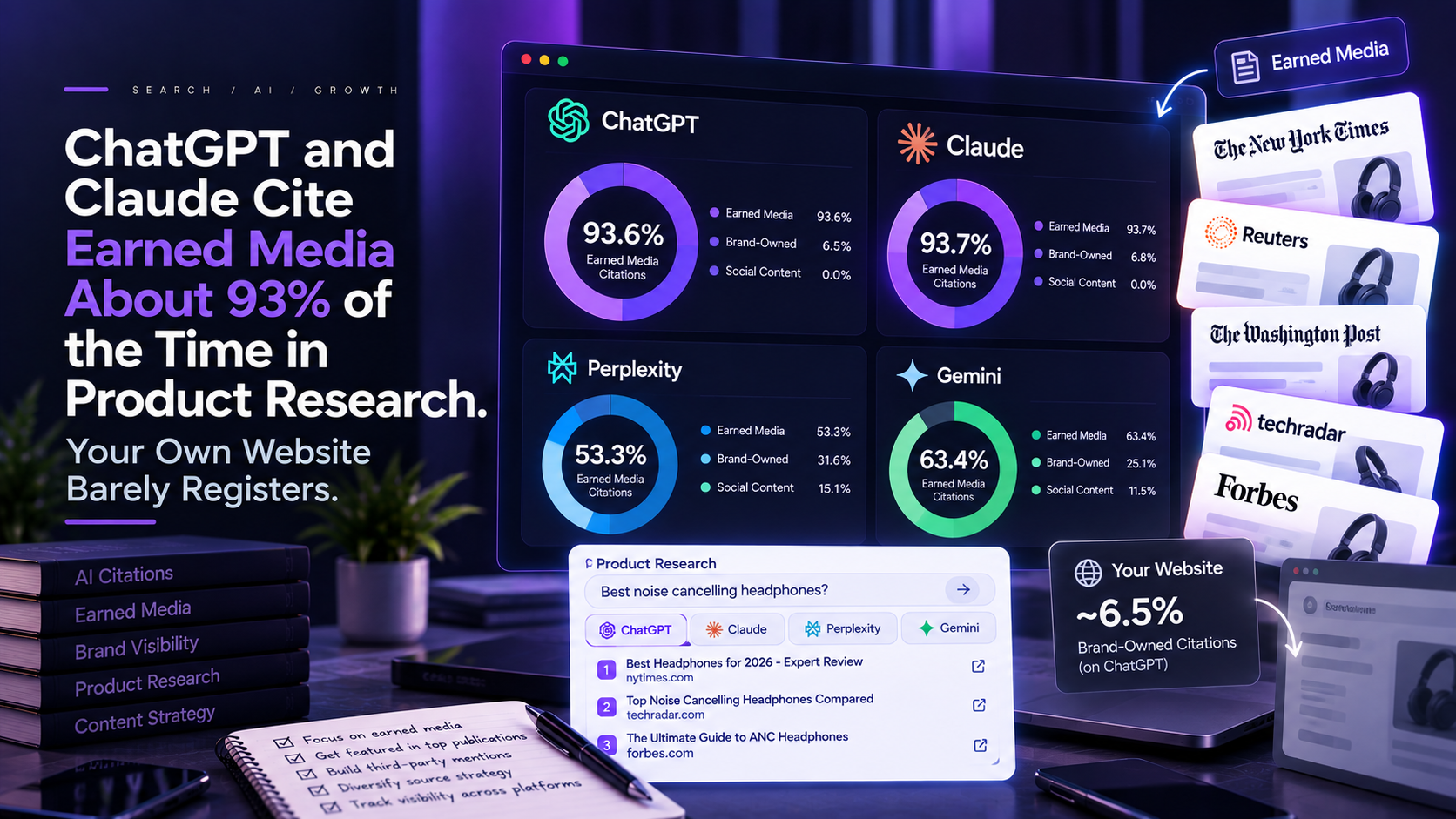
The numbers vary by engine, and the variation matters. In the consumer electronics vertical, Claude drew about 93.7% of its citations from earned media and ChatGPT about 93.6%. Perplexity was far lower at 53.3% earned, with 31.6% from brand-owned sites and 15.1% from social platforms.
Across the paper’s broader brand tests, the pattern held. For well-known brands, ChatGPT cited earned media 93.5% of the time and brand-owned pages 6.5%. Claude sat at 87.3% earned and 6.8% brand-owned. Perplexity came in at 67.4% earned and 8.8% brand-owned, with 23.8% from social. Gemini showed 63.4% earned and 25.1% brand-owned. For niche brands, ChatGPT reached 95.1% earned and 4.9% brand-owned, and Claude 86.3% earned and 10.6% brand-owned.
So the tidy line that AI engines cite earned media 93% of the time is accurate for ChatGPT and, in one vertical, for Claude. It is not accurate for Perplexity, and it clearly overstates the case for Gemini, which gave brand-owned pages a quarter of its citations in the well-known brand test. Your own website is close to invisible for ChatGPT on product queries. It is a real contributor to Gemini.
Note also that this is a preprint, and the queries are consumer product comparisons. A B2B services buyer asking about agencies or software may see different source mixes. Treat the paper as strong evidence about direction, not a guarantee for your category.
The third source: most citations do not come from Google’s first page
Ahrefs added two findings that support the same conclusion from a different angle.
In an analysis of 15,000 long-tail queries published on August 11, 2025, Ahrefs found that only 12% of URLs cited by ChatGPT, Gemini, and Copilot also appeared in Google’s top 10 for the same prompt. Put the other way, roughly 88% did not. Perplexity was the exception, with 28.6% overlap. This is why ranking well on Google, while still valuable, does not guarantee a citation. The AI engines are retrieved from a different set of pages.
The second finding is more useful for anyone planning outreach. Ahrefs examined the 1,000 pages ChatGPT cited most in September 2025 and concluded that roughly two-thirds of them are effectively off-limits to traditional outreach. The breakdown was Wikipedia at 29.7%, homepages and landing pages at 23.8%, educational pages at 19.4%, app stores at 6.6%, reviews at 5.8%, news and media at 5.2%, language and grammar sites at 4.0%, dictionary and reference at 2.2%, blog articles at 1.9%, community forums at 0.9%, and corporate pages at 0.5%.
Ahrefs counted only four categories as influenceable: educational pages, reviews, news and media, and blog articles. Together they make up 32.3% of the top 1,000.
This corrects a common retelling. Several summaries describe the off-limits share as Wikipedia, government sites, education, and major news. That is not what Ahrefs found. In the Ahrefs breakdown, educational pages and news were on the influenceable side, and the off-limits side was mostly Wikipedia, other organizations’ homepages, and reference-style sites. The opportunity is in educational content, reviews, news mentions, and articles.
What this does and does not prove
It proves that publishing on your own domain is not enough to earn citations from ChatGPT or Claude on product research queries. It supports the case that third-party mentions matter, and that they matter more on some engines than others.
It does not prove that your own website is irrelevant. Brand-owned content still accounts for 5% to 25% of citations in the Chen study depending on the engine, and pages that AI systems retrieve from your site are part of what makes third-party coverage credible. Your site is where a cited claim gets verified.
It also does not prove that any earned mention helps. The Yang paper shows that the citation pool for news is narrow, and the Ahrefs data shows that news is only 5.2% of ChatGPT’s most cited pages. A mention in a low-authority outlet is unlikely to move the needle.
What this means for link building and digital PR
The strongest business case in this research is for redefining what link building and digital PR are for. For years, the goal was a link that passed ranking signals. The goal now includes being named, described, and reviewed in the places AI engines already trust.
That changes priorities in four ways.
Prioritize the sources engines already cite. Before pitching anyone, check which publications, review platforms, and educational sites appear in AI answers for your category. Build the target list from that, not from domain authority alone.
Pursue reviews and comparisons, not just news. Reviews and educational pages are a much larger share of ChatGPT’s influenceable citations than news. Accurate, current listings on review platforms and inclusion in independent comparison content deserve more of the budget than they usually get.
Create material that other people want to cite. Original data, clear definitions, and expert commentary give journalists and educators a reason to reference you. This is the foundation of effective digital PR, and it also gives educational and blog sources something to link to.
Keep your own site accurate and consistent. When an outlet mentions you, engines and users will check your site. Consistent naming, clear service descriptions, and current facts make the third-party mention easier to trust.
Treat Wikipedia as a consequence, not a target. At 29.7% of ChatGPT’s top 1,000 cited pages, it is the single largest source, and Ahrefs places it outside the reach of outreach. Trying to force an entry is the wrong response. The sustainable route is to earn the independent coverage that makes a company notable in the first place, which is exactly what a disciplined digital PR program produces over time.
Expect a slow payoff. Third-party coverage takes weeks to publish and longer to be picked up by AI engines, so judge a campaign over quarters, not days. Pair the outreach with a monthly citation check so you can see which placements actually change what the engines say.
Set a baseline before you begin. Record which prompts cite your brand today, on which platforms, and from which sources. Repeat monthly. Without that, you cannot separate the effect of an outreach campaign from ordinary platform variability.
Where this leaves you
Optimizing your own site remains necessary. Sound search engine optimization fundamentals still determine whether you are found and understood. But the evidence now points to a second requirement that sits outside your domain. On ChatGPT and Claude, earned media supplies roughly nine in ten citations for product research. On Perplexity and Gemini the share is lower but still a majority. That is the reason generative engine optimization and answer engine optimization now include off-site work, and why link building teams are being asked to think about mentions, reviews, and reference sources, not just links.
Frequently Asked Questions
1. Do AI engines really cite earned media 93% of the time?
Answer: For ChatGPT and Claude in the consumer electronics vertical of the Chen study, yes: about 93.6% and 93.7%. Perplexity was near 53% and Gemini near 63% to 66% in other tests, so the figure does not apply to every engine.
2. What counts as earned media in these studies?
Answer: Third-party authoritative sources such as independent reviews, journalism, and expert publications. Brand-owned pages and social content are classified separately.
3. Does this mean my website does not matter for AI visibility?
Answer: No. Brand-owned pages still receive about 5% to 25% of citations depending on the engine, and your site is where third-party claims get checked. It is necessary but not sufficient, which is why answer engine optimization now includes off-site work.
4. Is it true that two-thirds of ChatGPT’s top citations cannot be influenced?
Answer: Ahrefs reported that roughly 67% of ChatGPT’s top 1,000 cited pages fell outside traditional outreach. Educational pages, reviews, news, and blog articles, about 32.3%, were the influenceable share.
5. Which earned media should I prioritize?
Answer: Start with sources AI engines already cite in your category: review platforms, educational content, and a short list of authoritative publications. Wire services and major national outlets dominate news citations for OpenAI models.
6. How do I measure whether digital PR is improving my AI citations?
Answer: Track a fixed set of buyer prompts on ChatGPT, Claude, Perplexity, and Gemini each month, and record whether your brand is cited and from which source.
If you want to see which third-party sources are shaping AI answers about your brand today, that is exactly what we cover in a free AI Visibility Audit.