
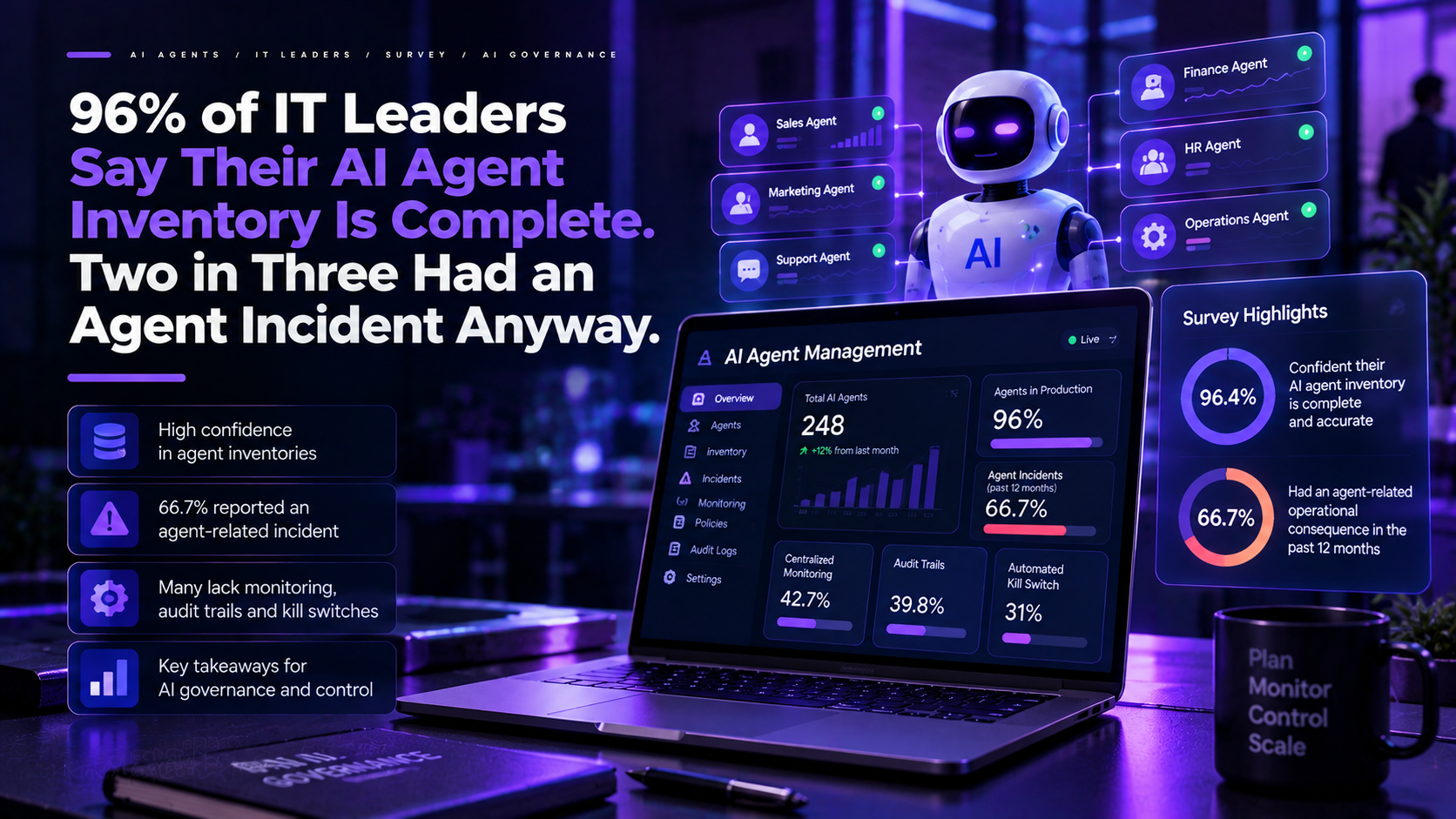
Ask most IT leaders whether they know which AI agents are running in their company, and the answer is yes. A new survey suggests that confidence may be running well ahead of the controls behind it. Published by Guild.ai and fielded by Morning Consult, it found that 96.4% of IT decision-makers are confident their agent inventory is complete and accurate, while 66.7% of organizations with agents reported an agent-related operational consequence in the past 12 months.
One point belongs at the top, not the bottom. Guild.ai sells tools for managing AI agents, so this is vendor-sponsored research, and it should be read that way. This piece follows on from our earlier look at shadow AI and sets out what the survey reports, what its wording and bases do and do not support, and what an organization can do with the findings. It is written for teams planning AI governance and AI automation programs for agents, not just buying software for them.
What the survey reports
According to Guild.ai’s September 22, 2026 release, Morning Consult surveyed 362 U.S. IT decision-makers at companies with 100 or more employees. Interviews were conducted online from August 4 to 9, 2026, and the data was weighted by age, company size, industry and role. The margin of error is plus or minus five percentage points for the full survey.
The headline figures are these. 96.4% of IT decision-makers are confident their organization has a “complete and accurate inventory” of its AI agents. 66.7% of organizations with agents had an agent-related operational consequence in the past 12 months. 96% of organizations report agents in production, and 47% of those with agents run dozens or more.
The control figures are lower. 42.7% have a centralized dashboard or monitoring tool, 39.8% have logging or audit trails, and 31% can immediately stop a malfunctioning agent with an automated kill switch. On unapproved use, 60.6% say it is very or somewhat likely that employees deploy agents without formal approval, 35.9% require agents to be registered before deployment, and about half have a formal policy on unauthorized agent use.
Who ran it, and why that matters
Morning Consult fielded the survey, but Guild.ai commissioned and published it. Guild describes its product as a control plane for the agent lifecycle, with offerings that include AI governance and AI observability tools, according to its website. The findings point toward exactly the kind of tooling it sells, such as the 83.9% who rate real-time visibility into agent activity as extremely or very valuable.
That does not make the numbers wrong. Vendor-sponsored surveys can be carefully run, and an outside firm doing the fieldwork counts in its favor. But the sponsor chose which results to feature, so treat the data as informative and the conclusions as the vendor’s.
What the numbers do and do not show
Several details affect how far the headline can be pushed.
The word incident is not defined. The release describes an “agent-related operational consequence” and, elsewhere, an agent-related incident, and neither term is defined in the material we reviewed. A consequence could be a minor disruption or a serious breach. Two in three is a striking figure, but without a definition it does not tell you how serious those events were.
The bases differ. The 96.4% is a share of IT decision-makers. The 66.7% is a share of organizations with agents. The release does not state the base for the monitoring, audit trail and kill switch figures, so they cannot be compared precisely with the others.
The scope may be narrower than it sounds. Guild’s report page describes the survey scope as internally built and actively managed agents. If that is right, the confidence is about agents an organization built and manages, and the survey does not show how confident leaders are about agents employees bring in on their own. The 60.6% on unauthorized deployment is the nearest measure of that, and it is a perception of likelihood, not a count.
Confidence is self-reported. A leader who says the inventory is complete is giving an opinion. The survey did not test whether the inventory was actually complete, so it shows a gap between belief and controls, not a measured gap between the inventory and reality.
The margin of error applies to the full survey. Subgroup figures, such as organizations with agents, rest on fewer respondents and carry more uncertainty than the plus or minus five points suggests.
The confidence gap, read carefully
The core observation is that confidence and controls do not line up. Nearly everyone is confident about the inventory, yet fewer than half have centralized monitoring and fewer than four in ten have audit trails. A complete inventory and no way to see what the agents do is a thin kind of control.
The kill switch figures need a careful reading, because they cut both ways. Only 31% have an automated kill switch. But Guild’s own release reports that 76.5% can stop a malfunctioning agent within minutes, using an automated switch or a manual process. So most organizations say they can stop an agent quickly, and a minority have automation to do it. The accurate summary is that manual shutdown is common and automation is not. Whether a manual process works at three in the morning, or when ten agents misbehave at once, is a different question the survey cannot answer.
A second survey, and the same caveat
A separate survey points in a similar direction. SecureWorld reported on August 31, 2026 on research by Cequence Security and Enterprise Management Associates, which ran the survey for Cequence. It reported that 94% of respondents were at least moderately confident that agents do not have more access than needed, while only 32.7% used least-privilege access scoped to the task. It also reported that 47% could not reliably inventory their agents, and that 65% had seen an agent act outside its intended scope.
The sample was 202 IT and security leaders, and the coverage did not describe fieldwork dates or margins of error. Cequence is also a security vendor. Two vendor-sponsored surveys finding a gap between confidence and practice is suggestive, not conclusive, since both sponsors benefit from that story. A Cequence executive said that confidence “is usually measuring compliance, not cyber”, which is one vendor’s view, not a finding.
Why a confident inventory is not a governed one
An inventory is a list. It tells you which agents exist. AI governance is what you do with the list: who owns each agent, what it may access, who approved it, what it costs, how it is monitored, how its changes are reviewed and how it is stopped or retired.
Seen that way, the survey’s pattern is easy to understand. Teams build agents quickly, record them in a spreadsheet and feel in control. Then an agent changes, a credential is shared or an owner leaves, and the list no longer matches reality. Confidence comes from writing the list. Control comes from keeping it true.
This is also why the registration figure matters. Only 35.9% require agents to be registered before deployment. Without a registration step, an inventory is something someone compiles occasionally, not something the process produces automatically.
What to do with this
You do not need the survey’s sponsor, or any vendor, to act on its lessons. These steps apply whether you buy tooling or do the work by hand.
Test the inventory by evidence. Do not ask whether the list is complete. Look for agents the list does not contain by checking service accounts, API keys, automation platforms and cloud billing for agent activity, and by asking each team what they run.
Assign an owner to every agent. A named person or team should answer for what each agent does and what it can reach.
Make registration a precondition. An agent should not go into production until it is on the list, with its permissions, data access and purpose recorded.
Log actions, not just existence. Keep a record of what each agent did, which tools it called and which data it touched, with enough retention to reconstruct an incident.
Define incident and track it. Agree what counts as an agent-related incident in your organization, from a near miss to a breach, and record each one. You cannot improve a rate you do not measure.
Rehearse the stop. Test how fast you can disable an agent and revoke its credentials, in practice, with the person who would actually do it. If the answer depends on one individual, write it down and share it.
Limit permissions. Give each agent the narrowest access that lets it do the job, and review the access on a schedule.
For businesses planning AI agent development or wider AI automation, these controls are cheaper to design in at the start than to add later. Teams doing generative AI development should treat identity, scoped permissions and logging as part of the build, not as a later compliance task.
Where this leaves you
The confirmed facts are these. Guild.ai published a Morning Consult survey of 362 U.S. IT decision-makers, fielded in August 2026. 96.4% are confident their agent inventory is complete, and 66.7% of organizations with agents reported an agent-related operational consequence in the past 12 months. Fewer than half have centralized monitoring or audit trails. The research is vendor-sponsored, its key terms are not defined in the release, and confidence is self-reported.
The practical response does not depend on any single percentage. Treat a complete-looking list as a starting point: test it, assign owners, log what agents do and practice stopping them, whether you are in AI agent development or simply adopting agents. Organizations that do this can adopt agents faster, because they know what they are running. For anyone building AI development capability, that discipline is the foundation.
Frequently Asked Questions
1. Who ran the Guild.ai AI agent survey?
Guild.ai published it and Morning Consult fielded it. It surveyed 362 U.S. IT decision-makers at companies with 100 or more employees, online, from August 4 to 9, 2026, with a margin of error of plus or minus five points. It is vendor-sponsored research.
2. What are the key findings?
96.4% of IT decision-makers are confident their agent inventory is complete and accurate, and 66.7% of organizations with agents had an agent-related operational consequence in the past 12 months. Only 42.7% have centralized monitoring, 39.8% have audit trails and 31% have an automated kill switch.
3. Does this prove that most companies have a governance problem?
It suggests a gap between confidence and controls, but it does not prove it. Confidence is self-reported, incident is not defined, and the survey is sponsored by a company that sells agent management tools.
4. Is an incident the same as a security breach?
Not necessarily. The release uses the phrase agent-related operational consequence and does not define it, so it could cover anything from minor disruption to serious harm.
5. Can most companies stop a misbehaving agent?
The release reports that 76.5% can stop one within minutes by automated or manual means, but only 31% have an automated kill switch. Manual shutdown may work in a calm test and be harder in a real incident.
6. What is the difference between an agent inventory and AI governance?
An inventory lists which agents exist. Governance covers ownership, permissions, approval, monitoring, change control and shutdown. Strong governance keeps the inventory accurate over time.
7. What should my company do first?
Test your inventory by looking for agents it does not list, then assign an owner to each agent, require registration before deployment and set up logging of what agents do.
If you want to know which of your workflows are ready for AI agents, and where the governance gaps sit, that is exactly what we look at in a free AI Readiness Audit.

Related Reading
 The UK Regulator Wants AI Assistants Like ChatGPT on Google’s Search Choice Screens, With One Condition for Publishers.
 Google Is Testing AI Overviews Inside Local Business Profiles. What Local Businesses Should Check Now.
 Google Switched On Checkout Inside AI Mode for Eligible Shopify Stores. Here Is What It Changes for Your Measurement.