
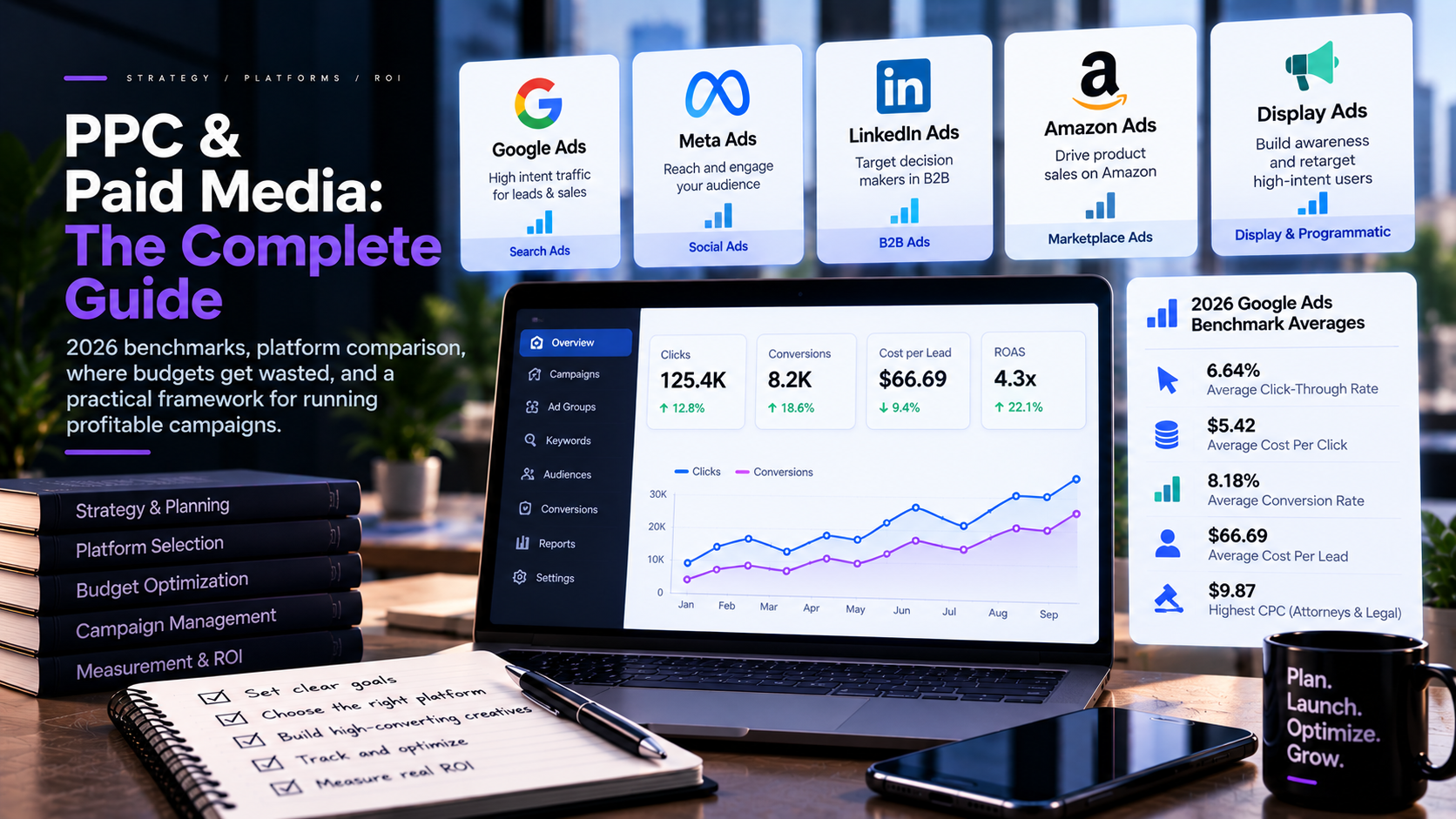
PPC (pay-per-click) and paid media are the practice of buying visibility — on Google, Meta, LinkedIn, Amazon, or elsewhere — instead of waiting to earn it organically, paying only when someone clicks, views, or takes an action you define. Where SEO and content compound over months, paid media is the lever that produces leads and revenue on a schedule you control, starting the day a campaign goes live. That immediacy is also why it’s the easiest channel to waste money in: the platforms are built to spend your budget efficiently for the platform, not necessarily for your business, unless someone is actively managing the account. This guide covers what paid media actually costs and returns right now, the platform-by-platform decision, where budgets get wasted, and a practical framework for running it well.
What Counts as Paid Media
Paid media isn’t one channel — it’s a category, and each platform serves a different intent:
- Search ads (Google Ads, Microsoft Ads): capture people already searching for what you sell. Highest intent, highest cost per click.
- Paid social (Meta, Instagram): reach people based on interests and behavior before they’re actively searching. Lower cost per click, but requires a stronger creative hook since the audience isn’t already looking.
- LinkedIn ads: the only platform with reliable B2B firmographic and job-title targeting — expensive per click, but the only place to reach “VP of Operations at a 50-person accounting firm” directly.
- Amazon and marketplace ads: capture purchase-intent search traffic inside the marketplace itself, for businesses selling physical products.
- Display and programmatic: broad-reach retargeting and brand awareness, usually the smallest and last-added piece of a paid media mix, not the first.
Most businesses don’t need all five — they need the one or two that match where their buyer actually is, layered with retargeting once there’s enough traffic to retarget.
The Real Numbers (2026 Benchmarks)
Current Google Ads benchmark data, based on an analysis of over 13,000 campaigns across 23 industries, gives an honest baseline before anyone quotes you a number:
- Average click-through rate: 6.64% across industries
- Average cost per click: $5.42 (more than doubled from $2.32 in 2016, but stable year-over-year for the first time in five years)
- Average conversion rate: 8.18%, with 87% of industries seeing conversion rates improve year-over-year — the second straight year of gains
- Average cost per lead: $66.69 — and for the first time in five years, this actually went down rather than up
- Highest-cost vertical: Attorneys & Legal Services, at $9.87 CPC and $131.63 cost per lead — a useful reference point for professional-services budgeting
These are averages, not promises — a well-run HVAC campaign and a poorly-run law firm campaign can each land far from the mean. But they’re the right numbers to benchmark against before accepting any agency’s promised cost-per-lead.
Platform-by-Platform: What Fits Which Business
| Business type | Primary platform | Why |
|---|---|---|
| Home services (HVAC, plumbing, roofing) | Google Search + Local Services Ads | Buyers search with emergency or near-term intent — “AC repair near me” — the exact moment search ads capture |
| Small B2B professional services (CPAs, law firms, consultants) | Google Search + LinkedIn | Search for active demand (deadline-driven searches), LinkedIn for outbound-style targeting by title/company size |
| E-commerce / physical products | Meta + Amazon Ads | Visual discovery drives impulse and considered purchases; Amazon captures in-marketplace purchase intent directly |
| Agencies/white-label | Whatever the end client’s buyers use | Platform choice inherits from the client’s ICP, not the agency’s preference |
Foreignerds runs all of these as distinct services rather than one generic “paid ads” offering: AI-powered PPC for search, Meta ads management, LinkedIn ads management, and Amazon marketplace ads — because the skill set, bidding logic, and creative requirements genuinely differ platform to platform.
Where Paid Media Budgets Actually Get Wasted
- No conversion tracking, or broken tracking. A campaign optimizing toward the wrong goal (or no goal) will spend efficiently toward the wrong outcome. This is the single most common issue found in account audits.
- Sending paid traffic to a generic homepage instead of a matched landing page. A click that cost $5.42 landing on a page that doesn’t answer the exact search intent is a wasted click regardless of how good the ad was.
- Fragmenting budget across too many campaigns. Ad platforms need enough conversion volume per campaign to exit the learning phase and optimize properly — splitting a small budget across five campaigns means none of them ever learn.
- Ignoring negative keywords (search) or audience exclusions (social). Without them, budget leaks to searches and audiences that were never going to convert.
- No connection between paid media and CRO. Driving more traffic to a page that converts at half the rate it should is buying clicks to compensate for a fixable landing-page problem instead of fixing it.
- Treating campaign launch as the finish line. Accounts that aren’t reviewed weekly for search-term reports, bid adjustments, and creative fatigue decay in performance within a month or two.
A Practical Implementation Framework
- Fix tracking before spending a dollar. Confirm conversion actions (form fills, calls, purchases) are firing correctly and connected to the ad platform, not just Google Analytics.
- Start with one platform, matched to buyer intent — search for active-demand businesses, social for visual/considered purchases, LinkedIn for named-account B2B — rather than spreading a first budget across three platforms at once.
- Build a landing page matched to the ad’s specific offer, not a link to the general site. This is where CRO work pays back the paid spend.
- Let campaigns exit the learning phase before judging them. Most platforms need meaningful conversion volume in the first 1–2 weeks before performance stabilizes — judging a campaign at day 3 is judging noise.
- Layer in retargeting once there’s enough traffic to build a meaningful audience — retargeting consistently converts cheaper than cold traffic, but needs volume to work.
- Route qualified leads into marketing automation immediately so a paid lead gets an instant response rather than waiting for a rep to notice a form fill — the gap between click and follow-up is where paid spend gets wasted after the click, not before it.
- Review weekly, restructure monthly. Search-term reports, audience performance, and creative fatigue all need a standing weekly check — not a “set it up once” mentality.
How to Measure Whether It’s Working
- Cost per qualified lead — not cost per lead. A cheap lead that never converts to revenue is not a win.
- Return on ad spend (ROAS) or cost per acquisition, tied to actual closed revenue, not platform-reported conversions alone.
- Conversion rate by landing page — benchmark against the 8.18% average conversion rate figure above to see if a specific page is underperforming.
- Search term quality — what people actually typed before your ad showed, reviewed monthly to catch wasted spend on irrelevant queries.
- Lead-to-close rate by channel — Google Search leads, Meta leads, and LinkedIn leads typically close at different rates and deserve separate tracking, not one blended number.
Paid Media by Business Type
- Home services: Google Search plus Local Services Ads for emergency and near-term intent, with tight geo-targeting and call tracking since phone calls, not form fills, are usually the primary conversion.
- Small B2B professional services: Google Search for deadline-driven and problem-aware searches (tax season, “need a lawyer for…”), LinkedIn for proactively targeting decision-makers who aren’t searching yet.
- Agencies and white-label partners: paid media is frequently the fastest-to-prove-value service to offer a new client, since results are visible within weeks rather than the months SEO takes — making it a common first engagement in a broader growth marketing relationship.
Key Takeaways
- 2026 Google Ads benchmarks: 6.64% average CTR, $5.42 average CPC, 8.18% average conversion rate, $66.69 average cost per lead — the first year-over-year decline in CPL in five years.
- Match the platform to buyer intent first: search for active-demand businesses (home services, deadline-driven B2B), social/LinkedIn for considered or named-account buying, Amazon for marketplace purchase intent.
- Broken conversion tracking and mismatched landing pages waste more budget than bad targeting does — fix those before touching bids.
- Judge campaigns after they exit the platform’s learning phase, not on day 3.
- Route every paid lead into an automated follow-up sequence immediately — the gap between click and response is where spend gets wasted after the click.
Frequently Asked Questions
How much should a small business budget for PPC?
There's no universal number, but a useful starting point is working backward from your target cost per qualified lead and expected close rate. Many small businesses start testing at $1,500–$4,000/month across one platform before scaling what's working.
Is Google Ads or Meta better for lead generation?
It depends on buyer intent. Google Search captures people already searching for a solution (home services, deadline-driven B2B), while Meta reaches people based on interests before they're actively searching — better suited to visual, considered purchases or building awareness ahead of demand.
How long before PPC results show up?
Campaigns typically need 1–2 weeks of conversion volume to exit a platform's learning phase before performance stabilizes. Judging results before that point is judging noise, not the campaign.
What's a good cost per lead?
2026 Google Ads benchmarks put the average cost per lead at $66.69 across industries, though this varies significantly by vertical — Attorneys & Legal Services average $131.63, while Arts & Entertainment averages $26.84. Benchmark against your specific industry, not the blended average.
Do I need a dedicated landing page for PPC, or can I send traffic to my homepage?
A dedicated landing page matched to the ad's specific offer converts meaningfully better than a generic homepage, since it answers the exact intent that made someone click. This is one of the most common places paid budget gets wasted.
Is PPC worth it if I already do SEO?
Yes — they solve different problems. SEO compounds over months and is harder to control on a schedule; PPC produces leads immediately and lets you control volume directly. Most mature marketing programs run both rather than choosing one.

Related Reading
Related Case Studies

Recent Posts
 Google’s September Spam Update Has a Two-Week Rollout Window, the Longest of 2026. Here Is What to Do While It Rolls Out.
 Salesforce Just Gave Its AI Agents Names, Job Titles and Goals That Run for Weeks
 AI Agents May Be Running Inside Your Company Without Approval. CrowdStrike Just Built a Product to Find Them.