
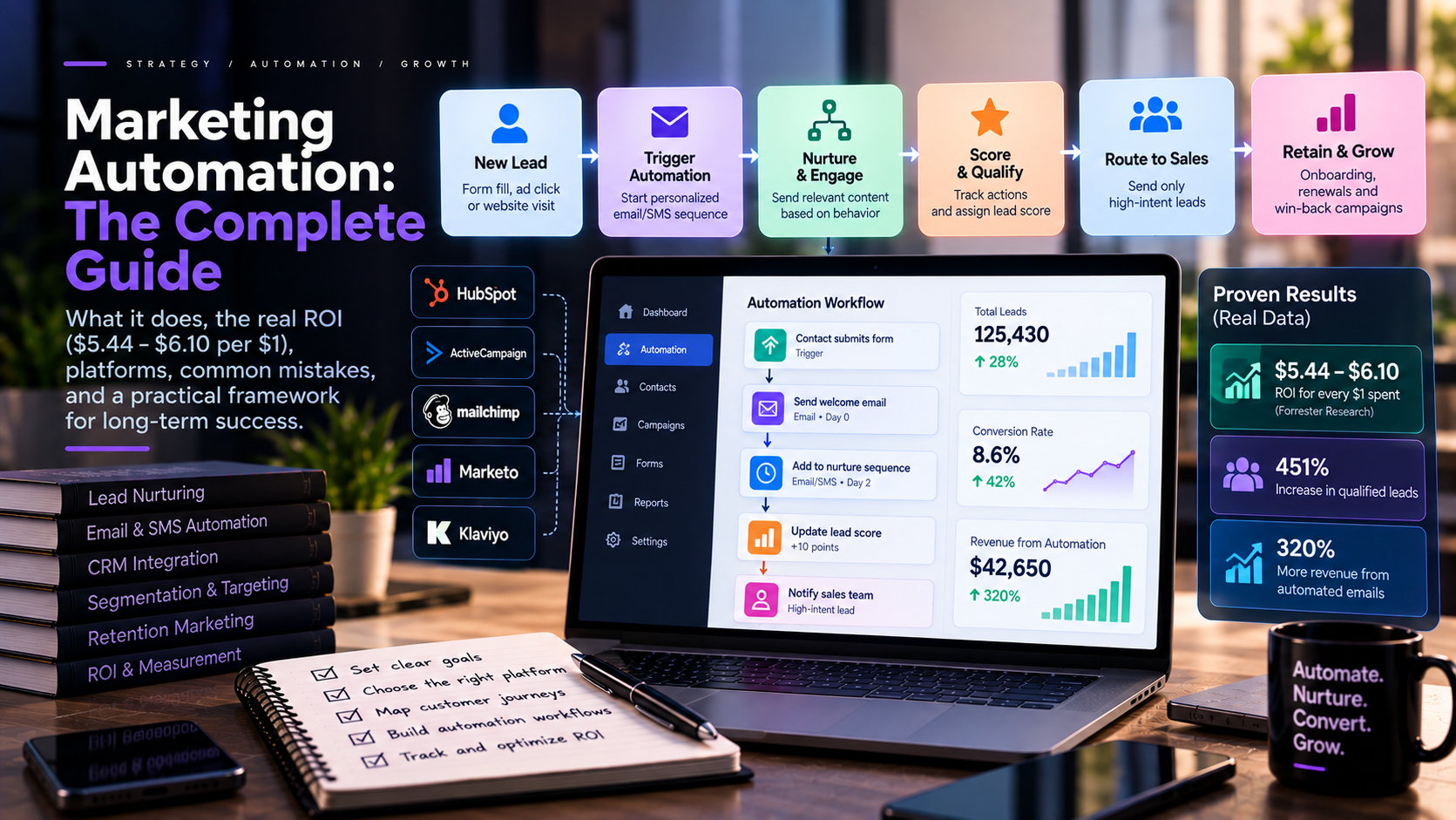
Marketing automation is the use of software to trigger, sequence, and personalize marketing actions — emails, SMS, ad audiences, lead scoring, CRM updates — based on a contact’s behavior, without a human manually sending each one. Done well, it turns a static list of leads into a system that nurtures every contact on its own schedule, hands sales only the leads worth calling, and keeps customers engaged after the sale closes. Done poorly, it’s an expensive email tool nobody customized past the default templates. This guide covers what marketing automation actually does, what it’s worth, where most implementations go wrong, and how to build one that pays for itself.
What Marketing Automation Actually Does
At its core, marketing automation replaces three manual jobs with rules: deciding who gets contacted, deciding when, and deciding what they see. A platform sits on top of your website, CRM, and ad accounts, watches for triggers — a form fill, a pricing-page visit, a cart abandonment, an inactive 90 days — and fires a pre-built sequence in response. The categories that matter for most businesses are:
- Lead nurturing: multi-step email/SMS sequences that move a new lead from “just downloaded a guide” to “booked a call,” without a rep touching it until it’s warm.
- Lead scoring and routing: assigning points for behavior (page visits, email opens, form fills) so sales only gets pinged when a lead crosses a real threshold, instead of every form submission.
- Lifecycle and retention marketing: onboarding sequences, renewal reminders, win-back campaigns for lapsed customers, review requests after a job completes.
- Ad audience automation: syncing your CRM segments (past customers, high-intent leads, churned accounts) into Meta and Google as living audiences instead of manually uploaded lists.
- Internal workflow automation: auto-creating CRM tasks, notifying a rep by Slack or SMS, updating a deal stage — the operational glue most people don’t think of as “marketing” but is where automation saves the most staff hours.
If you already have a lead generation engine bringing in volume, automation is what decides whether those leads convert or go cold in an inbox nobody’s watching.
What It’s Actually Worth: The Real Numbers
Marketing automation is one of the more evidence-backed categories in digital marketing — the data isn’t hype, and it doesn’t require guessing:
- Forrester Research has found that B2B organizations using marketing automation to nurture leads generate $5.44 to $6.10 in ROI for every $1 spent on the platform.
- Companies that nurture leads with automated sequences see a 451% increase in qualified leads compared to sending a single generic follow-up.
- Automated, behavior-triggered emails generate 320% more revenue than one-off broadcast emails sent to an entire list at once.
Those numbers hold up because automation fixes the specific failure mode most small and mid-sized businesses have: leads come in, get one follow-up email or call, and then nothing happens unless someone remembers to circle back. Automation removes the “remembering” step entirely.
The Platform Landscape
Marketing automation platforms fall into three tiers, and picking the wrong tier is the single most common expensive mistake:
| Tier | Examples | Best fit | Typical monthly cost |
|---|---|---|---|
| All-in-one CRM + automation | HubSpot, GoHighLevel, ActiveCampaign | Home services, small B2B, agencies managing multiple clients | $50–$800+ |
| E-commerce-focused | Klaviyo, Omnisend | DTC and e-commerce brands running abandoned-cart and post-purchase flows | $45–$1,000+ (scales with contacts) |
| Enterprise marketing clouds | Marketo, Salesforce Marketing Cloud, Pardot | Larger orgs with dedicated marketing ops staff | $1,000–$15,000+ |
Most home services businesses, CPAs, law firms, and consultants are correctly served by an all-in-one platform — they need automation bundled with a CRM and pipeline, not a standalone email tool that requires a separate system for everything else. Agencies managing several client accounts often standardize on one all-in-one platform (commonly GoHighLevel) specifically because it supports white-labeling and sub-account management.
The Mistakes That Waste the Investment
Most failed marketing automation projects don’t fail because of the software — they fail because of how it was implemented:
- Automating a broken process. If your sales follow-up is inconsistent, automation just makes the inconsistency happen faster and at scale. Fix the process, then automate it.
- No lead scoring, so sales drowns in noise. Every form fill hitting a rep’s phone trains them to ignore the automation entirely within a month.
- Set-and-forget sequences. A nurture sequence built once and never revisited decays as your offers, pricing, and messaging change. Automation still needs a quarterly review.
- Buying enterprise software for a five-person team. Marketo and Salesforce Marketing Cloud are built for dedicated marketing ops departments — a small business buying one usually uses 10% of the platform and pays for the other 90%.
- Treating automation as “set it and it replaces marketing.” Automation amplifies content and offers that already work. It does not generate demand on its own — that’s the job of content marketing, paid media, and SEO feeding the top of the funnel.
A Practical Implementation Framework
The businesses that get the Forrester-level returns follow roughly the same build order:
- Map the actual customer journey first. Write down every stage a real lead goes through — first touch, quote/consultation, decision, onboarding, renewal or repeat purchase — before opening any software.
- Start with the highest-leverage sequence, not the whole system. For most businesses that’s new-lead nurture (the gap between form-fill and first contact) or cart/quote abandonment. Build one sequence well, measure it, then expand.
- Build lead scoring around actual buying signals — pricing page visits, demo requests, repeat site visits — not vanity engagement like email opens alone.
- Connect the CRM and ad platforms so segments sync automatically. A “closed-won” list that updates your Meta and LinkedIn exclusion audiences in real time stops you from paying to re-target people who already bought.
- Set a review cadence. Sequences, scoring thresholds, and copy get revisited quarterly — automation is infrastructure, not a one-time project.
- Measure against revenue, not opens. Open rate and click rate are diagnostic metrics. The metric that matters is leads converted to booked calls/quotes and dollars closed per sequence.
Build, Buy, or Managed?
Three ways to get a marketing automation system running:
- DIY inside an existing tool. Works if you already have marketing staff with time to build and maintain sequences. Most small teams underestimate the ongoing maintenance and let it decay after month two.
- Buy and configure with an agency. An agency sets up the platform, builds the initial sequences and scoring model, and hands over a working system with documentation — the most common path for businesses without a dedicated marketing ops person.
- Fully managed. The agency owns ongoing sequence updates, A/B testing, and reporting as part of a retainer — best for businesses that want the ROI without building internal automation expertise. This is how Foreignerds runs marketing automation and growth marketing engagements: platform setup, sequence build, and ongoing optimization bundled together rather than sold as a one-time configuration.
How to Measure Whether It’s Working
Track these, in this order of importance:
- Lead-to-qualified-lead rate before and after implementing scoring — this is where the 451% figure shows up in practice.
- Sequence-attributed revenue — dollars closed from contacts who went through an automated nurture path versus those who didn’t.
- Response time to new leads — automation should cut the gap between form-fill and first meaningful contact from hours/days to minutes.
- Sequence completion and drop-off — where in a nurture flow people unsubscribe or stop engaging, which tells you where the messaging is off.
- Customer lifetime value for automated vs. manual onboarding/retention cohorts, once you have enough volume to compare.
These should tie back into the same reporting used for conversion rate optimization — automation and CRO are solving the same problem (more revenue from the same traffic) from different ends of the funnel.
Marketing Automation by Business Type
The right sequences differ meaningfully by vertical:
- Home services (HVAC, plumbing, roofing): the highest-value automation is missed-call and quote-follow-up sequences — a lead who doesn’t get a callback within minutes typically calls a competitor next. Seasonal maintenance reminders and review-request sequences after job completion are the next highest-leverage builds.
- Small B2B professional services (CPAs, law firms, consultants): automation centers on intake-to-consultation nurture, deadline-driven campaigns (tax season, renewal periods), and client onboarding sequences that reduce the manual admin load on a small team.
- Agencies and white-label partners: automation is the product as much as the marketing — a platform like GoHighLevel with sub-accounts lets an agency deliver automation as a packaged service to its own clients while managing dozens of accounts from one system.
Key Takeaways
- Marketing automation returns $5.44–$6.10 per $1 spent when built around real buying signals, per Forrester — but only when the underlying process being automated already works.
- Automated nurture sequences produce a 451% increase in qualified leads and automated triggered emails generate 320% more revenue than one-off broadcasts.
- Match the platform tier to team size: all-in-one CRM platforms fit most home services and small B2B businesses; enterprise marketing clouds are usually overkill below a dedicated marketing ops team.
- Start with one high-leverage sequence (new-lead nurture or abandonment recovery), measure it, then expand — building the whole system at once is how most implementations stall.
- Measure sequence-attributed revenue and lead-to-qualified-lead rate, not email opens, to know if it’s actually working.
Frequently Asked Questions
What's the difference between marketing automation and email marketing?
Email marketing is one channel; marketing automation is the system that decides who gets an email (or SMS, or ad audience update), when, and why, based on behavior. A platform can send email without any automation, and automation isn't limited to email — it also covers lead scoring, CRM updates, and ad audience syncing.
How much does marketing automation cost for a small business?
All-in-one platforms like HubSpot's starter tiers, ActiveCampaign, or GoHighLevel typically run $50–$800/month depending on contact volume and features, which fits most home services and small B2B budgets. Enterprise platforms like Marketo or Salesforce Marketing Cloud start in the $1,000+/month range and are usually overkill below a dedicated marketing ops team.
Do I need a CRM before I can use marketing automation?
Not separately — most small businesses are better served by an all-in-one platform that bundles CRM and automation together, rather than buying a standalone automation tool and a separate CRM that have to be integrated and kept in sync.
How long does it take to see results from marketing automation?
A single well-built sequence (like new-lead nurture) can show measurable impact within the first month, since it's fixing an existing gap in follow-up. The full Forrester-level ROI figures reflect a maturing program measured over quarters, not a first-month result.
Can marketing automation work for a home services business?
Yes — the highest-value automation for home services is typically missed-call and quote-follow-up sequences, since a lead who doesn't get a callback within minutes usually calls a competitor next, followed by seasonal maintenance reminders and post-job review requests.
What's the biggest mistake businesses make with marketing automation?
Automating a broken manual process instead of fixing it first. If sales follow-up is already inconsistent, automation just makes that inconsistency happen faster and at scale rather than solving the underlying problem.

Related Reading



Related Case Studies
 Reduced Medical Record Review Time by 65% and Cut Case Assignment from Days to Under 4 Hours
 Built RealGround's AI-Native Cybersecurity Platform in 14 Weeks — 80+ AI Security Assessments in 6 Months
 Built Marlo's AI-Native Deal Desk in 14 Weeks — Automating Brand Deals from Inbound Inquiry to Payment
Recent Posts
 Google’s September Spam Update Has a Two-Week Rollout Window, the Longest of 2026. Here Is What to Do While It Rolls Out.
 Salesforce Just Gave Its AI Agents Names, Job Titles and Goals That Run for Weeks
 AI Agents May Be Running Inside Your Company Without Approval. CrowdStrike Just Built a Product to Find Them.