For the last two years, enterprise AI has mostly been sold as a feature: a chatbot in the corner of a screen, a summarize button, an assistant that answers one question at a time. On September 11, 2026, Salesforce made a different kind of pitch. It introduced seven named Agentforce agents, each built for a specific job, and described one of them as able to pursue a goal across weeks instead of a single conversation.
The naming is not a cosmetic detail. It signals a shift in how vendors want buyers to think about AI: less as software you configure and more as labour you deploy. This piece follows on from our earlier look at MCP and A2A governance, and it covers what Salesforce announced, what its customer results do and do not show, and what a buyer should ask before treating an AI agent like an employee.
What Salesforce announced
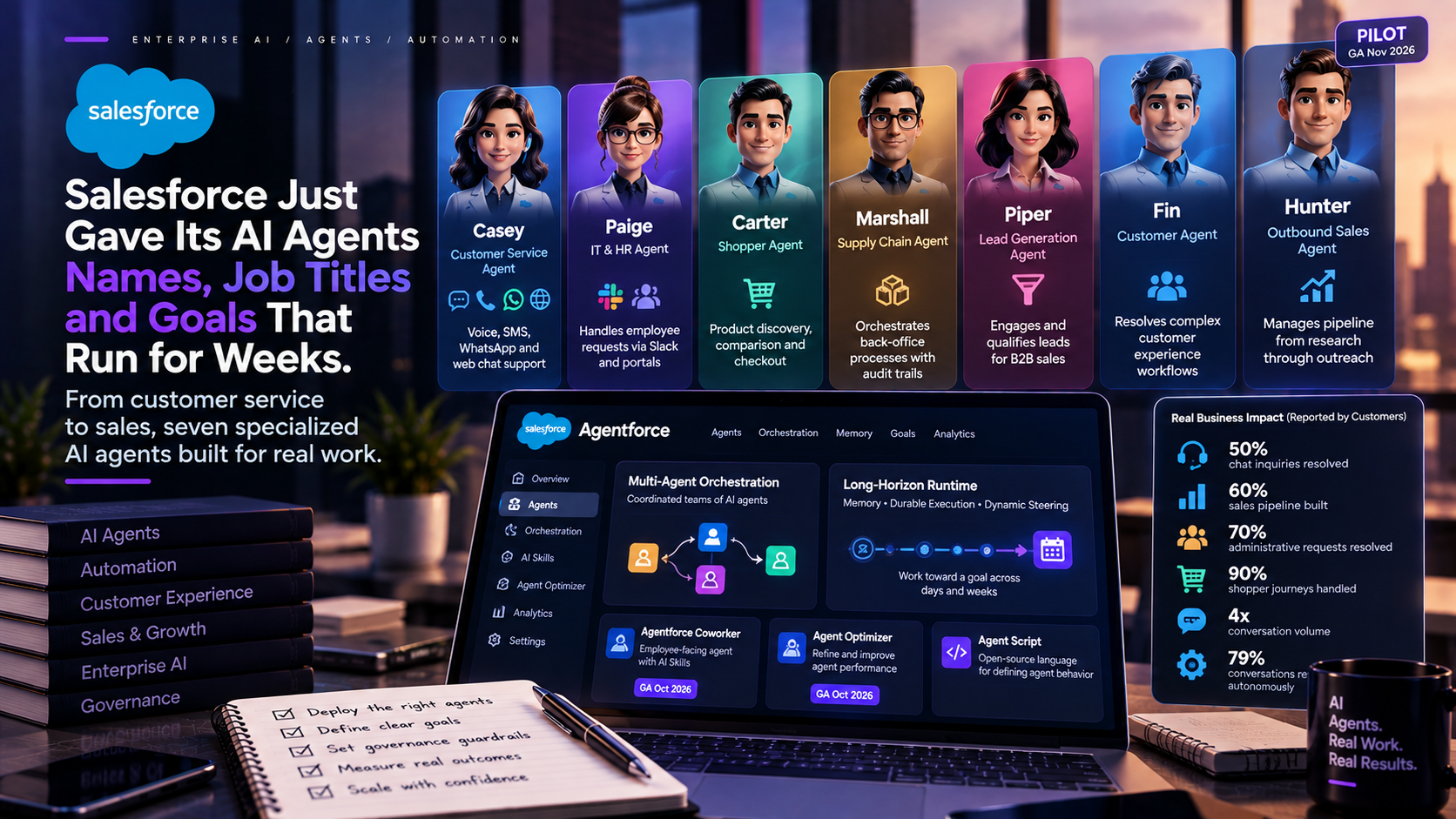
According to Salesforce’s announcement and coverage from Unite.AI and Startup Fortune, the seven agents and their jobs are as follows.
Casey is a help agent for customer service, working across voice, SMS, WhatsApp, and web chat. Paige handles IT and HR requests for employees, including through Slack and employee portals. Carter is a shopper agent that helps with product discovery, comparison, and checkout. Marshall is a supply chain agent that orchestrates back-office processes with audit trails. Piper handles inbound lead generation, engaging and qualifying leads for B2B sales. Fin is a customer agent that resolves complex customer-experience workflows. Hunter is an outbound sales agent that manages a pipeline from research through outreach.
Availability differs. Six of the seven, Casey, Paige, Carter, Marshall, Piper, and Fin, are generally available now. Hunter is in pilot, with general availability planned for November 2026.
Hunter is also the agent that uses a new long-horizon runtime. Salesforce describes it as built on three capabilities: memory, which preserves context across sessions; durable execution, which keeps a plan running over time; and dynamic steering, which adapts behavior based on feedback from users. The point of the runtime is that an agent can work toward a goal across days and weeks, instead of finishing one task and forgetting it. Hunter is the first agent to run on it.
The announcement included other platform pieces. Multi-Agent Orchestration, which routes work across coordinated teams of agents, is generally available. Agentforce Coworker, an employee-facing agent with AI Skills, and Agent Optimizer, a tool for refining agents, are scheduled for general availability in October 2026. Salesforce also introduced Agent Script, an open-source language for defining agent behavior with deterministic rules, which matters because it gives builders a way to fix certain steps in place instead of leaving everything to the model. None of the coverage we reviewed gave pricing.
How long the memory lasts
Some headlines around this launch describe agents with months of memory. The sources we reviewed do not support that. Salesforce’s own description is days and weeks. That is still a meaningful change, but the difference matters when a buyer is estimating how long an agent can hold onto a plan.
The customer results, and why to read them carefully
Salesforce published six customer results with the launch. All of them are reported by Salesforce, and none of the coverage we reviewed included independent verification or a definition of how each metric was measured.
Engine reported that 50% of chat inquiries are fully resolved by its help agent, which it calls Eva. Perk reported that Hunter built 60% of its sales pipeline. Autism Queensland reported that Paige resolves 70% of administrative requests. Hibbett reported that an agent handles 90% of core shopper journeys, after going live in six weeks. Asana reported 4x conversation volume driven by Piper. Anthropic reported that Fin resolves 79% of conversations autonomously.
These are useful as directional evidence. They are not benchmarks, and four things are missing that any buyer should ask about.
The first is definitions. Resolved could mean that a customer got a correct answer, or it could mean that the conversation ended without escalation. Those are very different outcomes. The second is baselines. Fifty percent resolved means more or less depending on what was resolved before the agent arrived. The third is scope. A figure for one team, one region, or one channel may not transfer to your business. The fourth is selection. Vendors highlight their strongest results, so a set of six published numbers says little about the distribution of outcomes across all customers.
There is one specific point on Perk. Hunter is still in pilot, so that result necessarily comes from early use, not a generally available product. Startup Fortune’s coverage made the same overall point, describing the results as early evidence and not a guarantee.
The governance layer was announced separately
Coverage of this launch sometimes lumps the AI Control Plane in with the seven agents. It was announced separately, one day earlier, on September 10, alongside what Salesforce calls a Trusted Enterprise AI Harness.
According to AI Weekly, the control plane provides routing, lineage, and cost and observability across both Salesforce and third-party AI, and it is positioned as a governance layer over a multi-vendor agent landscape. An analyst blog covering Dreamforce described it as a central registry of agents, MCP servers, and APIs with automatic discovery and a single gateway for model, MCP, and agent calls, and said it is designed to cover agents beyond Salesforce’s own.
Two cautions apply. AI Weekly reported that most capabilities are live while the rest are scheduled for fiscal year 2028, so buyers should not assume everything described is available today. And the same analyst blog noted that the control plane was initially previewed in 2025, which suggests some of it is an evolution of earlier work and not new this month. Neither source gave a general availability date for the full set.
A registry of agents, MCP servers, and APIs is exactly the kind of inventory that AI governance requires. It is also a reminder that governance products from a platform vendor cover that vendor’s view of the world first, so a company running agents from several suppliers should test how well the third-party coverage actually works.
Why names and job titles matter
Giving an agent a name and a role is a marketing decision, and it is also a framing decision. A named agent with a job title invites the same expectations we place on a person in that role: that it owns an outcome, that someone is accountable for it, and that it can be evaluated like a hire.
That framing has real benefits. It gives buyers a clearer mental model than a generic assistant. It pushes vendors to tie agents to measurable jobs such as resolving support tickets or qualifying leads, which is what sensible AI automation projects do anyway. And it makes it easier for a business to ask what work is being replaced, augmented, or created.
It also creates a risk. Names encourage people to trust an agent in the way they would trust a colleague, and an agent is not a colleague. It has no professional judgment, no personal accountability, and no understanding of context beyond what it has been given. Startup Fortune raised the question directly: “which decisions stay with people, which ones the agent takes alone?” That question should be answered in writing before an agent goes live, not discovered after an error.
Why weeks-long agents change the risk
The long-horizon runtime deserves separate attention, because it changes what can go wrong. A chatbot that answers one question and forgets it produces contained errors. An agent that holds a plan for weeks, remembers past interactions, and adjusts its behavior can compound a mistake, act on stale information, or continue a course of action after circumstances have changed.
Memory also raises data questions. What does the agent retain, for how long, and who can see or delete it? Durable execution raises control questions. How do you pause or stop an agent that is mid-plan, and how do you review what it did while nobody was watching? Dynamic steering raises accountability questions. When feedback changes an agent’s behavior, who approved that change?
These are design questions for anyone working on AI agent development, and they are procurement questions for anyone buying agents. The sensible default for a weeks-long agent is tighter limits: narrow permissions, explicit approval for irreversible actions, clear stop conditions, and a complete log of what it decided and why.
What to ask before you deploy a job-ready agent
Whether you buy from Salesforce or another vendor, the same questions apply.
What exactly is the job, and how is success measured? Define the metric before the pilot, including what counts as resolved or qualified.
What does the agent decide alone, and what needs a person? Write the boundary down and test it.
What data does it read, retain, and write? Confirm retention periods and deletion.
How do you audit and stop it? This is the core of AI governance for agents. Ask to see the logs and the pause controls.
How does it behave when it is wrong? Test escalation paths and error handling with real edge cases.
What is the fallback? Keep a documented way to run the process without the agent.
How does it fit with the rest of your agents? If you run agents from more than one vendor, check whether the governance layer really covers them.
Where this leaves you
The confirmed facts are these. Salesforce launched seven named agents on September 11, 2026. Six are generally available and Hunter is in pilot until a planned November release. Hunter runs on a new runtime designed to pursue goals over days and weeks. A separate governance announcement the day before introduced an AI Control Plane, with parts still to roll out. All customer results are Salesforce-reported and lack published definitions.
The broader shift is real. Enterprise AI is increasingly sold as a defined piece of work with a name attached. That makes it easier to evaluate, provided you insist on definitions, baselines, and limits. Businesses exploring AI automation, AI agent development, or generative AI development can borrow the useful part of the framing, which is to scope each agent to a specific job, and skip the risky part, which is treating it like a person.
Frequently Asked Questions
1. What are the seven Agentforce agents?
Answer: Casey (customer service), Paige (IT and HR), Carter (shopping), Marshall (supply chain), Piper (inbound lead generation), Fin (customer experience workflows), and Hunter (outbound sales). Salesforce announced them on September 11, 2026.
2. Which agents are available now?
Answer: Casey, Paige, Carter, Marshall, Piper, and Fin are generally available. Hunter is in pilot, with general availability planned for November 2026.
3. What is the long-horizon runtime?
Answer: It is a new runtime that lets an agent pursue goals across days and weeks using memory, durable execution, and dynamic steering. Hunter is the first agent to use it.
4. Are Salesforce’s customer results independent?
Answer: No. All six results are reported by Salesforce, and the coverage reviewed did not define how metrics such as resolved were measured. Treat them as directional evidence, not benchmarks.
5. What is the AI Control Plane?
Answer: It is a governance layer announced separately on September 10, 2026 that provides routing, lineage, cost and observability across Salesforce and third-party AI. Some capabilities are live and the rest are scheduled for fiscal year 2028.
6. How should a business evaluate an AI agent before deploying it?
Answer: Define the job and success metric, set the boundary between agent and human decisions, confirm data retention, check audit logs and stop controls, and test failure handling.
If you want to know which of your workflows are ready for AI agents and where the risks sit, that is exactly what we look at in a free AI Readiness Audit.
Related Reading
 AI Agents May Be Running Inside Your Company Without Approval. CrowdStrike Just Built a Product to Find Them.
 OpenAI Is Cutting Cursor Off in November. The Real Lesson Is About Every AI Vendor You Depend On.
 ChatGPT and Claude Cite Earned Media About 93% of the Time in Product Research. Your Own Website Barely Registers.