On August 27, SEO consultant Chris Long spotted something new in live search results and posted it immediately: “Holy moly SEOs: Google is now revealing the AI Mode prompt box BY DEFAULT for some queries.” His reading was blunt. “This is how Google continues to push AI Mode as the default search experience.”
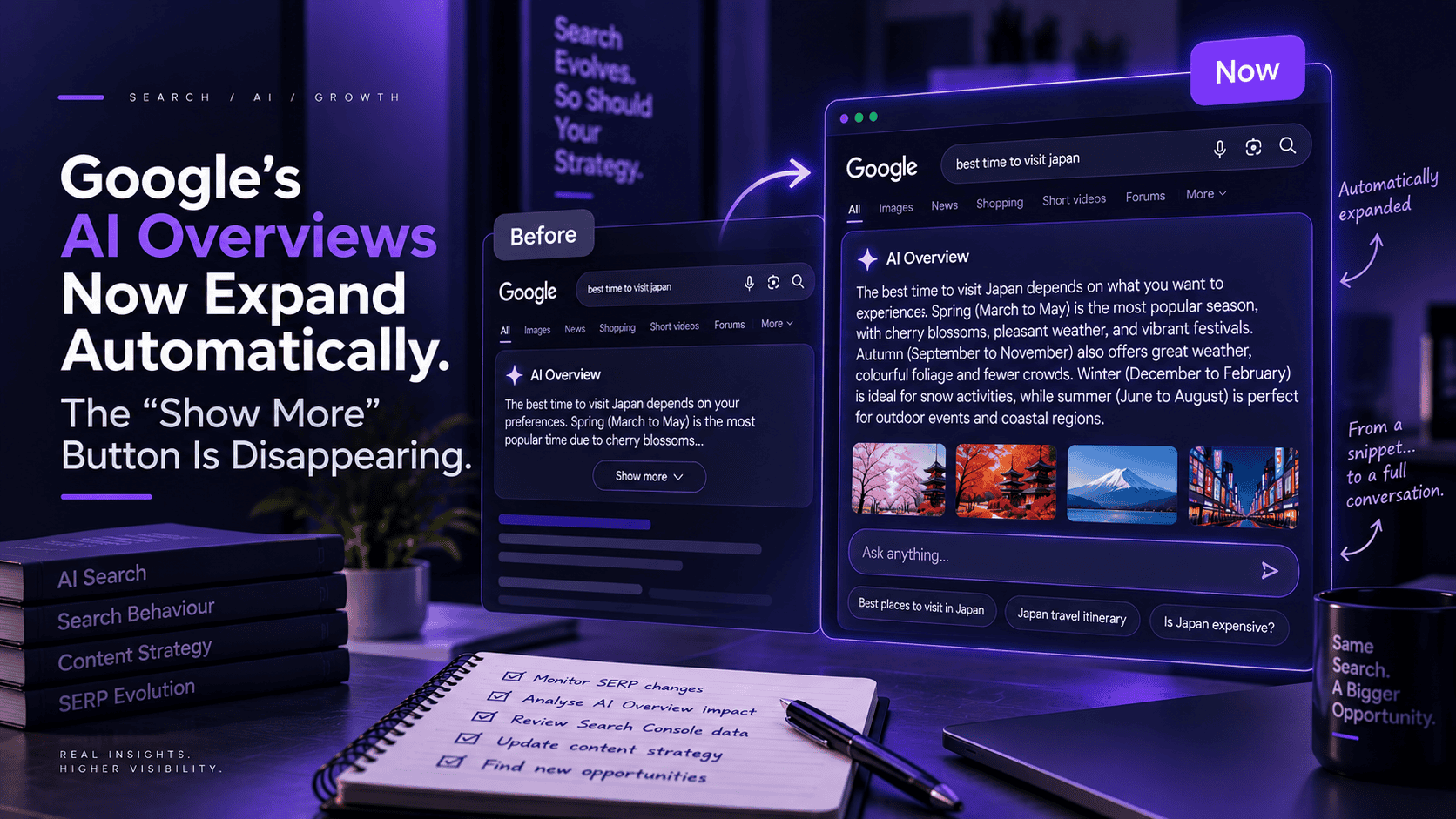
Google confirmed it the next day. In a statement to Search Engine Roundtable, the company said: “For some queries, AI Overviews may dynamically expand for topics where our systems determine it’s most useful for people. Our research has shown that with this dynamic experience, users find Search more helpful and engage deeper in follow-up exploration.” Robby Stein, VP of Product for Google Search, added a detail that matters if you’re mid-read: “If you’ve already started scrolling, the expansion stops to keep your place.”
What actually changed is this. An AI Overview used to load as a short snippet, with a manual “Show More” click needed to see the full answer. For some queries now, it loads fully expanded from the start, with an open “Ask anything” box sitting underneath it, the same interface AI Mode uses. Google has not said which share of queries trigger this, whether that share will grow, or when the behaviour might change again. Stein was explicit that it’s still being tuned: “We’re always testing and tuning these experiences, so we’ll continue to refine based on user feedback.”
A related change, one week earlier
A week before dynamic expansion, on August 19, Google rolled out a related but separate change: generative UI moving from AI Mode into AI Overviews. This is the feature that builds a custom interactive tool for a query instead of describing an answer in text. Google’s own example is searching “ph scale” and getting an interactive visual built on the spot inside the overview, not a paragraph explaining one. Practice quizzes for exam prep, custom document generation, and a homework-helper feature using Lens all shipped alongside it.
These two changes are easy to conflate because they’re pushing the same direction, but they were confirmed on different dates for different reasons, and it’s worth keeping them separate when you’re explaining this to a client. Generative UI changes what the answer looks like. Dynamic expansion changes how much of it you see before doing anything at all.
Neither is really a standalone event either. Both sit inside a longer arc that started at Google’s I/O in May 2026, when AI Overviews and AI Mode formally merged into one integrated search experience running on Gemini 3.5 Flash. Everything since then, including this, has been Google steadily erasing the line between a summary above the results and a conversation instead of the results.
The 48% and the 58% are not the same statistic
Coverage of this topic has been sloppy about one thing, and it’s worth being precise here because it’s an easy stat to misquote. BrightEdge found, in March 2026, that AI Overviews appear on roughly 48% of tracked queries, with the rate far higher in specific verticals: 88% for healthcare, 83% for education, 82% for B2B technology. Separately, Ahrefs found in February 2026 that when an AI Overview appears, the top organic result’s click-through rate falls by 58%. One is a prevalence number. The other is a click-loss number. They come from different studies, measuring different things, and citing them together as one connected trend, the way they often get repeated, overstates what either study actually claims on its own.
What both numbers agree on, independently, is the direction. AI Overviews show up on a large and growing share of searches, and when they do, fewer people click through afterward. Two separate, peer-reviewed studies this year support the second half of that. Pew Research found clicks on 8% of visits where an AI Overview appeared, against 15% where it didn’t, a gap that held even after controlling for query length and individual searcher habits. A randomized field experiment in July found that hiding AI Overviews entirely lifted outbound clicks by roughly 40% per search. A second randomized experiment in August found a smaller but still real 8.8 percentage point lift, and a genuinely interesting null result alongside it: removing the AI Overview didn’t measurably change how satisfied or trusting people felt about their search. The benefit Google says it delivers isn’t showing up in what users report either way.
Why “position” barely means what it used to
Here’s the detail most content advice skips, and it’s the one that should change how you think about your own reporting. Google’s own Search Console documentation states that an AI Overview occupies a single position in search results, and every link inside that overview is assigned that same shared position. There is no internal ranking. You cannot see whether your link sat first or fourth inside the answer, only that the whole block sat wherever it sat. This is exactly why treating an AI Overview citation as a traditional search engine optimization ranking problem misses the point, there is no position left to optimize toward once you’re inside the block.
The impression rule is stricter too. A normal search result counts as an impression once it’s served on the page. A link inside an AI Overview only counts once it’s actually scrolled or expanded into view. Two links from the same site inside one overview count as a single impression on the chart-level view, though they’re counted separately on the page-level table, which means the two numbers in your own Search Console won’t always add up to each other, and that’s not a bug, it’s two different ways of aggregating the same event.
There’s a real attribution problem sitting underneath all of this too. One publisher who tracked this properly, using a custom GA4 dimension that catches the text-fragment links Google sometimes appends to AI Overview citations, found that 22.4% of that traffic was landing in their analytics as Direct, not Organic Search. Nothing in a standard analytics setup tells you this is happening. If you get meaningful AI Overview citations, some real share of that traffic is currently invisible to whoever reports on your channels.
The surface nobody’s talking about
There’s one more wrinkle worth knowing if you’re trying to explain the scale of this to a client. A separate but related surface, People Also Ask, has effectively been taken over by the same shift. Independent tracking in early September found 97% of People Also Ask answers are now AI Overviews, up from just 12.6% a year earlier. A second, independently run dataset checking the old snippet endpoint directly found it had stopped returning results at all from August onward. Whatever you think dynamic expansion means for search results generally, the box that used to sit quietly beneath a query with a handful of related questions has already, almost entirely, become the same AI-generated surface this whole piece is about.
What to actually check on your own site
Pull Search Console and look at click-through rate by query, not just average position. A page holding position one or two with a falling CTR on an informational query is a strong sign an AI Overview is intercepting the click before your listing is ever really seen, whatever the position column says.
Separate your query types honestly. Local, transactional, and highly specific searches remain far harder for an AI Overview to fully resolve on its own, and that’s still where organic clicks convert. Simple factual and broad comparison queries are exactly the ones dynamic expansion is built for, and they’re the ones where you should expect this to get worse before it gets better.
Check whether your content is actually being cited inside the overview for your target terms, separate from whether you rank underneath it. Under dynamic expansion, being the source Google pulls from now matters more than the position of the blue link sitting below a fully expanded answer nobody has to click to read. This is the whole premise behind generative engine optimization and answer engine optimization as disciplines distinct from traditional ranking work, earning the citation itself rather than the position beneath it.
And don’t chase this as if it were a ranking algorithm problem, because it isn’t one. This is an interface change, not a core update. Rewriting content to win back a click that an interface decision is now suppressing by design treats the wrong layer of the problem.
What this means going forward
Google’s Search Console rolled its generative AI performance reports out to every property worldwide on August 31, closing the gap for site owners who previously had no visibility into any of this at all. It’s worth using, even with its limits: impressions only, no clicks, no queries, and the counting quirks above. It’s still the closest thing to a first-party signal you’ll get for how often your content actually surfaces inside these expanding answers.
The broader shift is straightforward to state and harder to act on. A “Show More” click used to be a small piece of friction that gave your listing a chance to be seen before someone gave up and left. That friction is being removed, query by query, and Google has told you plainly that it intends to keep tuning the removal rather than reverse it. Structuring content so it earns the citation inside the answer, not just a ranking beneath it, through deliberate answer engine optimization and generative engine optimization work rather than traditional keyword targeting alone, is no longer a forward-looking recommendation. It’s the baseline for anything you publish from here.
Frequently asked questions
1. Is “dynamic expansion” a new Google algorithm update?
Answer: No. It’s an interface change to how AI Overviews display, confirmed by Google on August 28, not a change to the ranking algorithm. It affects how much of an AI-generated answer a searcher sees automatically, not which pages rank where beneath it.
2. Are the 48% and 58% AI Overview statistics from the same study?
Answer: No, and they measure different things. BrightEdge’s 48% (March 2026) is how often AI Overviews appear across tracked queries. Ahrefs’ 58% (February 2026) is how much the top organic result’s click-through rate falls when an AI Overview appears. They’re often quoted together as if connected, but they come from separate research.
3. Does average position still mean anything if I’m cited inside an AI Overview?
Answer: Less than it used to. Google’s documentation confirms every link inside an AI Overview shares one single position value, with no visibility into internal ordering. Whether you’re cited at all now matters more than where within the overview that citation sits.
4. Why is my AI Overview traffic showing up wrong in my analytics?
Answer: A documented case found 22.4% of one site’s AI Overview traffic was misattributed as Direct rather than Organic Search, due to how citation links are sometimes formatted. Standard analytics setups don’t catch this automatically.
5. What should I actually change first?
Answer: Start with Search Console’s generative AI performance report, live worldwide since August 31, and cross-check it against click-through rate by query in your normal performance report. Prioritise fixing content for the query types AI Overviews answer most fully rather than reacting site-wide.
If you want to know whether your content is actually earning citations inside AI Overviews and AI Mode, or just ranking beneath answers nobody clicks through, that is exactly what we check in a free AI Visibility Audit.