
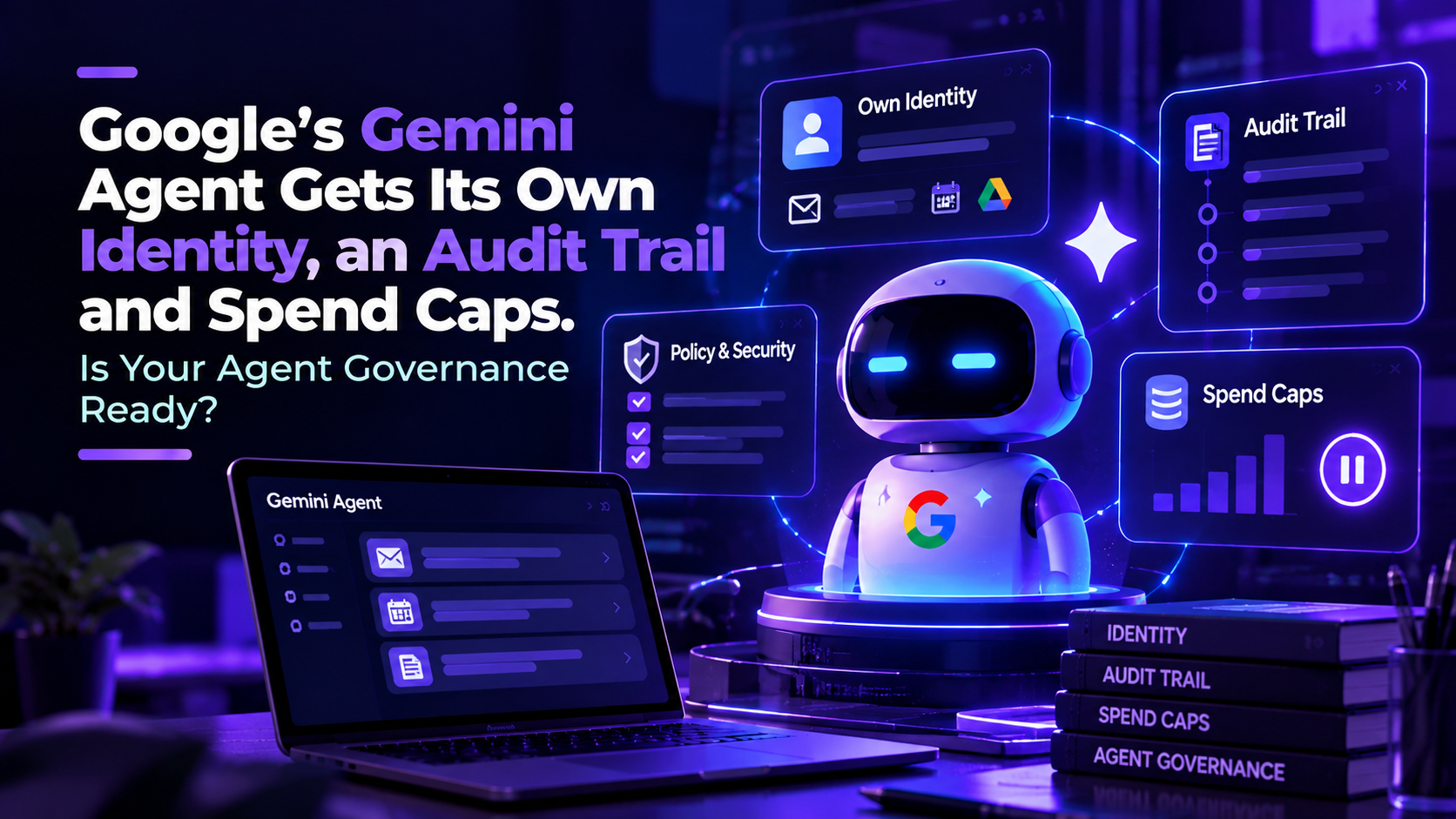
On October 8, 2026, Google Cloud introduced the Gemini agent, a general-purpose agent for work, at its Gemini at Work event. The announcement, published as a post by Google Cloud CEO Thomas Kurian, makes a specific pitch: an agent with its own account, its own audit trail and a budget cap that pauses it. For anyone responsible for AI governance, that is a notable shift, because controls that used to be added afterward are now described as part of the product.
This is a vendor announcement. Google’s claims have not been independently tested, and the post gives no general availability date, eligibility rules or agent pricing. This piece sets out what was announced, what is not established, and the question it raises: the features are Google’s, but who owns the policy behind them? It follows our earlier look at CrowdStrike’s shadow AI agent product and is written for teams doing AI agent development or generative AI development, and for those adopting agents from vendors.
What Google announced
According to the Google Cloud post, the Gemini agent plans tasks, uses tools, connects to a company’s business systems and returns finished work in the documents and inboxes people already use. The governance claims fall into four groups.
Identity. Google says coworker agents have dedicated identities, including their own email addresses on a company domain, and see only the context a person or team gives them. In Workspace, an agent gets its own account with an email address, a calendar, a Drive and a place in the company directory. Google also says each identity is cryptographically attested and limited to least-privilege permissions.
Audit trail. Google says every action the agent takes is written to an audit trail and “attributed to the agent rather than to a person.” The identity is stamped into the logs, and the logs can be watched in real time.
Spend caps. Administrators can set a hard limit on a project’s AI spend in the Cloud Billing Console. The project’s agent pauses when the cap is triggered, and work resumes with one click. Spend is tracked per project, so costs can be charged back to departments.
Policy and security. Rules are written once and apply to every agent, such as barring agents from documents classified as need to know. The post frames governance as four questions: who the agent is, what it is allowed to do, what it did and where you can see it, and what it should never touch.
Identity: an account is not an owner
A separate account solves a real problem. When an agent works through an employee’s login, its actions look like that employee’s, and revoking one disrupts the other. A separate identity lets security teams grant narrower access and switch the agent off without touching a person’s account. Analyst firm Futurum credits the design with giving security teams a clear line between human and agent actions.
What an account does not provide is an accountable owner: it does not say which person approved the agent’s permissions or answers when it gets something wrong. Google says an agent sees only what people share with it, which means someone is sharing, and that decision belongs to you. Our guide to AI agent governance puts inventory and scope of authority at the start of its framework for this reason.
The audit trail, and what it leaves open
An action-level log helps reconstruct what happened, and attributing entries to the agent keeps human and automated activity apart. It also raises a question the post does not address: how does a reviewer link an agent’s action back to the request, and the person, that set it off? That is our inference, not a gap Google has acknowledged.
A log only helps if someone reads it. A September survey published by Guild.ai, a vendor of agent management tools, and fielded by Morning Consult, reported that 39.8% have logging or audit trails and 31% have an automated kill switch. The release does not state the base for those figures and the research is vendor-sponsored, so treat them as indicative only.
Spend caps: useful, but thinly described
The post gives no time period, no alert thresholds and no figure for how quickly a cap takes effect. An earlier Google Cloud post on billing for agents, dated August 26, 2026, describes a firm monthly project cap, alerts at 50%, 80% and 100% of budget, and an optional overage setting. The October post does not say whether the same settings apply to the Gemini agent, so do not assume they do.
Two limits follow from how a cap works, and both are our reading. The cap sits at the project level, so one runaway agent could pause others sharing the project. And a cap limits cost, not harm: an agent can send a wrong message or delete a file at almost no cost, so caps sit beside permissions and approvals, not in place of them.
What independent voices say
Coverage so far is analysis of the announcement, not testing. Carmi Levy, an independent analyst quoted by CIO on October 8, said Google is trying to become “the gatekeeper of the new enterprise operating system.” He called Google arguably ahead on identity and audit trails, but questioned whether CIOs and CISOs can trust it with mission-critical processes.
Mahmoud Ramin of Info-Tech Research Group, quoted in the same article, said the announcement does not create a new category, and called enforcing governance non-negotiable.
Futurum, in an October 9 analysis, noted that Google says it does not intend to charge a per-seat license for coworker agents in Workspace, but has not said how it will meter agent activity.
What is and is not confirmed about availability
Google’s product page says “Not every feature shown on this page is available right now.” It lists delegating multi-step background tasks, mobile and desktop access, and third-party model choice as early access.
The Kurian post gives no general availability date, eligibility criteria or agent-specific price. It labels the Financial Services and Legal specializations as in preview, with Government, Healthcare and Retail coming soon. It does not label the core agent, coworker agents or spend caps as preview or generally available, so their status is unconfirmed. Futurum makes the same point: Google gave few general availability dates.
Reworked reports that a Google spokesperson told VentureBeat the agent comes at no additional charge where Gemini Enterprise is available. We did not find that in Google’s own posts, so treat it as reported.
Who owns the policy behind the controls
Google has built mechanisms: an identity, a log, a cap and a place to write rules. None of them decides anything. Someone still has to choose which agents may exist, which data counts as need to know, what each budget should be and who reviews the logs.
This is the point our CrowdStrike piece made about detection tools. A product can enforce a policy, but it cannot write one.
There is also a coverage problem. Google’s controls cover Google’s agent, while agents from Salesforce, Microsoft and others bring their own identities, logs and caps. Shared protocols help agents talk to one another, but as we noted in our look at MCP and A2A governance, they do not settle who is responsible. That belongs to a policy that sits above any one vendor.
Is your agent governance ready? A checklist
Use Google’s four questions as a test, whichever platform you run.
Who is the agent? Keep a register in which every agent has a named owner, a purpose and an identity of its own, not a shared login or a personal account.
What can it do? Grant the narrowest access that lets it do the job, name the data it must not open, and review access on a schedule.
What did it do? Retain logs long enough to reconstruct an incident, assign someone to review them, and record who requested each task.
What should it never touch? Write a short list covering regulated data, payments, deletion and external sending, then test that the controls block those actions.
Set a budget for each agent or project, and decide who is alerted and who may resume work. Rehearse the stop by timing how fast you can disable an agent and revoke its credentials. A short AI Readiness Audit can show which of these controls you already have.
What this means if you build or buy agents
For teams doing AI agent development, identity, scoped permissions, logging and spend limits belong in the requirements from the first sprint, because they are cheaper to design in than to add later. Teams working on generative AI development can use the four questions as a design review before an agent reaches production.
For AI automation that connects agents to CRM and finance systems, start with read-only access and add actions as controls prove themselves. Wider AI development programs should treat agents as production systems with an owner and a review schedule. Google’s preview focus on financial services and legal is a signal too: finance and banking and law firms should apply the strictest version of these questions.
Where this leaves you
The confirmed facts are these. On October 8, 2026, Google Cloud introduced the Gemini agent and said its agents have their own identities, including email, that every action is written to an audit trail attributed to the agent, and that project-level spend caps pause the agent when triggered. This is a vendor announcement that has not been independently tested. Google’s post gives no general availability date, eligibility rules or agent pricing, and some related features are in early access or preview.
The practical response does not depend on any one vendor. Treat identity, logging and caps as tools, and AI governance as the policy that tells them what to enforce. Decide who owns each agent, what it may touch, what it may spend and who reviews its record. That discipline supports AI automation and AI development alike, so write it down before the platform asks for it.
Frequently Asked Questions
1. What did Google announce on October 8, 2026?
Google Cloud introduced the Gemini agent in a post by CEO Thomas Kurian. Its governance claims include agent identities with email addresses, an audit trail attributed to the agent, and project-level spend caps.
2. Does the Gemini agent really get its own email address?
Google says so. In Workspace, a coworker agent gets its own account with an email address, calendar and Drive. It is a vendor claim, with no availability date given.
3. What does the audit trail record?
Google says every action is written to an audit trail attributed to the agent, not a person. The post does not describe log retention or how an action links back to the requester.
4. How do the spend caps work?
An administrator sets a hard limit on a project’s AI spend in the Cloud Billing Console, and the project’s agent pauses when it is triggered. The post gives no time period, thresholds or enforcement speed.
5. Is the Gemini agent available to everyone?
Not as far as Google’s pages show. The post gives no general availability date or eligibility rules, some capabilities are in early access, and some industry versions are in preview.
6. If I use Google’s agent, is my AI governance solved?
No. The platform supplies identity, logging and caps, but you still decide which agents exist, what they may access, what they may spend and who reviews their activity.
7. What should my company do first?
Answer Google’s four questions for every agent you run, name an owner for each, and write the policy before relying on any vendor’s controls.
If you want to know which of your workflows are ready for AI agents, and where the governance gaps sit, that is exactly what we look at in a free AI Readiness Audit.

Related Reading
 Google Adds a Fake-Author Warning to Its People-First Content Guidance. Here Is What to Check on Your Own Bylines.
 Anthropic’s New Usage Policy Bars Using Claude to Plant Fake Sources for AI Answers. What It Means for Brand Mentions.
 Google Appears to Be Serving Altered Results to Rank Trackers. How to Tell a Real Ranking Drop from a Fake One.
Recent Posts
 The UK Regulator Wants AI Assistants Like ChatGPT on Google’s Search Choice Screens, With One Condition for Publishers.
 96% of IT Leaders Say Their AI Agent Inventory Is Complete. Two in Three Had an Agent Incident Anyway.
 Google Is Testing AI Overviews Inside Local Business Profiles. What Local Businesses Should Check Now.