
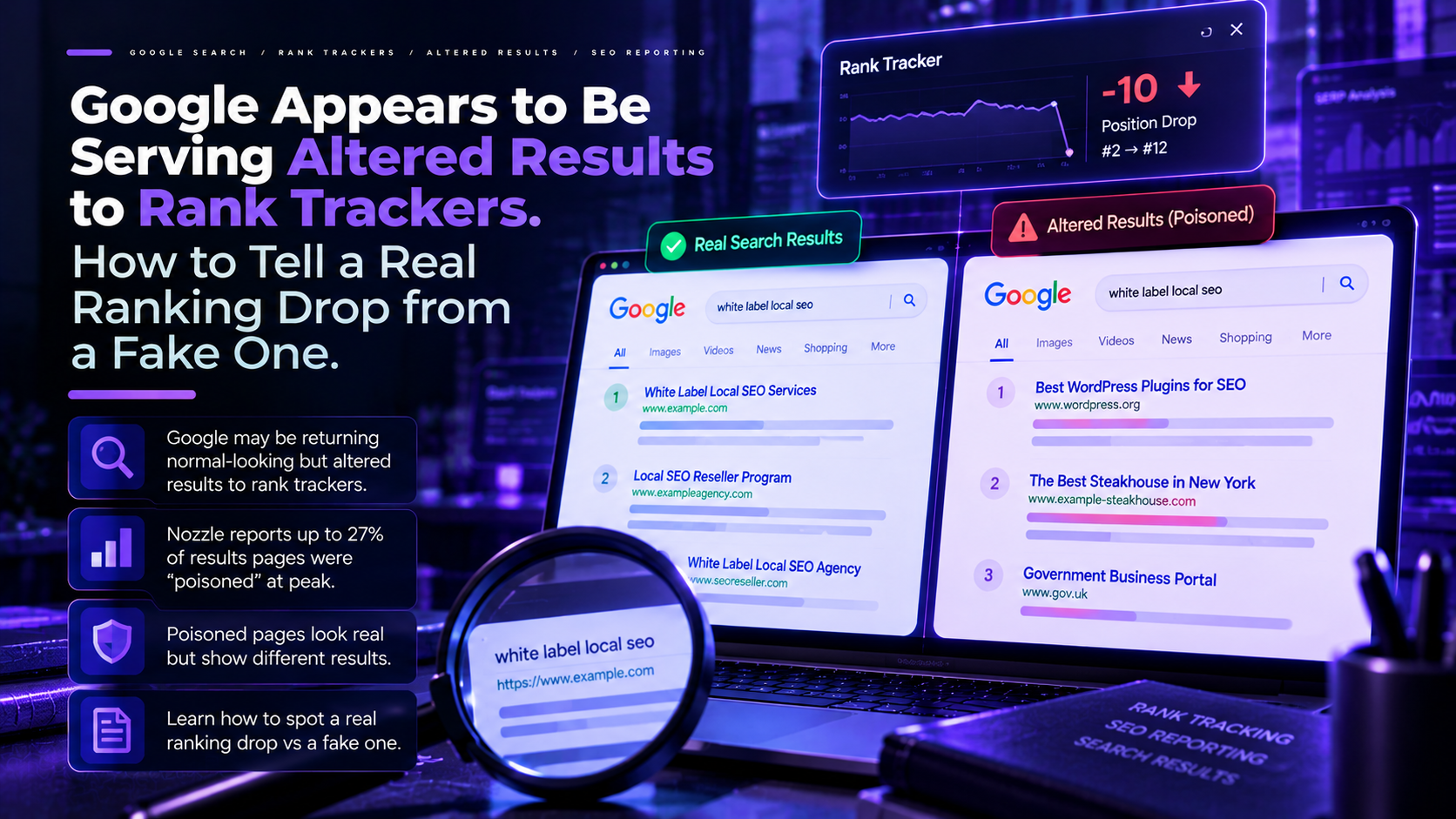
Picture a Monday morning report. Your rank tracker says a key page has fallen out of the top 10, and the pages that replaced it look unrelated. The usual reaction is to start rewriting. A new question belongs first: did the ranking change, or did the tool receive the wrong results page?
On October 10, 2026, the rank-tracking company Nozzle published research claiming that since September, Google has been returning complete, normal-looking results pages to its rank trackers with the real results swapped out. Nozzle sells rank tracking, and Google has not commented. This piece sets out what was reported, what is and is not established, and how to check before you react. It is written for teams responsible for search engine optimization reporting.
What Nozzle reported
Nozzle’s page analyzes 27.5 million search results pages from its customer datasets, collected between August 20 and October 9, 2026, across 49 countries, desktop and mobile.
From August 20 to September 9, about 0.17% of pages were poisoned, which is Nozzle’s baseline. On September 13, requests to Google began failing in large numbers. The first poisoned pages appeared on September 20. They peaked at roughly a quarter of all pages between September 27 and 29, at 24.9%, 26.7% and 27.0%. Since October 1, daily rates have run at about 4% to 11%. Across the period since September 13, Nozzle puts it at 8.0%.
The word poisoned matters. Google does not refuse these requests, according to Nozzle. It answers with a full page of wrong results. Nozzle puts it this way: “A poisoned request succeeds.” There is no error, no captcha and no change in the page template, so the only way to spot it is to compare a keyword’s results over time.
How it was measured, and a caution about the 8.0%
A keyword’s usual sites are those in the top 10 on at least 60% of its baseline pages. A page counts as poisoned when fewer than half of them appear on any page of the results, and they return later. Those thresholds are the study’s own choices.
Several limits apply. Detection is inferred from each keyword’s history, not from a signal Google has confirmed. The sample comes from Nozzle’s own customers, and the last few days are still filling in. And the headline 8.0% does not state its denominator: the daily table is labeled “All SERPs,” while the country and industry tables calculate against judged pages. Cite it as “Nozzle reports about 8%,” not as a measured rate of Google behavior.
What a poisoned page looks like
Nozzle reports these patterns on poisoned pages, compared with its baseline.
Organic results kept only 20.7% of the previous page’s sites, against 88.5% at baseline. A tracked project’s own site fell out of the top 10 on 58.6% of poisoned pages, against 2.7% at baseline. Reddit rose from 20.8% to 28.8% of top-10 appearances, and Facebook from 28.3% to 33.8%. An AI Overview appeared on 34.9% of poisoned pages, against 54.2%. Ads and shopping results were largely stable.
One example shows how complete the swap can be. For the desktop, US search “white label local seo,” all nine page-one sites on October 4 were the usual vendors. On October 7, all nine had been replaced by unrelated results, including a WordPress tool, a steakhouse and government sites.
The effect is usually brief. About 80% of poisoned spells lasted a single page, and 77.9% of poisoned pages had their usual sites back within three days. A real ranking change persists, which is how the two can be told apart.
Where it appears to hit hardest
Nozzle’s tables show wide variation. Since September 13, the poisoned share was 8.5% in the United States, 10.5% in Canada and 11.5% in Australia, with the United Kingdom lowest at 3.0%. Treat country figures as indications, since they depend on Nozzle’s sample sizes.
“Near me” searches were poisoned more often (11.4%) than other queries (7.8%), and navigational brand searches least often (5.3%). If you manage local SEO reporting, that is worth knowing.
By industry in the US, legal was highest at 15.9%, peaking at 51.3% on September 27. Pets was lowest at 4.3%. Firms in the legal sector should be the most careful about reacting to a single day.
The tools matter too. On the same days, one collection route returned 1% to 7% poisoned pages while another returned 9% to 30%, so how your vendor collects data affects what it sees.
A second vendor, and a reporter’s concern
Nozzle is not alone. DemandSphere, another rank-tracking company, posted on October 7 that Google returns spurious results when it suspects bot traffic, affecting about 11% of its daily results pages. PPC Land reported the figure on October 13. DemandSphere’s post does not describe a method or sample size. Both figures are vendor-reported and unaudited, and they agree on the mechanism and rough scale, little more.
Barry Schwartz of Search Engine Roundtable reported on October 12 that third-party rank tracking is returning incomplete or inaccurate data. He relayed the three tactics that Nozzle’s Derek Perkins described: wide IP blocking aimed at large residential proxy networks, a big increase in captchas, and injecting bad data into suspect pages. Schwartz singled out the third: “The third approach, injecting bad data, concerns me the most.” His reasoning is that tools may not notice it, so they can appear to work while their data is wrong. Several vendors, including Sistrix, SE Ranking and DataForSEO, reportedly posted notices about data problems.
What is not established
Google has not publicly commented on Nozzle’s or DemandSphere’s figures or on the September changes. Everything about motive comes from vendors and the trade press.
Nozzle reads the pattern as Google’s response to bulk collection of its results for AI grounding, which rank tracking resembles. DemandSphere’s founder makes a similar argument. Schwartz’s view, as reported, is that Google is aiming at AI bots and scraping services, not SEO tools. Roger Montti of Search Engine Journal adds that altered pages could also confuse spammers reverse-engineering rankings, a point Nozzle did not raise. None of these readings is confirmed.
There is also a confound. Google’s September 2026 spam update ran from September 24 to October 8, according to PPC Land and Looploop, so real ranking volatility and altered data overlapped in the same weeks. Our earlier piece on the September spam update covers the real-volatility side. A single dashboard showing a drop in that window could not tell the two apart.
Even first-party data can lag. Looploop reports that the Search Console Performance report ran more than 64 hours behind on October 11, so check the date range first.
How to tell a real drop from a poisoned page
Start with Search Console. If it still shows impressions and clicks for the same queries and dates, the site very likely did not drop. Confirm that its data is current first.
Compare against history. Look at the keyword’s usual top 10 over several weeks, not just yesterday, because yesterday may also have been poisoned.
Wait one to three days. Most altered pages clear quickly, while a real change persists.
Read the shape of the page. Nozzle says fewer AI Overviews, fewer “People also search for” modules, more image packs and social or forum sites, and shorter pagination are suggestive, but none is reliable alone.
Cross-check tools. A drop that only one tool reports is a question, not a conclusion.
Ask your vendor how it detects swapped pages and what its error rates are. Relevant Audience, citing PPC Land, reports that most do not yet publish comparable figures.
Hold off on changes. Do not rewrite pages from one chart. Our guide to reading your own traffic before you change anything sets out a three-step method that works here too.
What to change in your reporting
Make first-party data the reference. Search Console, analytics and conversions should anchor the monthly report, with the rank tracker used for trends. Our look at Google’s AI visibility reports in Search Console explains what that data does and does not include.
Set a rule for alerts. A drop seen on one day, in one tool, should trigger a check, not a client email. Require it to persist, or to appear in Search Console, before it is reported as a ranking loss.
Annotate your dashboards. Mark September 13 to October 9 as a period of suspected data problems, so later readers do not mistake a poisoned dip for a penalty.
Why this matters for AI search visibility
Nozzle’s data shows AI Overviews appearing less often on poisoned pages (34.9% against 54.2%). Any measurement that infers AI visibility from collected Google pages may pick up the same noise. That is our inference, not Nozzle’s finding, and tools that measure AI answers by other methods may behave differently.
The practical response is to avoid relying on one source. Generative engine optimization and answer engine optimization are about being cited and recommended in AI answers, and measuring that well means testing real buyer questions across several platforms, not reading a single scraped page. Keep the basics of generative engine optimization and answer engine optimization strong: clear answers, accurate information and consistent entities. Our complete guide to the AI Visibility Audit explains how that cross-platform measurement works. Strong search engine optimization remains the base for all of it.
Where this leaves you
The confirmed facts are these. Nozzle published research on October 10, 2026, covering 27.5 million results pages, and reports that since September 13 about 8.0% were poisoned, against 0.17% at baseline, with a peak near 27% in late September. DemandSphere reports about 11% on its own data. Google has not commented, the mechanism is Nozzle’s account, the motive is interpretation, and both figures come from vendors who sell rank tracking.
The lasting lesson is about method. A rank tracker is a sample of what Google returned to a tool, not a record of what your customers saw. Before reacting to a drop, check Search Console, compare with history, wait a few days and look at more than one source.
Frequently Asked Questions
1. What did Nozzle report about Google and rank trackers?
On October 10, 2026, Nozzle reported that since September, Google has returned complete, normal-looking results pages to rank trackers with the real results swapped out. It measured 8.0% of 27.5 million pages as poisoned since September 13, against 0.17% at baseline.
2. Has Google confirmed this?
No. Google has not publicly commented on Nozzle’s or DemandSphere’s figures or on the September changes. The explanations come from vendors and trade press.
3. Can I trust the 8.0% figure?
Treat it as Nozzle’s reported estimate. It is from a rank-tracking vendor and inferred from keyword history.
4. How do I know whether my ranking drop is real?
Check Search Console for the same queries and dates, compare with several weeks of history, and wait one to three days. Altered pages usually clear within days, while a real ranking change persists.
5. Does this affect Search Console data?
Nozzle’s study concerns data collected from Google results pages, not Search Console. Search Console can lag, though, so confirm the date range first.
6. Does this change how I should track AI visibility?
Tools that infer AI visibility from collected Google pages may pick up the same noise, which is our inference. Testing real buyer questions across several AI platforms does not depend on one scraped page.
7. Should I stop using my rank tracker?
No. Use it for trends, and confirm important changes in Search Console and analytics. Ask your vendor how it detects swapped pages and what its error rates are.
If you want to know how your brand appears across Google and AI answer engines, measured from real answers and not a single dashboard, that is exactly what we look at in a free AI Visibility Audit.

Related Reading
 Anthropic’s New Usage Policy Bars Using Claude to Plant Fake Sources for AI Answers. What It Means for Brand Mentions.
 The UK Regulator Wants AI Assistants Like ChatGPT on Google’s Search Choice Screens, With One Condition for Publishers.
 96% of IT Leaders Say Their AI Agent Inventory Is Complete. Two in Three Had an Agent Incident Anyway.
Recent Posts
 Google Is Testing AI Overviews Inside Local Business Profiles. What Local Businesses Should Check Now.
 Google Switched On Checkout Inside AI Mode for Eligible Shopify Stores. Here Is What It Changes for Your Measurement.
 Google’s September Spam Update Has a Two-Week Rollout Window, the Longest of 2026. Here Is What to Do While It Rolls Out.