
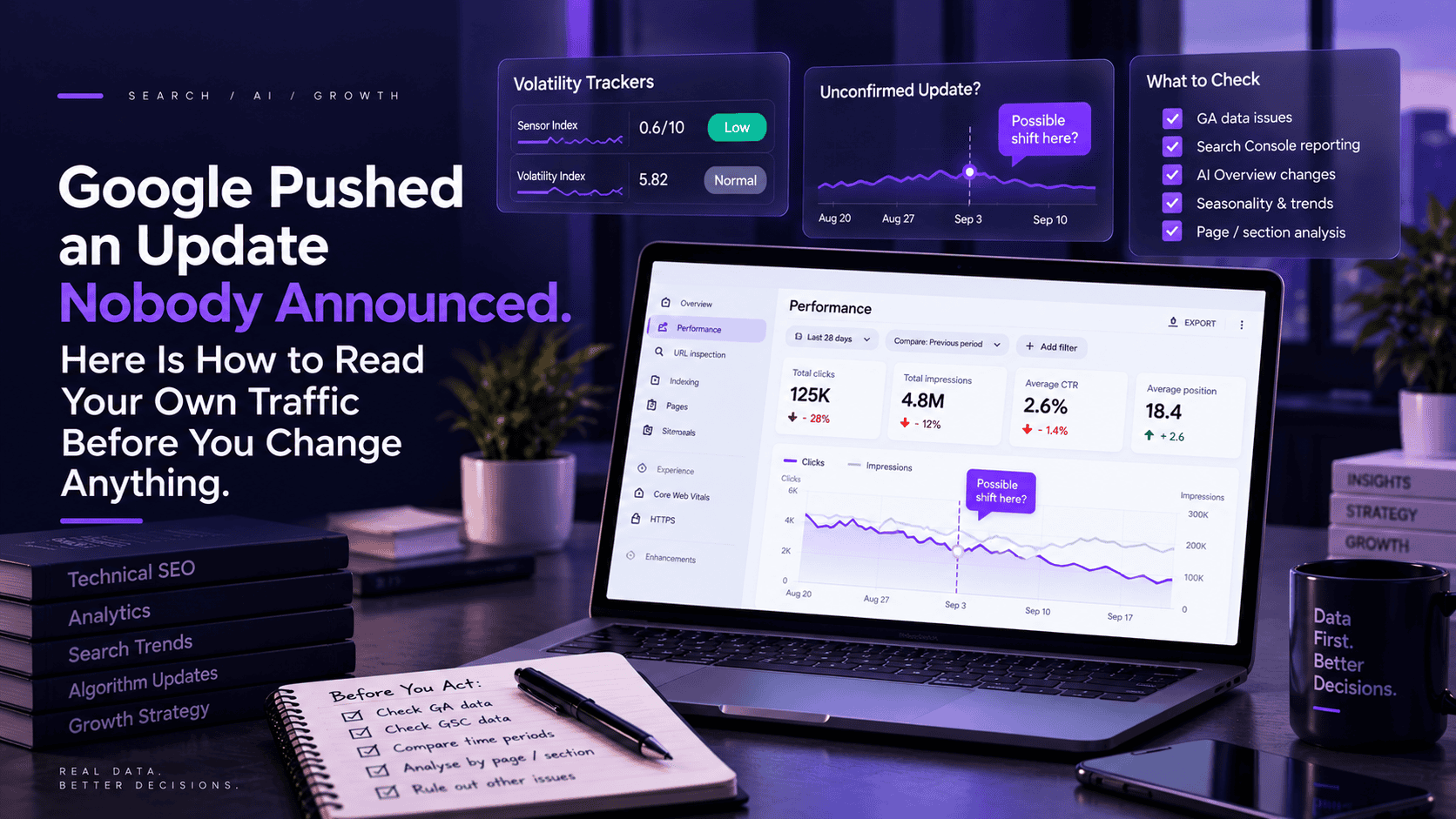
On September 12, Glenn Gabe posted something he’d sat on for a full day first, waiting for the data to firm up before going public. His read: an unconfirmed update rolled out in early September, sometime around the 3rd into the 4th. Marie Haynes reached the same conclusion independently, placing the shift closer to September 2. Two of the more measured, data-first voices in the SEO industry, arriving at the same window without coordinating, is not nothing.
Google has said nothing at all.
Here is the part that makes this genuinely confusing rather than simply another unconfirmed update: two days before Gabe and Haynes went public, a separate outlet checked the two most common volatility trackers and found almost nothing unusual. Semrush’s Sensor read 0.6 out of 10 on September 9, labelled Low. DataForSEO’s volatility index read 5.82 on September 8, a middling number with no sharp spike against its own recent baseline. Neither tool was flashing a warning.
So which is it. Did something real happen in early September, or did two respected analysts read noise into a quiet week that the aggregate trackers correctly saw as unremarkable.
Why the tools and the analysts can both be right
This isn’t actually a contradiction once you understand what each source is measuring.
Volatility trackers like Semrush Sensor and DataForSEO work by fingerprinting a large basket of tracked keywords and measuring how much the top results shuffle across that basket, in aggregate, across the whole web. That’s a genuinely useful signal for catching a broad core update. It is a much weaker signal for catching something narrower, a change that hits a specific content type, a specific vertical, or a specific query pattern hard while leaving most of the basket untouched.
Gabe and Haynes work differently. Their read comes substantially from looking at real client Search Console data directly, property by property. A shift that’s too narrow or too unevenly distributed to move an aggregate sensor can still show up clearly in the actual accounts they’re watching. This kind of week-to-week vigilance, checking real account data rather than waiting for a tool to flash red, is exactly what ongoing search engine optimization work is supposed to catch before a quiet shift turns into a real problem.
Neither approach is wrong. They’re measuring different things at different resolutions. Which means the honest starting position here is not “an update happened” or “an update didn’t happen.” It’s that something may have shifted for a meaningful subset of sites, without being broad enough to register clearly on tools built to catch a wide core update.
That distinction should change how you read your own data, not just whether you believe an update occurred. It also tells you something about which kind of site is more likely to feel this. A large publisher with thousands of tracked queries feeding into an aggregate sensor is exactly the profile a broad tool is built to catch. A smaller, more specialised site sitting in one content vertical is exactly the profile that can move meaningfully in its own Search Console data while barely registering on a basket built from the whole web. If you run a niche or narrowly scoped site, a quiet volatility sensor tells you less than it would for a large, broad publisher.
September has history, and that cuts both ways
Before assuming this fits a pattern, it’s worth knowing what the pattern actually is. Google’s confirmed rollout record shows real updates landing in or reaching into September repeatedly: an August 2025 spam update that ran all the way from August 26 through September 22, an August 2024 core update that carried into early September, a September 2023 helpful content update, and a September 2022 core update named for the month itself.
September is a genuinely plausible window for a rollout, based on that history. It is not, on its own, evidence that this specific unconfirmed shift is one. Google’s own recent cadence has been uneven, updates roughly 8 weeks apart at one point in 2026 and over 5 months apart at another. History tells you a September update wouldn’t be surprising. It doesn’t tell you this is one, and treating “September has a history” as confirmation is exactly the kind of shortcut that leads to premature action.
Rule out the boring explanations first
Before you treat a September dip as an algorithm story, rule out the things that look identical to one but aren’t.
Google Analytics reportedly showed missing data for September 1, including accounts reading zero users for part of that day. Separately, Google confirmed a brief Search Console indexing-reporting issue that existed and was resolved around September 9, with no exact start time given. Neither of these is a ranking change. Both can produce a chart that looks exactly like one if you’re only glancing at a dashboard rather than checking what’s actually being measured.
There’s a third confound worth naming: Google has also clarified how AI Overview impressions get counted inside Search Console, and average position no longer maps cleanly onto the old idea of ten blue links. This is precisely the shift that makes generative engine optimization and answer engine optimization work alongside traditional ranking now, not instead of it. A position metric that shifts because the reporting logic changed underneath it looks identical, on a graph, to a position metric that shifted because your rankings actually moved. And if a meaningful share of your queries now triggers an AI Overview that didn’t before, your click and position numbers can move for reasons that have nothing to do with a ranking algorithm changing at all.
There’s a fourth, narrower confound if a meaningful share of your traffic is European: separate reporting this same week covered changes to how Google’s results behave in the EU specifically. If your traffic is heavily skewed toward European markets, a regional change could easily be mistaken for a global algorithm shift when it’s actually confined to one geography.
Check these before anything else: was your reporting tool itself affected on the specific dates in question, is the change specific to position or AI Overview counted queries, does a large share of the affected traffic sit in Europe, and does the timing match a known reporting hiccup rather than the September 2-4 window Gabe and Haynes described.
Reddit is not a reliable second opinion here
If you go looking for corroboration in SEO forums, be careful what you count as confirmation. A review of early September threads across the main SEO communities found accounts that don’t cleanly agree with each other or with the Gabe/Haynes window. One report placed an initial drop on August 2-3, with a second decline on August 13, well before the window in question. Another, posted September 10, described clicks rising while impressions and position fell, a different pattern entirely, with no clear onset date attached. Cross-posted complaints without dated, corroborated specifics aren’t a second data point. They’re the same uncertainty wearing crowd.
How to actually read your own data
Once you’ve ruled out reporting glitches, the diagnosis comes down to three questions, in this order.
First, is the shift concentrated or spread out. Pull Search Console, filtered by page and by query, for September 2 through 8 against the week before. A decline that’s isolated to one content cluster or query type is a different problem than one that touches everything evenly. The former points toward something specific to that content. The latter points more toward something systemic, either on Google’s side or in a technical issue of yours.
Second, which metric actually moved. If clicks fell while impressions held steady, your visibility didn’t change, people just stopped clicking, which usually points to a SERP layout change or an AI Overview absorbing the click rather than a ranking loss. If impressions and clicks both fell while your average position held, Google is showing you for fewer queries than before, a relevance signal rather than a ranking signal. If position itself moved and the rest followed, that’s the pattern most people assume by default, and it’s worth confirming rather than presupposing.
Third, compare like for like. Use the same days of the week on both sides of the comparison, not a rolling seven days that happens to straddle a weekend dip. A lot of false alarms are just a Friday being compared against a Tuesday.
What not to touch until the picture is clear
The instinct to do something productive is exactly what causes the most damage here. Rewriting or gutting pages removes the version Google was already evaluating, so if this reverses on its own, you’ve destroyed the thing that would have recovered. Mass title tag edits add a new variable on top of an already unclear signal, and you won’t be able to tell which change caused which outcome. Filing a disavow request in response to a ranking dip is treating a possible relevance shift as a link penalty, which it almost certainly isn’t unless you have an actual manual action notice. And publishing new content quickly to “fill the gap” runs directly against whatever quality signal might be involved in the first place.
Every one of these actions makes sense emotionally and makes the diagnosis harder afterward.
When you actually have enough to act on
Give it a genuinely stable two-week window once volatility settles, not the first quiet Tuesday after a rocky week. Compare that window against the two weeks before September 2, same days, same metrics. If a clear, sustained pattern holds across that full window, you have something real to work from.
Then build the response around the specific pages and query clusters that actually moved, not the whole site. A shift this narrowly sourced, disagreed on even between two separate volatility tools, is unlikely to call for a site-wide response. It calls for a response scoped to wherever your own data actually shows movement.
Frequently asked questions
1. Is this a confirmed Google update?
Answer: No. Two independent, well-regarded analysts, Glenn Gabe and Marie Haynes, both reported evidence of an unannounced shift in early September, dated to roughly September 2 through 4. Google has not confirmed anything, and standard volatility trackers were reading low to moderate just before those reports went public.
2. Why did Semrush and DataForSEO not pick this up if something really happened?
Answer: Aggregate volatility tools measure shuffling across a large basket of tracked keywords site-wide across the web. A shift narrow enough to hit a specific content type or a specific set of properties hard, without moving the wider aggregate much, can be real and still not register clearly on those tools.
3. My traffic dropped around September 1. Is this the same thing?
Answer: Check your reporting tools before assuming so. Google Analytics reportedly had missing data for September 1, and a separate Search Console indexing-reporting issue existed and was resolved around September 9. Rule both out against your exact dates before treating a September 1 dip as part of this update.
4. How long should I wait before making changes?
Answer: At minimum, two full weeks of stable data after the volatility settles, compared against a matching two-week window before September 2. For an unconfirmed shift with no announced end date, waiting longer than you would for a named core update is the safer default.
5. What should I actually change if the pattern holds up after two weeks?
Answer: Only what your own segmented data points to. If the drop is concentrated in a specific content cluster or query type, address that cluster specifically. A site-wide response to a narrowly sourced shift usually does more harm than the shift itself.
If you want a second set of eyes on your own September numbers, whether the underlying issue is technical SEO, generative engine optimization, or plain reporting noise, that is exactly what we check in a free AI Visibility Audit.