Generative AI development builds custom models and applications that create text, images, code, or other content based on learned patterns, tailored to one specific business use case rather than a general-purpose tool. Most generative AI projects never leave the prototype stage, stalling before reaching production because the use case wasn't validated first. Foreignerds builds features that ship into production and hold up under real usage, not demos that stall in a slide deck.
Tell us what you're building — a real person replies within 1 business day, not an autoresponder.
And most agencies won't tell you that before they take your deposit. Our free Feasibility Scope tells you honestly whether your use case is a good fit, what it would actually take to build well, and where the real risk sits.
20 minutes. Zero cost. A real answer either way.
Get My Free Scope →A demo has to work once, on a good day, for people who already want to be impressed. A product has to work for a stranger, on a bad day, using ambiguous language, and it has to fail gracefully when it doesn't understand — not confidently make something up. That gap is where most generative AI projects actually die, and it's rarely about the underlying model. IEEE's 2026 global technology leadership survey found the largest share of organizations — 39% — now describe their generative AI adoption as "using regularly, but selectively."
There's a Real Gap Between a Generative AI Demo and a Generative AI Product. A demo has to work once, on a good day, for people who already want to be impressed. A product has to work for a stranger, on a bad day, using ambiguous language, and it has to fail gracefully when it doesn't understand — not confidently make something up. That gap is where most generative AI projects actually die, and it's rarely about the underlying model.
Before talking about what we build, it's worth being direct about what you might not need to pay anyone to build at all. If your need is genuinely simple — drafting emails, summarizing documents, brainstorming — an off-the-shelf tool like ChatGPT, Claude, or Gemini's paid tier likely already solves it, today, for the cost of a subscription. You don't need a developer for that.
Custom development starts making sense when: the generative capability needs to live inside your actual product, it needs to be grounded in your private data, it needs to integrate with your existing systems, or it needs guardrails and evaluation that an off-the-shelf tool doesn't give you control over. If none of those apply yet, save the budget and revisit this page when they do.
This applies whether you hire us or another agency. Ask every agency these questions before signing anything:
Full feature design and build around large language models for your specific product — defining the exact user interaction pattern (chat, inline suggestion, background generation), selecting the right foundation model for the task, building the prompt and context architecture around your product's actual data, and setting up output review before anything reaches a real user. Not a generic chatbot skin bolted onto your existing app, but a capability designed from the interaction pattern up.
End-to-end RAG builds: choosing and setting up a vector database, chunking and embedding your actual documentation or knowledge base correctly, building the retrieval logic that pulls the right context before generation, and tuning the system so answers are demonstrably grounded in your real data rather than the model's general training. This is the specific technical work that determines whether a generative feature is trustworthy or just plausible-sounding.
Structured generation workflows for teams producing content, copy, or creative assets at volume — including the prompt templates and style guides that keep output on-brand, a review and approval gate before anything publishes, and version tracking so you can see what was AI-assisted versus fully human-written. Built for teams that need real throughput, not a single demo prompt.
Adding generative capability to software you already have — auditing your current architecture to find the right integration point, building the feature with minimal disruption to what already works, setting up monitoring so you can see real usage and quality metrics after launch, and a clear rollback path if a feature underperforms in production.
Real, current research — not projections.
Generative AI spending has moved well past the experimentation phase. Menlo Ventures' enterprise research found generative AI spending reached $13.8 billion in 2024, a 6x increase over the prior year, with application-layer investment specifically growing 8x to $4.6 billion — a sign that budget is shifting from infrastructure experiments into shipped features. S&P Global Market Intelligence's Voice of the Enterprise research found 18% of organizations report generative AI fully integrated across their organization, a 5-point gain in just six months — while data quality and budget constraints remain the leading causes of AI projects being abandoned before launch.
Tell us what you're working with in one line — we'll take it from there.
This is a composite, illustrative example — not a specific client — to show what the process looks like end to end.
Say a mid-market SaaS company wants an in-product feature that lets customers ask natural-language questions about their own account data instead of digging through dashboards. Week 1 confirms this is a strong fit: the data is structured, the questions are answerable from real records, and there's a clear way to measure success (fewer support tickets asking the same questions). Weeks 2-3 design how the system retrieves the right account data before generating an answer, and what happens when a question falls outside what the data can answer — it says so plainly instead of guessing. Weeks 4-7 build against real customer data (anonymized for testing) and real question patterns pulled from actual support tickets, not synthetic examples. Week 8 launches to a small percentage of accounts first, with output quality monitored before a full rollout.
The point of walking through this isn't the specific feature — it's the shape: scope first, ground in real data, test against real scenarios, launch gradually with monitoring. That shape doesn't change much whether the use case is customer-facing, internal, or somewhere in between.
The same standard applied whether the project is a single feature or a company-wide rollout.
Diagnosing the real need before committing to the more expensive path by default.
Development against real data, with an evaluation framework built in from the start.
Rollout to a limited group first, output reviewed, before expanding.
Product description generation at catalog scale, personalized marketing copy, and AI-assisted visual merchandising.
First-draft generation for reports and research summaries, cutting blank-page time, with human review remaining the final gate.
In-product generative features — summarization, drafting, natural-language search — that become genuine differentiators.
Draft generation for structured documentation, with mandatory human review — never used for clinical or legal judgment.
Report summarization and internal knowledge search grounded in real, private data — never used to generate anything resembling financial advice.
Personalized learning content and adaptive practice material generated from a curriculum's actual source material.
A prototype that works for the CEO is not the same system as one that survives real users.
Deploying without measuring output quality means failures surface with customers, not testing.
Raw models with no retrieval on factual content produce confident, wrong answers.
A system with no graceful 'I don't know' path will hallucinate instead.
Evaluation and guardrails matter more than which model you pick.
Launching to 100% of users on day one turns any missed issue into a full incident.
Not sure if you're already making one of these?
That's Exactly What the Free Assessment Uncovers →Five honest signals — if two or more sound like you, custom development is worth scoping.
The real categories involved — not a build recipe, just enough to ask any agency the right questions.
Selected per project based on the task — not a fixed default stack.
None of these are permanent — they're just signs to fix first, before generative AI is the right next step rather than a wasted budget line.
Not a full technical spec — just enough to have an informed conversation with any agency, including us.
Still unsure what applies to your business?
That's Exactly What the Free Assessment Is For →Every number on this page is sourced — either from our own delivered work, or from named third-party research. Nothing here is invented to sound more impressive.
No pressure. The assessment and the first call are both free, with zero obligation.
15-20 minutes. Not an hour-long pitch. Here's exactly what we cover:
Not an hour-long pitch.
Whether generative AI is the right tool for your specific use case.
Not a forced yes — if it isn't a fit, we'll say so.
We don't list a price here for the same reason across every page: a number before real scoping is a guess. We're a service business, not a product with a SKU. A single in-product feature and an enterprise-wide generative AI rollout across a dozen products are not the same purchase, even though both start with this page.
That variation is real, not a hedge. An enterprise asking for generative capability across many products, each with its own data and evaluation needs, is a fundamentally different engagement than one team adding a single feature to one app. Pretending both fit one number would mean overcharging the small project or underscoping the large one.
The same standard most serious consulting and software engagements follow — not simplified to seem easier and not padded to seem more impressive.
Answer a few quick questions and we'll walk into the call already understanding what you need — not starting from scratch.
From AI voice outreach platforms to custom software and full-funnel marketing programs — every case study comes with numbers you can verify.
⟷ Drag to explore, or auto-scrolls — 100+ case studies live here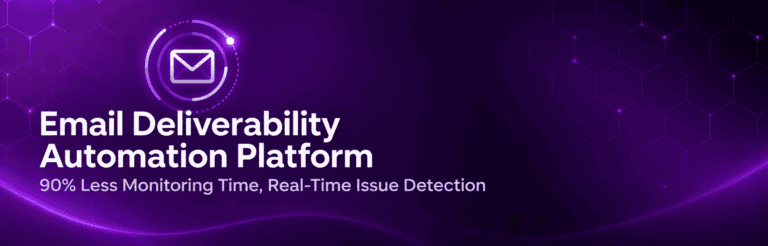
-90% Monitoring Time (15 hrs → 1.5 hrs)
View Case Study →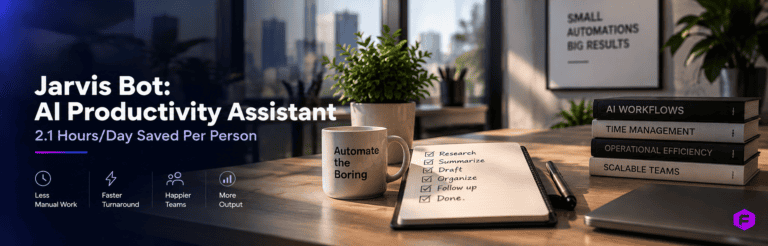
2.1 hrs Admin Time Saved Per Person/Day
View Case Study →
-70% Search Time Reduction
View Case Study →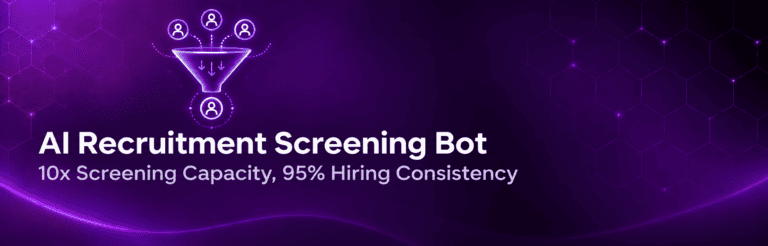
10x Screening Capacity Increase
View Case Study →
Yes, typically — you own the API relationship and the usage costs directly, we build the application layer on top.
We tell you directly on the free scope call, before any commitment, and suggest a better-fitting alternative.
Through retrieval grounding, evaluation frameworks, and confidence thresholds that trigger a fallback instead of a guess.
Most focused features take 6-10 weeks from scope to launch, depending on integration complexity.
You do, fully — confirmed in writing before the project starts.
Most generative AI features integrate directly into your existing product rather than living as a separate tool.
This is exactly what evaluation and grounding are designed to catch before launch — every system we build includes a defined fallback for genuine uncertainty.
We work across major providers — OpenAI, Anthropic, and others — and recommend the model that actually fits your use case.
Model API usage costs are separate from our development fee and billed directly by the provider to your own account.
Common situation. We audit what exists, diagnose whether the real gap is grounding, evaluation, or something else entirely.
Yes — documentation and a knowledge transfer session are part of every engagement.
Book the free Feasibility Scope call — we'll tell you honestly whether your use case is a good fit.
Retrieval-Augmented Generation — the model looks up real, relevant data before answering instead of relying purely on memory from training.
Yes — most real projects integrate directly with existing systems rather than replacing them wholesale.
It depends on scope — whether it needs custom grounding infrastructure, how complex the evaluation requirements are, and what it needs to integrate with.
Grounding data stays within your own infrastructure and access controls — the model retrieves from it, it doesn't get uploaded into a third-party training set.