Management consulting software and AI delivery systems support scoping, delivery, and pricing models for consulting firms moving away from hourly billing. Firms retaining hourly billing grew revenue just 2.1% annually, while those adopting value-based pricing models grew 8.7% — over four times faster. Foreignerds builds systems for that shift away from the billable hour, tracking outcomes clients actually pay for instead of hours logged.
Tell us what's going on — a real person replies within 1 business day, not an autoresponder.
That's precisely the trap. If a consultant completes a market analysis in 4 hours instead of 16, they deliver the same client value but bill 75% less under hourly pricing.
We build consulting infrastructure around the pricing-model shift itself — because the data is direct: firms that moved to value-based, fixed-fee, or subscription-advisory models grew revenue more than 4x faster than firms that kept billing by the hour while adopting AI underneath it.
Get a Real Assessment of Your Project →This is built for consulting firm partners and practice leaders confronting a genuine structural threat to their revenue model — AI compressing the hours the billable-hour model depends on — who need infrastructure supporting outcome-based pricing, not just faster delivery of the same hourly-billed work.
56% of professional-services firms report AI adoption, but only 24% have reached actual production deployment (Thomson Reuters' Future of Professionals Report 2025, 2,275 professionals) — a genuine, wide gap between experimentation and real operational integration.
78% of consulting professionals had used generative AI tools within 6 months of their availability (Accenture 2025 survey) — among the fastest individual-adopter rates of any professional-services segment. Gartner predicts 80% of the consulting workforce will use AI daily by 2026. The pricing-model divergence is the defining, dated data point: Deloitte's 2025 Professional Services Benchmark found firms retaining time-based pricing grew revenue 2.1% annually, while firms adopting value-based pricing models grew 8.7% — a more than 4x growth-rate gap directly attributable to how firms priced their AI-accelerated delivery, not to the AI itself.
It makes sense when: your firm still bills primarily by the hour while AI is measurably compressing the time your engagements require, creating the exact revenue-cannibalization risk Thomson Reuters describes as existential; your delivery infrastructure can't yet support fixed-fee, value-based, or subscription-advisory pricing models; or your current digital presence isn't showing up when prospective clients research consulting firms through AI assistants.
It's equally worth being honest about when this is premature. A very small, specialized consulting practice with deep relationship-based client work may get more value from foundational delivery-efficiency tools before restructuring pricing models entirely. A useful gut check: if you don't currently track engagement profitability with enough granularity to model a value-based alternative, pricing-model change without that visibility is a guess, not a strategy. What Happens If You Wait: There's no single dramatic failure point — most firms don't lose a specific client to a competitor's AI-driven pricing shift in a visible way. The gap compounds quietly instead: with only 18% of professionals saying their organizations track AI ROI at all, and 40% not knowing if it's measured, most firms are deploying AI without the visibility needed to know whether it's actually protecting or eroding revenue under their current pricing model. The client-expectation confusion is a live, current friction point: nearly 4 in 10 professionals surveyed report being told both to use AI and not to use AI on client matters, depending on the client — meaning firms without a clear, defensible AI-usage and disclosure policy are navigating real, inconsistent client expectations engagement by engagement, with no stable internal standard to fall back on.
Engagement-profitability and delivery-acceleration tooling built to support value-based pricing decisions, not just faster hourly-billed work. Selected from Foreignerds' full service catalog based on genuine Business & Management Consulting relevance — not a generic list reused across every industry page.
The research, data-gathering, and client-preparation work consuming 60-70% of consultant time, freed for genuine strategic client engagement. Custom Software Development & SaaS Development — delivery and engagement-management platforms built for fixed-fee and subscription-advisory pricing models.
Clear, documented AI-usage and disclosure policies addressing the real client-expectation inconsistency 4 in 10 professionals report. System Integration Services — connecting fragmented engagement, delivery, and financial data into one coherent operating system supporting pricing-model transition.
For consulting firms competing for B2B client acquisition. Generative Engine Optimization (GEO) & Answer Engine Optimization (AEO) — positioning for prospective clients researching consulting firms and specific practice-area capabilities through AI assistants.
A direct diagnostic of how your firm appears when potential clients ask AI assistants for consulting-firm recommendations. Reputation Management — directly material given how heavily trust and outcome credibility affect consulting-firm client acquisition.
Professional services automation (PSA) and engagement-management platform integrations. AI/ML platforms for research acceleration, data analysis, and client-preparation automation. Engagement-profitability and pricing-model analytics tooling. Consulting-firm-specific SEO, GEO, AEO, and AI Visibility Audit tooling.
The pricing-model shift is the real, documented lever: firms that moved to value-based pricing grew revenue 8.7% annually versus 2.1% for firms that kept hourly billing — a more than 4x growth-rate gap directly attributable to the pricing decision, not the AI itself.
Prospective clients evaluating consulting firms increasingly use AI assistants during vendor selection, following the same broader B2B research-behavior shift affecting professional-services procurement generally. This changes what needs to be true about a consulting firm's online presence. Traditional SEO optimizes to rank in search results for consulting services. GEO and AEO optimize for being the source an AI system cites or recommends when a prospective client asks about consulting capabilities in a specific practice area directly.
The consulting workforce is adopting AI faster than almost any professional-services segment measured.
The consulting workforce is adopting AI faster than almost any professional-services segment measured: 78% of consultants used generative AI within 6 months of availability, and Gartner projects 80% daily usage by 2026 — genuinely rapid, broad individual adoption.
But the structural business-model tension is the real story: the billable-hour model that has funded consulting firms for decades is directly threatened by the same AI capability driving adoption, and Deloitte's data shows the firms navigating this successfully aren't the ones adopting AI fastest — they're the ones that paired AI adoption with a genuine pricing-model shift, growing revenue more than 4x faster than firms that kept the old pricing model in place.
Tell us what's going on in one line — we'll take it from there.
Management consulting carries a lighter direct regulatory dimension than accounting or legal practice, but client confidentiality and NDA obligations apply to any AI system processing client data, and the broader professional-services trend toward E&O insurance AI exclusions (effective January 1, 2026) is relevant to consulting engagements involving AI-assisted deliverables. Firms serving regulated client industries (financial services, healthcare) inherit additional AI-governance expectations specific to those clients' compliance obligations.
This is a composite, illustrative example built from common, well-documented patterns in consulting AI deployment, not a specific named client.
A mid-size strategy consulting firm had adopted AI research and analysis tools broadly, cutting typical engagement research time significantly — but continued billing hourly, meaning the firm's own efficiency gains were directly reducing its own revenue per engagement.
Restructuring toward fixed-fee, outcome-based pricing for the same AI-accelerated deliverables — following the documented pattern behind the 8.7%-versus-2.1% revenue-growth divergence — captured the value of the efficiency gain instead of giving it away to clients for free.
Real delivery and pricing-model auditing, infrastructure built to support the pricing-model transition, plus ongoing pricing and delivery refinement and marketing.
Honest evaluation of current AI usage, engagement-profitability visibility, and readiness for a value-based or fixed-fee pricing transition.
Delivery-acceleration and engagement-management infrastructure built to support the pricing-model transition, not just faster hourly-billed work.
Continuous refinement of pricing and delivery models, plus client-acquisition marketing — including GEO/AEO.
Pricing-model transition and engagement-profitability tooling are the primary current levers.
Deep practice-area expertise combined with AI-driven delivery efficiency, distinct from generalist firm needs.
A genuinely distinct sub-vertical given the direct overlap between the consulting service and the AI technology itself.
Capacity-multiplication and value-based pricing infrastructure at a scale appropriate for individual practitioners.
Portfolio-wide standardization of AI-usage policy and pricing-model transition across many practice areas.
Directly cannibalizing revenue under the current billing model.
The current state for the large majority of firms, meaning most can't actually tell whether AI adoption is helping or hurting the bottom line.
Engagement by engagement, instead of establishing a clear, defensible firm-wide policy.
Rather than the pricing-model question the data shows it actually is.
Required to credibly transition to value-based or fixed-fee pricing.
Evaluating consulting firms, even as B2B procurement research shifts toward AI-assisted evaluation broadly.
Selected per project based on the task — not a fixed default stack.
Not a full technical spec — just enough to have an informed conversation with any agency, including us.
If two or more of these are true, this is very likely worth exploring.
These four questions are worth answering honestly before any AI investment — the audit will help you answer them with certainty.
We don't list a price here for the same reason across every page: a number before an assessment is a guess, and for consulting firms specifically, scope depends heavily on firm size and current pricing-model complexity. Your actual scope will determine cost after the audit.
Claim Your Free Business & Management Consulting AI Visibility Audit
Yes — real integration work is core to these projects. Scope depends on your specific platform.
Under hourly pricing, yes — that's the documented risk. The real fix is pairing AI adoption with a pricing-model shift, which the data shows grows revenue more than 4x faster than keeping hourly billing unchanged.
Pricing-model-aware development, not standard project-management functionality that ignores the specific revenue risk AI creates for hourly-billed firms.
This is common, and a legitimate starting point — building that visibility is usually the necessary first step before a credible pricing-model transition, and we'll say so honestly during the audit.
Depends heavily on firm size and current pricing-model complexity — the audit in Week 1 gives an honest, specific timeline.
Yes — the sub-vertical breakdown above reflects genuinely different needs and scale we scope separately.
A real, documented, industry-wide issue — nearly 4 in 10 professionals report exactly this — and we help build a clear, defensible policy you can adapt per client rather than navigating it ad hoc.
Yes — this is a real, documented gap, since only 18% of professionals say their organizations track AI ROI at all, and we build measurement into any AI deployment from the start.
Deloitte's 2025 Professional Services Benchmark found firms adopting value-based pricing grew revenue 8.7% annually versus 2.1% for firms keeping time-based pricing — a real, more than 4x growth-rate gap tied directly to the pricing decision, not the AI itself.
Very fast — Accenture's 2025 survey found 78% of consulting professionals had used generative AI tools within 6 months of their availability, among the fastest individual-adopter rates of any professional-services segment measured.
GEO is optimizing your content so AI systems cite or recommend your firm directly when a prospective client researches consulting capabilities.
AEO structures your content to be pulled as a direct answer by AI-driven search features during consulting-firm research.
A direct diagnostic of whether and how your firm currently appears when a prospective client asks an AI assistant for consulting recommendations in your practice area.
Increasingly yes, following the same broader B2B research-behavior shift affecting professional-services procurement generally.
Directly — trust and outcome credibility matter significantly in consulting selection, and AI systems weigh these signals when forming recommendations.
Yes — this shift is broad-based, and smaller firms invisible to AI discovery risk losing exactly the client consideration set larger firms are already capturing.
Through recurring AI Visibility Audits tracking citation and recommendation frequency, alongside traditional client-acquisition metrics.
Yes, under one roof — delivery automation, pricing-model support, SEO, GEO/AEO, and AI Visibility auditing together.
Not anymore — consulting-firm research behavior is shifting broadly, following the same pattern seen across other professional services.
Book a call — the audit gives you an honest picture of your current pricing-model risk, AI-usage governance, and AI search visibility.
Real projects. Real, sourced results.
Delivered consulting, professional-services, and broader AI work sits alongside our 1,250+ project history — verifiable, not invented, and available to discuss specifically on the call.
15-20 minutes, focused on your actual situation, not a generic pitch.
15-20 minutes, focused on your actual situation, not a generic pitch.
We tell you honestly if foundational work needs to happen before AI adds real value.
You leave with a specific, scoped next step — not a vague proposal.
100+ case studies live here

-90% Monitoring Time (15 hrs → 1.5 hrs)
View Case Study →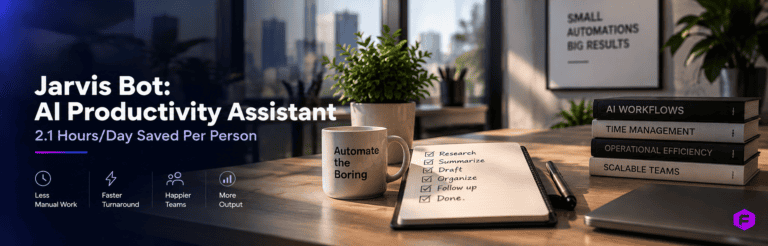
2.1 hrs Admin Time Saved Per Person/Day
View Case Study →
-70% Search Time Reduction
View Case Study →
10x Screening Capacity Increase
View Case Study →