Handyman business software and AI lead qualification handle scheduling, quoting, and follow-up for variable job types. The broader U.S. home maintenance services market is valued at $543 billion, with lead aggregators like Angi and Thumbtack charging 40-50% of job value. Foreignerds builds systems that reduce that dependency on paid lead platforms.
Tell us what's going on — a real person replies within 1 business day, not an autoresponder.
Job types range enormously in scope, value, and profitability, and without genuine qualification, a business can spend as much time on a low-value job as a high-value one.
We build handyman business systems around that specific variability — because efficient lead qualification, not just lead volume, is what actually determines profitability in a trade where job types and values swing this widely from one call to the next.
Get a Real Assessment of Your Project →This is built for handyman business owners juggling a genuinely wide, unpredictable range of small job types, who need AI infrastructure that qualifies and prioritizes leads efficiently rather than treating every inquiry the same regardless of job scope or profitability.
The broader U.S. home services market is valued at over $600 billion (Valve+Meter, 2025-2026), growing 7-9% annually, with handyman services positioned within the repair-and-maintenance segment that includes plumbing, electrical, HVAC maintenance, and appliance repair.
More than 90% of homeowners read reviews before choosing a contractor, and businesses with 4+ star ratings earn 32% more revenue than 3-star competitors (Valve+Meter) — directly material for handyman businesses given how much trust matters for a category defined by small, varied jobs often requiring repeat homeowner engagement over time for future projects. AI adoption accelerates broadly across home services (chatbots, estimate tools, lead scoring, predictive analytics), and lead aggregators like Angi, Thumbtack, and HomeAdvisor are losing relevance as smarter contractors shift spend to owned channels and Google — a real, current shift directly relevant to handyman businesses, which have historically relied heavily on these aggregator platforms.
It makes sense when: your business currently treats every lead identically regardless of job scope, missing the efficiency gains real qualification could provide; you rely heavily on lead aggregators (Angi, Thumbtack, HomeAdvisor) and want to shift toward owned-channel acquisition as the broader trade is documented doing; or your current digital presence isn't showing up when homeowners research handyman services through AI assistants.
It's equally worth being honest about when this is premature. A very small, solo-operator business with a manageable, referral-based job flow may get more value from foundational scheduling tools before investing in advanced AI-driven lead-qualification infrastructure built for higher volume. A useful gut check: if you're not currently overwhelmed by low-value or poorly-matched leads, qualification infrastructure may be less urgent than other priorities. What Happens If You Wait: There's no single dramatic failure point — most handyman businesses don't lose a specific job to poor qualification in a visible way. The gap compounds quietly instead: time spent on low-value, poorly-matched jobs is time not available for higher-value work, and without systematic qualification, that inefficiency persists call after call without ever becoming visible as a single dramatic loss. The aggregator-dependency risk is a live, current cost: paying 40-50% of job value to lead aggregators, as is common in this trade, is a real, ongoing margin cost — every month without a genuine owned-channel and AI-search-visibility strategy is a month of continued dependency on the aggregator margin the broader industry is documented moving away from.
Lead capture with genuine job-scope qualification, prioritizing calls by real fit and value rather than treating every inquiry identically. Selected from Foreignerds' full service catalog based on genuine Handyman Services relevance — not a generic list reused across every industry page.
Scheduling and job-tracking automation built for genuinely variable job types and durations. Custom Software Development & System Integration Services — licensing-threshold-aware quoting systems helping you identify when a job requires general contractor licensure.
Owned-channel content built to reduce dependency on lead aggregators charging 40-50% of job value. SEO & Local SEO — critical given how heavily local search drives handyman customer acquisition, and the documented shift away from aggregator platforms.
Positioning for homeowners researching handyman services through AI assistants directly. AI Visibility Audit — a direct diagnostic of whether your company appears when homeowners ask AI assistants for handyman recommendations.
For handyman advertising budgets shifting from aggregator spend toward owned-channel acquisition. Reputation Management — directly material given the documented 32% revenue premium for 4+ star businesses in a trust-dependent, small-job category.
Field service management and job-tracking platform integrations. AI voice/chat systems for lead capture with job-scope qualification. Licensing-threshold-aware quoting and scope-tracking tooling. Handyman-specific SEO, Local SEO, GEO, AEO, AI-Powered PPC, and AI Visibility Audit tooling.
The qualification pattern is the real, documented lever: aggregators can charge 40-50% of job value, and businesses with 4+ star ratings earn 32% more revenue — genuine qualification and owned-channel growth directly protect margin in a category with historically thin margins.
Homeowners researching handyman services increasingly use AI assistants for initial research, following the same broader consumer research-behavior shift affecting home-services selection generally. This changes what needs to be true about a handyman business's online presence. Traditional SEO optimizes to rank in local search results. GEO and AEO optimize for being the source an AI system cites or recommends when a homeowner asks about a small home-repair task or searches for a handyman directly.
The broader industry shift away from lead aggregators toward owned channels and Google is directly, particularly relevant to handyman businesses.
The broader industry shift away from lead aggregators (Angi, Thumbtack, HomeAdvisor) toward owned channels and Google is directly, particularly relevant to handyman businesses, which have historically relied heavily on these platforms given the category's traditionally lower average job values and thinner margins.
AI-driven lead scoring and estimate tools are accelerating broadly across home services — for a trade defined by genuinely variable job types and values, the real, current opportunity is in AI-driven qualification specifically, distinguishing high-value, well-matched jobs from low-value inquiries before committing scheduling and quoting time.
Tell us what's going on in one line — we'll take it from there.
Handyman licensing requirements vary significantly by state and often by job-value threshold — many states require a general contractor license once job value exceeds a specific dollar amount, meaning handyman businesses need clear systems for identifying when a job crosses into licensed-contractor territory. AI-driven lead-qualification and scheduling systems should account for these real, jurisdiction-specific and job-value-specific licensing boundaries.
This is a composite, illustrative example built from common, well-documented patterns in handyman-business AI deployment, not a specific named client.
A mid-size handyman business relied heavily on lead-aggregator platforms, paying a substantial share of each job's value in referral fees, while also lacking systematic qualification to distinguish high-value project work from low-value, less-profitable small jobs.
Building AI-driven lead capture with genuine job-scope qualification, alongside owned-channel content and local search visibility work, reduced aggregator dependency over time while improving the average value and fit of jobs the business actually booked.
Real job-mix and channel auditing, AI-driven lead capture with genuine job-scope qualification, plus ongoing monitoring and marketing.
Honest evaluation of current lead sources (aggregator vs. owned), typical job-value distribution, and qualification gaps.
AI-driven lead capture with genuine job-scope qualification, integrated with existing scheduling systems, alongside owned-channel content development.
Continuous qualification refinement, plus local, owned-channel-focused marketing — including GEO/AEO.
Genuine job-scope qualification matters most given the widest range of job types and values.
Higher-value jobs closer to the general-contractor licensing threshold, requiring careful scope tracking.
A genuinely distinct sub-vertical given recurring, contract-based relationships with property managers.
A distinct, often higher-margin niche (furniture assembly, TV mounting, smart home installation).
A growing, distinct sub-segment given rising demand for aging-in-place modifications.
Regardless of job type, scope, or value, wasting time on poorly-matched jobs.
Charging 40-50% of job value without building owned-channel capability alongside.
And inadvertently taking on jobs that require general contractor licensure.
Despite the documented 32% revenue premium for 4+ star businesses.
And estimate tools that competitors are already adopting.
Researching handyman services, even as this pattern shifts broadly across home services.
Selected per project based on the task — not a fixed default stack.
Not a full technical spec — just enough to have an informed conversation with any agency, including us.
If two or more of these are true, this is very likely worth exploring.
These four questions are worth answering honestly before any AI investment — the audit will help you answer them with certainty.
We don't list a price here for the same reason across every page: a number before an assessment is a guess, and for handyman businesses specifically, scope depends heavily on current job-mix and aggregator dependency. Your actual scope will determine cost after the audit.
Claim Your Free Handyman Services AI Visibility Audit
Yes — real integration work is core to these projects. Scope depends on your specific platform.
It's a real, common starting point, and not something we'd push you to abandon abruptly — the opportunity is building owned-channel capability alongside it, reducing dependency on platforms charging 40-50% of job value over time.
Qualification-first development, not standard SEO/PPC functionality that generates leads without distinguishing high-value, well-matched jobs from poor fits.
Yes — this is exactly the problem genuine qualification systems solve, distinguishing job scope and value before committing scheduling time, rather than generic lead-scoring built for more uniform trades.
Depends on current job mix and aggregator dependency — the audit in Week 1 gives an honest, specific timeline.
Yes — the sub-vertical breakdown above reflects genuinely different needs we scope separately.
Yes — genuine job-scope qualification at the lead-capture stage is a direct, measurable lever for improving the average value and fit of jobs you book.
We help build quoting systems that flag when a job's value approaches your state's licensing threshold, helping you avoid inadvertently operating outside your handyman license's scope.
7-9% annually, with the market topping $600 billion in 2024 (Valve+Meter, 2025-2026) — genuine, sustained growth handyman businesses sit within.
It's real and documented — smarter contractors are shifting spend to Google Ads and owned channels specifically because aggregators can charge 40-50% of job value, a cost structure increasingly hard to justify.
GEO is optimizing your content so AI systems cite or recommend your company directly when a homeowner asks for handyman help with a specific task.
AEO structures your content to be pulled as a direct answer by AI-driven search features during handyman-provider research.
A direct diagnostic of whether and how your company currently appears when a homeowner asks an AI assistant for handyman recommendations.
Increasingly yes, following the same broader consumer research-behavior shift affecting home-services selection generally.
Directly — trust matters significantly given the small, in-home nature of this work, and AI systems weigh review sentiment heavily when forming recommendations.
Yes — this shift is broad-based, and smaller businesses invisible to AI discovery risk losing exactly the increasingly AI-informed homeowners now researching this way.
Through recurring AI Visibility Audits tracking citation and recommendation frequency, alongside traditional local-lead-generation metrics.
Yes, under one roof — lead qualification, owned-channel content, SEO, GEO/AEO, and AI Visibility auditing together.
Not anymore — homeowner research behavior is shifting broadly, following the same pattern seen across other home-services categories.
Book a call — the audit gives you an honest picture of your current job-mix, aggregator dependency, and AI search visibility.
Real projects. Real, sourced results.
Delivered handyman, home-services, and broader AI work sits alongside our 1,250+ project history — verifiable, not invented, and available to discuss specifically on the call.
15-20 minutes, focused on your actual situation, not a generic pitch.
15-20 minutes, focused on your actual situation, not a generic pitch.
We tell you honestly if foundational work needs to happen before AI adds real value.
You leave with a specific, scoped next step — not a vague proposal.
100+ case studies live here

-90% Monitoring Time (15 hrs → 1.5 hrs)
View Case Study →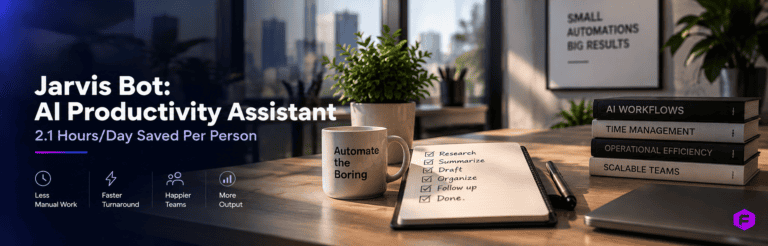
2.1 hrs Admin Time Saved Per Person/Day
View Case Study →
-70% Search Time Reduction
View Case Study →
10x Screening Capacity Increase
View Case Study →