Month: September 2026

What AI Agents Actually Do — and Where Businesses Get the Adoption Wrong

An AI agent is an autonomous software system powered by a language model that can use tools and run in a loop to accomplish multi-step goals without continuous human prompting. Unlike a chatbot that only replies with text, an agent observes its environment, plans a sequence of steps, takes action through connected tools, and reflects on the results before continuing — a cycle it repeats until the task is actually finished.
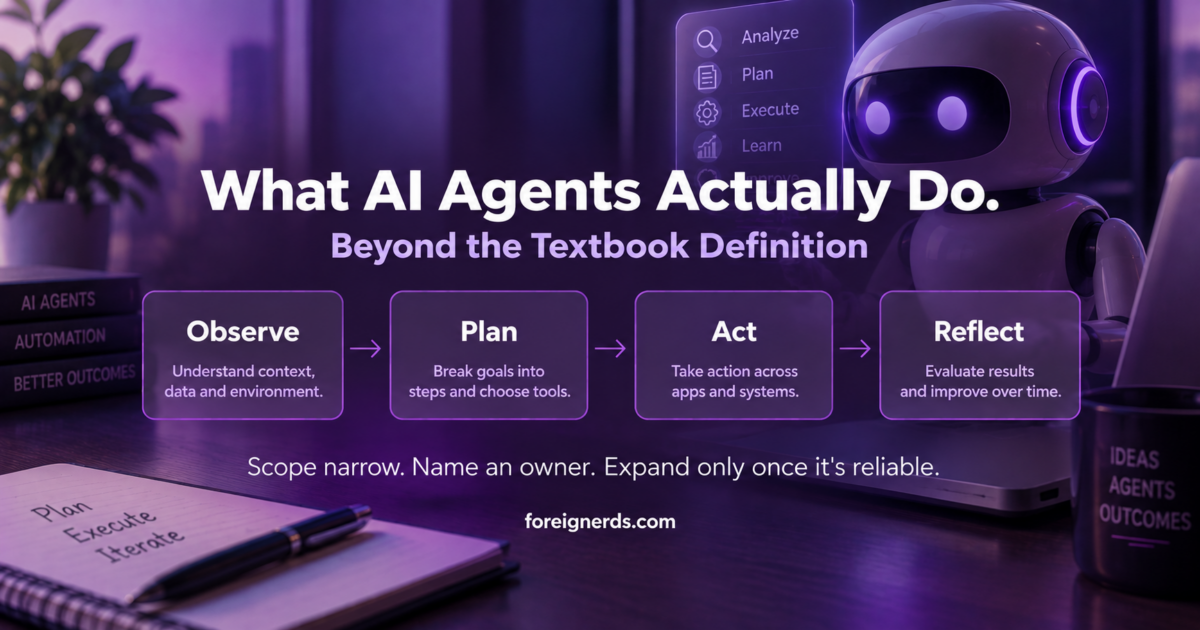
The AI agent action loop: observe, plan, act, reflect

Why the Textbook Definition Isn’t the Hard Part

IBM, Google Cloud, and AWS all publish clear, accurate explanations of what an AI agent is, and there’s no reason to repeat that ground here. The definition isn’t where businesses actually get stuck. The hard part is what happens after a team understands the concept and tries to actually deploy one — and that’s the part almost nothing written about AI agents addresses honestly.

The Four Real Components, and Where They Actually Break

Every AI agent is built from the same four pieces, and understanding where each one tends to fail in practice matters more than understanding the architecture in the abstract:

  • The foundation model — the language model handling comprehension and decisions. This is rarely where things break; current models are capable enough for most real business tasks.
  • The harness — the application wrapper connecting the model to tools, files, and systems. This is where most real failures happen — a poorly scoped harness gives an agent either too much access (a genuine risk) or too little to actually complete its job.
  • Memory — short and long-term context retention across steps. Agents that lose context mid-task produce the “it forgot what it was doing” failures that are the most common complaint from early deployments.
  • The action loop — observe, plan, act, reflect, repeat. An agent with no meaningful reflection step will confidently repeat the same mistake in a loop rather than catching and correcting it.

Most public discussion of AI agents focuses on the foundation model, since that’s the most visible and most marketed piece. Most real deployment problems live in the other three.

What “Autonomous” Actually Means in Practice — and What It Doesn’t

The word “autonomous” gets used loosely, and it’s worth being precise about what current AI agents genuinely do without supervision versus what they don’t. A well-built agent can genuinely execute a multi-step task without a human approving each individual step — searching for information, calling an API, checking the result, adjusting its approach, and repeating until done. What it generally shouldn’t do without a defined checkpoint is take an irreversible, consequential action on its own: sending a customer communication, making a purchase, deleting data, or changing a production system. The businesses getting real value from agents right now draw this line deliberately — full autonomy for reversible, low-stakes steps; a human checkpoint before anything consequential.

The Five Types Worth Knowing, Briefly

AI agents aren’t one category with uniform capability. A few distinctions genuinely matter when evaluating what to deploy:

Type What it does Typical use
Simple reflex agents Reacts to current input only, no memory of past state Basic automated responses, simple triggers
Model-based agents Maintains an internal model of its environment to inform decisions Tasks requiring context awareness across steps
Goal-based agents Plans a sequence of actions toward a defined goal Multi-step research or task completion
Utility-based agents Weighs multiple possible outcomes and picks the best one, not just any workable path Decisions with tradeoffs, not just a single correct answer
Learning agents Improves its own performance over time from feedback Long-running systems that need to adapt, not just execute a fixed process

Most business use cases today genuinely need only a goal-based agent with solid memory — the more advanced categories matter less for practical adoption than the marketing around “advanced AI agents” sometimes implies.

Is ChatGPT an AI Agent?

Not by itself, and this distinction trips up a lot of early conversations about adoption. ChatGPT, used as a chat interface, is a conversational assistant — it responds to prompts but doesn’t independently observe an environment, plan multi-step actions, or loop until a goal is complete without a person driving each turn. The same underlying model becomes part of a genuine agent once it’s placed inside a harness that gives it tools, memory, and an action loop — which is exactly why “AI agent” describes a system architecture, not a specific product. This distinction matters practically: a business asking “should we use an AI agent” is usually really asking whether their task needs that full observe-plan-act-reflect loop, or whether a simpler conversational tool already solves the actual problem at hand.

What Realistic Deployment Actually Looks Like, Month by Month

Based on how the narrow-scope-first approach described above typically plays out, a realistic timeline for a business’s first genuine agent deployment looks less dramatic than most vendor pitches suggest. The first few weeks go into defining the single narrow task precisely enough that “done” is unambiguous — this step gets rushed constantly, and rushing it is the single biggest predictor of a failed first deployment. The following few weeks are spent building and testing the harness against real data, not a clean demo scenario, since real business data is messier than whatever the agent was tested against initially. Only once that narrow version runs reliably, unsupervised, for a meaningful stretch does it make sense to either expand its scope or hand off a second narrow task to a second agent. Businesses that skip straight to an ambitious, broad deployment on their first attempt are the ones most likely to end up disillusioned with the technology within a quarter, not because the technology failed, but because the scope was wrong from the start.

Where Businesses Actually Get Value Today

Stripped of the more speculative framing common in AI agent coverage, the genuinely proven use cases right now cluster around a handful of patterns: research and information-gathering tasks that would otherwise take a person an hour of manual searching and cross-referencing; repetitive multi-step workflows with clear success criteria (data entry across systems, structured report generation, first-pass customer support triage); and monitoring tasks where an agent watches for a condition and takes a defined action when it occurs, rather than requiring someone to check manually. The common thread across all three: a clearly defined “done” state. Agents perform well when success is checkable. They perform poorly on open-ended, judgment-heavy work with no clear finish line.

The Adoption Mistake Showing Up Most Often

Starting broad instead of narrow

The most common early mistake isn’t technical — it’s scope. Teams excited about agent capability often start with an ambitious, broad goal (“manage our entire customer onboarding process”) rather than a narrow, well-defined one (“check for incomplete onboarding forms daily and send a specific reminder email”). The narrow version ships in days, works reliably, and builds real trust in the technology. The ambitious version usually stalls in development for months and, even when it ships, fails unpredictably in ways that are hard to debug because too many decisions were left to the agent’s judgment at once.

The practical fix

Consistent with how the same principle plays out in agent governance: start with the narrowest version of the task that still delivers real value, get it running reliably, and only then expand its scope — not the reverse.

Build vs. Buy: The Decision Most Teams Face First

Before writing any code, most teams should genuinely ask whether an existing agent platform already solves their specific need, rather than defaulting to a custom build. This decision deserves its own careful evaluation — the full build-vs-hire breakdown covers the actual tradeoffs in depth, including when an off-the-shelf agent platform is genuinely sufficient and when the specific integration needs justify a custom build instead.

What This Means for a Business Evaluating Agents Right Now

The technology is real and the proven use cases are genuinely valuable, but the gap between “AI agents are transformative” (true, eventually, for the right tasks) and “deploy one for your entire operation this quarter” (usually a mistake) is where most disappointment comes from. The businesses seeing real results share a pattern: they picked one narrow, checkable task, defined exactly where human judgment stays in the loop, and expanded only after the narrow version proved reliable. That’s a less exciting story than the broader promise of autonomous AI, but it’s the one that actually produces working systems rather than abandoned pilots.

Named Entities Worth Understanding If You’re Evaluating Vendors

A handful of terms come up repeatedly in agent-platform conversations and are worth knowing precisely: an orchestration layer coordinates multiple agents working on related sub-tasks, relevant once a business moves beyond a single narrow agent to several working together. A tool call is the specific mechanism by which an agent invokes an external function — a search, an API request, a code execution — and is the actual point where most security and access-scope decisions live. Grounding refers to connecting an agent’s reasoning to real, current data rather than relying solely on what a model learned during training, which matters enormously for any task involving facts that change over time. None of these terms are marketing buzzwords on their own — they describe real architectural decisions that determine whether a given agent platform fits a specific need, and a vendor conversation that never touches any of them specifically is worth treating with some skepticism.

Security and Access: The Question Most Pitches Skip

Because an agent’s harness determines what it can actually touch, the access-scoping decision is arguably the single most consequential technical choice in any deployment, and it’s the one most vendor demos gloss over entirely. A narrowly scoped agent — read access to a specific data source, write access to exactly one downstream system, nothing more — fails safely even when something goes wrong; the worst case is a task that doesn’t complete. A broadly scoped agent with wide system access can fail in ways that are much harder to contain, precisely because the same flexibility that makes it capable also makes an error more consequential. This is the practical version of the same principle covered in more depth in agent governance: access should be granted deliberately, tied to the specific task, and reviewed periodically — not granted broadly upfront because it’s more convenient during initial setup.

How to Tell If Your Team Is Actually Ready

Before evaluating specific tools or platforms, a short internal check is more useful than any vendor comparison: Is there one specific, narrow task identified, with a clear definition of “done”? Is there a named person who will own the agent once it’s live, the same way any new system needs an owner? Has someone mapped exactly what data or systems the agent needs to touch, and confirmed that scope is as narrow as it can be while still completing the task? And is there a plan for what happens when the agent gets something wrong — not if, when, since even well-built agents make mistakes on real-world edge cases? A team that can answer all four concretely is genuinely ready to move forward. A team that can’t is better served spending another week on definition before writing any code or signing any contract.

Where This Connects to a Real Deployment

Everything above is the evaluation and planning layer. Once a team has a narrow task defined, an owner named, and access scope mapped, the actual build is where AI agent development work happens — and it’s worth bringing that expertise in at the planning stage rather than after a first attempt has already gone sideways from unclear scope. The access-scoping discipline described above also connects directly to how AI security thinking applies more broadly — an agent with excessive permissions is a security question as much as an architecture one, and the same principles that govern AI-driven threat detection apply to scoping what an agent is allowed to touch.

The pattern holds across all of it: definitions are cheap to find, and every major cloud provider has written a good one. What actually determines whether an agent deployment succeeds is the unglamorous work — scoping the task narrowly, naming an owner, mapping access deliberately, and testing against real conditions before expanding. That discipline, not the underlying model, is what separates a working agent from an abandoned pilot.

Key Takeaways

  • An AI agent observes, plans, acts through tools, and reflects in a repeating loop until a task is done — different from a chatbot that only replies to prompts one turn at a time.
  • Of the four components (foundation model, harness, memory, action loop), the foundation model is rarely where things break — most real failures happen in the harness (too much or too little access) and memory (losing context mid-task).
  • “Autonomous” should mean full independence for reversible, low-stakes steps, with a human checkpoint before anything consequential — sending money, contacting a customer, changing a production system.
  • The single most common adoption mistake is starting broad instead of narrow — a narrow, well-defined task ships in days and builds real trust; an ambitious first deployment usually stalls for months.
How to Choose an AI Marketing Agency: Pricing, Red Flags, and What to Ask

An AI marketing agency uses machine learning, automated workflows, and data-driven systems to run, optimize, and personalize marketing campaigns faster than a traditional agency working manually. Pricing, actual capability, and genuine AI usage vary enormously between firms using this label, which makes evaluating one harder than the marketing copy on most agency websites suggests.

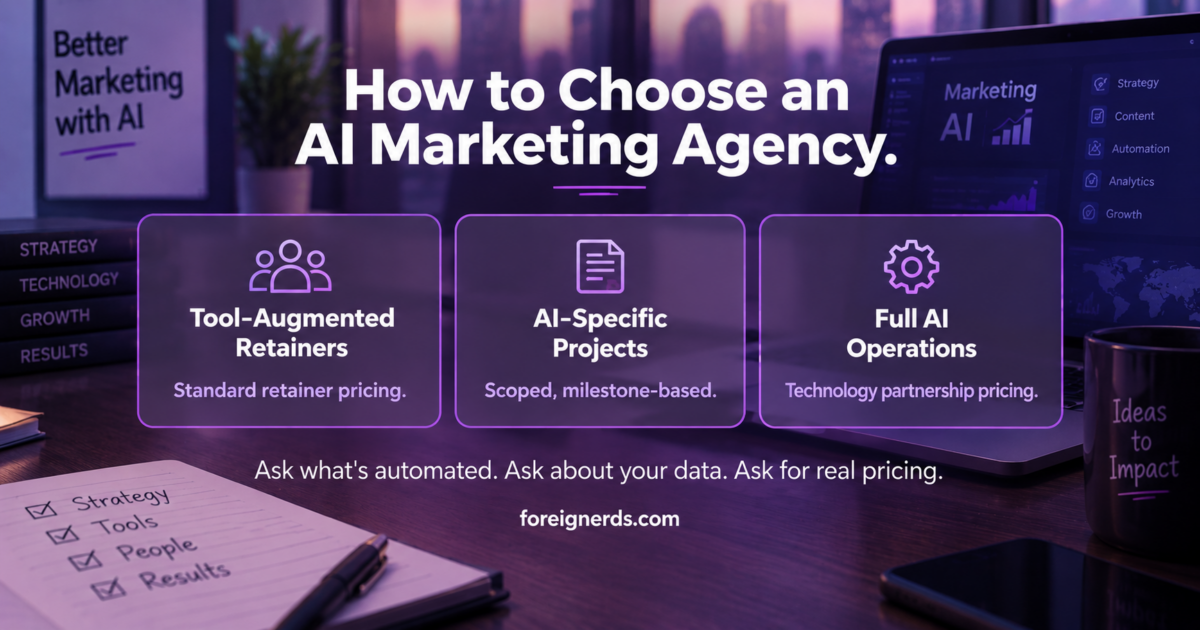
Three pricing tiers for choosing an AI marketing agency: tool-augmented retainers, AI-specific projects, full AI operations

Why This Is Harder to Evaluate Than It Looks

Search for “AI marketing agency” and most of what ranks is either another AI marketing agency describing itself in the best possible terms, or a listicle ranking ten agencies with no disclosed methodology. Neither is a neutral source. The honest starting point is this: “AI marketing agency” is not a regulated or standardized term. Some firms genuinely run AI-driven optimization across live campaigns. Others have simply added the phrase to their homepage after adopting ChatGPT for first drafts, the same as thousands of traditional agencies now do. The label alone tells you very little.

What a Genuinely AI-Driven Agency Actually Does Differently

Based on how the capability is described across the firms actually building it, three things separate a real AI-driven marketing operation from a traditional agency with an AI-adjacent tagline:

  • Real-time optimization — adjusting live ad campaigns automatically based on live performance data, rather than a person reviewing dashboards weekly and manually reallocating budget.
  • Genuine personalization at the individual level — tailoring messaging to an individual user’s behavior rather than broad audience segments, which requires actual data infrastructure, not just a smarter copywriting tool.
  • Workflow automation across repetitive tasks — using AI agents to handle data gathering, first-draft copy, basic design generation, and lead response, freeing human strategists for judgment calls machines genuinely can’t make yet.

A firm doing all three is meaningfully different from a traditional agency. A firm doing none of these but using the phrase in its branding is not — and it’s a completely fair question to ask directly in a first conversation.

What It Actually Costs

This is the question every buyer has and almost no agency website answers directly. Based on how AI-augmented marketing services are typically structured, most engagements fall into one of three tiers:

  • Tool-augmented retainers — a traditional marketing retainer where the agency uses AI tools internally to work faster. Pricing here is usually similar to a standard marketing retainer, since the AI is an efficiency layer for the agency, not a separately billed capability.
  • AI-specific project work — building a specific AI-driven system (a personalization engine, an automated campaign optimization pipeline) as a defined project with its own scope and price, separate from ongoing marketing spend.
  • Full AI-driven marketing operations — an agency running the actual campaign infrastructure with AI at the center, typically priced closer to a technology partnership than a traditional marketing retainer, reflecting the deeper technical build involved.

Any agency unwilling to explain which of these three actually describes their offering, in plain terms, in a first conversation, is a signal worth taking seriously.

A Practical Framework for the Actual Decision

Rather than starting from “which AI marketing agency is best,” a more useful starting question is what specific bottleneck is driving the search in the first place. Three common starting points lead to three different right answers:

Your actual situation What to look for
Campaigns work but take too long to launch and adjust An agency with genuine real-time optimization capability — ask specifically how campaign adjustments happen without a human reviewing dashboards manually
Messaging feels generic, conversion rates are flat An agency with true individual-level personalization infrastructure, not just audience segmentation with an AI label attached
Internal team is overwhelmed by repetitive production work An agency or partner focused on workflow automation for first-draft content, data gathering, and lead response — the mechanical layer, not the strategic one

Naming the actual bottleneck before evaluating any specific agency makes the four-question conversation above far more productive, because it turns a generic capability pitch into a direct answer to a specific problem.

How Agency Pricing Actually Breaks Down in Practice

Beyond the three broad tiers above, a few specific patterns show up consistently across how AI-augmented marketing engagements are actually structured. Tool-augmented retainers tend to track closely with traditional marketing retainer pricing in the same market and vertical, since the AI layer here is an efficiency gain for the agency’s own team rather than a separately built system. AI-specific project work is priced more like a software or data engineering project — scoped deliverables, defined timelines, and a fixed or milestone-based cost — because building an actual personalization or optimization system genuinely resembles a technical build more than a marketing engagement. Full AI-driven marketing operations sit closest to a technology partnership in both pricing structure and the depth of onboarding required, often including a genuine data integration phase before any campaign work begins — which is also why unrealistically fast timelines from a firm offering this tier are worth treating skeptically.

None of these tiers is inherently better — the right one depends entirely on which specific bottleneck from the table above is actually driving the search, and a competent agency in any tier should be able to explain, specifically, which of the three describes their own offering without hedging.

Red Flags Worth Naming Directly

No willingness to show the actual system, only the results

Case studies showing before/after metrics are useful, but a firm that can’t or won’t describe the actual mechanism producing those results — which tools, what data, what’s automated versus human-reviewed — is asking for trust without transparency. A legitimate AI-driven operation can explain its own system.

Every capability is “powered by AI” with no specifics

“AI-powered” attached to every service on a page, with no named tool, model, or specific workflow behind any of them, is usually a branding decision more than a technical one. This isn’t necessarily dishonest — the underlying work might still be good — but it means the AI framing isn’t carrying real information, and that’s worth knowing before evaluating the agency on that basis.

No discussion of what still requires a human

Every genuinely AI-augmented marketing operation still has human strategists making judgment calls current AI can’t reliably make — brand voice decisions, crisis response, creative direction. An agency that implies AI has replaced strategic thinking entirely, rather than accelerated the mechanical parts of it, is overselling.

Questions Worth Asking in a First Call

These four questions, asked directly, surface more real information than most agency sales pages:

  1. “Walk me through exactly what’s automated versus human-reviewed in a typical campaign.” A specific answer, not a general capability list, is the signal to look for.
  2. “What happens to our data, specifically?” — where it’s stored, whether it trains any shared model, who else can see it.
  3. “Can I see an example of the actual output before it was edited by a human?” This surfaces whether the AI layer is doing real work or mostly marketing language.
  4. “What’s your pricing model for this specifically, not your general retainer rate?” A clear, direct answer here is a genuinely good sign.

When a Traditional Agency Is Actually the Better Fit

Not every business benefits more from an AI-first agency than a traditional one. If the marketing need is primarily creative and brand-building — a campaign that depends on a genuinely original creative concept rather than data-driven optimization at scale — a traditional creative agency with strong strategists may outperform an AI-first operation that’s better suited to performance marketing at volume. The honest answer to “should I hire an AI marketing agency” is usually “it depends on whether your bottleneck is creative judgment or optimization at scale,” not a blanket yes.

How This Connects to a Broader AI Adoption Decision

Choosing an AI marketing agency is really a narrower version of a broader question many businesses are working through right now: how to evaluate any AI implementation partner, not just a marketing-specific one. The same evaluation discipline — asking what’s actually automated, what happens to your data, and what the real pricing model is — applies whether you’re hiring for marketing specifically or a broader AI initiative. It’s also worth understanding which specific AI marketing tools actually sit behind an agency’s claims, since a firm’s tool stack is often the most concrete, checkable thing behind an “AI marketing agency” label.

What Good Looks Like Once You’ve Chosen One

The agencies genuinely delivering value here share a pattern: they can explain their own system in plain language without deflecting to case studies, they’re specific about pricing rather than vague, they’re honest about what still requires human judgment, and they treat data handling as a real conversation rather than a line in a contract nobody reads. None of this requires picking the flashiest AI branding — it requires the same due diligence you’d apply to any vendor relationship where the actual mechanism matters more than the marketing language describing it.

How This Differs From Choosing a Traditional Digital Marketing Agency

Traditional agency evaluation focuses heavily on portfolio work, creative sensibility, and cultural fit with the strategist team you’ll work with directly. Those factors still matter with an AI-driven agency, but they sit alongside a second, more technical layer of diligence that traditional agency selection rarely requires: understanding what’s actually automated, what data infrastructure exists behind the personalization claims, and whether the pricing model reflects a technology build or a standard retainer with an AI label attached. Skipping this second layer and evaluating an AI marketing agency purely on the same criteria as a traditional one is the most common mistake buyers make in this specific decision — the portfolio can look identical between a firm doing genuine AI-driven work and one that isn’t, because the difference lives in the mechanism, not the output.

This is also why case studies alone are an incomplete evaluation tool here in a way they aren’t for traditional agency selection. A strong result achieved through genuine automation and a strong result achieved through a talented human team using ChatGPT for first drafts can look identical in a case study. The mechanism behind the result is what determines whether that result is repeatable at the scale and speed an “AI-driven” positioning implies — which is exactly why the four direct questions above matter more than the portfolio review that would normally come first in a traditional agency search.

A Short Glossary for This Space

A few terms come up repeatedly in agency conversations and are worth understanding precisely rather than nodding along to: real-time optimization refers to automated, live adjustments to active campaigns rather than scheduled manual reviews. Hyper-personalization means messaging tailored to an individual user’s behavior, not a broad demographic segment. Workflow automation covers the mechanical, repetitive tasks — data gathering, first-draft copy, lead routing — that AI agents handle so human strategists can focus on judgment calls. None of these terms guarantee quality on their own; they describe capability categories, and the actual evaluation still comes down to whether a specific agency can demonstrate each one concretely rather than simply naming it.

Where the Tool Question Fits Alongside the Agency Question

Part of evaluating any AI marketing agency honestly is understanding what’s actually behind their claims — and a firm’s own tool stack is often the most concrete, checkable evidence available. A practical framework for evaluating AI marketing tools directly is worth reviewing before any agency conversation, since it gives you the vocabulary to ask sharper questions about what’s actually automated versus what’s a person using ChatGPT behind the scenes. The same applies if the specific bottleneck is social content specifically rather than marketing broadly — the tool-selection discipline for social media management runs into nearly identical evaluation traps.

If what you actually need is a genuine marketing automation partner rather than a full agency relationship, that’s worth naming explicitly in a first conversation — the two are related but distinct engagements, and a firm that can’t clearly distinguish which one it’s offering is exhibiting the same vagueness problem described throughout this piece.

None of these distinctions require picking a side before the first conversation — they exist to make that first conversation sharper, so the agency you eventually choose ends up answering the actual question you meant to ask, not the one their pitch deck was built to answer.

Key Takeaways

  • “AI marketing agency” isn’t a regulated term — some firms genuinely run AI-driven optimization across live campaigns, others have simply added the phrase after adopting ChatGPT for first drafts.
  • Three things separate a genuinely AI-driven agency from a traditional one with an AI-adjacent tagline: real-time campaign optimization, individual-level personalization, and real workflow automation.
  • Pricing falls into three tiers — tool-augmented retainers (priced like standard retainers), AI-specific project work (priced like a technical build), and full AI-driven operations (priced like a technology partnership).
  • Four questions surface more real information than any sales page: what’s actually automated versus human-reviewed, what happens to your data, can you see unedited output, and what’s the specific pricing model.

AI Marketing Tools: A Practical Framework for Choosing and Actually Using Them

See also our related guide: AI Integration Services: The Complete Guide.

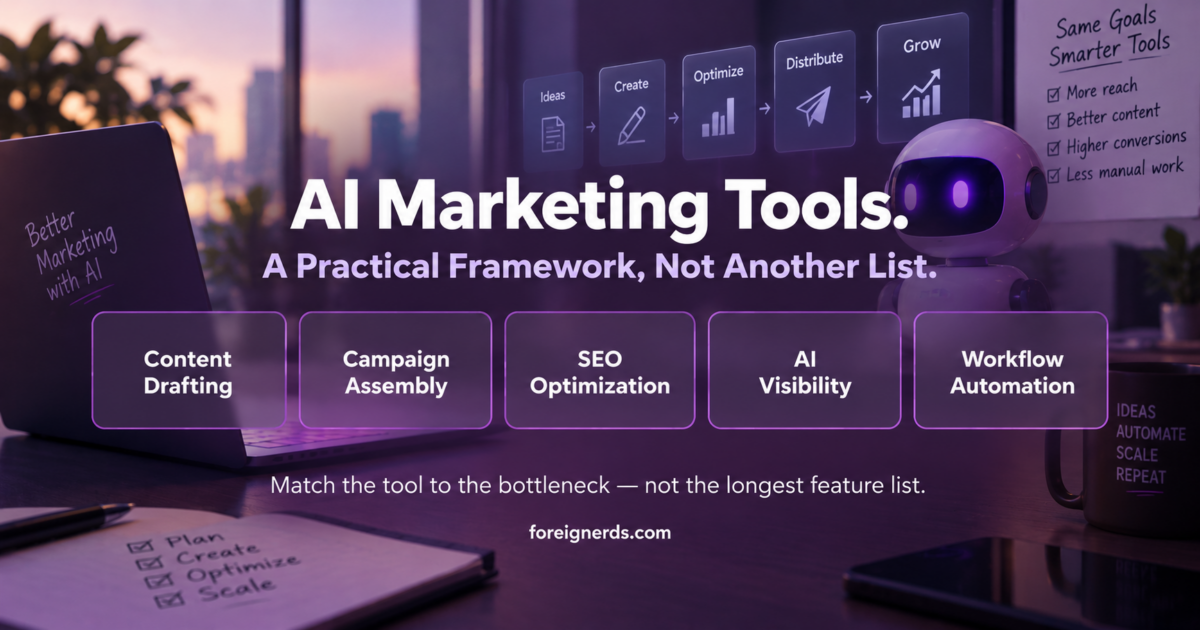
AI marketing tools framework: content drafting, campaign assembly, SEO optimization, AI visibility, workflow automation

AI marketing tools are software products that use machine learning to automate marketing tasks — writing copy, analyzing audience data, optimizing ad spend, and generating creative assets — rather than doing them manually. Dozens of new tools launch every month, and by mid-2026 most marketing teams use at least five of them without a coordinated strategy connecting them.

The Problem With Every “Best AI Marketing Tools” List You’ve Already Read

Search for this exact topic and you’ll find the same article eight different ways: a numbered list of 17, 25, 30, or 36 tools, usually grouped by category, usually including the same five or six names — ChatGPT, Jasper, Canva, HubSpot’s Campaign Assistant, Surfer SEO. Every one of these lists is accurate. None of them answer the question that actually matters once you’ve read the list: which of these should your specific business actually use, in what order, and how do they work together instead of creating five disconnected subscriptions nobody remembers to check?

That’s the real gap. A list of tools is not a strategy. Most businesses that “adopt AI marketing tools” end up with a pile of underused software licenses and no measurable change in output, because nobody thought through integration before signing up for the free trial.

What These Tools Actually Do, Grouped by the Job, Not the Brand Name

Rather than another tool-by-tool rundown, it’s more useful to think in terms of the actual jobs AI marketing tools handle, since that’s the decision that matters before any specific product gets chosen:

  • Content drafting and copy generation — tools like ChatGPT, Claude, and Jasper turn a rough brief into a first draft across blog posts, ad copy, and email. The realistic value here is speed on the first 70% of a draft, not a finished, publish-ready asset.
  • Multi-channel campaign assembly — tools like HubSpot’s Campaign Assistant take one input and generate matching assets across email, social, and landing pages simultaneously, which matters more for consistency than for any single asset’s quality.
  • SEO and content optimization — tools like Surfer SEO analyze what’s already ranking and suggest structural changes, which is genuinely useful but assumes someone is still making the actual editorial judgment calls.
  • AI visibility and brand monitoring — a newer category (Similarweb’s AI Brand Visibility feature is a recent example) that tracks how often a brand gets mentioned inside AI-generated chat responses, not just traditional search results.
  • Marketing automation and workflow orchestration — platforms that connect the other categories together so a lead’s behavior actually triggers the right next action, rather than living in five separate dashboards.

Most businesses only ever adopt tools from the first two categories, because they’re the most visible and the easiest to demo. The last category — actual orchestration — is where the real return sits, and it’s the one most listicles skip entirely because it’s harder to screenshot.

The Real Decision: Point Tools vs. an Integrated Stack

Every business adopting AI marketing tools eventually hits the same fork: keep adding individual point tools as needs arise, or invest in a smaller number of tools that are actually wired together. Both are legitimate, and the right answer depends on scale, not preference.

Point tools make sense when: the team is small, the use case is narrow (one person needs faster first-draft copy), and there’s no one dedicated to managing integrations. This is the right starting point for most businesses under 20 people, and it’s genuinely fine to stay there.

An integrated stack makes sense when: multiple people touch the same campaigns, data needs to flow between tools without manual re-entry, and the business has enough volume that a 10% efficiency gain across the whole funnel is worth more than a faster first draft on any single piece of content. This is where marketing automation platforms genuinely earn their cost — not by writing better copy than ChatGPT, but by making sure the right message reaches the right person at the right moment without someone manually checking five dashboards.

What Every Listicle Gets Wrong: Tool Sprawl Is the Actual Failure Mode

The pattern that shows up repeatedly in real implementations, not in vendor marketing: a business adopts three or four AI marketing tools independently, over a period of months, each solving one immediate problem. Six months later, nobody can say definitively which tool is actually driving results, because none of them talk to each other and the data lives in separate silos. The tools aren’t the problem — the lack of a decision about how they connect is.

This is a genuinely common and avoidable failure. Before adding a third or fourth AI tool to an existing stack, the more valuable question is usually not “which tool is best” but “does this tool need to talk to the tools I already have, and if so, does it actually do that, or will I be manually copying data between them in three months.”

A Practical Starting Framework

Before evaluating any specific product, four questions genuinely change the outcome:

  1. What’s the one bottleneck this needs to solve? Not “we want to use AI” — a specific, named bottleneck (slow first drafts, inconsistent campaign assets, no visibility into AI-search brand mentions).
  2. Who owns it once it’s live? A tool with no clear owner becomes the unused subscription six months later. This should be a named person, not “the marketing team.”
  3. Does it need to connect to anything you already use? If yes, verify the actual integration exists and works before buying — a listed “integration” on a pricing page is not the same as a tested, working connection.
  4. What does success look like in 90 days, specifically? A measurable outcome, not “see how it goes.”

Answering these four honestly before evaluating any specific tool eliminates most of the tool-sprawl problem before it starts.

How to Actually Evaluate a Specific Tool Before Buying

Once the four questions above point toward a genuine need, the actual evaluation of a specific product benefits from a short, consistent checklist rather than a fresh judgment call each time:

  • Ask for the actual output on your own content, not the demo example. Every AI marketing tool demo is tuned to look impressive on a curated sample. Run it on a real, slightly awkward piece of your own brand’s content before deciding anything.
  • Check what happens to your data. Marketing content often includes customer information, pricing details, or unreleased campaign plans. Understand explicitly whether the tool trains on your inputs, and whether that’s acceptable for your specific content.
  • Test the free tier or trial with a real deadline, not a sandbox exercise. Tools behave differently under real time pressure than in a leisurely evaluation — that’s often where genuine gaps between the marketing pitch and daily reality show up.
  • Confirm the integration claim with the tool actually connected, not just listed. “Integrates with HubSpot” on a pricing page and a working, tested connection between your specific accounts are two different things — verify the second before committing budget.

Common Mistakes Worth Naming Directly

Buying the tool before defining the workflow

The most common failure pattern: a business sees a demo, gets excited, buys the tool, and only then tries to figure out how it fits into existing work. The fix is genuinely simple — write down the current workflow first, then look for the specific step an AI tool would improve, rather than starting from the tool.

Treating AI-generated output as finished, not a first draft

Every current AI marketing tool, including the well-known ones, produces output that needs a human editorial pass before it goes out under a real brand’s name. Skipping that step is the single most common cause of AI-generated content reading as generic — not because the tool is bad, but because the editing step got skipped.

Ignoring where AI search visibility fits

Most businesses still measure marketing tool success purely by traditional search and social metrics, missing the newer AI Brand Visibility category entirely — a genuine blind spot given how much research now happens inside AI chat assistants before it ever reaches a traditional search engine.

The Honest Timeline for Seeing Real Value

A realistic expectation matters here, because AI marketing tool vendors routinely imply immediate transformation. In practice, the pattern that shows up across real implementations looks more like this: the first month is mostly setup and workflow adjustment, with output quality often lower than the pre-AI baseline while the team learns what the tool is actually good at. Months two and three typically show the first genuine efficiency gains, once the team has learned which tasks to hand to the tool and which still need a human starting point. Meaningful, measurable time savings usually don’t show up clearly until month three or four — not because the tools are slow, but because the human workflow around them takes that long to actually change.

Any vendor or case study promising a dramatically faster timeline than this is either describing an unusually simple use case, or measuring something narrower than genuine team-wide output. Setting this expectation upfront — with whoever owns the tool internally, per the framework above — avoids the common outcome where a genuinely useful tool gets abandoned in month two because it hasn’t yet delivered results that were never realistic to expect that early.

Where This Fits Alongside a Broader Marketing Automation Strategy

Individual AI marketing tools solve individual problems well. The businesses getting compounding value from this moment aren’t the ones with the most tools — they’re the ones who’ve connected a smaller number of tools into one working system, which is exactly what a genuine marketing automation strategy is built to do. If the four-question framework above surfaces a real integration need rather than just a single-task fix, that’s the point where point tools stop being sufficient on their own.

This also connects directly to how AI integration actually works in practice — the same principles apply just as directly to marketing tools specifically. If the agency side of this decision is also on the table, choosing an AI marketing agency runs into the exact same evaluation problem: too many self-promotional rankings, not enough vendor-neutral criteria.

What “Good” Actually Looks Like Six Months In

The businesses that get this right share a specific, recognizable pattern. There are usually two to four AI marketing tools in active use, not eight or ten — each one tied to a specific bottleneck someone identified before buying, not adopted because a competitor mentioned it. Someone can name, without checking a spreadsheet, exactly which tool handles which job and who owns it. When a tool stops earning its subscription cost, it gets cancelled rather than quietly forgotten, because someone is actually accountable for it. And critically, the tools that need to share data actually do, tested and confirmed, not just claimed on a pricing page.

None of this requires picking the single best tool from any list. It requires treating tool adoption as a decision with an owner and a measurable outcome, rather than a purchase made because a demo looked impressive. That discipline, more than any specific product choice, is what separates businesses seeing genuine efficiency gains from AI marketing tools six months in from the ones still paying for licenses nobody opens.

Point Tools vs. Integrated Stack: A Quick Comparison

Factor Point Tools Integrated Stack
Team size Under 20 people 20+ people, multiple hands on the same campaigns
Setup effort Low — sign up and start using Higher — requires actual integration work upfront
Data flow Manual, tool-to-tool Automated, shared across the stack
Best for One narrow, specific bottleneck Coordinated, multi-channel campaigns at volume
Ongoing management Minimal — mostly self-serve Needs a named owner tracking the whole system
Risk if unmanaged One underused subscription Multiple disconnected tools and siloed data

Most businesses starting out should default to the left column and only move right once the specific triggers described earlier — multiple people, real data-sharing needs, meaningful volume — actually show up.

Worth noting too: if the bottleneck your team is actually facing looks more like disorganized social content than disorganized marketing copy generally, choosing a social media management tool is a narrower, related version of this exact same evaluation problem — different tools, same underlying discipline.

Key Takeaways

  • By mid-2026 most marketing teams already use five or more AI marketing tools without a coordinated strategy connecting them — tool sprawl, not lack of tools, is the actual failure mode.
  • Before evaluating any specific product, four questions matter more than any feature list: what specific bottleneck this solves, who owns it once it’s live, whether it actually needs to connect to existing tools, and what success looks like in 90 days.
  • Real value takes longer than vendors imply — month one is mostly setup, months two and three bring the first genuine efficiency gains, and measurable time savings typically don’t show up until month three or four.
  • Point tools (under 20 people, one narrow bottleneck) and an integrated stack (multiple people, shared data, real volume) solve different problems — the right choice depends on scale, not preference.

Choosing a Social Media Management Tool: Pricing Models, Not Just Feature Lists

Social media management tools are software platforms that let a business plan, schedule, publish, and analyze content across multiple social networks from one dashboard, rather than logging into each platform separately. Pricing models vary significantly — some charge per social channel, others per team seat — and the right tool depends more on team structure and workflow than on which platform tops any given best-of list.

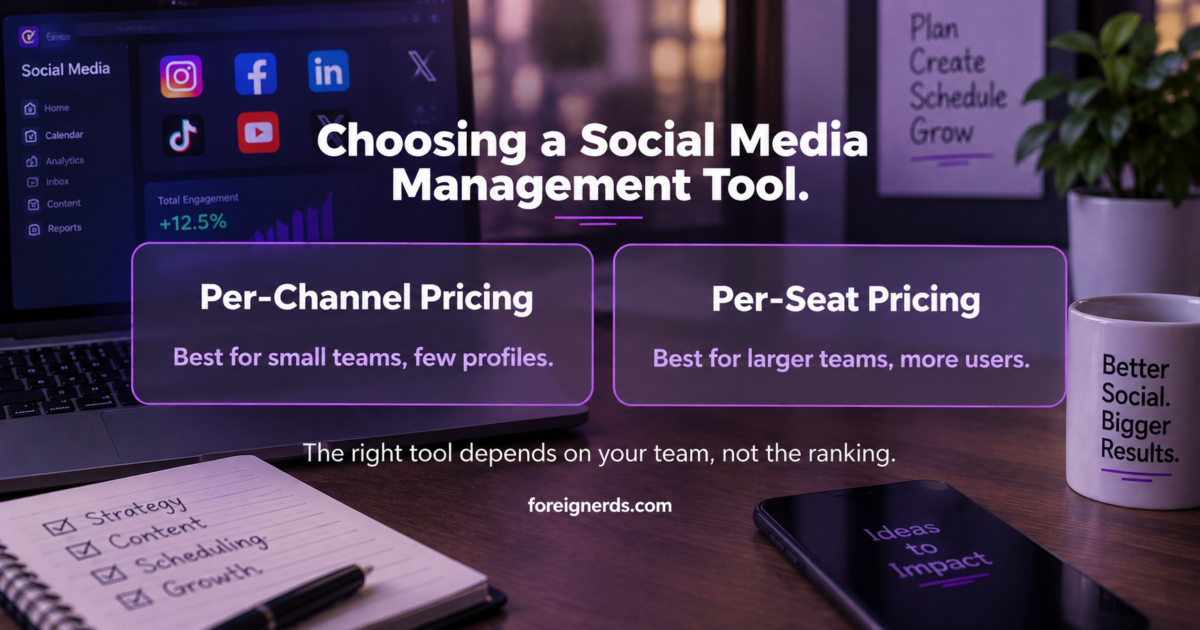
Social media management tool pricing comparison: per-channel versus per-seat

Why Every “Best Tools” List Says Something Different

Search this topic and the top results all rank the same handful of names — Buffer, Hootsuite, Sprout Social, SocialPilot, Zoho Social — in a different order depending on which site is publishing the list, often with an affiliate relationship to the tools ranked highest. None of this makes the individual reviews dishonest, but it does mean the actual decision — which tool fits a specific team’s actual workflow — gets buried under generic feature comparisons that read the same regardless of team size or structure.

The Real Question: Per-Channel or Per-Seat Pricing

This is the single most consequential and least-discussed decision in choosing a social media management tool, because it determines how cost scales as the business grows. Tools priced per social channel (Buffer’s model, starting around $6/month per channel) become expensive as a business adds more platforms and profiles, but stay cheap with a small team managing few channels. Tools priced per team seat (Hootsuite and Sprout Social both use this model, often $99-$199/month per user) scale the opposite way — cheap with few users regardless of channel count, expensive as more people need access. A five-person team managing three social profiles should be evaluating completely different tools than a solo marketer managing fifteen client accounts, and most comparison articles present both categories side by side as if the pricing model doesn’t matter.

Matching the Tool to the Actual Team Structure

Your situation What actually fits
Solo marketer or very small team, few channels Per-channel pricing (Buffer-style) — cost stays low, feature depth beyond scheduling matters less
Agency managing many client accounts Tools with client approval workflows and white-label reporting (SocialPilot-style) — the agency-specific features matter more than raw scheduling capability
Larger internal team, several people posting Per-seat pricing with a unified inbox (Hootsuite/Sprout-style) — worth the higher cost once coordination between people becomes the actual bottleneck
Business already inside another platform’s ecosystem (e.g., Zoho CRM) The ecosystem-native tool (Zoho Social) — the CRM integration often outweighs marginal feature differences elsewhere

What “AI-Assisted” Actually Means Across These Tools

Most current social media management platforms now market some AI capability, and the term covers a wide range of actual functionality worth distinguishing. At the simpler end, AI handles caption suggestions and basic hashtag recommendations — genuinely useful but a modest time-saver, not a strategic capability. Further along, some platforms use AI for posting-time optimization, analyzing when a specific account’s audience is actually most active rather than relying on generic best-practice timing. The most substantial current AI capability sits in automated first-pass comment and direct-message triage — flagging which incoming messages need a human response versus which are routine enough for an automated reply. None of these capabilities replace a genuine content strategy, and a tool’s AI features are worth evaluating as a modest efficiency layer, not a reason to select one platform over another on their own.

The Unified Inbox: More Important Than It Sounds

Scheduling posts is the visible, marketed feature, but for any team beyond a solo operator, the unified inbox — one feed showing all comments and direct messages across every connected platform — is usually the feature that determines whether the tool actually gets used daily or gets abandoned after the first month. Teams that skip evaluating this feature carefully, focusing instead on scheduling capability and pricing alone, often discover months in that they’re still checking each platform’s native inbox separately because the tool’s unified inbox was clunky or incomplete. This is worth testing directly during any trial period, with real accounts, rather than taking a features list at face value.

Free vs. Paid: When the Free Tier Is Actually Enough

Nearly every major social media management platform offers some free tier, typically capped at a small number of connected channels and a basic scheduling calendar with no unified inbox or advanced analytics. For a genuinely small operation — one or two people, three or fewer channels, no client-facing reporting requirement — the free tier of a tool like Buffer or Zoho Social is often genuinely sufficient, and upgrading before that need actually exists is a common and avoidable expense. The signal to actually upgrade is specific and checkable: channels exceed the free limit, more than one person needs to post or approve content, or someone needs to produce a real performance report for a boss or client. Upgrading in anticipation of future growth that hasn’t materialized yet is a subtler version of the same tool-sprawl problem that shows up elsewhere in AI-adjacent software adoption — paying for capacity a team isn’t yet using.

Common Mistakes in Choosing a Tool

Optimizing for the longest feature list

The tool with the most listed features is not automatically the right fit — many of those features go unused by any given team, while the pricing tier required to access them scales with the full feature set regardless of actual usage. Matching the tool to the specific workflow bottleneck, per the table above, produces a better outcome than comparing raw feature counts.

Ignoring the migration cost of switching later

Switching social media management tools means rebuilding saved content calendars, reconnecting every social profile, and retraining the team on a new interface. This makes the upfront decision more consequential than the monthly price difference alone suggests — a tool that’s 20% more expensive but genuinely fits the team’s actual workflow is usually the better long-term choice over a cheaper tool likely to be replaced within a year.

Underestimating analytics needs until reporting time

Scheduling and publishing get most of the attention during evaluation, but the analytics and reporting capability — especially for agencies needing to show clients real results — often matters more in practice. This is worth testing with a real reporting cycle during any trial, not assumed from a features page.

Where an Agency Relationship Changes the Calculation

Everything above assumes a business managing its own social accounts directly. When social media management is handled by an outside agency instead, the tool decision often isn’t the business’s to make at all — the agency’s existing stack, reporting format, and client workflow usually determine which platform gets used, and that’s a reasonable division of responsibility. What’s worth asking in that relationship isn’t which specific tool the agency uses, but whether their reporting genuinely reflects real account performance rather than vanity metrics, and whether the business retains actual ownership and access to its own social accounts and historical content independent of the agency relationship — a detail worth confirming explicitly before any tool or workflow decision, since losing access to your own account history when an agency relationship ends is a real and avoidable risk.

How This Fits a Broader Social Media Strategy

A management tool is the mechanism, not the strategy. Choosing the right tool solves a real operational problem — coordination, scheduling consistency, unified reporting — but doesn’t substitute for a genuine content strategy, which is where actual audience growth and engagement outcomes come from. Businesses that invest heavily in tool selection while treating content strategy as an afterthought typically see the operational efficiency gains they expected without the audience growth they actually wanted. The tool decision and the strategy decision are separate, and both matter, but they’re solving different problems.

A Short Evaluation Checklist

  1. Count your actual channels and team members — this determines whether per-channel or per-seat pricing favors you, before looking at any specific tool.
  2. Test the unified inbox with real accounts during a trial — this feature’s quality varies more between tools than the marketing copy suggests.
  3. Run one real reporting cycle before committing — especially if client-facing reporting is a genuine requirement, not a nice-to-have.
  4. Treat AI features as a minor efficiency layer, not a deciding factor — the underlying scheduling, inbox, and reporting capability matters more than which platform has the flashiest AI marketing.

None of this requires picking whichever tool tops this month’s ranking article. It requires matching a specific tool’s actual pricing model and feature depth to your team’s specific structure — a decision no generic listicle can make for you, because it depends entirely on facts about your own team the article’s author never had.

What to Actually Check During a Trial, Step by Step

Most trials get used to click through a features tour rather than genuinely stress-test the tool against real work, which is why so many businesses discover gaps only after committing to a paid plan. A more useful approach during any trial period: connect every social account you’d actually use in production, not a test account, since some platform integrations behave differently with accounts that have real history and follower counts. Schedule a genuine week of planned content rather than a handful of test posts, to see how the calendar view actually holds up under real volume. Have every team member who would use the tool daily log in and attempt their actual role — the person approving content, the person responding to comments, the person pulling reports — rather than one person evaluating the entire tool alone. And specifically try to break the unified inbox: reply to a comment, then check whether that reply actually appears correctly on the native platform, since sync issues between a management tool and the underlying social network are a common, hard-to-spot problem that only shows up under real use.

This is a meaningfully more thorough evaluation than most businesses run before committing to an annual plan, and it takes a few extra days relative to a rushed decision based on a features comparison page — a small cost against the real expense of migrating to a different tool six months later because the trial evaluation missed something a real workflow test would have caught immediately.

How This Relates to Broader AI Marketing Tool Choices

A social media management platform is really a specialized category within the broader world of AI marketing tools, and the same evaluation discipline applies: match the tool to a specific, named bottleneck rather than the longest feature list, confirm real integrations rather than claimed ones, and give someone specific ownership once it’s live. If social media management is being handled by an outside partner rather than in-house, the same due diligence that applies to choosing any AI-driven marketing agency applies here too — ask what’s actually automated versus manually managed, and get specific about reporting before signing anything. And if the actual need is connecting several of these tools into one coordinated system rather than picking a single platform, that’s the specific problem a genuine marketing automation engagement is built to solve.

Where AI Visibility Fits Into Social Strategy Now

One newer wrinkle worth naming directly: a growing share of research and discovery now happens inside AI chat assistants rather than traditional search or social feeds, which means brand visibility inside those AI responses is becoming a genuine, separate metric from social engagement numbers. This connects to the broader discipline covered in generative engine optimization — a business investing heavily in social scheduling tools while ignoring how it shows up in AI-generated answers is optimizing for only half of where its actual audience is now looking for it. The two are related but genuinely distinct workstreams, and treating them as the same thing is an increasingly common and avoidable gap.

A Final Word on Team Buy-In

The best-fitting tool on paper still fails if the team using it daily resents the workflow it imposes. Before finalizing any decision from the framework above, it’s worth a short, honest check with whoever will actually log in every day: does the interface feel like it fits how they already think about content, or does it feel like fighting the tool to do something it should make easy? A slightly less feature-rich tool that the team genuinely likes using consistently will outperform a more powerful one that gets opened reluctantly once a week. This is a soft factor that rarely shows up in a spec comparison, and it’s worth weighting more heavily than most evaluation frameworks, including the checklist above, would suggest on their own.

Key Takeaways

  • The most consequential, least-discussed decision is pricing model: per-channel pricing (like Buffer, from ~$6/month/channel) scales differently than per-seat pricing (like Hootsuite or Sprout, often $99–$199/month/user) — the right fit depends on team size and channel count, not which tool ranks highest on a listicle.
  • The unified inbox — not the scheduling calendar — is usually what determines whether a tool actually gets used daily.
  • AI features across these tools (caption suggestions, posting-time optimization, message triage) are a modest efficiency layer, not a reason to choose one platform over another.
  • The free tier is often genuinely sufficient for one or two people managing three or fewer channels — upgrade only when channels exceed the limit, more than one person needs access, or real client reporting is required.

Google’s AI Report vs. a Full AI Visibility Audit

This article is part of our complete guide: Generative Engine Optimization (GEO): The Complete Guide.

Google’s new Generative AI performance report in Search Console shows how often your pages appear in AI Overviews, AI Mode, and Discover — impressions only, with no score, clicks, or CTR data. Google rolled this out worldwide by August 31, 2026. It is useful, but not the same as the cross-platform “AI visibility audit” most vendors sell.

What Google Actually Launched

On June 3, 2026, Google added a dedicated Generative AI performance report inside Search Console — its own official name for the feature, confirmed directly on Google’s developer blog and its own help documentation. The report isolates how often your site’s pages appeared inside Google’s generative AI features on Search and Discover, breaking that data down by page, country, device, and date, with granularity from hourly to monthly. By August 31, 2026, Google confirmed the rollout had reached every website worldwide, not just the initial test group that saw it first.

The data itself was not new — Google confirmed these AI impressions were already counted inside your overall Search Console performance totals, mixed in with your regular organic search numbers. What changed is visibility: for the first time, that number is broken out into its own dedicated view instead of being buried inside an aggregate figure you could not isolate or act on separately. Before this launch, a site could be earning a meaningful share of its total impressions from AI Overviews and have no way to know it, because that traffic looked identical to a regular search impression in every report Search Console offered.

For the fuller picture of how AI search itself works, see our breakdown of how AI search actually works and what it means for SEO. This new report is also part of a broader shift industry-wide, not a Google-only move. The same week Google’s report rolled out more broadly, Microsoft’s Search team publicly confirmed similar AI performance reporting was coming to Bing Webmaster Tools — a signal that isolating AI-driven visibility from traditional organic visibility is becoming a baseline expectation for search platforms generally, not a one-off Google experiment.

What It Does Not Do

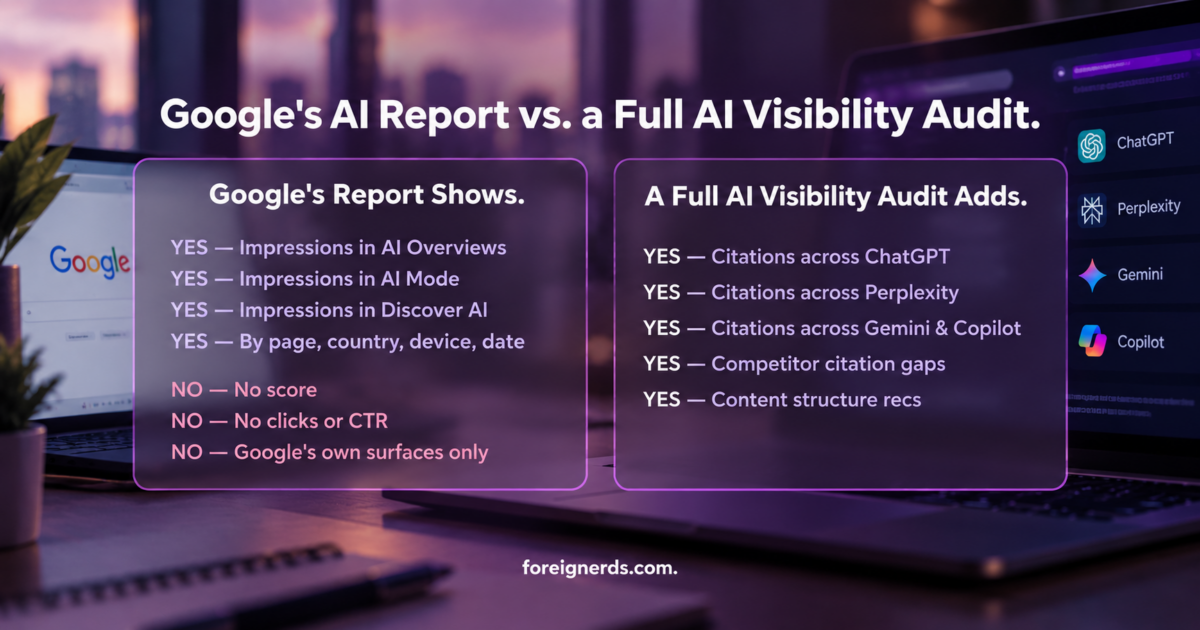
This is the part that gets lost in translation, and it matters more than the launch itself. The report shows impressions only. There is no click data, no click-through rate, and no query-level data in the current version — you can see that your page appeared inside an AI feature, but not whether anyone actually engaged with it once it did, and not which specific search query triggered that appearance. That is a real, meaningful gap for anyone trying to judge whether AI visibility is actually translating into business value.

There is also no score of any kind, despite how this feature gets described informally in some coverage. A business searching for “did Google give my site an AI visibility score” will not find one inside Search Console, because Google has not built one — what exists is a raw count of appearances, not a graded assessment of how well-optimized your content is for AI surfaces.

The report is also scoped narrowly by design: it covers only Google’s own generative AI surfaces — AI Overviews, AI Mode, and generative AI features inside Discover. It says nothing about whether your brand appears when someone asks ChatGPT, Claude, Perplexity, or Gemini the same question, because those are entirely separate systems Google has no visibility into and no reason to report on. Google also introduced a toggle letting site owners opt their content out of appearing in these AI features entirely. Opting out has no effect on standard Search rankings — it only affects eligibility for the AI-specific surfaces this report tracks, which is worth knowing before treating that toggle as a bigger decision than it actually is.

Comparison of Google AI visibility report versus a full AI visibility audit

Why This Gets Confused With a Full AI Visibility Audit

Search interest in “AI visibility audit” grew from essentially zero in early 2025 to 390 searches a month by July 2026 — genuine, fast-growing demand for a term that barely existed eighteen months earlier. We checked the current top-ranking results for that exact term, and every one of them — Semrush, Ahrefs, SE Ranking, Amplitude, WhiteLabelIQ — is a vendor selling a tool that tracks brand visibility across ChatGPT, Perplexity, and Gemini, not just Google’s own surfaces. That is a genuinely useful and different thing from what Google’s new report measures, but none of the current top results draw a clear line between the two ideas for a reader encountering both terms in the same week.

A reader searching either term could easily walk away with one of two wrong conclusions: either that Google’s report is the same thing as a full AI visibility audit, or that a paid audit tool is simply repackaging data Google already gives away for free. Neither assumption holds up under scrutiny. Google’s report tells you about Google’s own AI surfaces only, and only in impression-count form. A genuine AI visibility audit checks whether your brand gets cited by name across every major AI assistant a customer might actually ask — a materially broader question Google’s own tooling was never built to answer, because it was built to report on Google Search, not to audit the entire AI assistant landscape a customer might use instead.

What a Real AI Visibility Audit Adds on Top

A proper AI visibility audit picks up exactly where Google’s report stops, and the difference is not incremental — it is a different question entirely. It checks whether your brand is actually named when someone asks ChatGPT, Perplexity, Gemini, or Copilot a question in your category, not just whether Google’s crawler included your page in an AI Overview response. It identifies which competitors are getting cited instead of you, and on which specific questions your category’s buyers are actually asking these assistants — detail no Google-facing tool could ever surface, since Google has no access to what a competitor’s brand looks like inside a ChatGPT conversation.

It also looks at whether your content is structured in a way that makes it easy for any AI system to extract and cite accurately — clear entity naming, direct answers near the top of a page, genuine factual claims an AI model can quote with confidence — rather than optimizing purely for how Google’s own crawler happens to parse a page. None of that visibility exists anywhere inside Search Console, because Search Console is fundamentally a Google product reporting on Google’s own systems. It was never going to cover competitors’ AI systems, and expecting it to is asking a tool to do a job it was never built for.

What To Actually Do With This Data This Month

If the new Search Console report is available on your property, start with something simple: establish a real baseline. Note your current AI impression count by page, and revisit it monthly rather than treating the number as a one-time curiosity to check once and forget. A page with zero AI impressions is itself a genuine signal worth investigating — either the topic isn’t structured in a way AI Overviews can easily extract an answer from, or Google simply isn’t surfacing an AI answer for that particular query yet, which is useful to know either way.

Once that baseline exists, the honest next question is whether Google’s surfaces are actually the only ones that matter to your specific customers. If your buyers are just as likely to ask ChatGPT or Perplexity a question as they are to type it into Google, Google’s report alone will never reveal that gap to you — it structurally cannot, since it only measures what happens on Google’s own systems. That is exactly the point where a full AI visibility audit becomes the genuinely necessary next step rather than a redundant one, because it answers the specific question Google’s own report was never designed to address.

Common Misconceptions Worth Correcting

A few assumptions show up repeatedly once businesses start looking at this new report, and each one is worth addressing directly before it leads to a wasted decision.

“My AI impressions dropped, so my AI visibility is getting worse”

Not necessarily. Because this data was always counted inside your existing performance totals and has simply been broken out separately for the first time, a change in the isolated number can reflect a change in how Google is categorizing existing traffic, not necessarily a real change in how often you’re actually appearing. Compare the isolated AI number against your overall performance trend before drawing a conclusion from either alone.

“Opting out of AI features will protect my traffic”

Google has confirmed the opt-out toggle affects eligibility for AI Overviews, AI Mode, and Discover AI specifically — it does not restore or protect standard organic ranking traffic, because that traffic was never affected by inclusion in AI features in the first place. Opting out trades away the impressions and potential exposure those AI experiences provide, without changing your regular search position at all.

“If Google shows zero AI clicks, AI search isn’t sending me any traffic”

The current report doesn’t measure clicks at all, in either direction — its absence from the report is not evidence of zero AI-driven traffic, it’s simply a metric Google hasn’t built yet. Treating the absence of click data as proof of zero AI traffic value is reading more into the report than it currently supports.

Where This Sits Inside a Broader GEO Strategy

Google’s new report is best understood as one instrument on a dashboard, not the whole dashboard. It is a genuinely useful, free, first-party signal for the narrow question it answers — and it should be checked regularly precisely because it costs nothing to monitor and reflects real, verified Google data rather than a third party’s estimate of what Google might be doing. But treating it as a complete answer to “how visible is my brand in AI search” mistakes one instrument for the whole picture.

The businesses getting genuine value from this moment are the ones using Google’s report as the free baseline it actually is, then layering a proper cross-platform audit on top once that baseline raises real questions — a page with strong traditional rankings but zero AI impressions, a category where competitors are visibly better cited on ChatGPT than the same competitors rank on Google, a customer base that increasingly starts its research inside an AI assistant rather than a search box. Each of those signals points toward a genuine need for broader visibility work, not toward more time spent staring at Google’s own isolated number waiting for it to change on its own.

This is also why the underlying discipline matters more than any single report a platform happens to ship. Structuring content so an AI system — any AI system, Google’s or otherwise — can extract a clear, accurate, citable answer is the actual skill being measured here, whether that gets surfaced through Google’s Search Console report, a third-party audit tool, or simply asking ChatGPT the question yourself and seeing what comes back. The report is useful. The underlying content discipline it’s measuring is what actually matters.

How to Actually Check This on Your Own Site

If you have not looked yet, the report sits inside Search Console under the Search Results section, in its own dedicated panel rather than mixed into the standard performance report. Compare the isolated AI figure against the total impressions figure for the same date range, since neither number means much read entirely on its own — that ratio is a more honest starting metric than either number in isolation, since it tells you what share of your existing visibility is coming specifically from Google’s AI features rather than traditional blue-link results.

Worth checking specifically: which pages show meaningful AI impressions and which show none at all, even among pages with comparable traditional search performance. A page ranking well in standard search but earning zero AI impressions is a genuine, specific signal — often it means the page’s content isn’t structured with a clear, extractable, direct answer near the top, the exact structural pattern AI Overviews tend to favor when selecting which page to summarize from — a fixable, specific gap once it is actually made visible, which is precisely what this new report finally makes possible for any site owner willing to look.

Key Takeaways

  • Google’s Generative AI performance report (rolled out worldwide by August 31, 2026) shows only how often your pages appear in AI Overviews, AI Mode, and Discover — impressions only, with no clicks, CTR, query data, or “score” of any kind.
  • It’s scoped narrowly to Google’s own AI surfaces — it says nothing about whether your brand appears when someone asks ChatGPT, Claude, Perplexity, or Gemini the same question.
  • A full AI visibility audit answers the broader question Google’s report structurally can’t: whether your brand gets cited by name across every major AI assistant, and which competitors are getting cited instead of you.
  • The two aren’t competing tools — Google’s report is a useful free baseline; a cross-platform audit is the next step once that baseline raises real questions.

AI Agent Governance: A Practical Guide for Real Businesses

This article is part of our complete guide: AI in Cybersecurity: The Complete Guide for Business Leaders.

AI agent governance is the set of policies and controls that define what autonomous AI agents are allowed to do, who approves their actions, and how those actions get reviewed. Search interest in this topic grew from near zero in 2024 to over 200 monthly searches by 2026. Foreignerds builds practical governance for businesses that have not bought a monitoring platform yet.

Why This Is Suddenly a Real Conversation

Three years ago, almost nobody searched for this term. Search volume for “AI agent governance” sat near zero through most of 2024, then climbed steadily through 2025 and into 2026, reaching over 200 searches a month with a $51.65 cost-per-click — a signal of genuine buyer intent behind a still-modest number. That growth curve tells the real story: businesses did not start asking this question because a vendor invented a new problem to sell against. They started asking because AI agents quietly multiplied inside their own operations — a Zapier automation here, a customer-support bot there, a coding assistant with repository access somewhere else — and at some point, someone in the room asked who actually approved all of this.

This pattern repeats across nearly every business we talk to. Agents get adopted individually, department by department, often by whichever employee was comfortable enough with the tool to set it up. A marketing coordinator connects an AI writing tool to the CMS. A support lead turns on an AI chatbot that can issue refunds up to a certain dollar amount. A developer gives a coding assistant write access to a shared repository. Each decision is reasonable in isolation. None of them were made with the others in mind, and in most cases, nobody outside that one team knows the agent exists at all.

The result is what security teams sometimes call “shadow AI” — a layer of autonomous tooling running inside the business that was never centrally reviewed, inventoried, or authorized. It is the direct AI-era descendant of “shadow IT,” the older problem of employees adopting unsanctioned software tools, except the stakes are higher: shadow IT tools mostly stored or displayed data, while shadow AI agents can take real actions — sending money, communicating with customers, modifying systems — without a human confirming each one.

The Vendor-Neutral Gap

We pulled the current top-ranking results for this exact topic and found a consistent pattern worth naming directly. Every single one is either an official platform document — Microsoft publishes its own AI agent governance guidance inside the Azure Cloud Adoption Framework — or a vendor selling a dedicated governance or monitoring product: Zenity, CloudFuze, Airia, OneTrust, and AvePoint all rank with content that leads back to their own platform. That is not a criticism of those companies; a governance platform is a legitimate, sometimes necessary product for the businesses that genuinely need one, and several of them build genuinely useful tools for exactly that audience.

But it means the entire top of the search results is written from one of two vantage points: a cloud platform explaining how to use its own tooling, or a vendor whose content exists to move a reader toward a purchase. Neither vantage point is built to answer the question a smaller business actually has first: not “which platform should I buy,” but “what should I actually be doing right now, before I spend anything.” A business with five AI agents running across two departments does not need the same governance apparatus as an enterprise running hundreds across a regulated industry, and almost none of the current top-ranking content acknowledges that distinction exists at all — every one of them moves quickly toward a platform pitch regardless of the size or maturity of the business reading it.

That gap is exactly what this guide addresses: a starting point that does not assume the reader is already a platform customer, written from the perspective of an agency that builds the agents themselves rather than a company selling a separate tool to monitor someone else’s.

A Practical Starting Framework

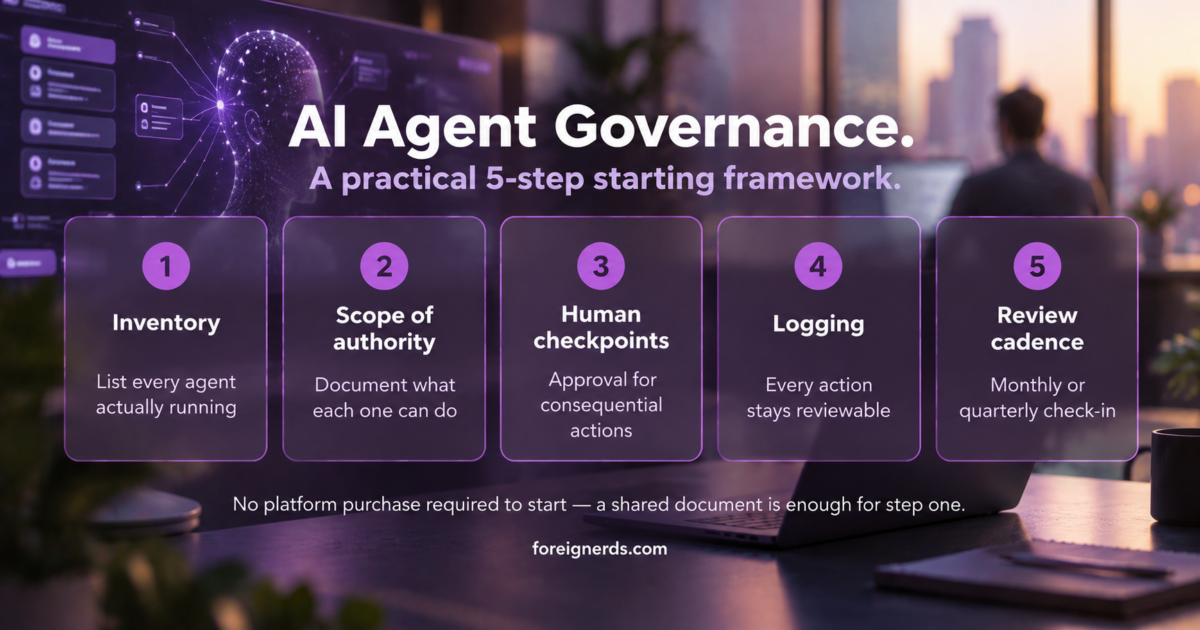
Before any business buys a dedicated governance platform, five things make up a workable AI agent governance framework using tools already on hand — a shared document, a recurring calendar invite, and an honest internal conversation are enough to start.

1. Inventory every agent actually running

Most businesses cannot answer this question accurately on the first try. List every automation, chatbot, coding assistant, and workflow tool with any degree of autonomous action — including the ones individual employees set up on their own without IT involvement. The honest way to do this is to ask every department lead directly, “what AI tools are you currently using that take actions on your behalf, not just ones that generate text or suggestions for you to review.” The distinction matters: a tool that drafts an email for a human to send is a different risk category from one that sends the email itself.

2. Document the scope of authority for each one

For every agent on that list, write down exactly what it is allowed to do: send external emails, spend money, access customer data, modify code, or take any other consequential action. If nobody can answer this for a given agent, that is the first thing to fix — an agent whose permissions nobody can describe is, by definition, ungoverned, regardless of how well it happens to be performing today.

3. Set human-in-the-loop checkpoints where the stakes justify it

Not every action needs human approval, but any action involving money, customer-facing communication, or irreversible system changes should require a sign-off until the agent has a real track record. This does not mean reviewing every single action forever — it means starting with a checkpoint and removing it deliberately once there is enough evidence to justify more autonomy, rather than granting full autonomy by default because removing a checkpoint later feels inconvenient.

4. Make sure every action gets logged somewhere reviewable

An agent that acts without leaving a trace is a liability regardless of how well it performs — logging is not optional even at small scale. This does not require a dedicated logging platform; many AI tools and automation platforms already produce activity logs that simply go unread. The immediate task is often not building new logging infrastructure, but making sure someone actually looks at what already exists on a regular basis.

5. Put a recurring review on the calendar

Governance that gets set up once and never revisited drifts out of date as fast as the agents themselves evolve. A monthly or quarterly review, even a short one, keeps the inventory and scope-of-authority documentation honest, and creates a natural checkpoint for catching new agents before they become another blind spot in next year’s audit.

AI agent governance 5-step framework: inventory, scope of authority, human checkpoints, logging, review cadence

When You Actually Need a Dedicated Governance Platform

A handful of agents doing well-defined, low-stakes tasks can usually be governed with the framework above and a shared document. The calculus changes once a business meets one or more of these conditions:

  • Multiple departments, multiple agents, no single owner. Once governance can no longer live in one person’s head or one shared spreadsheet without becoming unwieldy, a platform’s centralized visibility starts earning its cost.
  • Agents touching financial systems or sensitive customer data. The consequence of an ungoverned mistake scales directly with what the agent can access — an agent that can move money or view protected health information needs a materially higher standard of oversight than one drafting marketing copy.
  • Operating in a regulated industry. An auditor will eventually ask for documented proof of controls, not just a policy someone can describe verbally. A platform that generates that documentation automatically is often cheaper than the labor cost of manually proving compliance after the fact.
  • The agent footprint is growing faster than anyone can track manually. If new agents are appearing faster than the quarterly review can keep up with, that is itself a signal that manual tracking has reached its practical limit.

At that point, a dedicated platform earns its cost by providing the continuous monitoring, access logging, and policy enforcement that a shared spreadsheet cannot realistically sustain. Until that point, the five-step framework above is not a placeholder for “real” governance — it is a legitimate, defensible starting point that many businesses will operate on for years before outgrowing it.

What This Looks Like When It Goes Wrong

The realistic failure mode is rarely a single dramatic incident. It is usually a slow accumulation of small, undocumented decisions — an agent granted broader permissions “temporarily” that nobody ever revisited, a new automation added to an existing workflow without anyone updating the original scope-of-authority notes, a departing employee whose personal AI tool integrations were never audited before their access was revoked. None of these individually looks like a crisis while it is happening. Collectively, they are exactly what an auditor, a regulator, or a genuinely bad incident eventually surfaces all at once, at the worst possible time to discover it for the first time.

The five-step framework above is deliberately unglamorous for this reason. Governance failures are rarely caused by a sophisticated attack on a well-governed system — they are caused by the absence of a basic inventory that would have made an obvious problem visible months earlier.

Common Mistakes We See Businesses Make Here

A few patterns show up repeatedly across businesses figuring this out for the first time, and each one is avoidable once it is named directly.

Treating governance as a one-time setup instead of an ongoing habit

The inventory and scope-of-authority documentation described above are only accurate on the day they are written. Every new automation, every expanded permission, every new hire granted access to an existing AI tool changes the picture. Businesses that treat the initial setup as “done” rather than the first cycle of a recurring process are usually the ones surprised, months later, by an agent nobody remembers approving.

Assuming a low-cost tool means low-stakes authority

The price of an AI tool has no relationship to the consequences of what it is authorized to do. A free automation connecting a support inbox to a refund system can move real money just as easily as an expensive enterprise platform. Governance decisions should follow the scope of what an agent can actually do, not what it costs to set up.

Waiting for a platform to solve a documentation problem

A monitoring platform is genuinely valuable once a business has outgrown manual tracking — but it cannot retroactively tell you what an agent was supposed to be allowed to do if that scope was never documented in the first place. Platforms enforce and monitor policy; they do not invent it. Skipping the documentation step and going straight to a platform purchase often means paying for enforcement of a policy that still does not actually exist.

Only considering security risk, not operational risk

Most conversations about AI agent governance focus on security — unauthorized access, data exposure, malicious misuse. Those risks are real, but the more common failure mode in practice is operational: an agent doing exactly what it was told, at a scale or in a context nobody anticipated, because the original scope-of-authority conversation was too narrow. A refund-approval agent that works fine at ten requests a day can create a real financial exposure at ten thousand, even with zero security compromise involved anywhere in the chain.

Where This Fits Alongside Building the Agents Themselves

Whether you build AI agents in-house or bring in an outside team, governance and AI agent development are not sequential steps where one finishes before the other starts — they need to happen together. An agent built without governance in mind from the outset usually ends up retrofitted later, which is harder and less reliable than designing the scope of authority, logging, and human-in-the-loop checkpoints into the agent from its first version. When Foreignerds builds an agent for a client, the governance questions in this article — what is this allowed to do, who approves consequential actions, where does the activity log live — are part of the initial scoping conversation, not an afterthought addressed after launch.

This is also why a genuinely useful governance framework cannot be entirely generic. The right level of human oversight for an agent that drafts internal reports is different from the right level for one that can issue customer refunds, and a governance policy that treats every agent identically usually ends up either too restrictive for the low-stakes cases or too permissive for the high-stakes ones. The five-step framework in this article works precisely because it asks the scope-of-authority question per agent, not once for the whole business.

Getting Started

The five-step framework in this article is genuinely enough to begin with — none of it requires a purchase, a vendor conversation, or specialized software. What it does require is someone inside the business actually doing it, which is where most good intentions on this topic quietly stall. If the inventory step alone feels daunting, or if the honest answer to “who approves consequential agent actions here” is currently “nobody,” a structured outside review through our AI governance consulting work can get that foundation in place faster than building it internally from a standing start — sized to match where the business actually is today, not to a generic enterprise template — the same scoping conversation that happens before we design an agent in the first place, rather than a separate audit bolted on after the fact.

For a broader look at what these systems actually do beyond governance specifically — including where most first deployments go wrong — see what AI agents actually do and the adoption mistake that sinks most first attempts.

Key Takeaways

  • AI agent governance means defining what autonomous agents are allowed to do, who approves their actions, and how those actions get reviewed — demand for this is real, growing from near-zero search volume in 2024 to 200+ searches a month by 2026.
  • Most businesses don’t need a governance platform to start — a shared document covering five things (inventory, scope of authority, human checkpoints, logging, and a recurring review) is a legitimate starting point.
  • A dedicated platform earns its cost once governance spans multiple departments, touches financial or sensitive data, operates in a regulated industry, or grows faster than a manual review can track.
  • The realistic failure mode isn’t a dramatic breach — it’s a slow accumulation of undocumented decisions nobody revisits.

Generative Engine Optimization (GEO): The Complete Guide

Generative Engine Optimization (GEO) is the practice of structuring content so AI-driven search tools — ChatGPT, Perplexity, Google’s AI Overviews — can accurately retrieve, understand, and cite it in the answers they generate. The most important thing to understand about GEO going into 2026 is something Google itself has now said explicitly, in an official guide published specifically to correct the record: for Google Search, optimizing for generative AI features is not a separate discipline requiring a new toolkit — it runs on the same core search ranking and quality systems as traditional SEO. That doesn’t mean nothing has changed. It means the change is more specific, and more foundational, than most of the GEO advice circulating today.

Where the Term “GEO” Actually Comes From

Generative Engine Optimization isn’t marketing language invented by an agency — it originated as an academic term in AI retrieval research, describing how content creators could improve their visibility specifically within AI-generated, synthesized answers rather than traditional ranked search results. The distinction that research established early on has held up: retrieval (an AI system finding and pulling relevant content) and generation (synthesizing that content into a direct answer) are related but structurally different processes from how a classic search engine ranks and displays a list of links.

Google’s Official Position — Published May 2026, and It Changes the Conversation

In May 2026, Google published its first consolidated official guide specifically addressing how content surfaces inside its generative AI features, including AI Overviews and AI Mode. This matters enormously because it replaces speculation with an authoritative primary source, and its central message directly contradicts a lot of what gets sold as “GEO strategy”:

  • There is no separate eligibility system for AI Search. Google states plainly that because its generative AI features are built on the same core ranking and quality systems as regular Search, standard SEO best practices remain foundational and relevant — not replaced by a new set of rules.
  • Google names the actual underlying mechanism: its generative features draw on retrieval-augmented generation (RAG) and a technique it calls “query fan-out” — breaking a complex question into multiple retrieval queries — to surface and support AI-generated answers with real web content.
  • The guide explicitly mythbusts several common “GEO hack” tactics as unnecessary for Google Search specifically — including creating a separate `llms.txt` file, adding special markup beyond standard structured data, and excessively “chunking” content into artificial fragments.
  • Three factors are named as what actually matters: creating genuinely unique, valuable, non-commodity content; maintaining clean technical accessibility and crawlability; and overall page experience (speed, mobile usability, clear structure).

This is a meaningful, current shift in the conversation. A large share of GEO advice published over the past two years focused on speculative technical tactics — special files, markup schemes, content fragmentation — that Google’s own documentation now explicitly says are not required. The businesses that treated GEO as fundamentally different from good SEO are the ones most likely to have spent effort on tactics Google itself calls unnecessary.

What Genuinely Is Different — Because Something Is

Google’s guide focuses specifically on Google Search’s generative features. Other AI systems — ChatGPT, Perplexity, Claude with web search — are not Google products, don’t share Google’s index or ranking systems, and have their own distinct retrieval and citation behavior. This is where genuine GEO-specific practice still matters, separate from what Google’s guide addresses:

  • Direct-answer structure matters more for multi-platform AI citation. AI systems extract passages that directly answer a question; content that builds up to an answer through several paragraphs of preamble extracts poorly compared to content that states the answer plainly, then elaborates.
  • Self-contained sections extract better than page-dependent ones. AI systems often pull a specific section or paragraph, not an entire page — meaning each major section should make sense as a complete answer on its own.
  • Named, specific entities extract and cite better than vague references — across every AI platform, not just Google’s.
  • Different platforms have different retrieval behavior and citation policies that Google’s guide, understandably, doesn’t cover at all — optimizing only for how Google’s AI Overviews behave while ignoring how ChatGPT, Perplexity, and Claude each retrieve and cite content differently leaves real visibility on the table across a genuinely fragmented AI search landscape.

How to Actually Check Your AI Search Visibility

Unlike traditional SEO, where rank-tracking tools have existed for two decades, AI search visibility measurement is newer and less standardized across platforms. The practical approach available today:

  1. Manually query the major AI assistants — ChatGPT, Claude, Perplexity, Google AI Overviews, Microsoft Copilot — with the specific questions your target customers would realistically ask, and record whether and how your business is mentioned or cited.
  2. Track this over time, not as a one-time check. AI search results are less stable than traditional rankings and can shift meaningfully as underlying models update.
  3. Pay attention to which competitors get cited instead of you on queries where you would expect to be a relevant answer — this reveals content gaps more directly than traditional competitive keyword analysis often does.

This is precisely the exercise our own AI Visibility Audit is built around — direct, current, multi-platform testing rather than a single Google-focused snapshot.

The Content Gap Almost Nobody Fills

Every major resource currently ranking for this topic — including strong, credible sources like Google’s own guide, Wikipedia, and established SEO publications — is educational. They explain what GEO is and how it works. What’s largely missing across the current field is content that connects GEO explanation to a concrete, testable, measurable service: not “here’s what GEO is” but “here’s exactly how to find out where your specific business currently stands, across every platform your customers actually use.” That gap is where genuine differentiation lives, and it’s a gap general educational content — however well-written — structurally can’t fill on its own.

Common Misconceptions Worth Correcting

  • “GEO requires an entirely separate technical setup from SEO.” Google’s own May 2026 guidance directly contradicts this for its own platform — the foundational work is shared, not duplicated.
  • “Special files and markup guarantee AI citation.” Google explicitly names `llms.txt` and excessive special markup as unnecessary tactics for its Search features specifically.
  • “If you rank well traditionally, you’re automatically visible in AI answers.” The two systems are related but genuinely distinct — a page can be cited by an AI system without ranking in the traditional top 5 for the same query, and vice versa.
  • “Optimizing for Google’s AI Overviews covers AI search generally.” It covers Google’s generative features specifically. ChatGPT, Perplexity, and Claude are separate systems with their own retrieval behavior, not covered by Google’s guidance at all.

A Practical Framework for Building AI Search Visibility

  1. Audit existing high-priority content against the direct-answer structure first — does the core question get answered in the opening 100 words, or does the page build up to it?
  2. Ensure foundational SEO and technical health are genuinely solid — per Google’s own guidance, this remains the real foundation, not a box to check before moving to “the real GEO work.”
  3. Manually test current visibility across all major AI assistants for your actual target customer questions, not just Google-specific queries.
  4. Restructure content for self-contained, extractable sections where testing reveals gaps — this is the genuinely platform-agnostic GEO work that sits outside what Google’s guide addresses.
  5. Re-test on a recurring basis. AI search behavior shifts as underlying models update, in a way traditional rankings historically have not.

Build In-House or Bring in a Partner?

Given that genuine GEO work spans understanding platform-specific retrieval behavior across multiple AI systems most internal marketing teams have not deeply tested, this is an area where outside expertise typically accelerates results — particularly the multi-platform testing and measurement work, which requires ongoing, recurring effort rather than a one-time setup. A business with strong internal content and SEO capability may only need the testing/measurement layer added; a business earlier in its SEO maturity likely benefits from combining both.

For the deeper mechanics of how AI retrieval and synthesis actually work at a technical level, see our companion guide, How AI Search Actually Works — and What It Really Means for SEO.

How Different AI Platforms Actually Differ in Retrieval and Citation

Treating “AI search” as one undifferentiated thing is one of the most common strategic mistakes in this space. Each major platform has genuinely different mechanics:

  • Google’s AI Overviews and AI Mode draw directly from Google’s existing Search index using retrieval-augmented generation and query fan-out, per Google’s own May 2026 documentation — meaning strong traditional SEO fundamentals and Search Console visibility are directly relevant here in a way they are not necessarily for other platforms.
  • ChatGPT (with browsing/search enabled) uses its own web-crawling and retrieval system, separate from Google’s index, and has its own citation and linking behavior that OpenAI documents separately.
  • Perplexity is built around live web retrieval and citation as a core product feature, with a citation style that tends to favor clear, well-sourced, recently-updated content.
  • Claude (with web search enabled) retrieves and synthesizes from live web content with its own distinct approach to source selection and citation.

The practical implication: a content strategy optimized purely around Google’s documented guidance may perform well in AI Overviews specifically while remaining comparatively weak in ChatGPT or Perplexity results for the same queries, since those platforms are not bound by Google’s indexing or ranking systems at all. Multi-platform testing, not single-platform optimization, is what genuine GEO practice requires.

Entity Relationships: How to Think About This Structurally

Before writing or restructuring content for AI search visibility, it helps to explicitly map the entity relationships within a topic, rather than treating it as a bag of keywords. For example: Google Search connects to AI Overviews and AI Mode, which connect to Google’s Search index, which connects to retrieval-augmented generation, which connects to the specific webpages being retrieved and cited. Making these relationships explicit and precise within content — naming the specific mechanism, not just the general concept — is what separates content that reads as genuinely informed from content that reads as a surface-level summary, and this distinction matters for both human readers and AI extraction quality.

Measuring Whether GEO Investment Is Actually Working

Given how new and platform-fragmented AI search measurement still is, a realistic measurement approach combines several signals rather than relying on one:

  • Direct, manual testing results over time — the actual answers your target queries produce across each major platform, tracked as a recurring exercise rather than a single snapshot.
  • Google Search Console’s generative AI visibility reporting — Google introduced dedicated reporting specifically for visibility within its generative AI Search features, giving at least one platform a measurable, first-party data source. See our breakdown of exactly what this report shows and where it falls short for the full picture.
  • Referral traffic patterns from AI platforms where available, though this data remains less standardized across platforms than traditional referral tracking.
  • Business outcome tracking — ultimately, whether AI-driven visibility is translating into actual inquiries or leads, which is the metric that determines whether the investment is working regardless of how the intermediate visibility metrics look.

What This Means for a Business Just Starting on GEO

For a business with limited existing content investment, the most efficient sequence based on everything above: first, get foundational SEO and technical health genuinely solid, since Google’s own guidance confirms this remains the real foundation rather than a preliminary step to rush past. Second, restructure a handful of your highest-priority existing pages for direct-answer, self-contained-section structure, since this is the platform-agnostic work that benefits every AI system, not just Google’s. Third, begin manual multi-platform testing on your actual target customer questions to establish a real baseline before investing further. This sequence avoids the common mistake of jumping straight to speculative technical tactics — the `llms.txt` files and special markup schemes Google’s own guide explicitly calls unnecessary — before the foundational work is even in place.

Why This Matters More for Some Industries Than Others

  • Professional services (law, accounting, consulting) increasingly see prospective clients research providers through conversational AI queries before ever visiting a website directly — making direct-answer, citable content about specific expertise areas disproportionately valuable.
  • Home services and local businesses benefit from AI systems that increasingly handle local, comparative queries (“best plumber near me that also does X”) directly in conversational answers, a use case Google’s own guidance specifically flags as an area of continued development.
  • B2B software and technical services often see buyers using AI assistants for early-stage comparative research precisely because the format suits complex, multi-factor decisions better than scanning ten separate web pages — meaning technical accuracy and genuine expertise signals matter more here than in more commoditized categories.
  • E-commerce faces a more fragmented picture, since Google’s guide specifically addresses shopping content as a distinct area with its own considerations, separate from the general content guidance covered here.

The Competitive Landscape Right Now

GEO as a topic has moved past the early-adopter phase — established SEO platforms, major CRM and marketing tool providers, and a growing number of digital agencies now publish GEO guidance, and Google’s own official documentation has made this a mainstream topic rather than a niche one. What remains comparatively rare, even among agencies actively publishing on the topic, is content that pairs the explanation with an actual, standardized testing methodology a business could request today. That gap — explanation without a concrete, repeatable measurement offer behind it — is the throughline of the differentiation opportunity described earlier in this guide.

What “Good” GEO Content Actually Looks Like, in Practice

Pulling together everything above into a concrete standard: a well-optimized page for AI search visibility answers its core question within the first 100 words, uses specific named entities rather than vague references, contains genuine expertise or a real point of view rather than a neutral restatement of common knowledge, and remains technically crawlable and fast-loading per standard SEO fundamentals. None of this requires special files, exotic markup, or content restructured beyond recognition from what a good human reader would also want. That convergence — the same qualities that make content genuinely good for people also make it good for AI retrieval — is precisely the point Google’s May 2026 guidance is making, and it is a far more durable strategy than chasing whatever the newest speculative “GEO trick” happens to be at any given moment.

Structured Data: What Actually Helps vs. What Is a Waste of Effort

Given that Google’s own guidance explicitly rejects special GEO-specific markup as unnecessary, the practical question becomes what structured data is actually worth implementing. The answer is unglamorous but important: standard, accurate structured data that genuinely describes the page’s real content — Article markup, FAQPage markup for genuine Q&A content, BreadcrumbList for site navigation — continues to provide value by giving both traditional search and AI retrieval systems a clear, machine-readable signal of what a page is and what it directly answers. What does not help, per Google’s explicit guidance, is inventing new schema types specifically because they sound AI-relevant, or marking up content in ways that do not accurately reflect what is visibly on the page. The distinction is between structured data that describes reality accurately and structured data implemented as a speculative ranking trick — the former remains genuinely useful, the latter is exactly the kind of tactic Google’s May 2026 guidance was published to discourage.

A Note on Content Freshness

Because AI-generated answers increasingly synthesize from recently-updated content, and because the underlying models and retrieval systems themselves update on their own schedule, content in this specific space ages differently than evergreen topics do. A page explaining “what GEO is” from 2024 may describe a meaningfully less mature landscape than the reality in 2026 — this guide itself will need periodic revisiting as Google and other platforms continue to formalize their own guidance, exactly the kind of ongoing-discipline framing that applies across AI-adjacent topics generally, not just this one specifically.

For a deeper look at how AI-generated answers actually work under the hood, see our related article: How AI Search Actually Works — and What It Really Means for SEO.

Key Takeaways

  • GEO means structuring content so AI tools like ChatGPT, Perplexity, and Google’s AI Overviews can retrieve, understand, and cite it — and per Google’s own May 2026 guidance, it runs on the same core ranking and quality systems as traditional SEO, not a separate rulebook.
  • What Google’s guidance explicitly calls unnecessary: separate llms.txt files, special AI-specific markup, and artificial content chunking.
  • What genuinely differs across platforms: ChatGPT, Perplexity, and Claude each have their own retrieval and citation behavior separate from Google’s index — meaning multi-platform testing, not single-platform optimization, is the real GEO-specific work.
  • The practical starting sequence: solid foundational SEO first, then direct-answer restructuring, then manual multi-platform visibility testing — in that order.

AI in Cybersecurity: The Complete Guide for Business Leaders

AI cybersecurity is the use of machine learning and automation to detect, prioritize, and respond to threats faster than human analysts can — while, at the same time, giving attackers the same capabilities to generate more convincing phishing, deepfakes, and automated vulnerability scanning. This dual reality is why “should we adopt AI cybersecurity tools” is the wrong question for most businesses in 2026. The real question is which specific capabilities are worth the investment, how to avoid the governance gaps that are now demonstrably driving up breach costs, and how AI security decisions fit into the broader technology and business strategy of the company — not just the IT department.

This guide covers the full picture: what AI actually does in a modern security stack, what the current data says about cost and risk, how this plays out differently by industry, and a practical framework for deciding what to actually do about it.

Why This Matters Right Now, Not Eventually

The scale of investment and risk in this space has moved fast enough that guidance from even a year ago is measurably out of date. A few current, sourced data points establish why this is an active decision point for almost every business, not a future consideration:

  • Global information security spending is accelerating sharply. Gartner’s most recent forecast puts worldwide information security spending at $244.2 billion in 2026, a 13.3% year-over-year increase — and that acceleration is happening specifically because AI adoption is outpacing the security work needed to protect it.
  • Breach costs remain enormous, and the trend has reversed. IBM’s 2025 Cost of a Data Breach Report (research conducted with the Ponemon Institute, based on interviews with security and business leaders across 17 industries) found the global average cost of a data breach fell to $4.44 million in 2025 — the first decline in five years, driven largely by faster detection and containment from AI-enhanced security tools. However, IBM’s newer 2026 edition shows this reversing: the global average has climbed again to a new record high, driven specifically by an increase in AI-driven attacks, including AI deepfake impersonation and AI-enabled malware.
  • In the US specifically, breach costs are far above the global average — IBM’s research puts the average US breach cost at $10.22 million, more than double the global figure.
  • AI is already a factor in a meaningful share of breaches. IBM’s 2025 research found AI was used in 16% of breaches, primarily to power phishing campaigns and generate deepfakes. Separately, “shadow AI” — employees using unauthorized AI tools without IT oversight — was a factor in 20% of breaches and added an average of $670,000 to the cost of those incidents specifically.
  • The gap is governance, not capability. Perhaps the single most important finding in IBM’s research: of organizations that experienced an AI-related security incident, 97% lacked proper AI access controls, and 63% of organizations overall had no AI governance policy in place at all. This is not a technology gap — the tools to prevent this exist. It’s an organizational discipline gap.
  • Adoption is racing ahead of security maturity. Gartner projects that 40% of enterprise applications will include task-specific AI agents by the end of 2026, up from under 5% at the start of the year. Separately, vendor-sourced research (BigID’s 2025 AI Risk and Readiness study) found only around 6% of organizations report having an advanced AI security strategy in place. Even accounting for methodology differences between analyst and vendor research, that gap between deployment speed and security readiness is stark and consistent across sources.

Taken together, this data tells a consistent story: AI is already reshaping both the defensive tools available and the threats businesses face, spending is accelerating rapidly, and the organizations getting hurt are disproportionately the ones deploying AI without the access controls and governance to match. That last point is the most actionable one, and it’s the one most vendor content skips over in favor of simply selling a product.

What “AI Cybersecurity” Actually Means

Strip away the marketing language, and AI’s real, current contribution to cybersecurity comes down to a specific set of capabilities:

  • Behavioral anomaly detection. Traditional security tools rely on known signatures — patterns of previously identified malware or attack techniques. AI-driven systems instead learn what “normal” looks like for a specific network, user, or system, and flag deviations from that baseline. This is how modern tools catch attacks that have never been seen before, including novel ransomware variants and insider threats that would never trigger a signature-based alert. The tradeoff: these systems need a genuine baseline period before they’re reliable, and they can struggle against an attacker using legitimate, compromised credentials in ways that resemble normal behavior.
  • Alert triage and prioritization. A mid-sized company’s security stack can generate thousands of alerts daily, the overwhelming majority of which are false positives. AI models trained on historical incident data rank alerts by actual risk, letting a security team focus human attention on what matters. This is arguably the highest-value, least-hyped application of AI in security today.
  • Automated response for clearly-identified threats. For a textbook ransomware behavior pattern, AI-driven systems can isolate the affected device automatically, before a human has seen the alert — buying critical time in an event where minutes determine the scope of damage.
  • Autonomous security agents (the newest, fastest-growing category). Gartner’s own examples of task-specific AI agents in enterprise software specifically include autonomous cybersecurity response agents that scan network traffic, analyze system logs, and initiate responses without human intervention — a meaningfully more advanced capability than the alert-triage tools that dominated the last several years, and one that raises the governance stakes correspondingly.

The Other Side: AI Has Also Armed Attackers

Any credible treatment of this topic has to cover the offense side, because it directly changes what “cybersecurity” needs to defend against, and it’s the part generic AI-cybersecurity content most often skips:

  • AI-generated phishing has gotten dramatically more convincing. The old advice — “look for spelling mistakes and awkward phrasing” — is now close to useless against AI-drafted phishing that is grammatically flawless, contextually specific to the target, and generated at a volume no human attacker could match manually.
  • Voice cloning has made a specific, dangerous form of social engineering practical. A short public sample of someone’s voice is enough for modern tools to generate convincing fake audio, defeating a verification method — “I recognize that voice” — implicitly trusted for the entirety of business history until very recently.
  • Automated vulnerability scanning cuts both ways. The same AI capability that helps a security team find its own weaknesses before attackers do is equally available to attackers scanning for the same weaknesses first.
  • Forrester’s own 2026 security predictions go further, forecasting that an agentic AI deployment will cause a publicly disclosed data breach within the year, leading to employee dismissals — framed not as a single point of failure but a cascade of governance failures. That prediction was made in late 2025, and nothing in the data since has made it less plausible.

The AI Governance Gap — The Part Most Vendors Don’t Want to Dwell On

The single most consequential finding across the current research is this: the organizations getting hurt by AI-related security incidents are overwhelmingly the ones that deployed AI capability without deploying the governance and access controls to match it. IBM’s research is specific and stark: 97% of organizations that experienced an AI-related breach lacked proper AI access controls, and 63% of organizations across the board have no AI governance policy at all.

This matters enormously for how a business should actually sequence its AI security investment. The instinct, especially for a business excited about what AI can do for detection and response, is to prioritize buying and deploying the most capable AI security tool available. The data suggests a different priority order: establish AI access controls and governance policy first, then layer AI-driven detection and response capability on top of that foundation — not the reverse. A sophisticated AI security tool deployed without governance around who can access it, what data it touches, and how its actions are audited is exactly the pattern behind the 97% figure above. This is especially acute for autonomous AI agents specifically — see our practical guide to AI agent governance for a concrete starting framework.

How This Plays Out Differently by Industry

The right AI security investment looks different depending on what a business is actually protecting, and generic advice tends to flatten these differences in ways that lead to mismatched spending.

  • Financial services face the highest regulatory scrutiny on AI-driven decisions. An AI system that flags and blocks a transaction needs an audit trail explaining why, not just a black-box risk score — vendor evaluation here should weight explainability as heavily as raw detection accuracy.
  • Healthcare organizations deal with HIPAA-regulated data flowing through security tools that need visibility into that data to function, meaning the security vendor itself becomes part of the compliance surface area, not just a tool sitting outside it.
  • E-commerce and retail see AI-driven fraud detection as the most immediately measurable win, since fraudulent transaction patterns are exactly the kind of behavioral anomaly AI is well-suited to catch, with a direct, countable dollar impact.
  • Professional services firms (law, accounting, consulting) are disproportionately targeted by the social-engineering side of this threat — client trust relationships and email-based workflows make voice-cloning and AI-phishing attacks especially effective against this sector specifically.
  • Any business building or deploying its own AI agents — not just buying AI security tools — inherits the governance gap directly. If your own product or internal tooling includes an AI agent with access to systems or data, that agent itself needs the access controls and audit trail the IBM research shows most organizations currently lack.

A Practical Framework for Building an AI Security Strategy

Rather than a generic maturity model, this is the sequence that the current data actually supports, in order:

  1. Inventory what AI is already in use — including shadow AI. You cannot govern what you don’t know exists. Given that shadow AI factored into 20% of breaches in IBM’s research, an honest inventory of unauthorized AI tool usage across the organization is a legitimate, high-value first step, not a formality.
  2. Establish access controls and governance policy before expanding AI security tooling. Per the governance gap above, this is the step most commonly skipped, and the one most directly tied to whether an AI-related incident becomes catastrophic or contained.
  3. Audit current alert volume and false-positive rate before adding AI-driven triage, so you have a real baseline to measure improvement against.
  4. Start new AI-driven detection with visibility, not automated response authority. Automated isolation and remediation carry real business risk if the underlying model hasn’t been validated against your specific environment — earn trust in detection before handing a system response authority.
  5. Run new AI-driven alerts in parallel with existing tools for a defined period before retiring anything, so you can directly compare what each approach catches and misses.
  6. Update employee training to name AI-specific threats explicitly — voice-cloning verification protocols, AI-phishing red flags distinct from traditional phishing red flags — rather than assuming existing security-awareness material already covers this.
  7. Revisit the whole stack against real incident data every 6-12 months. This space is moving fast enough that a tool’s actual detection capability 18 months after deployment can look meaningfully different from its capability at purchase, in either direction.

Common Misconceptions Worth Correcting

  • “AI security tools replace the need for a security team.” No credible deployment today operates this way. Even sophisticated AI-driven systems handle detection, triage, and narrowly-defined automated response — not the judgment incident investigation and strategic security decisions require.
  • “More AI capability is always better.” The governance data argues the opposite in cases where capability outpaces access control — a highly capable AI security tool with no governance around it is a bigger, not smaller, risk surface.
  • “This is primarily an enterprise problem.” The threat side — AI-generated phishing, voice cloning — targets businesses of every size, and mid-market and smaller businesses often have less mature security operations to begin with, making the relative impact of these threats larger, not smaller.
  • “Our AI vendor handles security, so we don’t need to think about it.” The 97% governance-gap finding is about the deploying organization’s own access controls and policy, not the underlying AI vendor’s product security — these are separate responsibilities, and conflating them is exactly the pattern behind most AI-related breaches in the current data.

Build In-House, Buy a Point Solution, or Bring in an Outside Partner?

This decision genuinely depends on organizational maturity, not a universal best answer:

  • Build in-house makes sense when a business already has dedicated security staff with bandwidth to own governance policy, vendor evaluation, and ongoing tuning — otherwise, the tooling tends to get deployed without the governance layer the data above shows is the actual differentiator between contained and catastrophic incidents.
  • Buy a point solution (a specific AI-driven detection or triage tool) works well for a business with existing security operations that needs a specific capability gap filled, but doesn’t solve the organization-wide governance and access-control question on its own.
  • Bring in an outside partner makes the most sense for businesses without dedicated in-house security staff, or for the specific work of establishing AI governance policy and access controls before or alongside tool deployment — since this is precisely the foundational work most commonly skipped, and the work most benefits from experience across multiple organizations’ governance gaps, not just one company’s internal perspective.

For a deeper, technical look at how specific AI-driven detection mechanisms actually work — including named category-leading tools and the specific evaluation questions worth asking any vendor — see our companion guide, How AI Is Actually Changing Cybersecurity: Detection, Response, and the New Threats It Creates.

How to Evaluate Any AI Security Vendor — A Practical Checklist

Given how crowded and inconsistently-labeled the “AI security” vendor market has become, the practical questions that separate a genuinely capable solution from a repackaged legacy tool with an AI label attached to the marketing copy:

  • Does the system learn and adapt to your specific environment’s baseline, or does it rely primarily on generic, pre-trained threat signatures marketed as “AI”?
  • What is the actual false-positive rate in practice, not in the vendor’s marketing claims — ask for a reference customer of similar size and industry, and ask specifically what their false-positive rate looked like in the first 90 days versus after a full baseline period.
  • How does the system handle novel, previously-unseen attack patterns, as opposed to variations on known threats — this is the actual differentiator between genuine behavioral AI and signature detection with an AI marketing label.
  • What specific human-in-the-loop checkpoints exist for automated response actions, and how are those configured? Given the governance data above, a vendor who cannot answer this clearly and specifically is a real red flag, not a minor gap.
  • How is the training data for the underlying models sourced, and does that raise data-privacy or compliance considerations for your specific industry?
  • What does the vendor’s own AI governance and access-control model look like for their own product — a vendor selling AI security tooling without a clear answer to this question about their own system is worth serious scrutiny.
  • Can the vendor produce an audit trail explaining any automated decision, not just a confidence score? This matters most acutely in regulated industries but is a reasonable baseline expectation everywhere given the current governance data.

Understanding the ROI Case, Honestly

The honest ROI case for AI security investment is not “AI prevents all breaches” — no credible research supports that claim, and the 2026 data showing breach costs climbing again despite continued AI adoption is direct evidence against it. The defensible ROI case has three real components, each independently supported by current data:

  • Faster detection and containment reduces cost when a breach does occur. This was the primary driver behind the 2025 decline in average breach costs before the trend reversed in 2026 — meaning the tooling itself worked, but adoption of new AI-driven attack techniques outpaced it. This argues for continuous reassessment, not a one-time purchase decision.
  • Alert triage reduces the ongoing cost of security operations, independent of whether a major breach ever occurs — a security team spending less time on false positives is a measurable operational efficiency gain, not a hypothetical risk-reduction benefit.
  • Governance and access-control investment reduces the tail risk of the worst-case scenario — the $670,000 average cost premium IBM’s research attributes specifically to shadow AI incidents is a direct, quantifiable illustration of what inadequate governance costs when things go wrong, separate from whatever detection tooling is in place.

A vendor or consultant who cannot separate these three distinct value drivers, and instead offers a single blended “AI reduces breach risk by X%” claim, is oversimplifying in a way the underlying research does not support.

What Good Actually Looks Like

A useful way to sanity-check whether an organization’s AI security posture is actually working, beyond vendor dashboards: security teams should be spending measurably less time on alert fatigue and manual log review, there should be a documented, current AI governance policy that names specific access controls (not a general statement of intent), and any AI agent with system or data access should have a clear, auditable record of what it’s authorized to do and why. Organizations that can answer all three of these concretely are meaningfully ahead of the 63% with no governance policy at all — and meaningfully better positioned against the specific failure pattern the current breach data shows is most costly.

Why AI Security, AI Development, and AI Search Visibility Are Increasingly the Same Strategic Conversation

A pattern worth naming directly: the same organizational gap driving the AI security governance problem — deploying AI capability faster than the organization can responsibly manage it — shows up in how businesses adopt AI for software development and customer-facing search visibility too. A company building its own AI agents for customer service or internal automation faces the identical access-control and governance questions covered above, just applied to a product feature instead of a security tool. This is precisely why treating AI security, AI-native software development, and AI search strategy as three disconnected initiatives — often run by three different vendors with no shared context — tends to recreate the same governance gaps in each domain independently, rather than establishing one coherent approach to responsible AI adoption across the business.

This is also why the technical evaluation skills that matter for choosing an AI security vendor — asking for specifics instead of accepting marketing claims, understanding what’s genuinely novel versus rebranded, insisting on an audit trail rather than a black box — transfer directly to evaluating any AI vendor or partner, in security or otherwise.

What This Looks Like in Practice: A Realistic Timeline

For a mid-sized business starting from limited AI governance maturity — which, per the current data, describes the substantial majority of organizations — a realistic sequence looks like:

  • Weeks 1-2: Inventory existing AI tool usage across the organization, including unauthorized/shadow AI. This is primarily an internal discovery exercise, not a technology purchase.
  • Weeks 3-6: Draft and formalize an AI governance policy covering access controls, approved tools, and data-handling rules for AI systems. This does not require new technology spend — it requires organizational decision-making and documentation.
  • Months 2-3: Evaluate and pilot AI-driven detection/triage tooling against the vendor checklist above, with a defined parallel-run period against existing tools rather than an immediate full cutover.
  • Months 3-6: Extend automated response authority only to detection capability that has proven itself during the parallel-run period, and only for narrowly-defined, high-confidence threat patterns.
  • Ongoing, every 6-12 months: Reassess the full stack against current incident data and evolving threat patterns — given how much the underlying threat landscape has shifted even within 2025-2026, treating this as a one-time project rather than an ongoing discipline is itself a governance gap.

For a closer look at how detection and response are actually evolving in practice, see our related article: How AI Is Actually Changing Cybersecurity: Detection, Response, and the New Threats It Creates.

Agent-specific security is its own emerging concern within this landscape — how access scoping works for AI agents specifically applies the same minimize-access principle covered throughout this guide to a newer kind of system.

Key Takeaways

  • AI now cuts both ways in cybersecurity — it speeds up threat detection and response, but gives attackers the same leverage for convincing phishing, deepfakes, and automated vulnerability scanning.
  • Security spending is accelerating (Gartner: $244.2 billion globally in 2026, up 13.3%), and US breach costs average $10.22 million — more than double the global figure.
  • The real risk isn’t a technology gap: 97% of organizations hit by an AI-related breach had no proper AI access controls, and 63% overall have no AI governance policy at all.
  • The right sequence is governance first, detection/response tooling second — not the reverse.

How AI Search Actually Works — and What It Really Means for SEO

This article is part of our complete guide: Generative Engine Optimization (GEO): The Complete Guide.

AI search works by retrieving relevant information from across the web and synthesizing it into a direct answer, rather than returning a ranked list of links for a human to click through and evaluate themselves. This single shift — from “here are ten places that might have your answer” to “here is your answer, sourced from these places” — is the reason SEO strategy built entirely around classic ranking factors is now solving only half the problem. The other half is a discipline that goes by several names — Generative Engine Optimization (GEO), Answer Engine Optimization (AEO) — and it has its own distinct mechanics, separate from (though overlapping with) traditional SEO.

How AI Search Actually Retrieves and Generates Answers

Understanding the real mechanism matters more than memorizing tactics, because tactics change and the underlying mechanism explains why they work. Modern AI search systems (Google AI Overviews, ChatGPT with browsing, Perplexity, Claude with web search) operate in roughly two stages:

  • Retrieval: the system searches for and pulls content that appears relevant to the query, similar in spirit to traditional search indexing but often weighing different signals — content structure, clarity of the specific answer, and how directly a passage addresses the exact question asked.
  • Synthesis: the retrieved content gets summarized and combined into a single answer, often citing multiple sources rather than picking one “winner” the way a traditional search results page implicitly does with its #1 ranking.

This has a direct, practical implication: a page can be cited by an AI system without ranking #1 — or even top 5 — in traditional search for the same query. The two systems are related but genuinely distinct, which is exactly why a business ranking well traditionally can still be invisible in AI-generated answers, and vice versa.

What Actually Changes About On-Page Content for AI Search

Based on how retrieval and synthesis actually work, the content changes that matter are specific, not vague:

  • Direct answers near the top of a page or section. AI systems extract passages that directly answer a question; content that builds up to an answer through several paragraphs of preamble extracts poorly compared to content that states the answer plainly, then elaborates.
  • Content structured so individual sections stand alone. AI systems often pull a specific section or paragraph, not an entire page — meaning each major section should make sense as a self-contained answer, not depend on context established several paragraphs earlier.
  • Precise, named entities instead of vague references. “Modern AI tools can help with this” extracts and cites poorly compared to naming the specific approach, technology, or method being discussed.
  • Genuine specificity and real data points. AI synthesis engines, like human readers, prefer content with concrete, checkable information over generic statements — this is also where genuine subject-matter expertise (a named author with real credentials) provides a real, structural advantage over generic AI-generated filler content, since specificity is exactly what generic content lacks.

Where Traditional SEO and AI Search Optimization Overlap — and Where They Diverge

What still matters for both: genuine topical authority built over time, technical site health (fast load times, mobile usability, crawlability), and content that actually, substantively answers the question a searcher has — none of this has become obsolete. Google’s own developer guidance on succeeding in AI search is direct on this point: there are no special “AI SEO” requirements beyond the foundations of high-quality, crawlable, well-structured content — the same systems that support traditional Search also support AI Overviews and AI Mode.

What is genuinely different: keyword density and exact-match keyword placement matter far less to AI synthesis than to classic ranking algorithms; backlink profile as a trust signal matters differently, since AI systems appear to weigh direct content quality and structure more heavily in what gets cited, relative to how heavily classic SEO weighs link authority; and structured data / schema markup has taken on new importance as a way of explicitly telling an AI system what a piece of content is and directly answers.

How to Actually Check Your AI Search Visibility

Unlike traditional SEO, where rank-tracking tools have existed for two decades, AI search visibility measurement is newer and less standardized. The practical approach available today:

  1. Manually query the major AI assistants (ChatGPT, Claude, Perplexity, Google AI Overviews, Microsoft Copilot) with the specific questions your target customers would realistically ask, and record whether and how your business is mentioned or cited.
  2. Track this over time, not as a one-time check. AI search results are less stable than traditional rankings and can shift meaningfully as underlying models update.
  3. Pay attention to which competitors get cited instead of you on queries where you would expect to be a relevant answer — this reveals content gaps more directly than traditional competitive keyword analysis often does.

Common Mistakes Businesses Make With AI Search Optimization

  • Treating GEO/AEO as a checkbox add-on to existing SEO work, rather than recognizing it requires genuinely different content structure decisions — leading with the answer, self-contained sections, named specificity.
  • Assuming strong traditional rankings automatically translate to AI citation. The two systems correlate but are not the same measurement, and content optimized purely for classic ranking factors often underperforms in AI synthesis specifically because it lacks the direct-answer structure AI extraction favors.
  • Ignoring the multi-platform reality. Optimizing only for how Google’s AI Overviews behave, while ignoring how ChatGPT, Perplexity, and Claude each retrieve and cite content somewhat differently, leaves real visibility on the table across a genuinely fragmented AI search landscape.

Why Author Expertise Signals Matter More in AI Search, Not Less

A common assumption is that AI-generated content has made expertise signals less important, since AI can generate plausible-sounding text on any topic instantly. The opposite is closer to true for AI search specifically. Because AI systems now have to distinguish between genuinely authoritative content and generic, interchangeable content at a scale no human editorial process could review manually, the signals that indicate real expertise — a named author with a consistent body of work in a specific domain, specific claims tied to real experience rather than generic summary, content that demonstrates a point of view rather than neutrally restating common knowledge — become more valuable as differentiators, not less. This is the practical mechanism behind why E-E-A-T (Experience, Expertise, Authoritativeness, Trustworthiness) has become a more explicit part of the conversation around AI search specifically, not just traditional SEO.

A Practical Content Audit Framework

For a business assessing whether existing content is structured for AI search visibility, four questions applied page by page:

  1. Does the core question get a direct answer within the first 100 words? If a reader (or an AI system) has to read three paragraphs of context before reaching the actual answer, this needs restructuring.
  2. Could a single section be extracted and still make complete sense on its own? Sections that rely heavily on context established earlier in the page extract poorly.
  3. Are claims specific and named, or generic and vague? “AI tools can help with this” versus naming the specific approach, technology, or method — the specific version is both more useful to a human reader and more citable by an AI system.
  4. Is there a genuine point of view or expertise signal, or does the content just summarize what is already widely known? Content that only restates consensus information has little reason to be the source an AI system chooses to cite over dozens of other pages saying the same thing.

Running existing high-traffic or high-priority pages through this four-question audit is a faster starting point than a ground-up content strategy rebuild, and it directly targets the specific structural gaps that separate content AI systems extract and cite well from content that gets passed over even when it is factually accurate. This is the same audit framework we apply in our own Generative Engine Optimization engagements, alongside the foundational SEO work neither traditional search nor AI retrieval can substitute for.

What This Means for Foreignerdsu2019 Own Approach

This is exactly why our own AI Visibility Audit is built around direct, current testing across ChatGPT, Claude, Perplexity, and Googleu2019s AI Overviews — rather than relying solely on traditional rank-tracking data, which measures a genuinely different (though related) thing. A business can hold a strong position in classic search results while remaining largely invisible in the AI-generated answers an increasing share of prospective customers now see first, and the only way to know which situation actually applies to your business is to check both, directly, on a recurring basis rather than as a one-time snapshot.

If you want a direct, current read on how your business actually shows up — or does not — across ChatGPT, Claude, Perplexity, and Google’s AI Overviews for the questions your prospective customers are asking, that is precisely what an AI Visibility Audit is built to answer.

Understanding how AI search works mechanically is one half of the picture — the other is knowing how to actually measure your own visibility inside it, which is exactly what Google’s new AI visibility reporting can and cannot tell you.

Key Takeaways

  • AI search works in two stages — retrieval (finding relevant content) and synthesis (combining it into a direct answer) — which is why a page can be cited by an AI system without ranking in the traditional top 5 for the same query.
  • What still matters: topical authority, technical site health, and content that genuinely answers the question. What’s different: keyword density and backlinks matter less to AI synthesis, while direct-answer structure and named entities matter more.
  • The four-question audit that matters most: does the core answer appear in the first 100 words, could a section stand alone if extracted, are claims specific and named rather than vague, and is there a genuine point of view rather than a restatement of common knowledge?
  • Author expertise signals matter more in AI search, not less, because AI systems have to distinguish genuinely authoritative content from generic filler at a scale no human editor could review manually.

How AI Is Actually Changing Cybersecurity: Detection, Response, and the New Threats It Creates

This article is part of our complete guide: AI in Cybersecurity: The Complete Guide for Business Leaders.

AI has fundamentally changed cybersecurity on both sides of the fight. On defense, AI-driven systems now detect behavioral anomalies human analysts would miss, automate the triage of thousands of daily alerts, and compress incident response times from hours to minutes. On offense, the same underlying technology is generating more convincing phishing emails, cloning voices for social engineering, and automating vulnerability discovery at a scale manual attackers never could. Neither side of that equation has stopped moving since this topic first became mainstream — which is exactly why a genuinely useful answer here has to go past “AI helps detect threats” and into what specifically changed, what did not, and what a business should actually evaluate before investing.

What AI Actually Does in a Modern Security Stack

Strip away the marketing language, and AI’s real contribution to cybersecurity comes down to three concrete capabilities:

  • Behavioral anomaly detection. Traditional security tools rely on known signatures — patterns of previously identified malware or attack techniques. AI-driven systems instead learn what “normal” looks like for a specific network, user, or system, and flag deviations from that baseline. This is how modern tools catch attacks that have never been seen before, including novel ransomware variants and insider threats that would never trigger a signature-based alert.
  • Alert triage and prioritization. A mid-sized company’s security stack can generate thousands of alerts daily, the overwhelming majority of which are false positives. AI models trained on historical incident data can rank alerts by actual risk, letting a security team focus human attention on the handful that matter instead of drowning in noise. This is arguably the highest-value, least-hyped application of AI in security today — it does not stop attacks by itself, but it makes the humans who do stop them dramatically more effective.
  • Automated response for known patterns. For clearly identified threats — an endpoint exhibiting textbook ransomware behavior, for example — AI-driven systems can isolate the affected device from the network automatically, before a human has even seen the alert. This buys critical time in an event where minutes determine how much damage occurs.

The Two-Sided Reality: AI Also Arms Attackers

Any honest treatment of this topic has to cover the other half of the picture, because it directly changes what “cybersecurity” needs to defend against:

  • AI-generated phishing has gotten dramatically better. The old advice — “look for spelling mistakes and awkward phrasing” — is now close to useless. AI-drafted phishing emails are grammatically flawless, contextually specific to the target, and can be generated at a volume no human attacker could match manually.
  • Voice cloning has made a specific, dangerous form of social engineering practical. A short public sample of someone’s voice — from a company video, a podcast appearance, a conference talk — is enough for modern voice-cloning tools to generate convincing fake audio. This has already been used in real incidents where an employee received what sounded like an urgent call from a senior executive, directing an unusual wire transfer or credential share.
  • Automated vulnerability scanning cuts both ways. The same AI capability that helps a security team find weaknesses in their own systems before attackers do is equally available to attackers scanning for the same weaknesses first.

This is the part of the conversation that generic “AI improves cybersecurity” content usually skips entirely — and it is the part that actually determines whether an investment in AI security tools is keeping pace with the real threat landscape or just automating yesterday’s defenses.

Where AI Genuinely Helps vs. Where It Is Overhyped

Genuinely strong use cases: anomaly detection across large volumes of network traffic or log data; alert triage and prioritization; phishing email detection trained on linguistic and behavioral patterns (not just known bad senders); automated isolation of compromised endpoints. Category-leading tools in this space today — CrowdStrike Falcon for cloud-native endpoint protection, Microsoft Security Copilot for AI-assisted incident analysis, Palo Alto Networks Cortex XSIAM combining SIEM/SOAR with AI automation, and SentinelOne for autonomous endpoint detection — each take a genuinely different architectural approach worth understanding before choosing a category, not just a vendor.

Commonly overhyped: “fully autonomous” security operations claims — in practice, every credible AI security deployment still has human analysts in the loop for anything beyond the most clear-cut automated responses; AI as a complete replacement for foundational security hygiene (patching, access controls, employee training) rather than a layer on top of it.

What to Actually Look for in an AI Cybersecurity Solution

For a business evaluating vendors or an internal build — or working through this as part of a broader AI security consulting engagement — the practical questions that separate a genuinely capable solution from a repackaged legacy tool with “AI” added to the marketing copy:

  • Does the system learn and adapt to your specific environment’s baseline, or does it rely primarily on generic, pre-trained threat signatures?
  • What is the actual false-positive rate in practice, not in the vendor’s marketing claims — ask for a reference customer of similar size and industry.
  • How does the system handle novel, previously-unseen attack patterns, as opposed to variations on known threats?
  • What specific human-in-the-loop checkpoints exist for automated response actions, and how are those configured?
  • How is the training data for the underlying models sourced, and does that raise any data-privacy or compliance considerations for your industry?

Common Mistakes Businesses Make Here

  • Treating AI security tools as a replacement for basic hygiene. No amount of AI-driven anomaly detection compensates for unpatched systems, weak access controls, or an absent employee security-awareness program.
  • Ignoring the offense side entirely. A security strategy built only around detecting attacks, with no attention to the fact that AI has made social engineering and phishing meaningfully more dangerous, is defending against last year’s threat model.
  • Assuming “AI-powered” means the same thing across vendors. The term covers everything from genuinely sophisticated behavioral modeling to a basic rules engine with an AI label attached for marketing purposes. The evaluation questions above exist specifically to cut through this.

How AI Cybersecurity Plays Out Differently by Industry

The right AI security investment looks different depending on what a business is actually protecting, and generic advice tends to flatten these differences in ways that lead to mismatched spending.

  • Financial services face the highest regulatory scrutiny on AI-driven decisions — an AI system that flags and blocks a transaction needs an audit trail explaining why, not just a black-box score. Vendor evaluation here should weight explainability as heavily as detection accuracy.
  • Healthcare organizations deal with HIPAA-regulated data flowing through security tools that need visibility into that data to function — meaning the security vendor itself becomes part of the compliance surface area, not just a tool sitting outside it.
  • E-commerce and retail see AI-driven fraud detection as the most immediately measurable win, since fraudulent transaction patterns are exactly the kind of behavioral anomaly AI is well-suited to catch, with a direct, countable dollar impact.
  • Businesses without dedicated in-house security staff generally get more value from folding AI-driven detection into a broader managed IT services relationship than standing up standalone security tooling requiring expertise they do not have internally.
  • Professional services firms (law, accounting, consulting) are disproportionately targeted by the social-engineering side of this threat — client trust relationships and email-based workflows make voice-cloning and AI-phishing attacks especially effective against this sector specifically.

A Realistic Implementation Roadmap

Businesses that get real value from AI security tools tend to follow a similar sequence, rather than deploying everything simultaneously:

  1. Audit current alert volume and false-positive rate first. You cannot measure whether an AI triage layer is helping if you do not have a baseline for how much analyst time is currently being spent on noise.
  2. Start with detection and triage, not automated response. Automated isolation and remediation carry real business risk if the underlying detection model has not been validated against your specific environment yet — earn trust in the detection layer before handing it response authority.
  3. Run new AI-driven alerts in parallel with existing tools for a defined period before retiring the old system, so you can directly compare what each approach catches and misses.
  4. Update employee training to reflect AI-specific threats explicitly — voice-cloning verification protocols, AI-phishing red flags that differ from traditional phishing red flags — rather than assuming existing security-awareness material already covers this.
  5. Revisit vendor claims against real incident data every 6-12 months. This space moves fast enough that a tool’s actual detection capability 18 months after deployment may look meaningfully different from its capability at purchase, in either direction.

What “Good” Actually Looks Like in Practice

A useful way to sanity-check whether an AI security deployment is working: your security team should be spending measurably less time on alert fatigue and manual log review, and measurably more time on the handful of genuine incidents and proactive threat hunting that actually require human judgment. If alert volume has gone up since deploying an “AI-powered” tool, or your team still cannot tell you their real false-positive rate, the deployment has not delivered on the actual value proposition — regardless of what the dashboard reports show.

How Behavioral Baselining Actually Works, Technically

Understanding the mechanism behind AI-driven anomaly detection helps explain both why it works and where its limits are. The system observes a large volume of normal activity — login times, typical data-access patterns, standard network traffic between systems — and builds a statistical model of what “normal” looks like for that specific environment. When new activity falls sufficiently outside that learned baseline, the system flags it for review or, in narrowly-defined cases, triggers an automated response.

This has a direct practical implication worth knowing: the system needs a meaningful baseline period before it becomes reliable. A newly deployed AI security tool in its first weeks of operation, before it has learned your organization’s genuine patterns, will generate more false positives and may miss things a more mature deployment would catch. Vendors who claim immediate, out-of-the-box accuracy without acknowledging this learning curve are worth questioning closely.

It also explains a real limitation: an attacker who gains legitimate credentials and behaves in ways that resemble normal activity for that account is inherently harder for behavioral baselining to catch than an attacker using obviously anomalous techniques. This is why AI-driven detection is best understood as one layer in a defense-in-depth strategy — alongside access controls, multi-factor authentication, and the human judgment of a security team — rather than a single solution that closes every gap on its own.

If you are evaluating AI-driven security tooling — or trying to determine whether your current security stack has genuinely kept pace with how both defense and attack techniques have changed — that assessment is exactly the kind of work worth getting an outside, technical second opinion on before committing budget.

This sits within the broader picture covered in the complete guide to AI in cybersecurity, which walks through the full landscape beyond detection and response specifically.

Key Takeaways

  • AI cuts both ways in cybersecurity: on defense it enables behavioral anomaly detection, alert triage, and automated response to known threats; on offense, the same technology powers dramatically more convincing phishing and voice-cloning attacks.
  • Alert triage and prioritization is the highest-value, least-hyped use of AI in security today — it doesn’t stop attacks by itself, but it makes analysts dramatically more effective by cutting through false-positive noise.
  • Behavioral baselining needs a genuine learning period before it’s reliable, and it’s inherently weaker against an attacker using legitimate, stolen credentials that resemble normal activity.
  • The realistic rollout order: audit current alert volume first, start with detection and triage (not automated response), run new tools in parallel with existing ones before retiring them, and revisit vendor claims every 6-12 months.