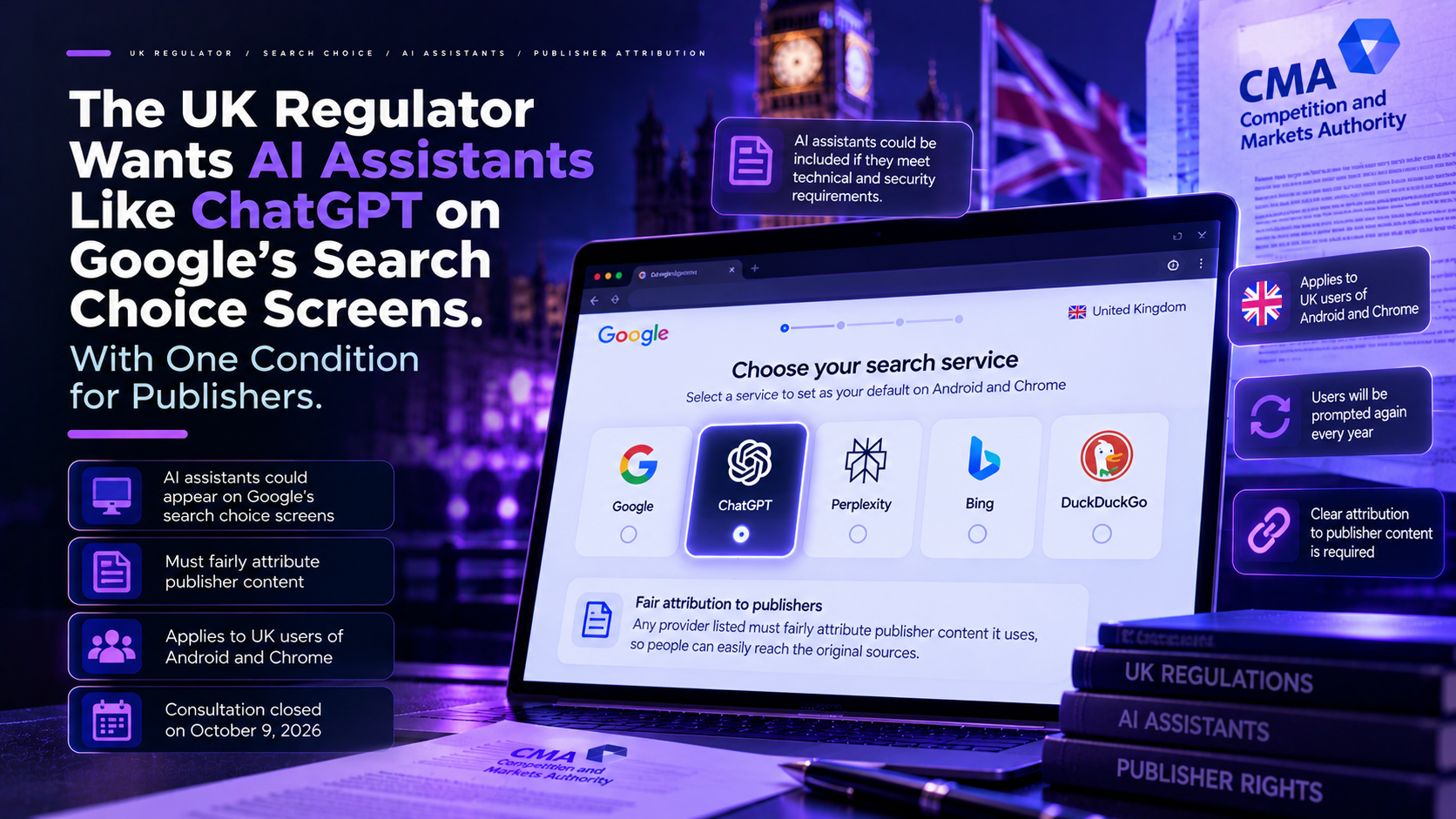
For most of the last two decades, a search choice screen was a way of picking between conventional search engines. A proposal from the UK’s Competition and Markets Authority (CMA) would change that. It would put AI assistants such as ChatGPT and Perplexity on the screens Google shows UK users, and it would attach a condition: any provider listed must fairly attribute the publisher content it uses.
This is a proposal, not a rule, and it applies to the UK only. But it shows a regulator treating AI assistants as search alternatives, and source attribution as a formal requirement. This piece sets out what the CMA proposed, how it would work, what is undecided and what teams responsible for AI visibility should watch.
What the CMA proposed
On September 23, 2026, the CMA published strengthened proposals to give UK users of Google’s Android and Chrome products greater choice and more control over their search services. The CMA says it listened to publishers, search providers and consumer groups, and that the update responds to services such as ChatGPT and Perplexity.
The core elements are these. Google would show Android and Chrome users a choice of search services when they first use an Android phone or open Chrome. Users would be prompted again every year to choose their default. AI assistants could be included on the choice screens if they meet the relevant criteria, including technical and security requirements. And search providers on the screens would have to fairly attribute publisher content when it is used, so that people can easily reach the original sources.
Sarah Cardell, the CMA’s Chief Executive, said the CMA is “responding quickly to the rise of AI assistants”, which people increasingly use as search services but which do not appear on Google’s choice screens today.
The consultation closed at 5pm on October 9, 2026. The CMA expects to make its final decision on this requirement by the end of 2026.
Where this sits in the CMA’s wider approach
Google was designated as having strategic market status in general search and search advertising in October 2025, which lets the CMA set conduct requirements for it. According to the CMA, it imposed publisher controls on June 3, 2026, and fair ranking and data portability requirements on June 17. The user choice requirement is the one still being decided, an updated version of a January 2026 proposal.
How a choice screen would work
The press release gives the outline. The CMA’s consultation document, which runs to 71 pages according to PPC Land, holds the detail. We could not open that PDF, so the following comes from two independent analyses of it, by the trade publication PPC Land and by the law firm Bratby Law, which agree on the main points.
According to those analyses, the screen would list up to 12 providers. If more than 12 qualify, Google would be expected to show the five most popular plus seven chosen at random. Providers would appear in random order, and users would have to scroll the whole list before confirming. Users could trial a provider for at least a week. The screen would be unskippable on new Android devices and fresh Chrome installs, and a skippable reminder would bring it back at least once a year.
These details come from analysis of a proposal that may change, so treat them as the current draft.
How an AI assistant could qualify
The CMA says AI assistants “could in theory be able to be listed”, a phrase quoted by Bratby Law from the consultation document. Nothing guarantees a place. Per those analyses, a service would have to meet three criteria.
First, it must adequately address the full range of use cases of a general search service. The CMA’s notes describe four types of query: navigational, transactional, simple informational and more complex informational.
Second, it must provide a functioning general search experience. That covers technical operation, compatibility with Android, minimum security requirements and credible plans to operate sustainably.
Third, a significant proportion of its UK users must consider it a general search service. The notes say this means a meaningful proportion, not a majority.
A service does not need its own web index. A syndicated index is acceptable.
Who decides matters too. Under the proposal, Google, not the CMA, would run the eligibility process every six months, deciding within two months and sending written reasons for any rejection to the applicant and the CMA. Bratby Law notes that the draft contains no appeal route to the CMA against those decisions, and that the written reasons are the main check. That is one lawyer’s reading of a draft.
The condition for publishers
The attribution condition is the part most relevant to anyone who creates content. Per the CMA, search providers on the choice screens would have to fairly attribute publisher content when it is used, so people can easily access the source. In the analyses of the consultation document, any generative AI summary would have to attribute web content clearly and accurately, with a clear route to the source, and each provider could choose how to do it.
Three points deserve care.
The condition is a requirement of being listed on the screen, not a general rule for all AI products. Because the CMA can impose requirements only on Google, it works as a condition of access to Google’s distribution. Bratby Law argues that it therefore becomes a de facto standard for any rival that wants a place, though that is the author’s view.
The condition does not, in anything we reviewed, require payment to publishers or guarantee any amount of traffic. It concerns attribution and a way to reach the source.
How it would be enforced, and how fairness or accuracy would be judged, are not set out in the press release. Watch the final text.
What is not decided
A lot remains open. The requirement has not been imposed, and the criteria, slots, attribution wording and timing could all change after consultation responses. Google has not commented, according to press reports.
Timing is also uncertain. The final decision is expected by the end of 2026. According to PPC Land’s reading, some obligations would start about a month after the requirement is imposed, and the rest within six months, so screens showing AI assistants may not reach UK users until some time after that. Do not plan around a date.
Geography matters too. This is UK law, covering UK users of Android and Chrome. It changes nothing for users in the United States, so for mainly American clients it is a signal to watch, not a task for this quarter.
Why teams working on AI visibility should watch it
There are three reasons.
AI assistants are being treated as search. The CMA describes them as increasingly used as search services and wants them offered as alternatives. For anyone working on generative engine optimization, that confirms what many teams assume: visibility in AI answers is becoming part of search visibility, in the eyes of regulators as well as users.
Attribution is becoming a formal concept. If a regulator makes fair attribution a condition for AI assistants to reach users, it normalizes the idea that answers should point back to sources. That could affect how assistants display citations over time, but it is a possibility, and we found no evidence yet of any change.
Distribution could shift. If more UK users chose an assistant, more searches might begin there, which would raise the importance of answer engine optimization, being cited and recommended in AI answers. That is a scenario. The proposal does not say how many people would pick an assistant.
None of this reduces the value of traditional search engine optimization. The sensible view is that search is widening, not being replaced.
What to do now
You do not need to change strategy because of a consultation. A few low-cost steps keep you ready.
Measure AI referrals now. Check your analytics for traffic from ChatGPT, Perplexity, Gemini and other assistants, and note how it changes. A baseline lets you see any shift later, whatever the cause.
Make attribution easy. Use clear titles, visible authorship and dates, stable canonical URLs and descriptive headings, so any assistant that wants to credit you can do so accurately.
Check how you are cited. Run real customer questions in several assistants and record whether your brand and pages appear and are attributed correctly. A free AI Visibility Audit does this across platforms.
Keep your source pages strong. Pages that answer a specific question clearly and carry original information are the likeliest to be cited, which is the same work that supports search engine optimization and generative engine optimization.
For UK clients, set a review date. Look again when the CMA publishes its decision, and read the final attribution wording before advising anyone.
Where this leaves you
The confirmed facts are these. On September 23, 2026, the CMA proposed that Google show Android and Chrome users in the UK a choice of search services at first use and prompt them annually. AI assistants could be listed if they meet the criteria, and providers listed would have to fairly attribute publisher content. The consultation closed on October 9, and a final decision is expected by the end of 2026. It is a proposal for the UK only.
The lasting lesson is about direction. Regulators are beginning to treat AI assistants as search services, and attribution as something that can be required, which matters for answer engine optimization planning. For teams reviewing how a brand appears in AI answers, that is a reason to measure now and watch the final wording.
Frequently Asked Questions
1. What did the CMA propose on September 23, 2026?
It proposed that Google show UK users of Android and Chrome a choice of search services at first use and prompt them again every year. AI assistants could be listed if they meet the criteria, and listed providers would have to fairly attribute publisher content.
2. Is this a final rule?
No. It is a proposed conduct requirement. The consultation closed on October 9, 2026, and the CMA expects to make its final decision by the end of 2026.
3. Will ChatGPT and Perplexity definitely appear on the screens?
No. The CMA says assistants could be listed if they meet the criteria, and analyses of the proposal describe three: covering the full range of search queries, providing a functioning search experience and being considered a general search service by a significant proportion of UK users.
4. Who decides which services are listed?
Under the proposal, Google decides, through an eligibility process every six months, with written reasons for rejections sent to the applicant and the CMA. Bratby Law notes that the draft contains no appeal route to the CMA.
5. What does the attribution condition require?
Providers on the screen would have to fairly attribute publisher content when it is used, so users can reach the original source. Analyses of the consultation document say generative AI summaries must attribute web content clearly and accurately. We found no requirement for payment or traffic.
6. Does this affect businesses outside the UK?
Not directly. It applies to UK users of Android and Chrome, but it signals how regulators are treating AI assistants and attribution.
7. What should I do about it now?
Measure traffic from AI assistants, make your pages easy to attribute and check how assistants cite you. Review again when the CMA publishes its final decision, rather than changing strategy on a proposal.
If you want to know how your brand appears across Google and AI answer engines today, that is exactly what we look at in a free AI Visibility Audit.

Related Reading
 96% of IT Leaders Say Their AI Agent Inventory Is Complete. Two in Three Had an Agent Incident Anyway.
 Google Is Testing AI Overviews Inside Local Business Profiles. What Local Businesses Should Check Now.
 Google Switched On Checkout Inside AI Mode for Eligible Shopify Stores. Here Is What It Changes for Your Measurement.