This is the third piece in our series on how AI platforms decide who gets cited. The first looked at how much AI referral traffic ChatGPT controls. The second looked at how selective it is about which sources it trusts. This one asks the practical follow-up: if two of the biggest AI platforms disagree this much about sources, what does that do to the way you measure visibility?
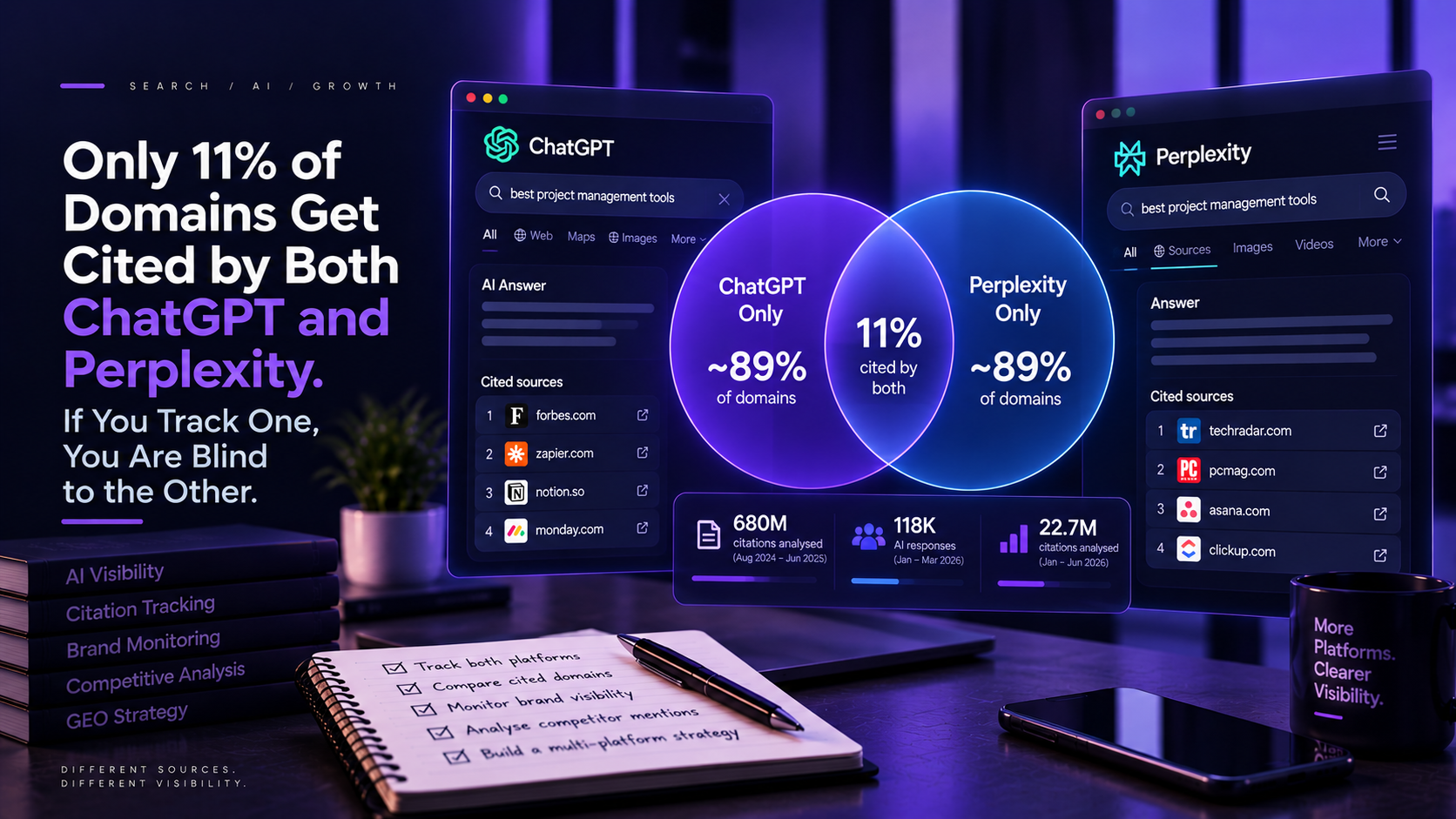
The headline number is that only about 11% of domains are cited by both ChatGPT and Perplexity. It has been repeated in dozens of articles this year, usually with a sentence claiming that single-platform tracking leaves 89% of your visibility invisible. That last part goes further than the data supports. The 11% figure is real and worth acting on, but it is also easy to misread, and several of the studies stacked underneath it measure different things. Here is what each one actually found, and what it means for how you track your brand.
Where the 11% comes from
The figure appears in three related but distinct places, and they are not the same study repeated three times.
The first is a dataset of 680 million citations covering August 2024 to June 2025, analyzed by Profound and cited in Averi’s B2B SaaS benchmark report. Averi’s report states that only 11% of domains are cited by both ChatGPT and Perplexity. Worth noting: the 680 million analysis is Profound’s work, and Averi uses it as a supporting reference rather than presenting original research of its own. Several articles online attribute the analysis to Averi directly, which is a small but real attribution error.
The second is a Qwairy analysis of 118,000 AI responses collected between January and March 2026 across ChatGPT, Perplexity, Google AI Mode, and Claude, which Whitehat SEO cites in its own comparison. It found that only 11% of cited domains appeared across multiple platforms. That is a slightly different measurement from the first one. It looks across four platforms at once instead of comparing ChatGPT and Perplexity as a pair, so the matching 11% is a coincidence of two different methods, not one result confirmed twice.
The third is a Wellows study of 22.7 million citations across 1.15 million questions, covering January to June 2026. It approaches the same question from the opposite direction and reports that 89% of websites ChatGPT cited on a given question were never cited by Perplexity on that same question. That is essentially the mirror image of the 11% figure, measured at the website level, on identical questions.
So three datasets, three time windows, and two different definitions of overlap all point the same way: the two platforms draw on substantially different sets of sources. That agreement is the meaningful finding. The exact percentage matters less than the direction.
What the 11% does and does not mean
Now for the overreach. A low overlap between two platforms’ cited domains does not mean 89% of your potential visibility is hidden from you. Authority Tech, which curates and compares these studies, states explicitly that the figure does not imply that. There are three reasons.
First, the overlap is measured across all domains cited, not across your domain. Your brand could appear consistently on both platforms while the rest of the web fragments around you. The 11% describes the whole citation landscape, and your own footprint inside it is a separate question.
Second, Wellows itself is careful about this. Its authors describe the gap as a different candidate pool rather than a more unpredictable engine, and they point out that the number measures which sources answer a particular question, not which websites are permanently available to each platform.
Third, overlap depends heavily on how strictly you match. Wellows reports different results at website level, page level, and with different levels of address cleanup. A percentage that moves that much with the matching rule should be read as a range, not a fixed law.
The accurate version of the claim is narrower and still useful: if you only measure one platform, you are measuring a different slice of the web than the one your buyers see on the other. That alone is reason enough to change how you track.
A different 12% that gets mixed in
Ahrefs published a widely quoted 12% figure that often gets bundled into this conversation, and it deserves separating out. Ahrefs analyzed 15,000 long-tail queries in a study published on August 11, 2025, and found that only 12% of URLs cited by ChatGPT, Gemini, and Copilot also ranked in Google’s top 10 for the same prompt. The measurement compares AI citations with Google rankings. It does not compare one AI platform with another.
The Ahrefs data does contain a useful platform-level detail, though. Perplexity’s overlap with Google’s top 10 was 28.6%, far higher than ChatGPT at around 8%. So Perplexity leans on pages that also rank well in traditional search, while ChatGPT draws more heavily from pages that do not. Placed next to the 11% cross-platform figure, that goes a long way toward explaining why the two platforms disagree. They are retrieving from different places.
For anyone doing search engine optimization alongside AI visibility work, this is the important takeaway. Ranking well in Google helps you with Perplexity noticeably more than it helps you with ChatGPT. Treating them as one channel with one strategy will over-serve one and under-serve the other.
The same brand, very different results
Two more datasets show what this looks like at the brand level, and both are better evidence for multi-platform tracking than the 11% headline.
Superlines analyzed 34,234 AI responses across 10 platforms between January 14 and February 13, 2026, and reported a 615x gap in citation volume between the highest-citing platform, Grok at a 27.01% citation rate, and the lowest, Claude, at close to zero. The number is striking, but it needs context. It reflects how differently each platform handles linking out to commercial brand sites, which is partly a product design difference and not purely a measure of how much each platform likes any given brand.
Slate HQ published a 90-day study on March 30, 2026, tracking six B2B SaaS brands across ChatGPT, Perplexity, Gemini, Claude, Google AI Overview, and Google AI Mode, with more than 300,000 citation data points. Its central finding is that 76.3% of all citations went to domains that were neither the brand nor its direct competitors. Most of the visibility lives on third-party sources.
The per-platform breakdown Slate published for one email security client illustrates the spread. Brand-owned citation share was 10.2% on Google AI Mode, 10.0% on Google AI Overview, 9.1% on Claude, 6.9% on Gemini, 6.8% on Perplexity, and 4.5% on ChatGPT. Those are the numbers for one client, not an average across all six brands, and it would be wrong to say ChatGPT was the weakest platform for every company studied. But the spread within that single brand, more than double between the highest and lowest platform, makes the point clear. The same company can look strong on one platform and weak on another during the same 90 days.
Slate also found that Claude had the narrowest external source pool at 54% unidentified sources, while Perplexity cast the widest net at 67.7%. Different platforms are not just citing different pages. They are behaving differently in how broadly they search.
What to do with this
The practical response is not to panic about an invisible 89%. It is to stop treating AI visibility as a single number.
Track each platform separately. A blended score hides exactly the variation the studies above describe. At a minimum, report ChatGPT, Perplexity, Google AI Overviews, and Claude as separate lines, and watch each for movement independently. This is the foundation of any serious generative engine optimization program.
Identify which sources each platform trusts in your category. Since most citations go to third-party domains, your visibility depends on where you are mentioned as much as on what you publish. Check which review sites, directories, and community platforms each engine leans on for your topics, then look at whether you are present there.
Match your optimization to the platform. Because Perplexity correlates more strongly with Google rankings, traditional ranking work supports it. ChatGPT draws from a broader mix, so entity clarity, third-party mentions, and presence on the sources it favors carry more weight. This is where generative engine optimization and answer engine optimization diverge in practice, even though they are often discussed as one thing.
Set a baseline before changing anything. Record your citation presence per platform for a fixed set of prompts this week, then repeat monthly. Without a starting point, you cannot tell whether a change came from your work or from platform variability.
Treat every overlap statistic as a range. Different matching rules produce different percentages, and the sample sizes, time windows, and definitions vary. Use the studies to understand direction, then validate against your own prompts.
Where this leaves you
Only 11% of domains being cited by both platforms is a real signal, backed by three independent datasets using different methods. It does not mean 89% of your visibility is lost, and it is not the same as the Ahrefs 12% figure, which compares AI citations with Google rankings. What it does show is that ChatGPT and Perplexity behave like separate channels with separate source preferences, and that measurement built around one will miss what the other is doing. Track them separately, benchmark against a baseline, and treat the percentages as direction, not precision. That is the discipline answer engine optimization now demands.
Frequently Asked Questions
1. Is it true that only 11% of domains are cited by both ChatGPT and Perplexity?
Answer: Yes, that figure appears in several studies, including a 680 million citation dataset analyzed by Profound and a Qwairy analysis of 118,000 responses. Definitions differ slightly between studies, so treat 11% as an approximate indicator of low overlap, not an exact constant.
2. Does this mean 89% of my AI visibility is hidden if I only track one platform?
Answer: Not exactly. The 11% describes overlap across all cited domains, not your own brand. It does show that each platform draws on a different pool of sources, so single-platform tracking gives you an incomplete picture.
3. Is the Ahrefs 12% the same statistic?
Answer: No. Ahrefs found that only 12% of URLs cited by ChatGPT, Gemini, and Copilot also rank in Google’s top 10 for the same prompt. That compares AI citations with Google rankings, not one AI platform with another.
4. Which platform gives brands the highest citation share?
Answer: It depends on the brand and category. In Slate HQ’s example for one email security client, Google AI Mode and AI Overview were highest and ChatGPT was lowest. That is a single-client result and should not be generalized to every company.
5. What does the 615x citation gap mean?
Answer: Superlines found a 615x difference in citation volume between the highest platform, Grok, and the lowest, Claude, across 34,234 responses. It reflects how differently platforms link to commercial sites, so it shows platform behavior more than brand preference.
6. What should I track first?
Answer: Start with a fixed list of prompts your buyers actually ask, then record whether your brand is cited on ChatGPT, Perplexity, Google AI Overviews, and Claude separately. Repeat monthly and compare against that baseline.
If you want to see where your brand stands on each platform, not just one, that is exactly what we cover in a free AI Visibility Audit.
Related Reading



Recent Posts
 ChatGPT and Claude Cite Earned Media About 93% of the Time in Product Research. Your Own Website Barely Registers.
 Google Is Now Hiding the Real Links in Its Search Results, and What It Breaks, and What It Doesn’t
 Google’s AI Overviews Now Expand Automatically. The “Show More” Button Is Disappearing.