
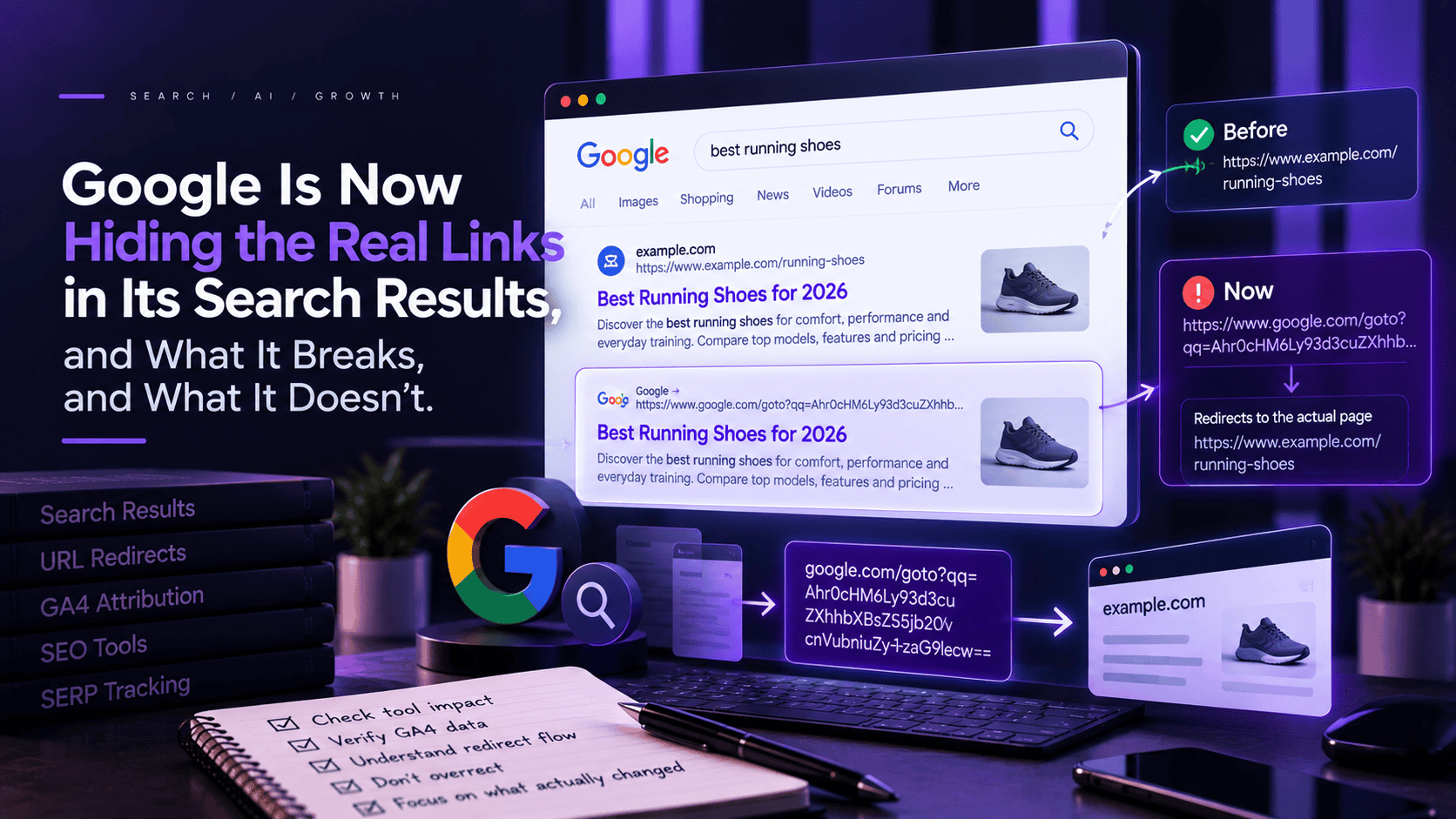
On August 26, a Google spokesperson confirmed what SEOs had already been spotting in the wild since late June. Search result links are being rewritten to route through google.com/goto before landing on the actual destination page. Google’s stated reason was procedural: it said it regularly deploys technical measures to protect its services and users from evolving abuse. This sits alongside a separate legal fight, Google’s suit against SerpAPI, first filed in July and amended in August, over how that company accesses Google’s search results.
That much is confirmed. What happens after that point, in coverage of this story, splits into two very different camps, and it is worth being precise about which claims are actually settled and which ones are not before you act on either.
What actually changed, mechanically
Instead of a result linking straight to a destination page, the link now points to google.com/goto, with the destination URL encoded using Protocol Buffers, Google’s own binary data format. A server-side redirect on Google’s end then forwards the visitor to the real page. For a person clicking a result, nothing looks different. They click, they land where they expected. What changed sits entirely underneath that click, in a URL structure that any tool reading destination links now has to parse differently than before.
Third-party tools that read destination URLs directly took the first hit, and here the evidence is solid because the vendors themselves reported it. SerpAPI confirmed impact across several of its products. Ahrefs confirmed what it called a temporary inconsistency in its data. One rank-tracking vendor documented a real six-day window, August 26 through September 2, where its Share of Voice reporting misattributed clicks because its parser was not reading the new format correctly. That has since been fixed, with the affected data being backfilled for customers.
Not every tool broke the same way, and this is worth sitting with for a moment. SE Ranking and Semrush both confirmed no impact on their own position tracking data at all. So the blanket claim that the /goto redirect broke SEO tools is not quite accurate. Some tools broke. Others, reading the exact same search results pages, did not, which suggests the difference has more to do with how each vendor’s parser was originally built than with the redirect itself being universally disruptive.
Where the coverage actually splits
Here is where a real divide appears. Several sources treat GA4 organic-to-direct misattribution as an established, active problem, describing what one piece called “massive organic attribution data loss” and sudden, unexplained spikes in Direct traffic. That framing has spread fast, because it is the scariest possible read of a genuinely technical, genuinely unresolved situation, and alarming framing tends to travel faster online than careful, hedged framing ever does.
Now look at what the more carefully sourced coverage actually says. As of late August, one detailed technical write-up stated plainly that nobody had reported confirmed organic undercounting inside GA4. A separate analysis went further and ran an actual test across ten device and browser combinations, checking whether referrer data survived the redirect chain. It found the referrer stayed intact in every case, and GA4 correctly classified those sessions as Organic Search each time. Multiple outlets, working independently of each other, land on the same conclusion. Google has not confirmed a GA4 attribution impact, and the direct evidence gathered so far does not show one either.
None of that means the concern is baseless. The mechanism Google’s own documentation describes makes an attribution gap plausible in principle. If a redirect chain ever strips referrer data before it reaches your site, GA4’s fallback logic would file that session as Direct rather than Organic Search, silently, with no alert generated anywhere in your dashboard. That is a real risk worth watching closely. It is not the same thing as a confirmed, ongoing problem, and treating it as something that has already happened is exactly the kind of overstatement that risks needing a correction once more data actually comes in, one way or the other.
Why the distinction actually matters
It would be easy to read the last two sections and conclude the difference between disputed and confirmed is mostly semantic. It is not, and the practical stakes are worth spelling out.
If a team reacts to this as a confirmed GA4 problem, the natural response is to start second-guessing every organic traffic number reported for the past month, which burns real time reconciling data against a theory that current testing does not support. Budget conversations get harder to have with confidence when the underlying numbers are being treated as suspect without evidence. Reporting to a client or a leadership team gets shakier too, since telling a room that your organic numbers might be wrong because of a redirect Google has not confirmed affects attribution is not a comfortable thing to say out loud in a review meeting.
If a team instead treats this as a plausible, unconfirmed risk worth monitoring, the response looks completely different. You set a baseline, you watch two specific ratios over the following weeks, and you keep operating normally in the meantime rather than freezing decisions around a risk that has not actually materialized in the testing done so far. That is the more defensible position given what is currently known, and it is also simply less exhausting to maintain.
A second, less-discussed layer
There is a second angle here that is easy to miss if you are only thinking about traditional search engine optimization reporting. Reports say /goto-wrapped URLs are starting to show up as cited sources inside ChatGPT, Perplexity, and Claude, wherever those systems pull from Google’s search results as part of answering a query. If a citation-tracking tool has the same blind spot rank trackers had in late August, before their parsers caught up, the same kind of silent misattribution could in theory apply to AI citation counts, not only to GA4 sessions.
Nobody has published confirmed data on this specifically yet either. It follows the same underlying mechanism, and the same caution about calling something confirmed before the evidence is actually in applies here just as much. This is precisely the kind of gap that generative engine optimization and answer engine optimization work now has to account for. Visibility inside an AI answer is only useful if you can actually measure it, and a measurement tool with an unpatched blind spot will quietly undercount exposure it should be reporting, in exactly the way several rank trackers briefly did in late August.
Setting a baseline instead of guessing
The sensible response to a disputed, plausible-but-unconfirmed risk is not to panic and it is not to ignore it. It is to set a baseline now, so that if this ever does show up in your own data, you catch it immediately instead of noticing it months later as an unexplained trend with no starting point to compare against.
Record this week’s ratio of Search Console clicks to GA4 organic sessions for your key properties, and write the number down somewhere you will actually revisit. Do the same for your current organic-to-direct traffic split. These two figures are your tripwire. If either one moves meaningfully in the weeks ahead with nothing else in your setup changing, that is your signal to look closer, rather than reacting to someone else’s alarmed blog post as though it were your own data.
Reconcile Search Console against GA4 weekly for the next month, instead of your usual monthly cadence. A real attribution gap, if one exists, would show up as a widening divergence between the two figures over time, not as a single dramatic jump you would notice immediately anyway.
Check your GA4 referral exclusion list for any new entries appearing as google.com/goto. If Google’s own redirect domain starts showing up there as a distinct referral source, rather than resolving cleanly through to Organic Search, add it to your exclusions so it does not fragment your organic channel into two separate, harder-to-reconcile pieces.
Hold off on reacting to a rank-tracker alert this week unless you have confirmed that specific tool already adjusted its parser to read the new /goto format correctly. Given that SE Ranking and Semrush reported no impact while SerpAPI and Ahrefs did, an alert from a tool that has not caught up yet is more likely a parsing problem on their end than an actual ranking change on your site.
And if you are already doing any AI visibility tracking, apply the same caution to what you see there. A cited source appearing as a raw /goto link rather than a resolved domain in your reporting is a sign your tool needs to catch up, not evidence that your underlying citation count has actually changed.
Where this leaves you
Google confirmed the redirect itself on August 26. It has not been confirmed, and the direct testing done so far does not support a GA4 attribution problem. Some SEO tools broke, others did not, and the ones that did have mostly already fixed their parsers by now. The plausible risk to your own analytics is real enough to baseline and monitor closely. It is not, as of this writing, a confirmed, active problem serious enough to justify the level of alarm some coverage is giving it, and treating an unconfirmed risk as settled fact is its own kind of mistake, one that tends to send teams chasing a problem that is not actually there yet while a genuinely useful baselining exercise gets skipped entirely.
Frequently Asked Questions
1. Is Google’s /goto redirect confirmed?
Answer: Yes. A Google spokesperson confirmed the rollout on August 26 and described it as a technical measure to protect Google’s services and users from evolving abuse. The rollout itself is not in dispute anywhere in the coverage. What remains unsettled is how far its effects reach.
2. Is my GA4 organic traffic being misattributed because of it?
Answer: Not as far as anyone has confirmed. Google has not acknowledged a GA4 attribution impact, and one technical test across ten device and browser combinations found referrer data stayed intact, with sessions classified as Organic Search. The risk is plausible in principle, so it is worth monitoring, but it is not a confirmed problem.
3. Why is my rank tracker showing odd data?
Answer: It depends on the tool. SerpAPI and Ahrefs confirmed some impact, with Ahrefs calling it a temporary inconsistency, while SE Ranking and Semrush confirmed none. Check whether your vendor has published a statement or a fix before assuming your rankings actually moved.
4. Does this affect AI citation tracking?
Answer: Possibly, but nothing is confirmed. /goto-wrapped links are reportedly appearing as cited sources in ChatGPT, Perplexity, and Claude. A tool that cannot parse them could undercount your citations. Treat any sudden citation drop as a possible tracking issue first, and verify it manually.
5. What should I check first?
Answer: Record this week’s ratio of Search Console clicks to GA4 organic sessions, plus your organic-to-direct traffic split. These two numbers are your baseline. If either shifts meaningfully with nothing else changing, investigate then.
6. How often should I reconcile Search Console and GA4?
Answer: Weekly for the next month, instead of monthly. A genuine attribution gap would show up as a widening divergence between the two over several weeks, not as a single sudden jump.
7. Should I change my SEO strategy because of this?
Answer: No. Nothing about the redirect changes how rankings are earned. Keep your strategy as it is, baseline your data, and update only if a confirmed impact emerges.
If you want a second set of eyes on whether your own reporting, or your AI visibility specifically, is being affected, that is exactly what we check in a free AI Visibility Audit.
Related Reading



Recent Posts
 ChatGPT and Claude Cite Earned Media About 93% of the Time in Product Research. Your Own Website Barely Registers.
 Only 11% of Domains Get Cited by Both ChatGPT and Perplexity. If You Track One, You Are Blind to the Other.
 Google’s AI Overviews Now Expand Automatically. The “Show More” Button Is Disappearing.