Telecom and IT software with AI network systems support scale, reliability, and customer service automation for telecom companies managing massive call and ticket volume. IT and telecommunications reached 38% AI adoption in 2025, and the sector projects $4.7 trillion in gross value added through AI by 2035. Foreignerds builds systems for that trajectory, focused on reliability metrics that actually affect churn, not just cost reduction.
Tell us what's going on — a real person replies within 1 business day, not an autoresponder.
That approach produces systems that work in a demo and buckle under real production traffic.
We build telecom and IT systems around genuine reliability and scale — because in an industry where virtual assistants already handle 65% of initial customer inquiries at major providers, the systems behind that automation need production-grade engineering, not a prototype.
Get a Real Assessment of Your Project →This is built for telecom and IT operations leaders and customer-experience directors who need AI systems built for genuine production-scale reliability, not a prototype that works in a demo and fails under real traffic.
The technology and communications sector accounts for 32% of the global AI market — the single largest sector share of any industry measured, ahead of automotive (29%), financial services (28%), energy (27%), and media/entertainment (22%). IT and telecom specifically have reached 38% AI adoption as of 2025.
The customer-experience case is concrete: virtual assistants now handle approximately 65% of initial customer inquiries across major telecom providers, positioning customer experience as the second most widely implemented AI application after network optimization. Industry-wide alliances like the AI-RAN Alliance have formed specifically to accelerate the fusion of AI and cellular network technology. The most widespread current application is network optimization — AI systems automatically adjusting network resources based on real-time usage patterns, a genuinely operational (not just customer-facing) use case that's become foundational infrastructure rather than an emerging experiment in this sector.
It makes sense when: your customer-service operation still relies heavily on manual handling of routine inquiries that AI-driven virtual assistants now handle at scale industry-wide; your network operations lack real-time, AI-driven resource optimization; or your current digital presence isn't showing up when business customers research telecom or IT service providers through AI assistants directly.
It's equally worth being honest about when this is premature. A very small IT services firm with limited customer volume may get more value from foundational systems before investing in advanced network-scale AI infrastructure built for a different scale of operation. A useful gut check: if your current systems can't handle real-time data at meaningful scale, AI layered on top will inherit that limitation, not fix it. What Happens If You Wait: There's no single dramatic failure point — most telecom and IT organizations don't notice a specific customer or efficiency loss traceable to slower AI adoption in real time. The gap compounds quietly instead: with this sector projecting $4.7 trillion in gross value addition through AI by 2035, organizations moving now are positioning ahead of a genuinely massive, structural value shift, not chasing an incremental trend. The customer-experience gap is a live, current cost: with virtual assistants already handling 65% of initial inquiries at major providers, organizations still relying primarily on manual customer service are operating at a real cost and response-time disadvantage against competitors who've already automated this layer at scale.
Network optimization and resource-allocation systems built on real-time usage data, the sector's most widespread current AI application, supported industry-wide by alliances like the AI-RAN Alliance formed specifically to accelerate AI-cellular technology fusion. Selected from Foreignerds' full service catalog based on genuine Telecom & IT relevance — not a generic list reused across every industry page.
Customer-inquiry handling at scale, following the documented pattern where virtual assistants now resolve 65% of initial inquiries at major providers. Custom Software Development & Enterprise Software Development — network management, billing, and internal operational platforms built for genuine production scale.
Real integration with existing network-management and customer-service infrastructure, not standalone tools. Managed IT Services & DevOps Consulting — the reliability and uptime discipline appropriate for telecom-scale operations.
For telecom and IT providers competing for both consumer and business customer search. Generative Engine Optimization (GEO) & Answer Engine Optimization (AEO) — positioning for business customers researching telecom and IT providers through AI assistants.
A direct diagnostic of how your company appears when potential customers ask AI assistants for telecom or IT service recommendations. AI Security Consulting — increasingly material given generative AI adoption in telecom cybersecurity strategies is itself a growing, distinct application area.
Network management and telecom infrastructure integrations. AI/ML platforms for real-time network optimization and resource allocation. Conversational AI for high-volume customer-inquiry handling, built for production-scale reliability. Telecom/IT-specific SEO, GEO, AEO, AI Visibility Audit tooling, and AI security consulting.
The scale pattern is the real, documented lever: technology and communications holds 32% of the global AI market, the largest of any sector, and this sector alone is projected to add $4.7 trillion in gross value through AI by 2035 — organizations moving now are positioning ahead of a structural value shift.
Business customers researching telecom and IT service providers increasingly use AI assistants during vendor evaluation, following the same broader B2B research-behavior shift affecting procurement generally across other industries covered in this research. This changes what needs to be true about a telecom or IT provider's online presence. Traditional SEO optimizes to rank in search results for service categories. GEO and AEO optimize for being the source an AI system cites or recommends when a business customer asks about specific telecom or IT capabilities directly — genuinely different from how this industry has traditionally marketed through direct sales and channel partnerships alone.
This is currently the single most AI-adoptive sector measured in this research.
This is currently the single most AI-adoptive sector measured in this research — technology/communications holds 32% of the global AI market, the largest of any industry, with telecom/IT specifically at 38% adoption. Network optimization is the most widespread application, reflecting AI's move into foundational operational infrastructure rather than experimental customer-facing features alone.
The projected structural value shift is genuinely large: this sector alone is projected to add $4.7 trillion in gross value through AI implementations by 2035 — among the largest sector-specific AI value projections in this research, reflecting both the sector's data-intensive nature and its position at the infrastructure layer other industries increasingly depend on.
Tell us what's going on in one line — we'll take it from there.
Telecommunications carriers and interconnected VoIP providers are directly subject to FCC rules under Section 222 of the Communications Act, requiring reasonable safeguards for Customer Proprietary Network Information (CPNI), breach notification to consumers and law enforcement, and annual compliance certification. Any AI system processing customer usage or network data must be architected with CPNI protections built in, not added after the fact.
This is a composite, illustrative example built from common, well-documented patterns in telecom and IT AI deployment, not a specific named client.
A mid-size managed IT services provider had customer support handled entirely by a small human team, creating real response-time bottlenecks during peak periods.
Building AI-driven inquiry handling for routine, well-defined requests — with clear escalation to human staff for complex issues — followed the documented industry pattern where virtual assistants now resolve the majority of initial inquiries at major providers, freeing the human team to focus on genuinely complex client needs.
Real operations and scale auditing, production-grade AI systems built for genuine reliability, plus ongoing support and marketing.
Honest evaluation of current customer-experience automation, network or infrastructure optimization needs, and realistic scale requirements.
Production-grade AI systems built for genuine reliability at your real operational scale, integrated with existing network and customer-service infrastructure.
Managed IT and reliability support appropriate for telecom-scale systems, plus B2B customer-acquisition marketing — including GEO/AEO.
Network optimization and large-scale customer-experience automation are the primary current levers.
Client-facing automation and internal operational efficiency, distinct from carrier-scale network needs.
AI-driven service delivery and client-acquisition marketing built around technical credibility.
A genuinely distinct AI adoption pattern given real-time resource allocation and reliability requirements.
A growing, distinct application area given rising generative AI adoption specifically within telecom and IT cybersecurity strategies.
Producing systems that work in a demo and fail under real traffic volume.
Rather than the sector's most widespread current AI application, falling behind competitors who've already made it foundational.
Damaging trust in an industry where reliability is existential.
Despite generative AI adoption in telecom cybersecurity strategies being a real, growing, distinct application area.
Even as business buyers increasingly evaluate providers through AI assistants.
When managed IT providers and smaller telecom-adjacent businesses can access comparable capability through the right integration approach.
Selected per project based on the task — not a fixed default stack.
Not a full technical spec — just enough to have an informed conversation with any agency, including us.
If two or more of these are true, this is very likely worth exploring.
These four questions are worth answering honestly before any AI investment — the audit will help you answer them with certainty.
We don't list a price here for the same reason across every page: a number before an assessment is a guess, and in telecom and IT specifically, scope depends heavily on operational scale and reliability requirements. Your actual scope will determine cost after the audit.
Claim Your Free Telecom & IT AI Visibility Audit
Yes — real integration work is core to these projects. Scope depends on your specific infrastructure.
Yes, with real evidence — virtual assistants already handle approximately 65% of initial inquiries at major telecom providers, though this requires production-grade engineering, not a prototype-level chatbot.
Reliability-first, production-scale development, not general competence applied to an industry with genuinely different uptime and performance requirements.
We'll tell you honestly whether AI-driven customer-experience automation is genuinely worthwhile at your current scale, rather than selling infrastructure ahead of real need.
Depends heavily on operational scale and reliability requirements — the audit in Week 1 gives an honest, specific timeline.
Yes — the sub-vertical breakdown above reflects genuinely different needs we scope separately.
Yes — network optimization, where AI systems automatically adjust resources based on real-time usage, is the sector's most widespread current AI application, reflecting genuine operational (not just customer-facing) value.
A real, growing, distinct concern — generative AI adoption within telecom cybersecurity strategies is its own application area, and we scope AI security consulting alongside any customer-facing or network AI we build.
It's the most AI-adoptive sector measured in this research specifically — technology/communications holds 32% of the global AI market, the largest single-sector share of any industry covered.
The AI-RAN Alliance — a real, named industry alliance formed specifically to accelerate the fusion of AI and cellular (Radio Access Network) technology.
GEO is optimizing your content so AI systems cite or recommend your company directly when a business customer researches telecom or IT providers.
AEO structures your content to be pulled as a direct answer by AI-driven search features during B2B provider research.
A direct diagnostic of whether and how your company currently appears when a business customer asks an AI assistant for telecom or IT service recommendations.
Increasingly yes, following the same broader B2B research-behavior shift affecting procurement generally, especially given this sector's own high, 38% AI adoption rate shaping buyer expectations.
Directly — reliability and technical credibility are central to provider selection in this industry, and AI systems weigh these signals when forming recommendations.
Yes — B2B research behavior is shifting broadly, and smaller providers invisible to AI discovery risk losing exactly the consideration set larger competitors are already capturing.
Through recurring AI Visibility Audits tracking citation and recommendation frequency, alongside traditional B2B lead-generation metrics.
Yes, under one roof — network/customer-experience AI, SEO, GEO/AEO, and AI Visibility auditing together.
Not anymore — B2B provider-research behavior is shifting broadly, following the same pattern seen across other procurement-driven industries.
Book a call — the audit gives you an honest picture of your current AI-adoption maturity, reliability engineering, and AI search visibility.
Real projects. Real, sourced results.
Delivered telecom, IT, and broader AI work sits alongside our 1,250+ project history — verifiable, not invented, and available to discuss specifically on the call.
15-20 minutes, focused on your actual situation, not a generic pitch.
15-20 minutes, focused on your actual situation, not a generic pitch.
We tell you honestly if foundational work needs to happen before AI adds real value.
You leave with a specific, scoped next step — not a vague proposal.
100+ case studies live here

-90% Monitoring Time (15 hrs → 1.5 hrs)
View Case Study →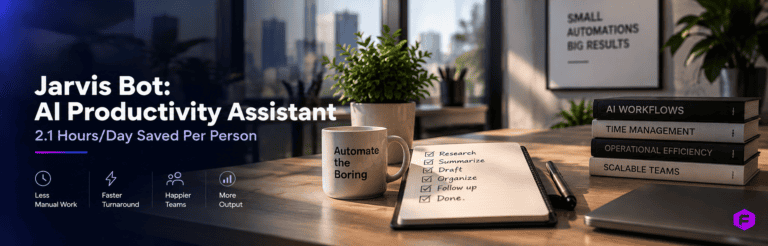
2.1 hrs Admin Time Saved Per Person/Day
View Case Study →
-70% Search Time Reduction
View Case Study →
10x Screening Capacity Increase
View Case Study →