HR and recruitment software with AI talent systems support candidate screening, matching, and hiring workflows for recruiting teams under pressure to fill roles faster. 87% of companies now use AI in recruitment, though 26% of recruiters still believe AI recruitment could harm the profession's human judgment. Foreignerds builds systems that balance that speed against real trust concerns, keeping a recruiter in the decision loop, not replaced by it.
Tell us what's going on — a real person replies within 1 business day, not an autoresponder.
That approach produces systems that move fast and create real legal and reputational exposure the moment a candidate challenges a rejection.
We build recruitment AI around real fairness and audit-trail infrastructure, not just speed — because 58% of HR departments now use AI for resume screening, up from 35% in 2023, and the acceleration only helps if it's defensible.
Get a Real Assessment of Your Project →This is built for HR leaders, staffing agency owners, and talent-acquisition directors who are already using AI informally in parts of their process but haven't built the systematic, bias-aware infrastructure that separates measured time and cost savings from a tool that quietly introduces new risk.
The AI-in-HR-recruitment segment generated $206.4 million in revenue globally in 2022, projected to reach $323.2 million by 2030. North America leads AI adoption for HR processes, delivering an average 40% cost reduction in HR processes, with Europe close behind at 36%.
Adoption at the enterprise level is now near-universal: 99% of Fortune 500 companies currently use AI recruitment methods, and 65% of recruiters broadly use them. More than 73% of companies plan to invest further in recruitment automation, and documented benefits include time savings (67% of adopters), bias reduction (43%), and higher interview success rates (14%). The honest tension in this data is real and worth naming directly: even as adoption accelerates, 26% of recruiters believe AI recruitment could potentially harm the HR industry, and 89% of HR professionals recognize genuine risks alongside the benefits. This isn't a fringe concern — it reflects a real, split professional judgment about how fast to move, which is exactly why bias-tested, auditable systems matter more here than speed alone.
It makes sense when: your screening or interview-scheduling process is consuming hours that could go toward higher-value candidate engagement; your current AI tools (if any) lack documented bias testing in an environment where regulatory scrutiny of algorithmic hiring is increasing; or your current digital presence isn't showing up when candidates or client companies research staffing and HR partners through AI assistants.
It's equally worth being honest about when this is premature. A very small HR team with low hiring volume may get more value from foundational process improvements before investing in advanced AI screening infrastructure built for higher volume. A useful gut check: if you can't currently document how a hiring decision was reached, adding AI on top will make that transparency gap worse, not better. What Happens If You Wait: There's no single dramatic failure point — most HR teams don't notice a specific discrimination claim traceable to an unaudited AI tool until it happens. The gap compounds quietly instead: 58% of HR departments now screen resumes with AI, up from 35% in 2023, meaning organizations without documented bias-testing are operating in an increasingly scrutinized regulatory environment with every hire. The competitive-speed case is real too: 99% of Fortune 500 companies already use AI recruitment methods, and time savings reported by 67% of adopters translate directly into faster time-to-hire against competitors still running fully manual screening. Every hiring cycle without automation is a cycle where competitors with faster funnels are winning candidates first.
Resume screening and candidate-scoring systems built with documented bias-testing, not black-box automation. Selected from Foreignerds' full service catalog based on genuine HR & Recruitment relevance — not a generic list reused across every industry page.
Candidate communication and interview-scheduling automation, addressing the documented time-savings benchmark reported by 67% of adopters. AI Governance Consulting — the bias-audit and compliance infrastructure increasingly required by state and local algorithmic-hiring regulations.
Applicant-tracking and candidate-relationship platforms integrated with existing HR systems, not disconnected point tools. Business Process Automation — administrative HR workflow automation (onboarding, scheduling, documentation) beyond just candidate screening.
For staffing agencies and HR service providers competing for both candidate and client-company search. Generative Engine Optimization (GEO) & Answer Engine Optimization (AEO) — positioning for candidates and hiring companies researching staffing and HR partners through AI assistants.
A direct diagnostic of how your organization appears when candidates or client companies ask AI assistants for recommendations. Reputation Management — directly material given how heavily employer and agency reputation affects both candidate applications and client trust.
Applicant tracking system (ATS) and HR information system (HRIS) integrations. AI/ML platforms for resume screening and candidate scoring, built with documented bias-testing methodology. Conversational AI for candidate communication and interview scheduling. HR/staffing-specific SEO, GEO, AEO, and AI Visibility Audit tooling.
The fairness-and-speed pattern is the real path forward: 67% of adopters report time savings and 43% report bias reduction when screening is built with genuine, documented fairness testing — showing speed and defensibility aren't actually in tension when built correctly from the start.
Candidates and hiring companies increasingly research staffing agencies and HR service providers through AI assistants during the vendor-evaluation process, following the same broader B2B and consumer research-behavior shift affecting procurement and job-search generally. This changes what needs to be true about an HR or staffing organization's online presence. Traditional SEO optimizes to rank in search results for staffing services. GEO and AEO optimize for being the source an AI system cites or recommends when a candidate or hiring manager asks about staffing or HR service providers directly.
Adoption has moved from experimentation to near-universal enterprise practice.
Adoption has moved from experimentation to near-universal enterprise practice: 99% of Fortune 500 companies use AI recruitment methods, and 58% of HR departments use AI specifically for resume screening, up from 35% in 2023 — genuine, fast-moving acceleration in under three years.
But the regulatory and trust layer is catching up in real time: algorithmic-hiring bias-audit requirements (like NYC Local Law 144) are expanding, and 26% of recruiters still hold real reservations about AI's impact on the profession — meaning the organizations building genuinely fair, documented systems now are positioned ahead of both the regulatory curve and the trust gap, not just the efficiency curve.
Tell us what's going on in one line — we'll take it from there.
NYC Local Law 144 requires an independent bias audit within the past year, a public results summary, and at least 10 business days' notice to every candidate before an automated employment-decision tool touches a single applicant — non-compliance carries fines of $500-1,500 per violation, counted separately per day and per un-notified candidate, meaning penalties compound fast (one mid-sized agency was fined $18,000 for a single missed audit). The EEOC applies its four-fifths adverse-impact rule (an 80% selection-ratio threshold) to algorithmic hiring under Title VII, and the EU AI Act classifies recruitment AI as high-risk under Annex III, with obligations enforceable since August 2, 2026, including human oversight and 6-month log retention. A genuine, common compliance trap: modern applicant tracking systems often have AI ranking or scoring features activated by default that employers don't realize qualify as regulated automated employment-decision tools.
This is a composite, illustrative example built from common, well-documented patterns in HR AI deployment, not a specific named client.
A mid-size staffing agency had resume screening handled by a third-party AI tool with no documented bias-testing, creating real exposure as algorithmic-hiring regulation expanded in several of the states it operated in.
Rebuilding the screening process with documented bias audits and clear human review for borderline candidates reduced both time-to-shortlist and regulatory exposure simultaneously — following the documented pattern where fairness infrastructure and speed aren't actually in tension when built correctly from the start.
Real process and compliance auditing, bias-tested screening automation integrated with existing systems, plus ongoing governance monitoring and marketing.
Honest evaluation of current screening workflows, existing AI tools (if any) and their documented bias-testing status, and applicable state/local algorithmic-hiring regulations.
Bias-tested screening and candidate-communication automation integrated with existing applicant-tracking and HR systems.
Continuous bias-audit monitoring as regulations evolve, plus candidate and client-acquisition marketing — including GEO/AEO.
Internal hiring-funnel automation and bias-compliant screening infrastructure.
Candidate-matching and client-facing reporting automation at higher volume.
A genuinely distinct need given lower volume but higher-stakes, relationship-driven placement.
Often building AI-native from the start, but need genuine bias-testing validation built in.
A distinct application area given the direct regulatory and audit-trail requirements involved.
Creating real legal exposure as algorithmic-hiring regulation expands state by state.
Rather than a legitimate signal worth addressing through genuine human-in-the-loop design.
67% report time savings, but speed without documented fairness testing is a real, not just theoretical, risk.
Like NYC Local Law 144, until a compliance review or candidate complaint forces the issue.
Despite this being one of the clearest, least legally sensitive time-savings opportunities available.
When marketing staffing and HR services.
Selected per project based on the task — not a fixed default stack.
Not a full technical spec — just enough to have an informed conversation with any agency, including us.
If two or more of these are true, this is very likely worth exploring.
These four questions are worth answering honestly before any AI investment — the audit will help you answer them with certainty.
We don't list a price here for the same reason across every page: a number before an assessment is a guess, and in HR and recruitment specifically, scope depends heavily on hiring volume and current compliance posture. Your actual scope will determine cost after the audit.
Claim Your Free HR & Recruitment AI Visibility Audit
Yes — real integration work is core to these projects. Scope depends on your specific platform.
It can be, without documented bias-testing — which is exactly why we build fairness validation and audit trails into any screening AI from the start, not as an afterthought.
Fairness-and-audit-first development, not standard applicant-tracking functionality with an AI feature added without bias validation.
A legitimate concern shared by 26% of recruiters — we design systems that augment recruiter judgment on volume and speed, not replace it, with humans kept in the loop for final decisions.
Depends on hiring volume and current compliance posture — the audit in Week 1 gives an honest, specific timeline.
Yes — the sub-vertical breakdown above reflects genuinely different needs we scope separately.
We build bias-audit and compliance infrastructure aligned with applicable regulations like NYC Local Law 144, not generic screening tools that ignore this layer.
Yes, with real evidence — 67% of adopters report time savings and 14% report higher interview success rates when screening is built with genuine quality and fairness testing behind it.
Very possibly, and it's a genuinely common surprise — modern ATS platforms often ship with AI ranking, recommendation, or candidate-quality-score features activated by default, which can qualify as regulated automated employment-decision tools without anyone realizing it.
Steeper than most employers expect — NYC Local Law 144 fines run $500-1,500 per violation, counted separately per day and per un-notified candidate, and one mid-sized agency was fined $18,000 for a single missed audit.
GEO is optimizing your content so AI systems cite or recommend your organization directly when a candidate or hiring company asks for recommendations.
AEO structures your content to be pulled as a direct answer by AI-driven search features during candidate or client research.
A direct diagnostic of whether and how your organization currently appears when candidates or client companies ask an AI assistant for recommendations.
Increasingly yes, following the same broader research-behavior shift affecting both consumer job search and B2B procurement generally.
Directly — trust signals matter significantly to both candidates and client companies, and AI systems weigh reputation when forming recommendations.
Yes — this shift is broad-based, and smaller agencies invisible to AI discovery risk losing exactly the candidates and clients now researching this way.
Through recurring AI Visibility Audits tracking citation and recommendation frequency, alongside traditional candidate and client-acquisition metrics.
Yes, under one roof — bias-tested screening AI, SEO, GEO/AEO, and AI Visibility auditing together.
Not anymore — candidate and client research behavior is shifting broadly, following the same pattern seen across other service industries.
Book a call — the audit gives you an honest picture of your current screening compliance, process efficiency, and AI search visibility.
Real projects. Real, sourced results.
Delivered HR, staffing, and broader AI work sits alongside our 1,250+ project history — verifiable, not invented, and available to discuss specifically on the call.
15-20 minutes, focused on your actual situation, not a generic pitch.
15-20 minutes, focused on your actual situation, not a generic pitch.
We tell you honestly if foundational work needs to happen before AI adds real value.
You leave with a specific, scoped next step — not a vague proposal.
100+ case studies live here

-90% Monitoring Time (15 hrs → 1.5 hrs)
View Case Study →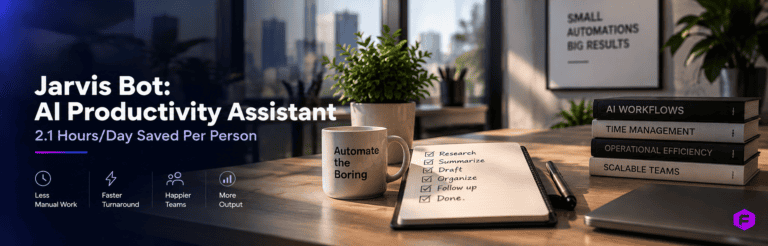
2.1 hrs Admin Time Saved Per Person/Day
View Case Study →
-70% Search Time Reduction
View Case Study →
10x Screening Capacity Increase
View Case Study →