Travel and hospitality software with AI personalization support guest experience, dynamic pricing, and demand forecasting for hotels competing on both price and service. 98% of hotel owners now incorporate AI into operations in some form, yet only 32% have embedded it across most functions consistently. Foreignerds builds systems that close that adoption-to-execution gap, turning scattered AI pilots into a system guests actually notice.
Tell us what's going on — a real person replies within 1 business day, not an autoresponder.
A booking engine, a basic chatbot, call it done. That approach produces properties that look modernized on paper and lose bookings to AI-driven search shifts they never accounted for.
We build hospitality systems around real guest data and genuine AI-driven discovery — because AI search disruption is already threatening direct-booking visibility, and a property invisible to that shift is losing bookings quietly, every day.
Get a Real Assessment of Your Project →This is built for hotel general managers, hospitality brand marketing directors, and property management companies who have real guest and booking data but are losing direct-booking revenue to OTA commissions and AI-driven discovery shifts they haven't yet addressed.
The AI in hospitality and tourism market is projected to grow from $20.39 billion in 2025 to $26.53 billion in 2026, reaching $75.66 billion by 2030 at a 29.9% CAGR. AI adoption in U.S. hotels rose from 18% in 2020 to 41% by 2023, and 62% of hospitality executives planned to invest over $1 million in AI technologies by 2025 (Deloitte survey).
The guest-experience case is concrete: hotels using AI-powered chatbots reduced average response times by 70%, and AI virtual concierges now resolve 92% of guest queries without human intervention, boosting satisfaction by 18%. Hotels using AI-driven personalization can lift booking conversions by 20%, and AI-based demand forecasting lifts occupancy rates by 12%. The revenue-management case is equally direct: 40% of hotel owners already report higher revenue specifically from AI-driven dynamic pricing. But adoption is uneven across use cases. Analysis from Phocuswire found properties that implemented AI-powered pricing and personalization between 2020 and 2023 demonstrated significantly faster recovery from the pandemic downturn than comparable properties that did not — real, dated evidence that AI adoption timing has produced measurable competitive separation before, not just theoretically.
It makes sense when: your booking conversion or guest-response times lag documented AI-engaged benchmarks; your property isn't showing up when travelers research destinations and accommodations through AI assistants directly; or your revenue-management approach is still largely manual in a category where AI-driven dynamic pricing already shows a 40% revenue lift for adopters.
It's equally worth being honest about when this is premature. A very small independent property with minimal booking volume may get more value from foundational digital presence work before investing in advanced personalization infrastructure that needs real guest-data volume to perform well. A useful gut check: if you don't have unified guest data across booking, stay, and loyalty touchpoints today, AI layered on top will inherit that fragmentation, not fix it. What Happens If You Wait: There's no single dramatic failure point — most properties don't notice AI-driven booking research shifting away from them in real time. The gap compounds quietly instead: 90% of travel leaders expect generative AI to transform their business model within three years, yet only 12% of small travel and hospitality businesses currently have a formal AI strategy — a wide, currently open gap between expectation and readiness. The AI-search-visibility risk is specific and current, not theoretical: the gap between having a website and having an AI-visible website is real, and issues like missing schema markup, slow page loads, and content AI engines can't parse often go completely undetected by standard analytics tools. Properties losing direct-booking visibility to AI search disruption don't see it in a traditional analytics dashboard — they just see fewer direct bookings. The demographic shift adds urgency: 67% of Gen Z travelers specifically want AI-personalized destination recommendations — meaning properties not investing in AI-driven guest experience now are positioning to lose an entire rising generation of travelers to competitors who do.
Guest communication and virtual concierge systems that resolve the majority of inquiries without human intervention, following the documented 92% resolution rate benchmark, in a segment projected to grow from $400 million (2022) to over $1.5 billion by 2028. Selected from Foreignerds' full service catalog based on genuine Travel & Hospitality relevance — not a generic list reused across every industry page.
Demand forecasting and dynamic pricing built on real, unified guest and booking data, tied to the documented 40% revenue lift from AI-driven pricing; revenue management is projected to contribute more than 30% of the total AI-in-hospitality market by 2025. Custom Software Development & System Integration Services — booking engines, property management system integration, and guest-data unification across every touchpoint.
Guest communication, check-in/check-out workflows, and staff scheduling automation. SEO & Local SEO — critical given how heavily local and destination search drives direct bookings.
Positioning for travelers researching destinations and properties through AI assistants directly, a documented and growing share of travel research. AI Visibility Audit — a direct diagnostic including technical AI-readiness factors (schema markup, page speed, content structure) that standard analytics tools miss entirely.
Directly material given how heavily review sentiment shapes booking decisions and how AI assistants weigh it when recommending properties. eCommerce Marketing & Email Marketing — guest retention and direct-booking campaigns that reduce dependency on third-party OTA commission.
Property management system (PMS) and booking-engine integrations. AI/ML platforms for dynamic pricing, demand forecasting, and guest personalization. Conversational AI and virtual concierge systems for guest communication. Hospitality-specific SEO, Local SEO, GEO, AEO, and AI Visibility Audit tooling, including schema markup and AI-crawlability fixes.
The guest-data-unification pattern is the real, documented lever: 40% of hotel owners already report higher revenue specifically from AI-driven dynamic pricing, and AI demand forecasting lifts occupancy rates by 12% — but personalization only moves booking behavior once guest data is unified across booking, stay, and loyalty touchpoints.
Travel research behavior is shifting toward AI-assisted discovery meaningfully: 90% of travel leaders expect generative AI to transform their business model within three years, and travelers increasingly ask AI assistants for destination comparisons and property recommendations before visiting a booking site directly. This changes what needs to be true about a property's or travel brand's online presence. Traditional SEO optimizes to rank in OTA listings and search results. GEO and AEO optimize for being the source an AI system cites or recommends when a traveler asks directly — and the technical prerequisites (schema markup, AI-parseable content, page speed) are exactly the factors standard hotel-marketing analytics miss.
Adoption has moved from experimentation toward infrastructure, but execution significantly trails adoption.
Adoption has moved from experimentation toward infrastructure: 98% of hotel owners now incorporate AI in some form, with guest communications the leading current investment area at 58% of hoteliers. AI-powered chatbots have cut guest response times by 70%, and AI virtual concierges now resolve 92% of queries without human help.
But execution significantly trails adoption: 73% of hotel owners describe the AI adoption-to-execution gap as overwhelming, and only 32% report AI embedded across most operational functions despite near-universal basic adoption.
Tell us what's going on in one line — we'll take it from there.
PCI-DSS applies directly given payment processing across booking and stay; hospitality properties also carry standard ADA public-accommodation obligations extending to digital booking experiences, and most US states require guest-data breach notification within specific windows tied to occupancy and payment records.
This is a composite, illustrative example built from common, well-documented patterns in hospitality AI deployment, not a specific named client.
An independent boutique hotel had strong guest satisfaction scores but heavy dependency on OTA bookings with high commission costs.
Unifying guest data across booking, stay, and loyalty touchpoints, then building direct-booking-focused GEO/AEO alongside AI-driven guest communication, reduced OTA dependency while maintaining the personalized guest experience the property was known for — following the documented pattern where guest-data unification, not AI features alone, determines whether personalization actually moves booking behavior.
Real guest-data and AI-readiness auditing, personalization infrastructure built on unified data, plus ongoing revenue-management refinement and marketing.
Honest evaluation of current guest-data unification, AI search visibility, and where automation would genuinely improve guest experience or revenue management.
Real personalization and guest-communication infrastructure built on unified data, plus AI-search-visibility technical fixes most standard vendors miss.
Continuous revenue-management refinement, plus direct-booking marketing — including GEO/AEO — built to reduce OTA dependency over time.
Guest personalization and direct-booking marketing matter most, given heavy reliance on OTA traffic without it.
Portfolio-wide revenue management and demand forecasting at scale.
Dynamic pricing and guest-communication automation across distributed properties.
AI-assisted itinerary personalization and destination-research positioning.
A distinct AI adoption pattern within the broader hospitality market, with its own reservation and guest-communication needs.
While missing the higher-ROI applications (dynamic pricing, demand forecasting) that remain underused industry-wide.
Schema markup, page speed, AI-parseable content — that standard hotel-marketing analytics don't surface at all.
Across booking, stay, and loyalty systems instead of unifying it as the real prerequisite for personalization.
Despite the documented 40% revenue lift for adopters, while over-indexing on guest-facing chat.
67% of Gen Z travelers specifically want AI-personalized recommendations.
Without building direct-booking-focused AI-search visibility to reduce commission costs over time.
Selected per project based on the task — not a fixed default stack.
Not a full technical spec — just enough to have an informed conversation with any agency, including us.
If two or more of these are true, this is very likely worth exploring.
These four questions are worth answering honestly before any AI investment — the audit will help you answer them with certainty.
We don't list a price here for the same reason across every page: a number before an assessment is a guess, and in hospitality specifically, scope depends heavily on property size and current guest-data unification. Your actual scope will determine cost after the audit.
Claim Your Free Travel & Hospitality AI Visibility Audit
Yes — real integration work is core to these projects. Scope depends on your specific platform.
The data is real — 40% of hotel owners already report higher revenue specifically from AI-driven dynamic pricing, and AI demand forecasting lifts occupancy rates by 12%.
This is common, and a legitimate starting point — data unification is usually the necessary first step, and we'll say so directly during the audit.
Guest-data-first development and real AI-search-visibility expertise, not standard PMS/booking functionality with an AI label added.
Depends heavily on property size and current data fragmentation — the audit in Week 1 gives an honest, specific timeline.
Yes — the sub-vertical breakdown above reflects genuinely different needs we scope separately.
Directly, through better direct-booking conversion and AI-search visibility — this is one of the clearest, most measurable value propositions in hospitality AI right now.
We'll tell you honestly whether you have enough guest-data volume for advanced personalization to work well yet, or whether foundational digital presence needs to come first.
The documented evidence says yes for adopters — 40% of hotel owners already report higher revenue specifically from AI-driven dynamic pricing, and AI demand forecasting is separately documented to lift occupancy rates by 12%.
GEO is optimizing your content so AI systems cite or recommend your property directly when a traveler asks — directly relevant given AI search disruption is already threatening direct-booking visibility industry-wide.
AEO structures your content to be pulled as a direct answer by AI-driven search features, rather than only appearing in an OTA listing.
A direct diagnostic covering both AI citation/recommendation frequency and the technical AI-readiness factors — schema markup, page speed, crawlable content — that standard hotel marketing analytics completely miss.
Increasingly yes — 90% of travel leaders expect generative AI to transform their business model within three years, and 67% of Gen Z travelers specifically want AI-personalized destination recommendations.
Increasingly yes, as travelers describe trip needs and receive guidance that can include specific property or destination suggestions.
Directly — review sentiment heavily shapes booking decisions, and AI assistants weigh it significantly when recommending properties.
Yes — this shift is broad-based, and smaller properties invisible to AI discovery risk losing exactly the increasingly AI-informed travelers now researching this way.
Through recurring AI Visibility Audits tracking citation and recommendation frequency, alongside traditional direct-booking and conversion metrics.
Yes, under one roof — guest-data unification, personalization, SEO, GEO/AEO, and AI Visibility auditing together.
Not anymore — travel-research behavior is shifting broadly, following the same pattern seen across other major consumer purchases.
Book a call — the audit gives you an honest picture of your current guest-data infrastructure, revenue-management maturity, and AI search visibility.
Real projects. Real, sourced results.
Delivered hospitality, travel, and broader AI work sits alongside our 1,250+ project history — verifiable, not invented, and available to discuss specifically on the call.
15-20 minutes, focused on your actual situation, not a generic pitch.
15-20 minutes, focused on your actual situation, not a generic pitch.
We tell you honestly if foundational work needs to happen before AI adds real value.
You leave with a specific, scoped next step — not a vague proposal.
100+ case studies live here

-90% Monitoring Time (15 hrs → 1.5 hrs)
View Case Study →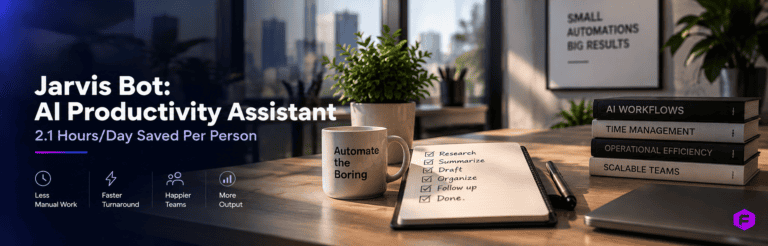
2.1 hrs Admin Time Saved Per Person/Day
View Case Study →
-70% Search Time Reduction
View Case Study →
10x Screening Capacity Increase
View Case Study →