Construction and infrastructure software with AI project management support labor allocation, scheduling, and workforce planning for construction firms facing a documented skilled-labor shortage. The U.S. construction industry needs an estimated 349,000 net new workers in 2026 just to keep supply and demand in balance. Foreignerds builds systems for that labor-constrained reality, maximizing output from the crews a firm already has on payroll.
Tell us what's going on — a real person replies within 1 business day, not an autoresponder.
That approach produces tools that track problems without solving the actual constraint most firms face: not enough skilled people to do the work.
We build construction technology around the industry's real, structural problem — because 55% of construction leaders now cite lack of skilled talent as a barrier to growth, up from 43% just a year earlier, and software that doesn't address that isn't actually solving anything.
Get a Real Assessment of Your Project →This is built for construction firm owners and operations leaders facing a genuine labor shortage crisis — needing to attract 349,000 net new workers in 2026 alone — who need AI to close the gap between project demand and available skilled labor, not a generic project-management dashboard.
The AI in construction market is valued at $3.02 billion in 2026, projected to reach $9.48 billion by 2030 at a 33.1% CAGR. A global RICS study of more than 2,200 construction professionals found 45% reported no AI implementation at all, 34% were in early pilot phases, and just under 12% reported regularly using AI within specific processes — organization-wide implementation remained below 1%.
More recent indicators point toward acceleration: the 2026 Construction Hiring and Business Outlook from AGC and Sage found 61% of respondents were using AI or planned to increase investment in it, up from 44% the previous year. AI was most commonly applied to office and administrative functions, estimating, and preconstruction — the areas where labor-shortage pressure is most acute. The connection between AI and the labor crisis is explicit in the survey data: 45% of firms believe AI and robotics will positively impact construction jobs specifically by automating manual, error-prone tasks (AGC/NCCER). A majority of the 2026 hiring need is attributable to retirements, not growth — meaning the labor gap isn't cyclical, it's structural, and it's not closing on its own.
It makes sense when: your estimating, preconstruction, or administrative workflows still consume hours that could go toward the skilled work your labor shortage is actually constraining; you're one of the 45% of firms with zero current AI implementation while 61% of the industry is already moving; or your current digital presence isn't showing up when general contractors and project owners research construction partners through AI assistants.
It's equally worth being honest about when this is premature. A very small residential contractor with simple, low-volume projects may get more value from foundational digital tools before investing in advanced AI estimating or scheduling infrastructure built for larger project complexity. A useful gut check: if your project data currently lives on paper or in disconnected spreadsheets, AI layered on top will inherit that fragmentation, not fix it. What Happens If You Wait: There's no single dramatic failure point — most construction firms don't lose a specific bid to an AI-adopting competitor in a visible way. The gap compounds quietly instead: 73% of large construction firms (revenue >$100M) are already using AI tools, compared to just 41% of smaller firms — a real, current gap that risks widening further as larger firms compound the labor-productivity advantage AI provides. The labor-shortage timeline adds real urgency: the industry needs 349,000 net new workers in 2026 and 456,000 more in 2027, with most of that need coming from retirements, not growth. This isn't a problem that resolves with a better hiring campaign — it's a structural shift that makes automating administrative and estimating work a genuine capacity lever, not a nice-to-have efficiency gain.
Estimating, preconstruction, and scheduling automation targeting the office and administrative functions where AI is already most commonly applied industry-wide. Selected from Foreignerds' full service catalog based on genuine Construction & Infrastructure relevance — not a generic list reused across every industry page.
The exact narrow, production-ready use cases that free skilled labor for the work only skilled labor can do, directly addressing the 349,000-worker gap. Custom Software Development & System Integration Services — project-management and BIM-adjacent platforms integrated with existing tools, not disconnected dashboards.
Site-inquiry and subcontractor-communication automation for high-volume, repetitive coordination. System Integration Services — connecting fragmented project, safety, and administrative data into one coherent operating system.
Critical given how heavily local and regional search drives contractor and subcontractor discovery. Generative Engine Optimization (GEO) & Answer Engine Optimization (AEO) — positioning for general contractors and project owners researching construction partners through AI assistants directly.
A direct diagnostic of whether your firm appears when project owners ask AI assistants for contractor or partner recommendations. Reputation Management — directly material given how heavily trust and safety track record affect contractor selection.
Project-management and BIM-adjacent platform integrations. AI/ML platforms for estimating, preconstruction planning, and scheduling automation. Conversational AI for subcontractor and site-inquiry coordination. Construction-specific SEO, Local SEO, GEO, AEO, and AI Visibility Audit tooling.
The labor-capacity pattern is the real, documented lever: 73% of large firms already use AI versus 41% of smaller firms, and with 349,000 net new workers needed in 2026 alone, automating estimating and preconstruction work is a genuine capacity lever, not a nice-to-have efficiency gain.
General contractors and project owners increasingly research and evaluate construction partners through AI assistants during vendor selection, following the same broader B2B research-behavior shift affecting procurement generally. This changes what needs to be true about a construction firm's online presence. Traditional SEO optimizes to rank in search results for contractor services. GEO and AEO optimize for being the source an AI system cites or recommends when a project owner asks about contractors with specific capabilities, safety records, or project types directly.
Adoption is accelerating from a genuinely early base, concentrated in administrative and preconstruction functions.
Adoption is accelerating from a genuinely early base: 61% of firms are using or planning to increase AI investment, up sharply from 44% the previous year — a real, dated jump reflecting the labor-shortage pressure pushing adoption faster than pure efficiency motives would.
The clearest current application area is administrative and preconstruction — estimating, office functions, and planning — precisely because these are the tasks that can be automated to free skilled labor for the physical work only skilled labor can perform, directly addressing the structural, retirement-driven labor gap rather than a cyclical hiring problem.
Tell us what's going on in one line — we'll take it from there.
Construction AI systems touching safety, labor, or site data intersect with OSHA recordkeeping requirements, and government-funded infrastructure projects carry additional Davis-Bacon Act wage-reporting and Buy America compliance obligations. AI-assisted safety monitoring and site inspection tools must be architected to support, not complicate, existing OSHA 300 log and incident-reporting requirements.
This is a composite, illustrative example built from common, well-documented patterns in construction AI deployment, not a specific named client.
A mid-size general contractor had estimating handled entirely by two senior estimators, creating a real bottleneck as bid volume grew faster than hiring could keep pace.
Building AI-assisted estimating support — accelerating first-pass takeoffs while keeping senior estimators focused on final review and complex judgment calls — increased bid throughput without adding headcount, following the documented pattern where AI applied to administrative and preconstruction functions delivers the clearest current ROI in this industry.
Real workflow and labor-capacity auditing, estimating or scheduling automation scoped to your real bottleneck, plus ongoing refinement and marketing.
Honest evaluation of where administrative and estimating bottlenecks are actually constraining project throughput, and where AI would genuinely free skilled capacity.
Estimating, preconstruction, or scheduling automation integrated with existing project-management tools, scoped to your real bottleneck, not a generic feature list.
Continuous refinement as project types and volume evolve, plus partner-acquisition marketing — including GEO/AEO — built around how contractors are now evaluated.
Estimating, preconstruction, and subcontractor-coordination automation are the primary current levers.
Scheduling and administrative automation matter most given typically leaner back-office staffing.
Portfolio-wide project visibility and safety-compliance automation at scale.
AI-assisted design review and documentation, distinct from field-execution needs.
Often building AI-native from the start, but need genuine field-data integration depth.
When the labor-shortage pressure driving urgency affects firms of every size.
And calling it AI transformation, while the real administrative and estimating bottlenecks remain unaddressed.
Treating it as a temporary hiring problem solvable with better recruiting alone.
Instead of addressing the underlying digitization gap first.
Despite real OSHA recordkeeping and reporting requirements that structured AI tools can genuinely support.
Even as general contractors and project owners increasingly evaluate partners through AI assistants.
Selected per project based on the task — not a fixed default stack.
Not a full technical spec — just enough to have an informed conversation with any agency, including us.
If two or more of these are true, this is very likely worth exploring.
These four questions are worth answering honestly before any AI investment — the audit will help you answer them with certainty.
We don't list a price here for the same reason across every page: a number before an assessment is a guess, and in construction specifically, scope depends heavily on project complexity and current data digitization. Your actual scope will determine cost after the audit.
Claim Your Free Construction & Infrastructure AI Visibility Audit
Yes — real integration work is core to these projects. Scope depends on your specific platform.
Indirectly but genuinely — AI automating administrative and estimating work frees skilled labor for the physical work only skilled labor can do, directly addressing the capacity constraint, not the headcount itself.
Labor-capacity-first development, not standard tracking-dashboard functionality that leaves the real bottleneck unaddressed.
This is common, and a legitimate starting point — digitization is usually the necessary first step, and we'll say so honestly during the audit.
Depends heavily on project complexity and current data digitization — the audit in Week 1 gives an honest, specific timeline.
Yes — the sub-vertical breakdown above reflects genuinely different needs we scope separately.
Yes — this is one of the areas where AI is already most commonly applied industry-wide, precisely because it addresses the current labor-capacity bottleneck directly.
This is exactly the gap worth closing — 73% of large firms use AI versus 41% of smaller firms, and narrow, focused automation doesn't require enterprise-scale investment.
The data points that way — most of the 2026 hiring need comes from retirements, not growth, and the average construction worker is now 42.5 years old with only 16% of the workforce under 35, making this a structural, not cyclical, pressure.
Built correctly, it supports OSHA recordkeeping rather than complicating it — we architect safety-monitoring AI with existing OSHA 300 log and incident-reporting requirements in mind from the start.
GEO is optimizing your content so AI systems cite or recommend your firm directly when a project owner researches contractors with specific capabilities.
AEO structures your content to be pulled as a direct answer by AI-driven search features during contractor research.
A direct diagnostic of whether and how your firm currently appears when a project owner asks an AI assistant for contractor recommendations.
Increasingly yes, following the same broader B2B research-behavior shift affecting procurement generally, as buyers use AI assistants to evaluate vendors before direct contact.
Directly — trust and safety track record are central to contractor selection, and AI systems weigh these signals when forming recommendations.
Yes — B2B research behavior is shifting broadly, and smaller contractors invisible to AI discovery risk losing exactly the partner-selection consideration larger competitors are already capturing.
Through recurring AI Visibility Audits tracking citation and recommendation frequency, alongside traditional B2B lead-generation metrics.
Yes, under one roof — estimating automation, project systems, SEO, GEO/AEO, and AI Visibility auditing together.
Not anymore — B2B partner-research behavior is shifting broadly, following the same pattern seen across other procurement-driven industries.
Book a call — the audit gives you an honest picture of your current labor-capacity constraints, data digitization, and AI search visibility.
Real projects. Real, sourced results.
Delivered construction, infrastructure, and broader AI work sits alongside our 1,250+ project history — verifiable, not invented, and available to discuss specifically on the call.
15-20 minutes, focused on your actual situation, not a generic pitch.
15-20 minutes, focused on your actual situation, not a generic pitch.
We tell you honestly if foundational work needs to happen before AI adds real value.
You leave with a specific, scoped next step — not a vague proposal.
100+ case studies live here

-90% Monitoring Time (15 hrs → 1.5 hrs)
View Case Study →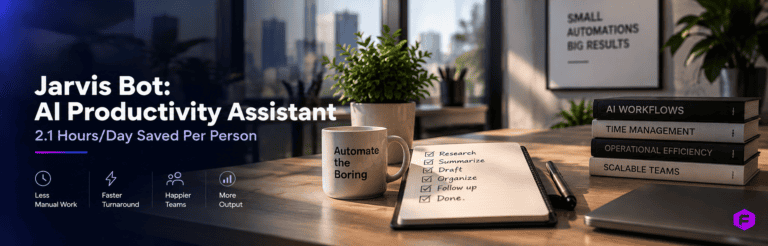
2.1 hrs Admin Time Saved Per Person/Day
View Case Study →
-70% Search Time Reduction
View Case Study →
10x Screening Capacity Increase
View Case Study →