Roofing company software and AI lead response handle storm-driven demand spikes and scheduling for roofing businesses competing on speed after severe weather. 67% of roofing companies use AI, the second-highest adoption of any trade measured after HVAC at 81.5%. Foreignerds builds systems sized for roofing's structurally volatile, storm-driven demand pattern, ready to scale response the moment a storm hits, not days later.
Tell us what's going on — a real person replies within 1 business day, not an autoresponder.
That approach misses roofing's genuinely distinct demand pattern: storm events create sudden, massive lead spikes that steady-state systems aren't built to capture or respond to fast enough.
We build roofing company systems around that specific volatility — because at a documented 27% industry-wide unanswered-call rate under normal conditions, that gap widens dramatically during storm-driven demand spikes when call volume surges and response speed determines who actually gets the job.
Get a Real Assessment of Your Project →This is built for roofing contractors managing genuinely volatile, storm-driven demand cycles who need AI infrastructure that scales lead capture and response during sudden demand spikes, not steady-state marketing built for predictable, even-paced trades.
67% of roofing companies use AI, the second-highest adoption of any trade measured, trailing only HVAC's industry-leading 81.5% and ahead of plumbing (65%) and electrical (64%) — a genuinely strong position reflecting real, substantial investment in the trade.
The lead-economics data applies with particular force to roofing given its demand pattern: 27% of calls to home services businesses go unanswered under normal conditions industry-wide, and roofing's storm-driven demand spikes create real risk of that gap widening significantly during exactly the highest-volume, highest-opportunity periods. Two-thirds of contractors across trades (66%) expect AI to bring moderate or major transformation to their businesses within one to three years (ServiceTitan's 2026 State of AI in the Trades, surveying 1,032 contractors across seven trades including roofing) — but only 12% have embedded AI into operations today, meaning the gap between expectation and current execution remains wide even in a relatively high-adoption trade like roofing.
It makes sense when: your company's lead-response capacity doesn't scale during storm-driven demand spikes, when volume surges create exactly the conditions for missed calls to compound; your quoting and follow-up systems can't handle the volume swings roofing's demand pattern genuinely creates; or your current digital presence isn't showing up when homeowners research roofing companies through AI assistants, especially after storm events.
It's equally worth being honest about when this is premature. A very small, single-crew operation with limited capacity may get more value from foundational scheduling systems before investing in advanced AI-driven demand-spike infrastructure built for handling larger volume swings. A useful gut check: if your current capacity can't handle a storm-driven demand spike even with perfect lead capture, closing the lead-capture gap alone won't solve the underlying capacity constraint. What Happens If You Wait: There's no single dramatic failure point — most roofing companies don't lose a specific storm-driven lead to a missed call in a visible way. The gap compounds quietly instead: during the exact periods when demand and opportunity are highest, companies without scalable lead-capture systems are losing a larger share of that surge than they would during steady-state periods, precisely when the revenue opportunity is largest. The competitive-positioning case is a live, current dynamic: with roofing already showing the second-highest AI adoption of any trade, companies not keeping pace are falling behind an already fast-moving trade peer group, not a slow-adopting category with room to casually catch up later.
Call answering and lead capture built to scale during storm-driven demand spikes, not just steady-state volume. Selected from Foreignerds' full service catalog based on genuine Roofing Contractors relevance — not a generic list reused across every industry page.
Quoting and follow-up automation designed to handle real volume swings without the response-time degradation that surge periods otherwise create. Custom Software Development & System Integration Services — storm-damage documentation and insurance-claim-adjacent workflow tools built with transparency in mind given real regulatory attention on this work.
Demand forecasting incorporating weather-event data to help anticipate and prepare for genuine demand spikes. SEO & Local SEO — critical given how heavily local, storm-triggered search drives roofing customer acquisition.
Positioning for homeowners researching roofing damage and companies through AI assistants directly, especially immediately after storm events. AI Visibility Audit — a direct diagnostic of whether your company appears when homeowners ask AI assistants for roofing recommendations.
For roofing advertising budgets that need to flex with genuinely volatile, storm-driven demand. Reputation Management — directly material given real consumer wariness of storm-chasing practices and how heavily trust signals affect roofing company selection.
Field service management and dispatch platform integrations. AI voice/chat systems built for surge-capacity call handling during demand spikes. Storm-damage documentation and insurance-claim-adjacent workflow tooling. Roofing-specific SEO, Local SEO, GEO, AEO, AI-Powered PPC, and AI Visibility Audit tooling.
The surge-capacity pattern is the real, documented lever: roofing shows the second-highest AI adoption of any trade at 67%, but the real question is whether that adoption is architected for actual demand volatility — companies with genuinely surge-capable systems capture a meaningfully larger share of storm-driven demand.
Homeowners researching roofing damage and companies increasingly use AI assistants for initial research, especially immediately following storm events, following the same broader consumer research-behavior shift affecting home-services selection generally. This changes what needs to be true about a roofing company's online presence. Traditional SEO optimizes to rank in local search results. GEO and AEO optimize for being the source an AI system cites or recommends when a homeowner asks about roof damage or searches for a company directly — often during the exact post-storm window when the largest share of the year's demand is concentrated.
Roofing shows the second-highest AI adoption of any trade, but the real gap isn't adoption breadth — it's whether that adoption is built for roofing's actual demand shape.
Roofing shows the second-highest AI adoption of any trade at 67%, trailing only HVAC — genuinely strong, fast-moving adoption for a trade with a fundamentally different, more volatile demand pattern than most other home services.
The real, current gap isn't adoption breadth — it's whether that adoption is built for roofing's actual demand shape. Storm events create sudden, massive lead spikes that steady-state AI systems (built assuming even, predictable volume) aren't necessarily architected to handle, meaning companies with genuinely surge-capable systems are positioned to capture a meaningfully larger share of storm-driven demand than competitors running steady-state tools during exactly the periods that matter most.
Tell us what's going on in one line — we'll take it from there.
Roofing contractors require state and often local licensing, with bonding and insurance requirements that vary significantly by jurisdiction. Storm-damage and insurance-claim-adjacent roofing work carries additional documentation and consumer-protection considerations in many states, given historical concerns about storm-chasing contractor practices — AI-driven lead-generation and quoting systems should be built with accurate, transparent documentation in mind given this real regulatory attention.
This is a composite, illustrative example built from common, well-documented patterns in roofing company AI deployment, not a specific named client.
A regional roofing contractor had steady, well-functioning lead capture during normal demand periods, but a major storm event created a call-volume spike the existing system couldn't handle, resulting in a documented share of storm-driven leads going unanswered during exactly the highest-opportunity window of the year.
Building AI-driven call handling specifically designed to scale during demand surges — rather than steady-state systems assuming even volume — captured measurably more of the storm-driven demand in the following season's comparable event.
Real demand-pattern and capacity auditing, AI-driven call handling built for surge-capacity, plus ongoing readiness monitoring and marketing.
Honest evaluation of current lead-capture performance during both steady-state and storm-driven demand spikes.
AI-driven call handling and lead management built specifically for surge-capacity, integrated with existing scheduling and quoting systems.
Continuous readiness monitoring ahead of storm seasons, plus local, event-responsive marketing — including GEO/AEO.
Storm-response capacity and lead-capture scaling matter most given the genuinely volatile, event-driven demand pattern.
A genuinely distinct sub-vertical given longer sales cycles and different damage/inspection patterns.
A distinct sub-segment given the real regulatory and reputational considerations around this specific work.
Project-based demand distinct from repair and storm-response work.
Portfolio-wide surge-capacity standardization across markets with different storm exposure.
When roofing's real demand pattern is fundamentally storm-driven and volatile.
When it likely widens significantly during genuine demand spikes without surge-capable systems.
And regulatory attention in lead-generation and documentation practices.
Despite roofing's uniquely event-driven demand pattern.
When the real question is whether that adoption is architected for actual demand volatility.
Researching storm damage, even as this research pattern shifts broadly across home services.
Selected per project based on the task — not a fixed default stack.
Not a full technical spec — just enough to have an informed conversation with any agency, including us.
If two or more of these are true, this is very likely worth exploring.
These four questions are worth answering honestly before any AI investment — the audit will help you answer them with certainty.
We don't list a price here for the same reason across every page: a number before an assessment is a guess, and for roofing contractors specifically, scope depends heavily on typical demand volatility and current surge-capacity readiness. Your actual scope will determine cost after the audit.
Claim Your Free Roofing Contractors AI Visibility Audit
Yes — real integration work is core to these projects. Scope depends on your specific platform.
Because roofing's demand pattern is genuinely more volatile — storm events create sudden, massive lead spikes that steady-state systems built for even-paced trades aren't necessarily architected to handle.
Surge-capacity-first development, not standard SEO/PPC functionality built for steady demand that doesn't match roofing's actual, storm-driven pattern.
This is precisely the gap worth closing — steady-state performance doesn't guarantee surge performance, and the highest-opportunity periods are exactly when systems need to hold up.
Depends on typical demand volatility and current surge-capacity readiness — the audit in Week 1 gives an honest, specific timeline.
Yes — the sub-vertical breakdown above reflects genuinely different needs we scope separately.
Yes — this is a real, distinct application, and demand forecasting incorporating weather-event data helps anticipate spikes rather than just reacting to them after they hit.
We build lead-generation and documentation practices with real transparency in mind, positioning your company as distinctly trustworthy given genuine consumer wariness and regulatory attention on this category.
Second-highest of any trade measured at 67%, trailing only HVAC's 81.5% and ahead of plumbing (65%) and electrical (64%) — a genuinely strong, fast-moving position.
66% expect moderate or major transformation within one to three years, per ServiceTitan's 2026 survey of 1,032 contractors across seven trades including roofing — though only 12% have actually embedded AI into operations today.
GEO is optimizing your content so AI systems cite or recommend your company directly when a homeowner asks about roof damage or roofing companies.
AEO structures your content to be pulled as a direct answer by AI-driven search features, especially during the post-storm window when demand concentrates heavily.
A direct diagnostic of whether and how your company currently appears when a homeowner asks an AI assistant for roofing recommendations.
Increasingly yes, following the same broader consumer research-behavior shift affecting home-services selection generally, especially for post-storm troubleshooting.
Directly — trust matters significantly given both the cost of roofing work and the industry-wide reputational concerns around storm-chasing, and AI systems weigh review sentiment heavily.
Yes — this shift is broad-based, and smaller companies invisible to AI discovery risk losing exactly the increasingly AI-informed homeowners now researching this way.
Through recurring AI Visibility Audits tracking citation and recommendation frequency, alongside traditional local-lead-generation metrics.
Yes, under one roof — call handling, demand forecasting, SEO, GEO/AEO, and AI Visibility auditing together.
Not anymore — homeowner research behavior is shifting broadly, following the same pattern seen across other home-services categories.
Book a call — the audit gives you an honest picture of your current surge-capacity readiness, lead-capture performance, and AI search visibility.
Real projects. Real, sourced results.
Delivered roofing, home-services, and broader AI work sits alongside our 1,250+ project history — verifiable, not invented, and available to discuss specifically on the call.
15-20 minutes, focused on your actual situation, not a generic pitch.
15-20 minutes, focused on your actual situation, not a generic pitch.
We tell you honestly if foundational work needs to happen before AI adds real value.
You leave with a specific, scoped next step — not a vague proposal.
100+ case studies live here

-90% Monitoring Time (15 hrs → 1.5 hrs)
View Case Study →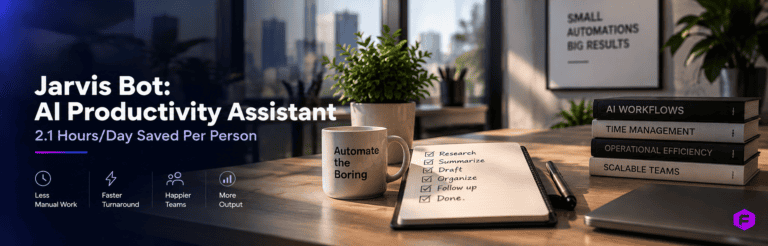
2.1 hrs Admin Time Saved Per Person/Day
View Case Study →
-70% Search Time Reduction
View Case Study →
10x Screening Capacity Increase
View Case Study →