Author: Sarah Bennett

Anthropic’s New Usage Policy Bars Using Claude to Plant Fake Sources for AI Answers. What It Means for Brand Mentions.

Every marketer working on AI visibility has the same suspicion: if AI assistants lean on third-party sources, the shortest route to a mention is to create those sources. A policy update from Anthropic, the company behind Claude, puts a line through part of that idea. Announced on October 8, 2026 and effective November 12, it prohibits using Anthropic’s products to seed the sources AI systems draw answers from with content that misrepresents who is behind it.

The wording is narrower than some headlines suggest, and the policy binds users of Anthropic’s products, not the web at large. This piece sets out what the text says, what it does not say, and the practical test it offers brands deciding between earned mentions and planted ones. It is written for teams planning generative engine optimization and digital PR programs.

What the policy says

The change sits in a new section of Anthropic’s usage policy on deceptive campaigns and artificial activity. Read from the policy page, it prohibits using Anthropic’s products to create fake personas, accounts, media outlets or organizations, or to impersonate real ones. It prohibits hiding the sponsorship of content meant to influence opinion or decision-makers, and spreading content through networks of fake or ostensibly independent sites that share a common source. It also covers building tools for deceptive campaigns and marketing any of these activities.

The clause that matters here prohibits manipulating the sources from which search engines or AI systems draw answers, by “seeding them with content that misrepresents its origin, authorship, or independence.” The policy’s own example is a network of sites posing as unaffiliated sources that corroborate the same claims.

Notice what triggers the rule. It is not seeding, volume or the use of AI. It is misrepresentation: content that hides its origin, its author or its lack of independence.

Who it binds, and who it does not

The policy applies to anyone who submits inputs to Anthropic’s products. That covers individuals using Claude.ai or Claude Code, businesses using the API, customers who reach Claude through cloud providers or resellers, and end users of products built on Claude. A marketing tool built on Claude puts its own users under the same rules, as Relevant Audience points out.

It does not bind search engines, other AI companies or the open web, and it does not govern how Claude ranks or cites content. Mike King of the GEO consultancy iPullRank makes the same point in his analysis: the policy is about how people use Claude.

Enforcement works against the account, not the website. Anthropic’s Safeguards Team monitors for violations, and if one is suspected Anthropic may warn, throttle, limit, suspend or terminate access to its products. That differs from Google’s spam policies, which act on sites.

A new rule, or a clearer one?

Search Engine Journal reads the update as a clarification, not a brand-new ban. The 2025 policy did not mention search engines or AI answers, but Anthropic says it already prohibited fake-account networks and fake news sites, spread across other sections. The new text states the principle directly and applies it to the sources AI draws on.

Search Engine Journal also describes the case Anthropic linked to the section. According to that report, Anthropic found a network of around 70 sites posing as independent local news outlets, tied to a France-based advertising agency. The network used Claude to produce articles designed to “boost their site’s authority rankings on search engines.” It published at least 8,913 articles in about 20 languages, though most got little engagement. Anthropic removed the account and banned the organization.

Two cautions apply. The coverage does not say whether those sites improved their rankings or appeared in AI answers, so the case shows the tactic being attempted, not working. And Search Engine Journal does not link the full text of Anthropic’s report, so its details rest on that outlet’s summary.

Where the line sits

Relevant Audience reads the clause as aimed at deception about who is behind content, not at producing content for AI visibility. In its reading, the policy does not ban using Claude to write content, structure pages for AI answers or publish at volume. That is the publication’s interpretation of the text, which Anthropic has not spelled out for edge cases. For example, Anthropic has not said how it would treat several openly branded sites run by one company, and the policy text points to misrepresented independence as the trigger.

Read together, the sources suggest a useful test, which Relevant Audience frames as its own and not Anthropic’s: would the tactic still work if every reader knew who wrote the content and who paid for it? King puts a similar idea in terms of durability, arguing that manufactured independence has “an expiration date.”

Earned versus planted mentions

That test separates two things that can look alike from outside.

An earned mention exists because someone independent chose to write it. A journalist cites your original research. An expert quotes you. A customer reviews your product. A publisher runs a contributed article under a real byline. A sponsored placement is labeled as sponsored.

A planted mention only looks independent. A network of sites that recommend the same brand while hiding common ownership. Reviews from fake personas. Undisclosed paid listicles. Forum answers posted by accounts that conceal their affiliation. iPullRank, which sells GEO services and so has an interest in the framing, lists these among the tactics to avoid. The policy text itself names fake personas, hidden sponsorship and networks of ostensibly independent sites.

This is the distinction our earlier piece on why third-party mentions matter for AI search turns on. The reason independent sources carry weight in AI answers is that they are independent. Faking independence takes away the thing that made the mention valuable, and it now carries account-level risk for anyone doing it with Claude.

What to do before November 12

None of this requires a strategy rewrite. It asks for a short audit.

Check your own content network. If you or an agency have used Claude to produce content for several sites that appear independent but share an owner or a sponsor, review it now. Search Engine Journal suggests this audit.

Ask vendors direct questions. Relevant Audience recommends asking agencies and tools how they build AI visibility and whether any sites in their plans are owned by them without saying so. A vague answer is information.

Label sponsorship. Where a placement is paid, say so on the page. Where a comparison page is brand-owned, make that obvious.

Use real bylines and real experts. Contributed content should carry the name of the person who wrote it and a verifiable role.

Fund the earned route. Original data, expert commentary and useful tools give journalists and publishers a reason to cite you. That is the work behind digital PR and ethical link building, and the slower route is the durable one.

Measure what you earn. Track whether your brand is mentioned and cited across AI platforms, and which sources drive the mentions. A free AI Visibility Audit does this across platforms and shows where earned coverage is missing.

What this does not tell you

The policy is not evidence that seeding works, or that it fails. The reporting does not show whether the network Anthropic banned gained rankings or appeared in AI answers.

It does not describe how detection works beyond general monitoring, and it does not cover other AI companies. ChatGPT, Gemini and Perplexity have their own terms, and Google has its own spam policies. Do not read this one document as a rule for all of GEO.

It also does not tell you that AI-written content is off limits. The text turns on misrepresentation, though edge cases remain untested. If you use AI tools to draft, the safe course is the same as it has always been: a real author, accurate claims and no pretense about who is speaking.

Why this matters for AI search visibility

AI assistants increasingly shape which brands get recommended, so the temptation to manufacture sources will not disappear. What this update does is move one major provider’s rules in the opposite direction, and mark provenance as the thing platforms are watching. For answer engine optimization, the safest assets are the ones that can survive scrutiny: clear answers, original information, real authors and accurate facts. Our full guide to optimizing for AI search covers that groundwork, and sound search engine optimization supports all of it.

Where this leaves you

The confirmed facts are these. Anthropic announced an updated usage policy on October 8, 2026, effective November 12. A new section prohibits using its products to seed the sources search engines and AI systems draw answers from with content that misrepresents its origin, authorship or independence. Enforcement is against accounts. The policy binds users of Anthropic’s products, not other companies or the open web.

The practical response is to build mentions that would still work if everyone knew who was behind them. That favors original research, real experts, labeled sponsorship and honest digital PR and link building, backed by measurement of what AI platforms actually say about you. Whether the aim is generative engine optimization, answer engine optimization or plain search engine optimization, the same provenance rules apply.

Frequently Asked Questions

1. What did Anthropic’s updated usage policy change?
It added a section on deceptive campaigns and artificial activity, which prohibits using Anthropic’s products to seed the sources search engines and AI systems draw answers from with content that misrepresents its origin, authorship or independence. It takes effect November 12, 2026.

2. Does it ban GEO?
No. The trigger is misrepresentation, not optimization. Writing clear content, structuring pages for AI answers and earning mentions are not what the clause describes, though Anthropic has not addressed every edge case.

3. Who does the policy apply to?
Anyone who submits inputs to Anthropic’s products, including individuals, API developers, customers using Claude through cloud providers and end users of products built on Claude. It does not bind search engines or other AI companies.

4. What happens if someone violates it?
Anthropic may warn, throttle, limit, suspend or terminate access to its products. In the case Search Engine Journal describes, Anthropic removed the account and banned the organization.

5. Is it a new rule?
Search Engine Journal reads it as a clarification. Anthropic says fake-account networks and fake news sites were already prohibited under other sections, and the update names the search and AI answer context directly.

6. How do I tell an earned mention from a planted one?
Ask whether the tactic would still work if readers knew who wrote and paid for the content. Independent coverage, real reviews, labeled sponsorships and bylined expert content pass. Fake personas, hidden-owner site networks and undisclosed paid listicles do not.

7. What should I do before November 12?
Audit any Claude-made content running across sites that appear independent, ask agencies and tools how they build AI visibility, label sponsored content and use real bylines. Then measure your actual mentions across AI platforms.

If you want to know where your brand is mentioned and cited across Google and AI answer engines today, and which sources are driving it, that is exactly what we look at in a free AI Visibility Audit

The UK Regulator Wants AI Assistants Like ChatGPT on Google’s Search Choice Screens, With One Condition for Publishers.

For most of the last two decades, a search choice screen was a way of picking between conventional search engines. A proposal from the UK’s Competition and Markets Authority (CMA) would change that. It would put AI assistants such as ChatGPT and Perplexity on the screens Google shows UK users, and it would attach a condition: any provider listed must fairly attribute the publisher content it uses.

This is a proposal, not a rule, and it applies to the UK only. But it shows a regulator treating AI assistants as search alternatives, and source attribution as a formal requirement. This piece sets out what the CMA proposed, how it would work, what is undecided and what teams responsible for AI visibility should watch.

What the CMA proposed

On September 23, 2026, the CMA published strengthened proposals to give UK users of Google’s Android and Chrome products greater choice and more control over their search services. The CMA says it listened to publishers, search providers and consumer groups, and that the update responds to services such as ChatGPT and Perplexity.

The core elements are these. Google would show Android and Chrome users a choice of search services when they first use an Android phone or open Chrome. Users would be prompted again every year to choose their default. AI assistants could be included on the choice screens if they meet the relevant criteria, including technical and security requirements. And search providers on the screens would have to fairly attribute publisher content when it is used, so that people can easily reach the original sources.

Sarah Cardell, the CMA’s Chief Executive, said the CMA is “responding quickly to the rise of AI assistants”, which people increasingly use as search services but which do not appear on Google’s choice screens today.

The consultation closed at 5pm on October 9, 2026. The CMA expects to make its final decision on this requirement by the end of 2026.

Where this sits in the CMA’s wider approach

Google was designated as having strategic market status in general search and search advertising in October 2025, which lets the CMA set conduct requirements for it. According to the CMA, it imposed publisher controls on June 3, 2026, and fair ranking and data portability requirements on June 17. The user choice requirement is the one still being decided, an updated version of a January 2026 proposal.

How a choice screen would work

The press release gives the outline. The CMA’s consultation document, which runs to 71 pages according to PPC Land, holds the detail. We could not open that PDF, so the following comes from two independent analyses of it, by the trade publication PPC Land and by the law firm Bratby Law, which agree on the main points.

According to those analyses, the screen would list up to 12 providers. If more than 12 qualify, Google would be expected to show the five most popular plus seven chosen at random. Providers would appear in random order, and users would have to scroll the whole list before confirming. Users could trial a provider for at least a week. The screen would be unskippable on new Android devices and fresh Chrome installs, and a skippable reminder would bring it back at least once a year.

These details come from analysis of a proposal that may change, so treat them as the current draft.

How an AI assistant could qualify

The CMA says AI assistants “could in theory be able to be listed”, a phrase quoted by Bratby Law from the consultation document. Nothing guarantees a place. Per those analyses, a service would have to meet three criteria.

First, it must adequately address the full range of use cases of a general search service. The CMA’s notes describe four types of query: navigational, transactional, simple informational and more complex informational.

Second, it must provide a functioning general search experience. That covers technical operation, compatibility with Android, minimum security requirements and credible plans to operate sustainably.

Third, a significant proportion of its UK users must consider it a general search service. The notes say this means a meaningful proportion, not a majority.

A service does not need its own web index. A syndicated index is acceptable.

Who decides matters too. Under the proposal, Google, not the CMA, would run the eligibility process every six months, deciding within two months and sending written reasons for any rejection to the applicant and the CMA. Bratby Law notes that the draft contains no appeal route to the CMA against those decisions, and that the written reasons are the main check. That is one lawyer’s reading of a draft.

The condition for publishers

The attribution condition is the part most relevant to anyone who creates content. Per the CMA, search providers on the choice screens would have to fairly attribute publisher content when it is used, so people can easily access the source. In the analyses of the consultation document, any generative AI summary would have to attribute web content clearly and accurately, with a clear route to the source, and each provider could choose how to do it.

Three points deserve care.

The condition is a requirement of being listed on the screen, not a general rule for all AI products. Because the CMA can impose requirements only on Google, it works as a condition of access to Google’s distribution. Bratby Law argues that it therefore becomes a de facto standard for any rival that wants a place, though that is the author’s view.

The condition does not, in anything we reviewed, require payment to publishers or guarantee any amount of traffic. It concerns attribution and a way to reach the source.

How it would be enforced, and how fairness or accuracy would be judged, are not set out in the press release. Watch the final text.

What is not decided

A lot remains open. The requirement has not been imposed, and the criteria, slots, attribution wording and timing could all change after consultation responses. Google has not commented, according to press reports.

Timing is also uncertain. The final decision is expected by the end of 2026. According to PPC Land’s reading, some obligations would start about a month after the requirement is imposed, and the rest within six months, so screens showing AI assistants may not reach UK users until some time after that. Do not plan around a date.

Geography matters too. This is UK law, covering UK users of Android and Chrome. It changes nothing for users in the United States, so for mainly American clients it is a signal to watch, not a task for this quarter.

Why teams working on AI visibility should watch it

There are three reasons.

AI assistants are being treated as search. The CMA describes them as increasingly used as search services and wants them offered as alternatives. For anyone working on generative engine optimization, that confirms what many teams assume: visibility in AI answers is becoming part of search visibility, in the eyes of regulators as well as users.

Attribution is becoming a formal concept. If a regulator makes fair attribution a condition for AI assistants to reach users, it normalizes the idea that answers should point back to sources. That could affect how assistants display citations over time, but it is a possibility, and we found no evidence yet of any change.

Distribution could shift. If more UK users chose an assistant, more searches might begin there, which would raise the importance of answer engine optimization, being cited and recommended in AI answers. That is a scenario. The proposal does not say how many people would pick an assistant.

None of this reduces the value of traditional search engine optimization. The sensible view is that search is widening, not being replaced.

What to do now

You do not need to change strategy because of a consultation. A few low-cost steps keep you ready.

Measure AI referrals now. Check your analytics for traffic from ChatGPT, Perplexity, Gemini and other assistants, and note how it changes. A baseline lets you see any shift later, whatever the cause.

Make attribution easy. Use clear titles, visible authorship and dates, stable canonical URLs and descriptive headings, so any assistant that wants to credit you can do so accurately.

Check how you are cited. Run real customer questions in several assistants and record whether your brand and pages appear and are attributed correctly. A free AI Visibility Audit does this across platforms.

Keep your source pages strong. Pages that answer a specific question clearly and carry original information are the likeliest to be cited, which is the same work that supports search engine optimization and generative engine optimization.

For UK clients, set a review date. Look again when the CMA publishes its decision, and read the final attribution wording before advising anyone.

Where this leaves you

The confirmed facts are these. On September 23, 2026, the CMA proposed that Google show Android and Chrome users in the UK a choice of search services at first use and prompt them annually. AI assistants could be listed if they meet the criteria, and providers listed would have to fairly attribute publisher content. The consultation closed on October 9, and a final decision is expected by the end of 2026. It is a proposal for the UK only.

The lasting lesson is about direction. Regulators are beginning to treat AI assistants as search services, and attribution as something that can be required, which matters for answer engine optimization planning. For teams reviewing how a brand appears in AI answers, that is a reason to measure now and watch the final wording.

Frequently Asked Questions

1. What did the CMA propose on September 23, 2026?
It proposed that Google show UK users of Android and Chrome a choice of search services at first use and prompt them again every year. AI assistants could be listed if they meet the criteria, and listed providers would have to fairly attribute publisher content.

2. Is this a final rule?
No. It is a proposed conduct requirement. The consultation closed on October 9, 2026, and the CMA expects to make its final decision by the end of 2026.

3. Will ChatGPT and Perplexity definitely appear on the screens?
No. The CMA says assistants could be listed if they meet the criteria, and analyses of the proposal describe three: covering the full range of search queries, providing a functioning search experience and being considered a general search service by a significant proportion of UK users.

4. Who decides which services are listed?
Under the proposal, Google decides, through an eligibility process every six months, with written reasons for rejections sent to the applicant and the CMA. Bratby Law notes that the draft contains no appeal route to the CMA.

5. What does the attribution condition require?
Providers on the screen would have to fairly attribute publisher content when it is used, so users can reach the original source. Analyses of the consultation document say generative AI summaries must attribute web content clearly and accurately. We found no requirement for payment or traffic.

6. Does this affect businesses outside the UK?
Not directly. It applies to UK users of Android and Chrome, but it signals how regulators are treating AI assistants and attribution.

7. What should I do about it now?
Measure traffic from AI assistants, make your pages easy to attribute and check how assistants cite you. Review again when the CMA publishes its final decision, rather than changing strategy on a proposal.

If you want to know how your brand appears across Google and AI answer engines today, that is exactly what we look at in a free AI Visibility Audit.

AI Agents May Be Running Inside Your Company Without Approval. CrowdStrike Just Built a Product to Find Them.

Most companies have a policy on which software employees can install. Far fewer have one for AI agents, the programs that can read files, call tools, and take actions on a person’s behalf. That gap is now the subject of a commercial product category, and the clearest sign came on September 1, 2026, when CrowdStrike launched Falcon Guardian at its Fal.Con conference in Las Vegas.

The launch is worth reading closely, not because a single product settles anything, but because of what it assumes: that unapproved AI agents are already running on company machines and that the endpoint is where they need to be caught. Two statistics have been attached to the story, and they need careful handling. Here is what is confirmed, what the numbers actually show, and what the practical lesson is for AI security and AI governance teams.

What CrowdStrike announced

According to CrowdStrike’s press release and coverage from SiliconANGLE, Security Boulevard, and BizTech, Falcon Guardian does four things.

First, it discovers known and shadow AI agents across Windows and macOS endpoints. Second, it blocks agents that are not on an approved list from running on managed systems. Third, it ties agent behavior to endpoint telemetry, linking user prompts to identities, the tools an agent invoked, and the resulting system changes. Fourth, it detects attacks aimed at agents and agents that misbehave, and it estimates the blast radius when an incident occurs.

CrowdStrike also announced supporting pieces: an AI Gateway for centralized control of enterprise AI traffic, a managed service called Falcon Complete for Guardian, a threat hunting service called Falcon Adversary OverWatch for Guardian, and integration with its Next-Gen SIEM.

Availability is uneven, and that matters for anyone planning around it. SiliconANGLE reported that the core Guardian features and the managed threat hunting service are available now, while the AI Gateway is pre-beta and expected to reach general availability next quarter, and Falcon Complete for Guardian is due later this quarter. CrowdStrike’s press release did not list pricing.

CEO George Kurtz framed the pitch in one line: AI has not changed the attack, it has changed its speed. The company’s argument is that the endpoint, which it has long positioned as the control point for stopping attacks, is also the place where agents execute.

What the sources do not say is equally useful. They name Windows and macOS as the supported endpoints and say nothing about other environments. They do not list which agent tools or frameworks Guardian recognizes. And none of the coverage we reviewed includes an independent evaluation of how well it works. Treat this as a vendor announcement, not a tested result.

What shadow AI means in practice

The term is borrowed from shadow IT, where employees adopt tools without approval from the technology or security team. Shadow AI is the same pattern applied to AI: assistants, coding agents, browser extensions, and automation tools that staff install or connect on their own.

It happens for understandable reasons. The tools are free or cheap, they are useful on day one, and many can be installed in minutes without any request to IT. A developer adds a coding agent. A marketer connects an assistant to a shared drive. A finance analyst runs an automation that reads email. Each decision looks small. Together they create a set of programs with real access to company data that nobody has inventoried.

Agents raise the stakes over ordinary shadow IT because they act, not just store. A file-sharing app that nobody approved holds data. An agent that nobody approved can read that data, send it somewhere, and run commands, often with the permissions of the person who installed it.

The two numbers, and what they do and do not show

Two statistics have been attached to this story. They come from different sources and they measure different things.

The first is 89%. CrowdStrike’s 2026 Global Threat Report, published on February 24, 2026, states that AI-enabled adversaries increased their activity by 89%, measured year over year from 2024 to 2025. That is a statement about attackers using AI, not about employees installing unapproved agents. It is also about activity, which is broader than the attacks some summaries describe. The same report says adversaries exploited legitimate generative AI tools at more than 90 organizations by injecting malicious prompts to steal credentials and cryptocurrency. That second figure is closer to the shadow AI concern, because it shows AI tools themselves being used as an attack path.

The 89% is real, and it comes from the company selling the product. It supports the argument that the threat is accelerating. It does not show how many unapproved agents are running inside any given company.

The second number is 17,800. AIR Security, a startup that announced $50 million in funding on September 3, 2026, reported finding more than 17,800 public AI add-ons, with 6.7 million installations in total, that rely on untrusted external sources for their instructions. The company also reported finding AI skills that impersonate Anthropic and OpenAI and are designed to get past security reviews and run arbitrary code. Coverage describes add-ons as skills, plugins, and MCP servers, which are the extensions that give agents new abilities.

Two cautions apply. AIR Security sells a firewall for AI agents, so it has a commercial interest in the finding, and it is a separate company from CrowdStrike. The coverage we reviewed also did not include a published methodology or a link to a full report, so the count cannot be independently checked. That does not make it wrong. It means it should be read as a vendor’s research and used to understand the type of risk, not as a measured baseline.

Together the two figures make a reasonable case for taking the issue seriously. Attackers are using AI more, and the supply chain of extensions that agents rely on is largely unvetted. Neither figure tells you your own exposure.

Why this is a governance problem first

The most important detail in the product description is easy to miss. Guardian blocks agents that are not on an approved list. That means someone has to create the list.

A detection tool can tell you which agents are running. It cannot decide which ones should be. That decision is AI governance: defining which agents are allowed, for which tasks, with which permissions, approved by whom, and reviewed how often. Without it, a discovery tool produces an inventory and a set of alerts with no policy to measure them against.

Kurtz described the aim as turning policy into protection. The order of that phrase is the point. Policy comes first. Organizations that buy enforcement tooling before they write the policy tend to discover that the hardest questions were never technical. Who can approve a new agent? What counts as sensitive data an agent may not touch? Which extensions and MCP servers are acceptable? What happens when a team needs something that is not on the list?

What a practical response looks like

You do not need to buy a product to start. The same steps apply whether you use an endpoint platform, a gateway, or manual review.

Find out what is already running. Ask every team which AI assistants, agents, and extensions they use, and check managed devices where you have the tooling to do so. Expect the first answer to be incomplete.

Write an approved list and a request path. If the only answer to a new tool is no, people will route around you. Make it easy to ask, and give a fast answer.

Vet the extension supply chain. Skills, plugins, and MCP servers can pull in instructions from outside your control. Review where each one loads content from, what permissions it requests, and who publishes it. Be cautious with anything that carries a familiar brand name but comes from an unverified publisher.

Apply least privilege. This is basic AI security hygiene, and it applies to agents as much as to people. Give agents the narrowest access they need. An agent that only has to read one folder should not be able to reach the whole drive or run commands on the machine.

Log what agents do. Record which identity started an agent, which tools it invoked, and what it changed. If something goes wrong, that record is what lets you estimate the blast radius.

Plan the response. Decide in advance who can disable an agent, revoke its credentials, and notify affected teams.

Evaluate vendors on evidence. When assessing any agent security product, ask which agents and platforms it covers, how discovery works, what it does when it finds an unapproved agent, and what independent testing exists.

For companies that build agents for customers or for internal use, this also shapes design. Teams working on AI agent development should build in identity, scoped permissions, and audit logging from the beginning, so that the agents they ship are ones a security team can actually govern.

Where this leaves you

Falcon Guardian is a confirmed product launch with a defined feature set, some parts available now and others still to come. The 89% figure is CrowdStrike’s own finding about attacker activity. The 17,800 figure is a separate vendor’s research with no published methodology in the coverage we reviewed. None of these prove that your company has a shadow AI problem today.

What they do show is that the industry now treats unapproved agents as an AI security category worth building products for, and that the endpoint is one place to look. The durable part of the story is the AI governance work underneath: an inventory, an approved list, vetted extensions, limited permissions, and a record of what agents do. Companies that have those in place can evaluate any tool from a position of strength. Companies that do not will be buying software to solve a policy gap.

Frequently Asked Questions

1. What is Falcon Guardian?
Answer:Falcon Guardian is CrowdStrike’s AI agent security product, launched on September 1, 2026 at Fal.Con. It discovers known and shadow AI agents on Windows and macOS endpoints, blocks agents that are not approved, and links agent behavior to endpoint telemetry.

2. What is shadow AI?
Answer: Shadow AI refers to AI tools and agents that employees use or install without approval from IT or security. Because agents can read data and take actions, they carry more risk than ordinary unapproved apps.

3. Where does the 89% figure come from?
Answer: It comes from CrowdStrike’s 2026 Global Threat Report, published February 24, 2026, which says AI-enabled adversaries increased their activity by 89% year over year. It measures attacker activity, not unapproved agents inside companies.

4. Is the 17,800 add-ons figure from CrowdStrike?
Answer: No. It comes from AIR Security, a separate startup that sells an AI agent firewall. It reported more than 17,800 public add-ons with 6.7 million installations relying on untrusted instruction sources. The coverage reviewed did not include a published methodology.

5. Do I need a product like Falcon Guardian?
Answer: Not necessarily. Start with an inventory of the agents in use, an approved list, and a request process. A tool can enforce that policy, but it cannot write it for you.

6. What should an AI governance policy for agents include?
Answer: It should define who can approve agents, which data they may access, which extensions and MCP servers are acceptable, what permissions they receive, how their actions are logged, and who can shut them down.

If you want to know which AI agents and tools your teams are already relying on, and where the governance gaps are, that is exactly what we look at in a free AI Readiness Audit.

Google Pushed an Update Nobody Announced. Here Is How to Read Your Own Traffic Before You Change Anything.

On September 12, Glenn Gabe posted something he’d sat on for a full day first, waiting for the data to firm up before going public. His read: an unconfirmed update rolled out in early September, sometime around the 3rd into the 4th. Marie Haynes reached the same conclusion independently, placing the shift closer to September 2. Two of the more measured, data-first voices in the SEO industry, arriving at the same window without coordinating, is not nothing.

Google has said nothing at all.

Here is the part that makes this genuinely confusing rather than simply another unconfirmed update: two days before Gabe and Haynes went public, a separate outlet checked the two most common volatility trackers and found almost nothing unusual. Semrush’s Sensor read 0.6 out of 10 on September 9, labelled Low. DataForSEO’s volatility index read 5.82 on September 8, a middling number with no sharp spike against its own recent baseline. Neither tool was flashing a warning.

So which is it. Did something real happen in early September, or did two respected analysts read noise into a quiet week that the aggregate trackers correctly saw as unremarkable.

Why the tools and the analysts can both be right

This isn’t actually a contradiction once you understand what each source is measuring.

Volatility trackers like Semrush Sensor and DataForSEO work by fingerprinting a large basket of tracked keywords and measuring how much the top results shuffle across that basket, in aggregate, across the whole web. That’s a genuinely useful signal for catching a broad core update. It is a much weaker signal for catching something narrower, a change that hits a specific content type, a specific vertical, or a specific query pattern hard while leaving most of the basket untouched.

Gabe and Haynes work differently. Their read comes substantially from looking at real client Search Console data directly, property by property. A shift that’s too narrow or too unevenly distributed to move an aggregate sensor can still show up clearly in the actual accounts they’re watching. This kind of week-to-week vigilance, checking real account data rather than waiting for a tool to flash red, is exactly what ongoing search engine optimization work is supposed to catch before a quiet shift turns into a real problem.

Neither approach is wrong. They’re measuring different things at different resolutions. Which means the honest starting position here is not “an update happened” or “an update didn’t happen.” It’s that something may have shifted for a meaningful subset of sites, without being broad enough to register clearly on tools built to catch a wide core update.

That distinction should change how you read your own data, not just whether you believe an update occurred. It also tells you something about which kind of site is more likely to feel this. A large publisher with thousands of tracked queries feeding into an aggregate sensor is exactly the profile a broad tool is built to catch. A smaller, more specialised site sitting in one content vertical is exactly the profile that can move meaningfully in its own Search Console data while barely registering on a basket built from the whole web. If you run a niche or narrowly scoped site, a quiet volatility sensor tells you less than it would for a large, broad publisher.

September has history, and that cuts both ways

Before assuming this fits a pattern, it’s worth knowing what the pattern actually is. Google’s confirmed rollout record shows real updates landing in or reaching into September repeatedly: an August 2025 spam update that ran all the way from August 26 through September 22, an August 2024 core update that carried into early September, a September 2023 helpful content update, and a September 2022 core update named for the month itself.

September is a genuinely plausible window for a rollout, based on that history. It is not, on its own, evidence that this specific unconfirmed shift is one. Google’s own recent cadence has been uneven, updates roughly 8 weeks apart at one point in 2026 and over 5 months apart at another. History tells you a September update wouldn’t be surprising. It doesn’t tell you this is one, and treating “September has a history” as confirmation is exactly the kind of shortcut that leads to premature action.

Rule out the boring explanations first

Before you treat a September dip as an algorithm story, rule out the things that look identical to one but aren’t.

Google Analytics reportedly showed missing data for September 1, including accounts reading zero users for part of that day. Separately, Google confirmed a brief Search Console indexing-reporting issue that existed and was resolved around September 9, with no exact start time given. Neither of these is a ranking change. Both can produce a chart that looks exactly like one if you’re only glancing at a dashboard rather than checking what’s actually being measured.

There’s a third confound worth naming: Google has also clarified how AI Overview impressions get counted inside Search Console, and average position no longer maps cleanly onto the old idea of ten blue links. This is precisely the shift that makes generative engine optimization and answer engine optimization work alongside traditional ranking now, not instead of it. A position metric that shifts because the reporting logic changed underneath it looks identical, on a graph, to a position metric that shifted because your rankings actually moved. And if a meaningful share of your queries now triggers an AI Overview that didn’t before, your click and position numbers can move for reasons that have nothing to do with a ranking algorithm changing at all.

There’s a fourth, narrower confound if a meaningful share of your traffic is European: separate reporting this same week covered changes to how Google’s results behave in the EU specifically. If your traffic is heavily skewed toward European markets, a regional change could easily be mistaken for a global algorithm shift when it’s actually confined to one geography.

Check these before anything else: was your reporting tool itself affected on the specific dates in question, is the change specific to position or AI Overview counted queries, does a large share of the affected traffic sit in Europe, and does the timing match a known reporting hiccup rather than the September 2-4 window Gabe and Haynes described.

Reddit is not a reliable second opinion here

If you go looking for corroboration in SEO forums, be careful what you count as confirmation. A review of early September threads across the main SEO communities found accounts that don’t cleanly agree with each other or with the Gabe/Haynes window. One report placed an initial drop on August 2-3, with a second decline on August 13, well before the window in question. Another, posted September 10, described clicks rising while impressions and position fell, a different pattern entirely, with no clear onset date attached. Cross-posted complaints without dated, corroborated specifics aren’t a second data point. They’re the same uncertainty wearing crowd.

How to actually read your own data

Once you’ve ruled out reporting glitches, the diagnosis comes down to three questions, in this order.

First, is the shift concentrated or spread out. Pull Search Console, filtered by page and by query, for September 2 through 8 against the week before. A decline that’s isolated to one content cluster or query type is a different problem than one that touches everything evenly. The former points toward something specific to that content. The latter points more toward something systemic, either on Google’s side or in a technical issue of yours.

Second, which metric actually moved. If clicks fell while impressions held steady, your visibility didn’t change, people just stopped clicking, which usually points to a SERP layout change or an AI Overview absorbing the click rather than a ranking loss. If impressions and clicks both fell while your average position held, Google is showing you for fewer queries than before, a relevance signal rather than a ranking signal. If position itself moved and the rest followed, that’s the pattern most people assume by default, and it’s worth confirming rather than presupposing.

Third, compare like for like. Use the same days of the week on both sides of the comparison, not a rolling seven days that happens to straddle a weekend dip. A lot of false alarms are just a Friday being compared against a Tuesday.

What not to touch until the picture is clear

The instinct to do something productive is exactly what causes the most damage here. Rewriting or gutting pages removes the version Google was already evaluating, so if this reverses on its own, you’ve destroyed the thing that would have recovered. Mass title tag edits add a new variable on top of an already unclear signal, and you won’t be able to tell which change caused which outcome. Filing a disavow request in response to a ranking dip is treating a possible relevance shift as a link penalty, which it almost certainly isn’t unless you have an actual manual action notice. And publishing new content quickly to “fill the gap” runs directly against whatever quality signal might be involved in the first place.

Every one of these actions makes sense emotionally and makes the diagnosis harder afterward.

When you actually have enough to act on

Give it a genuinely stable two-week window once volatility settles, not the first quiet Tuesday after a rocky week. Compare that window against the two weeks before September 2, same days, same metrics. If a clear, sustained pattern holds across that full window, you have something real to work from.

Then build the response around the specific pages and query clusters that actually moved, not the whole site. A shift this narrowly sourced, disagreed on even between two separate volatility tools, is unlikely to call for a site-wide response. It calls for a response scoped to wherever your own data actually shows movement.

Frequently asked questions

1. Is this a confirmed Google update?
Answer: No. Two independent, well-regarded analysts, Glenn Gabe and Marie Haynes, both reported evidence of an unannounced shift in early September, dated to roughly September 2 through 4. Google has not confirmed anything, and standard volatility trackers were reading low to moderate just before those reports went public.

2. Why did Semrush and DataForSEO not pick this up if something really happened?
Answer: Aggregate volatility tools measure shuffling across a large basket of tracked keywords site-wide across the web. A shift narrow enough to hit a specific content type or a specific set of properties hard, without moving the wider aggregate much, can be real and still not register clearly on those tools.

3. My traffic dropped around September 1. Is this the same thing?
Answer: Check your reporting tools before assuming so. Google Analytics reportedly had missing data for September 1, and a separate Search Console indexing-reporting issue existed and was resolved around September 9. Rule both out against your exact dates before treating a September 1 dip as part of this update.

4. How long should I wait before making changes?
Answer: At minimum, two full weeks of stable data after the volatility settles, compared against a matching two-week window before September 2. For an unconfirmed shift with no announced end date, waiting longer than you would for a named core update is the safer default.

5. What should I actually change if the pattern holds up after two weeks?
Answer: Only what your own segmented data points to. If the drop is concentrated in a specific content cluster or query type, address that cluster specifically. A site-wide response to a narrowly sourced shift usually does more harm than the shift itself.

If you want a second set of eyes on your own September numbers, whether the underlying issue is technical SEO, generative engine optimization, or plain reporting noise, that is exactly what we check in a free AI Visibility Audit.

Choosing a Social Media Management Tool: Pricing Models, Not Just Feature Lists

Social media management tools are software platforms that let a business plan, schedule, publish, and analyze content across multiple social networks from one dashboard, rather than logging into each platform separately. Pricing models vary significantly — some charge per social channel, others per team seat — and the right tool depends more on team structure and workflow than on which platform tops any given best-of list.

Social media management tool pricing comparison: per-channel versus per-seat

Why Every “Best Tools” List Says Something Different

Search this topic and the top results all rank the same handful of names — Buffer, Hootsuite, Sprout Social, SocialPilot, Zoho Social — in a different order depending on which site is publishing the list, often with an affiliate relationship to the tools ranked highest. None of this makes the individual reviews dishonest, but it does mean the actual decision — which tool fits a specific team’s actual workflow — gets buried under generic feature comparisons that read the same regardless of team size or structure.

The Real Question: Per-Channel or Per-Seat Pricing

This is the single most consequential and least-discussed decision in choosing a social media management tool, because it determines how cost scales as the business grows. Tools priced per social channel (Buffer’s model, starting around $6/month per channel) become expensive as a business adds more platforms and profiles, but stay cheap with a small team managing few channels. Tools priced per team seat (Hootsuite and Sprout Social both use this model, often $99-$199/month per user) scale the opposite way — cheap with few users regardless of channel count, expensive as more people need access. A five-person team managing three social profiles should be evaluating completely different tools than a solo marketer managing fifteen client accounts, and most comparison articles present both categories side by side as if the pricing model doesn’t matter.

Matching the Tool to the Actual Team Structure

Your situation What actually fits
Solo marketer or very small team, few channels Per-channel pricing (Buffer-style) — cost stays low, feature depth beyond scheduling matters less
Agency managing many client accounts Tools with client approval workflows and white-label reporting (SocialPilot-style) — the agency-specific features matter more than raw scheduling capability
Larger internal team, several people posting Per-seat pricing with a unified inbox (Hootsuite/Sprout-style) — worth the higher cost once coordination between people becomes the actual bottleneck
Business already inside another platform’s ecosystem (e.g., Zoho CRM) The ecosystem-native tool (Zoho Social) — the CRM integration often outweighs marginal feature differences elsewhere

What “AI-Assisted” Actually Means Across These Tools

Most current social media management platforms now market some AI capability, and the term covers a wide range of actual functionality worth distinguishing. At the simpler end, AI handles caption suggestions and basic hashtag recommendations — genuinely useful but a modest time-saver, not a strategic capability. Further along, some platforms use AI for posting-time optimization, analyzing when a specific account’s audience is actually most active rather than relying on generic best-practice timing. The most substantial current AI capability sits in automated first-pass comment and direct-message triage — flagging which incoming messages need a human response versus which are routine enough for an automated reply. None of these capabilities replace a genuine content strategy, and a tool’s AI features are worth evaluating as a modest efficiency layer, not a reason to select one platform over another on their own.

The Unified Inbox: More Important Than It Sounds

Scheduling posts is the visible, marketed feature, but for any team beyond a solo operator, the unified inbox — one feed showing all comments and direct messages across every connected platform — is usually the feature that determines whether the tool actually gets used daily or gets abandoned after the first month. Teams that skip evaluating this feature carefully, focusing instead on scheduling capability and pricing alone, often discover months in that they’re still checking each platform’s native inbox separately because the tool’s unified inbox was clunky or incomplete. This is worth testing directly during any trial period, with real accounts, rather than taking a features list at face value.

Free vs. Paid: When the Free Tier Is Actually Enough

Nearly every major social media management platform offers some free tier, typically capped at a small number of connected channels and a basic scheduling calendar with no unified inbox or advanced analytics. For a genuinely small operation — one or two people, three or fewer channels, no client-facing reporting requirement — the free tier of a tool like Buffer or Zoho Social is often genuinely sufficient, and upgrading before that need actually exists is a common and avoidable expense. The signal to actually upgrade is specific and checkable: channels exceed the free limit, more than one person needs to post or approve content, or someone needs to produce a real performance report for a boss or client. Upgrading in anticipation of future growth that hasn’t materialized yet is a subtler version of the same tool-sprawl problem that shows up elsewhere in AI-adjacent software adoption — paying for capacity a team isn’t yet using.

Common Mistakes in Choosing a Tool

Optimizing for the longest feature list

The tool with the most listed features is not automatically the right fit — many of those features go unused by any given team, while the pricing tier required to access them scales with the full feature set regardless of actual usage. Matching the tool to the specific workflow bottleneck, per the table above, produces a better outcome than comparing raw feature counts.

Ignoring the migration cost of switching later

Switching social media management tools means rebuilding saved content calendars, reconnecting every social profile, and retraining the team on a new interface. This makes the upfront decision more consequential than the monthly price difference alone suggests — a tool that’s 20% more expensive but genuinely fits the team’s actual workflow is usually the better long-term choice over a cheaper tool likely to be replaced within a year.

Underestimating analytics needs until reporting time

Scheduling and publishing get most of the attention during evaluation, but the analytics and reporting capability — especially for agencies needing to show clients real results — often matters more in practice. This is worth testing with a real reporting cycle during any trial, not assumed from a features page.

Where an Agency Relationship Changes the Calculation

Everything above assumes a business managing its own social accounts directly. When social media management is handled by an outside agency instead, the tool decision often isn’t the business’s to make at all — the agency’s existing stack, reporting format, and client workflow usually determine which platform gets used, and that’s a reasonable division of responsibility. What’s worth asking in that relationship isn’t which specific tool the agency uses, but whether their reporting genuinely reflects real account performance rather than vanity metrics, and whether the business retains actual ownership and access to its own social accounts and historical content independent of the agency relationship — a detail worth confirming explicitly before any tool or workflow decision, since losing access to your own account history when an agency relationship ends is a real and avoidable risk.

How This Fits a Broader Social Media Strategy

A management tool is the mechanism, not the strategy. Choosing the right tool solves a real operational problem — coordination, scheduling consistency, unified reporting — but doesn’t substitute for a genuine content strategy, which is where actual audience growth and engagement outcomes come from. Businesses that invest heavily in tool selection while treating content strategy as an afterthought typically see the operational efficiency gains they expected without the audience growth they actually wanted. The tool decision and the strategy decision are separate, and both matter, but they’re solving different problems.

A Short Evaluation Checklist

  1. Count your actual channels and team members — this determines whether per-channel or per-seat pricing favors you, before looking at any specific tool.
  2. Test the unified inbox with real accounts during a trial — this feature’s quality varies more between tools than the marketing copy suggests.
  3. Run one real reporting cycle before committing — especially if client-facing reporting is a genuine requirement, not a nice-to-have.
  4. Treat AI features as a minor efficiency layer, not a deciding factor — the underlying scheduling, inbox, and reporting capability matters more than which platform has the flashiest AI marketing.

None of this requires picking whichever tool tops this month’s ranking article. It requires matching a specific tool’s actual pricing model and feature depth to your team’s specific structure — a decision no generic listicle can make for you, because it depends entirely on facts about your own team the article’s author never had.

What to Actually Check During a Trial, Step by Step

Most trials get used to click through a features tour rather than genuinely stress-test the tool against real work, which is why so many businesses discover gaps only after committing to a paid plan. A more useful approach during any trial period: connect every social account you’d actually use in production, not a test account, since some platform integrations behave differently with accounts that have real history and follower counts. Schedule a genuine week of planned content rather than a handful of test posts, to see how the calendar view actually holds up under real volume. Have every team member who would use the tool daily log in and attempt their actual role — the person approving content, the person responding to comments, the person pulling reports — rather than one person evaluating the entire tool alone. And specifically try to break the unified inbox: reply to a comment, then check whether that reply actually appears correctly on the native platform, since sync issues between a management tool and the underlying social network are a common, hard-to-spot problem that only shows up under real use.

This is a meaningfully more thorough evaluation than most businesses run before committing to an annual plan, and it takes a few extra days relative to a rushed decision based on a features comparison page — a small cost against the real expense of migrating to a different tool six months later because the trial evaluation missed something a real workflow test would have caught immediately.

How This Relates to Broader AI Marketing Tool Choices

A social media management platform is really a specialized category within the broader world of AI marketing tools, and the same evaluation discipline applies: match the tool to a specific, named bottleneck rather than the longest feature list, confirm real integrations rather than claimed ones, and give someone specific ownership once it’s live. If social media management is being handled by an outside partner rather than in-house, the same due diligence that applies to choosing any AI-driven marketing agency applies here too — ask what’s actually automated versus manually managed, and get specific about reporting before signing anything. And if the actual need is connecting several of these tools into one coordinated system rather than picking a single platform, that’s the specific problem a genuine marketing automation engagement is built to solve.

Where AI Visibility Fits Into Social Strategy Now

One newer wrinkle worth naming directly: a growing share of research and discovery now happens inside AI chat assistants rather than traditional search or social feeds, which means brand visibility inside those AI responses is becoming a genuine, separate metric from social engagement numbers. This connects to the broader discipline covered in generative engine optimization — a business investing heavily in social scheduling tools while ignoring how it shows up in AI-generated answers is optimizing for only half of where its actual audience is now looking for it. The two are related but genuinely distinct workstreams, and treating them as the same thing is an increasingly common and avoidable gap.

A Final Word on Team Buy-In

The best-fitting tool on paper still fails if the team using it daily resents the workflow it imposes. Before finalizing any decision from the framework above, it’s worth a short, honest check with whoever will actually log in every day: does the interface feel like it fits how they already think about content, or does it feel like fighting the tool to do something it should make easy? A slightly less feature-rich tool that the team genuinely likes using consistently will outperform a more powerful one that gets opened reluctantly once a week. This is a soft factor that rarely shows up in a spec comparison, and it’s worth weighting more heavily than most evaluation frameworks, including the checklist above, would suggest on their own.

Key Takeaways

  • The most consequential, least-discussed decision is pricing model: per-channel pricing (like Buffer, from ~$6/month/channel) scales differently than per-seat pricing (like Hootsuite or Sprout, often $99–$199/month/user) — the right fit depends on team size and channel count, not which tool ranks highest on a listicle.
  • The unified inbox — not the scheduling calendar — is usually what determines whether a tool actually gets used daily.
  • AI features across these tools (caption suggestions, posting-time optimization, message triage) are a modest efficiency layer, not a reason to choose one platform over another.
  • The free tier is often genuinely sufficient for one or two people managing three or fewer channels — upgrade only when channels exceed the limit, more than one person needs access, or real client reporting is required.

Google’s AI Report vs. a Full AI Visibility Audit

This article is part of our complete guide: Generative Engine Optimization (GEO): The Complete Guide.

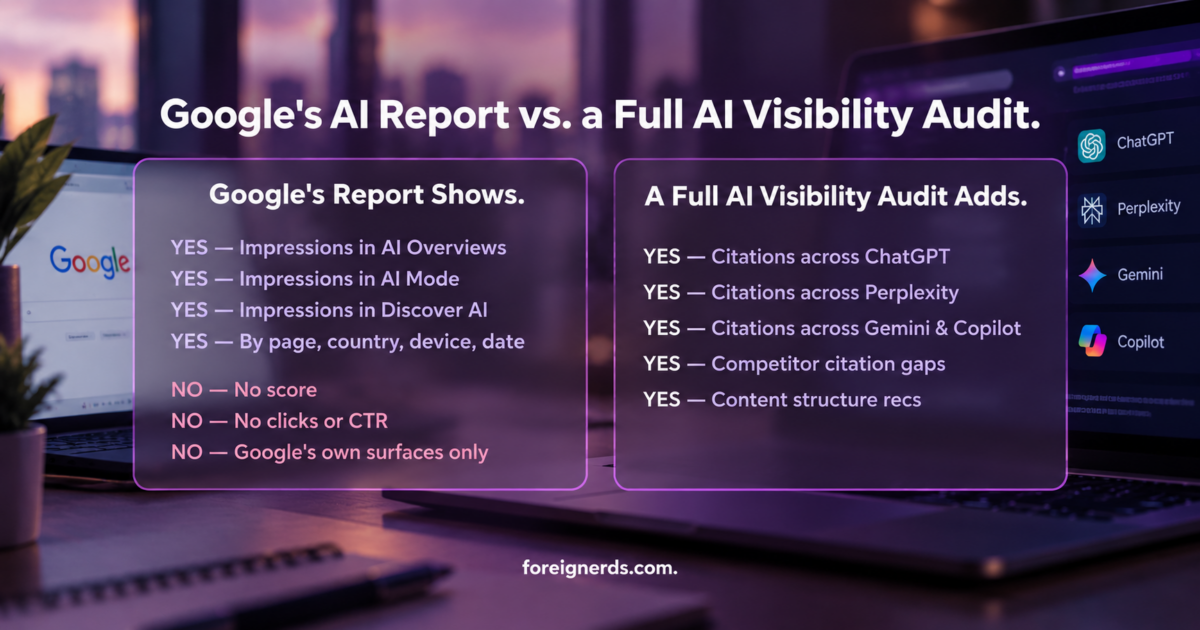
Google’s new Generative AI performance report in Search Console shows how often your pages appear in AI Overviews, AI Mode, and Discover — impressions only, with no score, clicks, or CTR data. Google rolled this out worldwide by August 31, 2026. It is useful, but not the same as the cross-platform “AI visibility audit” most vendors sell.

What Google Actually Launched

On June 3, 2026, Google added a dedicated Generative AI performance report inside Search Console — its own official name for the feature, confirmed directly on Google’s developer blog and its own help documentation. The report isolates how often your site’s pages appeared inside Google’s generative AI features on Search and Discover, breaking that data down by page, country, device, and date, with granularity from hourly to monthly. By August 31, 2026, Google confirmed the rollout had reached every website worldwide, not just the initial test group that saw it first.

The data itself was not new — Google confirmed these AI impressions were already counted inside your overall Search Console performance totals, mixed in with your regular organic search numbers. What changed is visibility: for the first time, that number is broken out into its own dedicated view instead of being buried inside an aggregate figure you could not isolate or act on separately. Before this launch, a site could be earning a meaningful share of its total impressions from AI Overviews and have no way to know it, because that traffic looked identical to a regular search impression in every report Search Console offered.

For the fuller picture of how AI search itself works, see our breakdown of how AI search actually works and what it means for SEO. This new report is also part of a broader shift industry-wide, not a Google-only move. The same week Google’s report rolled out more broadly, Microsoft’s Search team publicly confirmed similar AI performance reporting was coming to Bing Webmaster Tools — a signal that isolating AI-driven visibility from traditional organic visibility is becoming a baseline expectation for search platforms generally, not a one-off Google experiment.

What It Does Not Do

This is the part that gets lost in translation, and it matters more than the launch itself. The report shows impressions only. There is no click data, no click-through rate, and no query-level data in the current version — you can see that your page appeared inside an AI feature, but not whether anyone actually engaged with it once it did, and not which specific search query triggered that appearance. That is a real, meaningful gap for anyone trying to judge whether AI visibility is actually translating into business value.

There is also no score of any kind, despite how this feature gets described informally in some coverage. A business searching for “did Google give my site an AI visibility score” will not find one inside Search Console, because Google has not built one — what exists is a raw count of appearances, not a graded assessment of how well-optimized your content is for AI surfaces.

The report is also scoped narrowly by design: it covers only Google’s own generative AI surfaces — AI Overviews, AI Mode, and generative AI features inside Discover. It says nothing about whether your brand appears when someone asks ChatGPT, Claude, Perplexity, or Gemini the same question, because those are entirely separate systems Google has no visibility into and no reason to report on. Google also introduced a toggle letting site owners opt their content out of appearing in these AI features entirely. Opting out has no effect on standard Search rankings — it only affects eligibility for the AI-specific surfaces this report tracks, which is worth knowing before treating that toggle as a bigger decision than it actually is.

Comparison of Google AI visibility report versus a full AI visibility audit

Why This Gets Confused With a Full AI Visibility Audit

Search interest in “AI visibility audit” grew from essentially zero in early 2025 to 390 searches a month by July 2026 — genuine, fast-growing demand for a term that barely existed eighteen months earlier. We checked the current top-ranking results for that exact term, and every one of them — Semrush, Ahrefs, SE Ranking, Amplitude, WhiteLabelIQ — is a vendor selling a tool that tracks brand visibility across ChatGPT, Perplexity, and Gemini, not just Google’s own surfaces. That is a genuinely useful and different thing from what Google’s new report measures, but none of the current top results draw a clear line between the two ideas for a reader encountering both terms in the same week.

A reader searching either term could easily walk away with one of two wrong conclusions: either that Google’s report is the same thing as a full AI visibility audit, or that a paid audit tool is simply repackaging data Google already gives away for free. Neither assumption holds up under scrutiny. Google’s report tells you about Google’s own AI surfaces only, and only in impression-count form. A genuine AI visibility audit checks whether your brand gets cited by name across every major AI assistant a customer might actually ask — a materially broader question Google’s own tooling was never built to answer, because it was built to report on Google Search, not to audit the entire AI assistant landscape a customer might use instead.

What a Real AI Visibility Audit Adds on Top

A proper AI visibility audit picks up exactly where Google’s report stops, and the difference is not incremental — it is a different question entirely. It checks whether your brand is actually named when someone asks ChatGPT, Perplexity, Gemini, or Copilot a question in your category, not just whether Google’s crawler included your page in an AI Overview response. It identifies which competitors are getting cited instead of you, and on which specific questions your category’s buyers are actually asking these assistants — detail no Google-facing tool could ever surface, since Google has no access to what a competitor’s brand looks like inside a ChatGPT conversation.

It also looks at whether your content is structured in a way that makes it easy for any AI system to extract and cite accurately — clear entity naming, direct answers near the top of a page, genuine factual claims an AI model can quote with confidence — rather than optimizing purely for how Google’s own crawler happens to parse a page. None of that visibility exists anywhere inside Search Console, because Search Console is fundamentally a Google product reporting on Google’s own systems. It was never going to cover competitors’ AI systems, and expecting it to is asking a tool to do a job it was never built for.

What To Actually Do With This Data This Month

If the new Search Console report is available on your property, start with something simple: establish a real baseline. Note your current AI impression count by page, and revisit it monthly rather than treating the number as a one-time curiosity to check once and forget. A page with zero AI impressions is itself a genuine signal worth investigating — either the topic isn’t structured in a way AI Overviews can easily extract an answer from, or Google simply isn’t surfacing an AI answer for that particular query yet, which is useful to know either way.

Once that baseline exists, the honest next question is whether Google’s surfaces are actually the only ones that matter to your specific customers. If your buyers are just as likely to ask ChatGPT or Perplexity a question as they are to type it into Google, Google’s report alone will never reveal that gap to you — it structurally cannot, since it only measures what happens on Google’s own systems. That is exactly the point where a full AI visibility audit becomes the genuinely necessary next step rather than a redundant one, because it answers the specific question Google’s own report was never designed to address.

Common Misconceptions Worth Correcting

A few assumptions show up repeatedly once businesses start looking at this new report, and each one is worth addressing directly before it leads to a wasted decision.

“My AI impressions dropped, so my AI visibility is getting worse”

Not necessarily. Because this data was always counted inside your existing performance totals and has simply been broken out separately for the first time, a change in the isolated number can reflect a change in how Google is categorizing existing traffic, not necessarily a real change in how often you’re actually appearing. Compare the isolated AI number against your overall performance trend before drawing a conclusion from either alone.

“Opting out of AI features will protect my traffic”

Google has confirmed the opt-out toggle affects eligibility for AI Overviews, AI Mode, and Discover AI specifically — it does not restore or protect standard organic ranking traffic, because that traffic was never affected by inclusion in AI features in the first place. Opting out trades away the impressions and potential exposure those AI experiences provide, without changing your regular search position at all.

“If Google shows zero AI clicks, AI search isn’t sending me any traffic”

The current report doesn’t measure clicks at all, in either direction — its absence from the report is not evidence of zero AI-driven traffic, it’s simply a metric Google hasn’t built yet. Treating the absence of click data as proof of zero AI traffic value is reading more into the report than it currently supports.

Where This Sits Inside a Broader GEO Strategy

Google’s new report is best understood as one instrument on a dashboard, not the whole dashboard. It is a genuinely useful, free, first-party signal for the narrow question it answers — and it should be checked regularly precisely because it costs nothing to monitor and reflects real, verified Google data rather than a third party’s estimate of what Google might be doing. But treating it as a complete answer to “how visible is my brand in AI search” mistakes one instrument for the whole picture.

The businesses getting genuine value from this moment are the ones using Google’s report as the free baseline it actually is, then layering a proper cross-platform audit on top once that baseline raises real questions — a page with strong traditional rankings but zero AI impressions, a category where competitors are visibly better cited on ChatGPT than the same competitors rank on Google, a customer base that increasingly starts its research inside an AI assistant rather than a search box. Each of those signals points toward a genuine need for broader visibility work, not toward more time spent staring at Google’s own isolated number waiting for it to change on its own.

This is also why the underlying discipline matters more than any single report a platform happens to ship. Structuring content so an AI system — any AI system, Google’s or otherwise — can extract a clear, accurate, citable answer is the actual skill being measured here, whether that gets surfaced through Google’s Search Console report, a third-party audit tool, or simply asking ChatGPT the question yourself and seeing what comes back. The report is useful. The underlying content discipline it’s measuring is what actually matters.

How to Actually Check This on Your Own Site

If you have not looked yet, the report sits inside Search Console under the Search Results section, in its own dedicated panel rather than mixed into the standard performance report. Compare the isolated AI figure against the total impressions figure for the same date range, since neither number means much read entirely on its own — that ratio is a more honest starting metric than either number in isolation, since it tells you what share of your existing visibility is coming specifically from Google’s AI features rather than traditional blue-link results.

Worth checking specifically: which pages show meaningful AI impressions and which show none at all, even among pages with comparable traditional search performance. A page ranking well in standard search but earning zero AI impressions is a genuine, specific signal — often it means the page’s content isn’t structured with a clear, extractable, direct answer near the top, the exact structural pattern AI Overviews tend to favor when selecting which page to summarize from — a fixable, specific gap once it is actually made visible, which is precisely what this new report finally makes possible for any site owner willing to look.

Key Takeaways

  • Google’s Generative AI performance report (rolled out worldwide by August 31, 2026) shows only how often your pages appear in AI Overviews, AI Mode, and Discover — impressions only, with no clicks, CTR, query data, or “score” of any kind.
  • It’s scoped narrowly to Google’s own AI surfaces — it says nothing about whether your brand appears when someone asks ChatGPT, Claude, Perplexity, or Gemini the same question.
  • A full AI visibility audit answers the broader question Google’s report structurally can’t: whether your brand gets cited by name across every major AI assistant, and which competitors are getting cited instead of you.
  • The two aren’t competing tools — Google’s report is a useful free baseline; a cross-platform audit is the next step once that baseline raises real questions.

Generative Engine Optimization (GEO): The Complete Guide

Generative Engine Optimization (GEO) is the practice of structuring content so AI-driven search tools — ChatGPT, Perplexity, Google’s AI Overviews — can accurately retrieve, understand, and cite it in the answers they generate. The most important thing to understand about GEO going into 2026 is something Google itself has now said explicitly, in an official guide published specifically to correct the record: for Google Search, optimizing for generative AI features is not a separate discipline requiring a new toolkit — it runs on the same core search ranking and quality systems as traditional SEO. That doesn’t mean nothing has changed. It means the change is more specific, and more foundational, than most of the GEO advice circulating today.

Where the Term “GEO” Actually Comes From

Generative Engine Optimization isn’t marketing language invented by an agency — it originated as an academic term in AI retrieval research, describing how content creators could improve their visibility specifically within AI-generated, synthesized answers rather than traditional ranked search results. The distinction that research established early on has held up: retrieval (an AI system finding and pulling relevant content) and generation (synthesizing that content into a direct answer) are related but structurally different processes from how a classic search engine ranks and displays a list of links.

Google’s Official Position — Published May 2026, and It Changes the Conversation

In May 2026, Google published its first consolidated official guide specifically addressing how content surfaces inside its generative AI features, including AI Overviews and AI Mode. This matters enormously because it replaces speculation with an authoritative primary source, and its central message directly contradicts a lot of what gets sold as “GEO strategy”:

  • There is no separate eligibility system for AI Search. Google states plainly that because its generative AI features are built on the same core ranking and quality systems as regular Search, standard SEO best practices remain foundational and relevant — not replaced by a new set of rules.
  • Google names the actual underlying mechanism: its generative features draw on retrieval-augmented generation (RAG) and a technique it calls “query fan-out” — breaking a complex question into multiple retrieval queries — to surface and support AI-generated answers with real web content.
  • The guide explicitly mythbusts several common “GEO hack” tactics as unnecessary for Google Search specifically — including creating a separate `llms.txt` file, adding special markup beyond standard structured data, and excessively “chunking” content into artificial fragments.
  • Three factors are named as what actually matters: creating genuinely unique, valuable, non-commodity content; maintaining clean technical accessibility and crawlability; and overall page experience (speed, mobile usability, clear structure).

This is a meaningful, current shift in the conversation. A large share of GEO advice published over the past two years focused on speculative technical tactics — special files, markup schemes, content fragmentation — that Google’s own documentation now explicitly says are not required. The businesses that treated GEO as fundamentally different from good SEO are the ones most likely to have spent effort on tactics Google itself calls unnecessary.

What Genuinely Is Different — Because Something Is

Google’s guide focuses specifically on Google Search’s generative features. Other AI systems — ChatGPT, Perplexity, Claude with web search — are not Google products, don’t share Google’s index or ranking systems, and have their own distinct retrieval and citation behavior. This is where genuine GEO-specific practice still matters, separate from what Google’s guide addresses:

  • Direct-answer structure matters more for multi-platform AI citation. AI systems extract passages that directly answer a question; content that builds up to an answer through several paragraphs of preamble extracts poorly compared to content that states the answer plainly, then elaborates.
  • Self-contained sections extract better than page-dependent ones. AI systems often pull a specific section or paragraph, not an entire page — meaning each major section should make sense as a complete answer on its own.
  • Named, specific entities extract and cite better than vague references — across every AI platform, not just Google’s.
  • Different platforms have different retrieval behavior and citation policies that Google’s guide, understandably, doesn’t cover at all — optimizing only for how Google’s AI Overviews behave while ignoring how ChatGPT, Perplexity, and Claude each retrieve and cite content differently leaves real visibility on the table across a genuinely fragmented AI search landscape.

How to Actually Check Your AI Search Visibility

Unlike traditional SEO, where rank-tracking tools have existed for two decades, AI search visibility measurement is newer and less standardized across platforms. The practical approach available today:

  1. Manually query the major AI assistants — ChatGPT, Claude, Perplexity, Google AI Overviews, Microsoft Copilot — with the specific questions your target customers would realistically ask, and record whether and how your business is mentioned or cited.
  2. Track this over time, not as a one-time check. AI search results are less stable than traditional rankings and can shift meaningfully as underlying models update.
  3. Pay attention to which competitors get cited instead of you on queries where you would expect to be a relevant answer — this reveals content gaps more directly than traditional competitive keyword analysis often does.

This is precisely the exercise our own AI Visibility Audit is built around — direct, current, multi-platform testing rather than a single Google-focused snapshot.

The Content Gap Almost Nobody Fills

Every major resource currently ranking for this topic — including strong, credible sources like Google’s own guide, Wikipedia, and established SEO publications — is educational. They explain what GEO is and how it works. What’s largely missing across the current field is content that connects GEO explanation to a concrete, testable, measurable service: not “here’s what GEO is” but “here’s exactly how to find out where your specific business currently stands, across every platform your customers actually use.” That gap is where genuine differentiation lives, and it’s a gap general educational content — however well-written — structurally can’t fill on its own.

Common Misconceptions Worth Correcting

  • “GEO requires an entirely separate technical setup from SEO.” Google’s own May 2026 guidance directly contradicts this for its own platform — the foundational work is shared, not duplicated.
  • “Special files and markup guarantee AI citation.” Google explicitly names `llms.txt` and excessive special markup as unnecessary tactics for its Search features specifically.
  • “If you rank well traditionally, you’re automatically visible in AI answers.” The two systems are related but genuinely distinct — a page can be cited by an AI system without ranking in the traditional top 5 for the same query, and vice versa.
  • “Optimizing for Google’s AI Overviews covers AI search generally.” It covers Google’s generative features specifically. ChatGPT, Perplexity, and Claude are separate systems with their own retrieval behavior, not covered by Google’s guidance at all.

A Practical Framework for Building AI Search Visibility

  1. Audit existing high-priority content against the direct-answer structure first — does the core question get answered in the opening 100 words, or does the page build up to it?
  2. Ensure foundational SEO and technical health are genuinely solid — per Google’s own guidance, this remains the real foundation, not a box to check before moving to “the real GEO work.”
  3. Manually test current visibility across all major AI assistants for your actual target customer questions, not just Google-specific queries.
  4. Restructure content for self-contained, extractable sections where testing reveals gaps — this is the genuinely platform-agnostic GEO work that sits outside what Google’s guide addresses.
  5. Re-test on a recurring basis. AI search behavior shifts as underlying models update, in a way traditional rankings historically have not.

Build In-House or Bring in a Partner?

Given that genuine GEO work spans understanding platform-specific retrieval behavior across multiple AI systems most internal marketing teams have not deeply tested, this is an area where outside expertise typically accelerates results — particularly the multi-platform testing and measurement work, which requires ongoing, recurring effort rather than a one-time setup. A business with strong internal content and SEO capability may only need the testing/measurement layer added; a business earlier in its SEO maturity likely benefits from combining both.

For the deeper mechanics of how AI retrieval and synthesis actually work at a technical level, see our companion guide, How AI Search Actually Works — and What It Really Means for SEO.

How Different AI Platforms Actually Differ in Retrieval and Citation

Treating “AI search” as one undifferentiated thing is one of the most common strategic mistakes in this space. Each major platform has genuinely different mechanics:

  • Google’s AI Overviews and AI Mode draw directly from Google’s existing Search index using retrieval-augmented generation and query fan-out, per Google’s own May 2026 documentation — meaning strong traditional SEO fundamentals and Search Console visibility are directly relevant here in a way they are not necessarily for other platforms.
  • ChatGPT (with browsing/search enabled) uses its own web-crawling and retrieval system, separate from Google’s index, and has its own citation and linking behavior that OpenAI documents separately.
  • Perplexity is built around live web retrieval and citation as a core product feature, with a citation style that tends to favor clear, well-sourced, recently-updated content.
  • Claude (with web search enabled) retrieves and synthesizes from live web content with its own distinct approach to source selection and citation.

The practical implication: a content strategy optimized purely around Google’s documented guidance may perform well in AI Overviews specifically while remaining comparatively weak in ChatGPT or Perplexity results for the same queries, since those platforms are not bound by Google’s indexing or ranking systems at all. Multi-platform testing, not single-platform optimization, is what genuine GEO practice requires.

Entity Relationships: How to Think About This Structurally

Before writing or restructuring content for AI search visibility, it helps to explicitly map the entity relationships within a topic, rather than treating it as a bag of keywords. For example: Google Search connects to AI Overviews and AI Mode, which connect to Google’s Search index, which connects to retrieval-augmented generation, which connects to the specific webpages being retrieved and cited. Making these relationships explicit and precise within content — naming the specific mechanism, not just the general concept — is what separates content that reads as genuinely informed from content that reads as a surface-level summary, and this distinction matters for both human readers and AI extraction quality.

Measuring Whether GEO Investment Is Actually Working

Given how new and platform-fragmented AI search measurement still is, a realistic measurement approach combines several signals rather than relying on one:

  • Direct, manual testing results over time — the actual answers your target queries produce across each major platform, tracked as a recurring exercise rather than a single snapshot.
  • Google Search Console’s generative AI visibility reporting — Google introduced dedicated reporting specifically for visibility within its generative AI Search features, giving at least one platform a measurable, first-party data source. See our breakdown of exactly what this report shows and where it falls short for the full picture.
  • Referral traffic patterns from AI platforms where available, though this data remains less standardized across platforms than traditional referral tracking.
  • Business outcome tracking — ultimately, whether AI-driven visibility is translating into actual inquiries or leads, which is the metric that determines whether the investment is working regardless of how the intermediate visibility metrics look.

What This Means for a Business Just Starting on GEO

For a business with limited existing content investment, the most efficient sequence based on everything above: first, get foundational SEO and technical health genuinely solid, since Google’s own guidance confirms this remains the real foundation rather than a preliminary step to rush past. Second, restructure a handful of your highest-priority existing pages for direct-answer, self-contained-section structure, since this is the platform-agnostic work that benefits every AI system, not just Google’s. Third, begin manual multi-platform testing on your actual target customer questions to establish a real baseline before investing further. This sequence avoids the common mistake of jumping straight to speculative technical tactics — the `llms.txt` files and special markup schemes Google’s own guide explicitly calls unnecessary — before the foundational work is even in place.

Why This Matters More for Some Industries Than Others

  • Professional services (law, accounting, consulting) increasingly see prospective clients research providers through conversational AI queries before ever visiting a website directly — making direct-answer, citable content about specific expertise areas disproportionately valuable.
  • Home services and local businesses benefit from AI systems that increasingly handle local, comparative queries (“best plumber near me that also does X”) directly in conversational answers, a use case Google’s own guidance specifically flags as an area of continued development.
  • B2B software and technical services often see buyers using AI assistants for early-stage comparative research precisely because the format suits complex, multi-factor decisions better than scanning ten separate web pages — meaning technical accuracy and genuine expertise signals matter more here than in more commoditized categories.
  • E-commerce faces a more fragmented picture, since Google’s guide specifically addresses shopping content as a distinct area with its own considerations, separate from the general content guidance covered here.

The Competitive Landscape Right Now

GEO as a topic has moved past the early-adopter phase — established SEO platforms, major CRM and marketing tool providers, and a growing number of digital agencies now publish GEO guidance, and Google’s own official documentation has made this a mainstream topic rather than a niche one. What remains comparatively rare, even among agencies actively publishing on the topic, is content that pairs the explanation with an actual, standardized testing methodology a business could request today. That gap — explanation without a concrete, repeatable measurement offer behind it — is the throughline of the differentiation opportunity described earlier in this guide.

What “Good” GEO Content Actually Looks Like, in Practice

Pulling together everything above into a concrete standard: a well-optimized page for AI search visibility answers its core question within the first 100 words, uses specific named entities rather than vague references, contains genuine expertise or a real point of view rather than a neutral restatement of common knowledge, and remains technically crawlable and fast-loading per standard SEO fundamentals. None of this requires special files, exotic markup, or content restructured beyond recognition from what a good human reader would also want. That convergence — the same qualities that make content genuinely good for people also make it good for AI retrieval — is precisely the point Google’s May 2026 guidance is making, and it is a far more durable strategy than chasing whatever the newest speculative “GEO trick” happens to be at any given moment.

Structured Data: What Actually Helps vs. What Is a Waste of Effort

Given that Google’s own guidance explicitly rejects special GEO-specific markup as unnecessary, the practical question becomes what structured data is actually worth implementing. The answer is unglamorous but important: standard, accurate structured data that genuinely describes the page’s real content — Article markup, FAQPage markup for genuine Q&A content, BreadcrumbList for site navigation — continues to provide value by giving both traditional search and AI retrieval systems a clear, machine-readable signal of what a page is and what it directly answers. What does not help, per Google’s explicit guidance, is inventing new schema types specifically because they sound AI-relevant, or marking up content in ways that do not accurately reflect what is visibly on the page. The distinction is between structured data that describes reality accurately and structured data implemented as a speculative ranking trick — the former remains genuinely useful, the latter is exactly the kind of tactic Google’s May 2026 guidance was published to discourage.

A Note on Content Freshness

Because AI-generated answers increasingly synthesize from recently-updated content, and because the underlying models and retrieval systems themselves update on their own schedule, content in this specific space ages differently than evergreen topics do. A page explaining “what GEO is” from 2024 may describe a meaningfully less mature landscape than the reality in 2026 — this guide itself will need periodic revisiting as Google and other platforms continue to formalize their own guidance, exactly the kind of ongoing-discipline framing that applies across AI-adjacent topics generally, not just this one specifically.

For a deeper look at how AI-generated answers actually work under the hood, see our related article: How AI Search Actually Works — and What It Really Means for SEO.

Want to see how your own site measures up? Explore our Answer Engine Optimization services.

Key Takeaways

  • GEO means structuring content so AI tools like ChatGPT, Perplexity, and Google’s AI Overviews can retrieve, understand, and cite it — and per Google’s own May 2026 guidance, it runs on the same core ranking and quality systems as traditional SEO, not a separate rulebook.
  • What Google’s guidance explicitly calls unnecessary: separate llms.txt files, special AI-specific markup, and artificial content chunking.
  • What genuinely differs across platforms: ChatGPT, Perplexity, and Claude each have their own retrieval and citation behavior separate from Google’s index — meaning multi-platform testing, not single-platform optimization, is the real GEO-specific work.
  • The practical starting sequence: solid foundational SEO first, then direct-answer restructuring, then manual multi-platform visibility testing — in that order.

How AI Search Actually Works — and What It Really Means for SEO

This article is part of our complete guide: Generative Engine Optimization (GEO): The Complete Guide.

AI search works by retrieving relevant information from across the web and synthesizing it into a direct answer, rather than returning a ranked list of links for a human to click through and evaluate themselves. This single shift — from “here are ten places that might have your answer” to “here is your answer, sourced from these places” — is the reason SEO strategy built entirely around classic ranking factors is now solving only half the problem. The other half is a discipline that goes by several names — Generative Engine Optimization (GEO), Answer Engine Optimization (AEO) — and it has its own distinct mechanics, separate from (though overlapping with) traditional SEO.

How AI Search Actually Retrieves and Generates Answers

Understanding the real mechanism matters more than memorizing tactics, because tactics change and the underlying mechanism explains why they work. Modern AI search systems (Google AI Overviews, ChatGPT with browsing, Perplexity, Claude with web search) operate in roughly two stages:

  • Retrieval: the system searches for and pulls content that appears relevant to the query, similar in spirit to traditional search indexing but often weighing different signals — content structure, clarity of the specific answer, and how directly a passage addresses the exact question asked.
  • Synthesis: the retrieved content gets summarized and combined into a single answer, often citing multiple sources rather than picking one “winner” the way a traditional search results page implicitly does with its #1 ranking.

This has a direct, practical implication: a page can be cited by an AI system without ranking #1 — or even top 5 — in traditional search for the same query. The two systems are related but genuinely distinct, which is exactly why a business ranking well traditionally can still be invisible in AI-generated answers, and vice versa.

What Actually Changes About On-Page Content for AI Search

Based on how retrieval and synthesis actually work, the content changes that matter are specific, not vague:

  • Direct answers near the top of a page or section. AI systems extract passages that directly answer a question; content that builds up to an answer through several paragraphs of preamble extracts poorly compared to content that states the answer plainly, then elaborates.
  • Content structured so individual sections stand alone. AI systems often pull a specific section or paragraph, not an entire page — meaning each major section should make sense as a self-contained answer, not depend on context established several paragraphs earlier.
  • Precise, named entities instead of vague references. “Modern AI tools can help with this” extracts and cites poorly compared to naming the specific approach, technology, or method being discussed.
  • Genuine specificity and real data points. AI synthesis engines, like human readers, prefer content with concrete, checkable information over generic statements — this is also where genuine subject-matter expertise (a named author with real credentials) provides a real, structural advantage over generic AI-generated filler content, since specificity is exactly what generic content lacks.

Where Traditional SEO and AI Search Optimization Overlap — and Where They Diverge

What still matters for both: genuine topical authority built over time, technical site health (fast load times, mobile usability, crawlability), and content that actually, substantively answers the question a searcher has — none of this has become obsolete. Google’s own developer guidance on succeeding in AI search is direct on this point: there are no special “AI SEO” requirements beyond the foundations of high-quality, crawlable, well-structured content — the same systems that support traditional Search also support AI Overviews and AI Mode.

What is genuinely different: keyword density and exact-match keyword placement matter far less to AI synthesis than to classic ranking algorithms; backlink profile as a trust signal matters differently, since AI systems appear to weigh direct content quality and structure more heavily in what gets cited, relative to how heavily classic SEO weighs link authority; and structured data / schema markup has taken on new importance as a way of explicitly telling an AI system what a piece of content is and directly answers.

How to Actually Check Your AI Search Visibility

Unlike traditional SEO, where rank-tracking tools have existed for two decades, AI search visibility measurement is newer and less standardized. The practical approach available today:

  1. Manually query the major AI assistants (ChatGPT, Claude, Perplexity, Google AI Overviews, Microsoft Copilot) with the specific questions your target customers would realistically ask, and record whether and how your business is mentioned or cited.
  2. Track this over time, not as a one-time check. AI search results are less stable than traditional rankings and can shift meaningfully as underlying models update.
  3. Pay attention to which competitors get cited instead of you on queries where you would expect to be a relevant answer — this reveals content gaps more directly than traditional competitive keyword analysis often does.

Common Mistakes Businesses Make With AI Search Optimization

  • Treating GEO/AEO as a checkbox add-on to existing SEO work, rather than recognizing it requires genuinely different content structure decisions — leading with the answer, self-contained sections, named specificity.
  • Assuming strong traditional rankings automatically translate to AI citation. The two systems correlate but are not the same measurement, and content optimized purely for classic ranking factors often underperforms in AI synthesis specifically because it lacks the direct-answer structure AI extraction favors.
  • Ignoring the multi-platform reality. Optimizing only for how Google’s AI Overviews behave, while ignoring how ChatGPT, Perplexity, and Claude each retrieve and cite content somewhat differently, leaves real visibility on the table across a genuinely fragmented AI search landscape.

Why Author Expertise Signals Matter More in AI Search, Not Less

A common assumption is that AI-generated content has made expertise signals less important, since AI can generate plausible-sounding text on any topic instantly. The opposite is closer to true for AI search specifically. Because AI systems now have to distinguish between genuinely authoritative content and generic, interchangeable content at a scale no human editorial process could review manually, the signals that indicate real expertise — a named author with a consistent body of work in a specific domain, specific claims tied to real experience rather than generic summary, content that demonstrates a point of view rather than neutrally restating common knowledge — become more valuable as differentiators, not less. This is the practical mechanism behind why E-E-A-T (Experience, Expertise, Authoritativeness, Trustworthiness) has become a more explicit part of the conversation around AI search specifically, not just traditional SEO.

A Practical Content Audit Framework

For a business assessing whether existing content is structured for AI search visibility, four questions applied page by page:

  1. Does the core question get a direct answer within the first 100 words? If a reader (or an AI system) has to read three paragraphs of context before reaching the actual answer, this needs restructuring.
  2. Could a single section be extracted and still make complete sense on its own? Sections that rely heavily on context established earlier in the page extract poorly.
  3. Are claims specific and named, or generic and vague? “AI tools can help with this” versus naming the specific approach, technology, or method — the specific version is both more useful to a human reader and more citable by an AI system.
  4. Is there a genuine point of view or expertise signal, or does the content just summarize what is already widely known? Content that only restates consensus information has little reason to be the source an AI system chooses to cite over dozens of other pages saying the same thing.

Running existing high-traffic or high-priority pages through this four-question audit is a faster starting point than a ground-up content strategy rebuild, and it directly targets the specific structural gaps that separate content AI systems extract and cite well from content that gets passed over even when it is factually accurate. This is the same audit framework we apply in our own Generative Engine Optimization engagements, alongside the foundational SEO work neither traditional search nor AI retrieval can substitute for.

What This Means for Foreignerdsu2019 Own Approach

This is exactly why our own AI Visibility Audit is built around direct, current testing across ChatGPT, Claude, Perplexity, and Googleu2019s AI Overviews — rather than relying solely on traditional rank-tracking data, which measures a genuinely different (though related) thing. A business can hold a strong position in classic search results while remaining largely invisible in the AI-generated answers an increasing share of prospective customers now see first, and the only way to know which situation actually applies to your business is to check both, directly, on a recurring basis rather than as a one-time snapshot.

If you want a direct, current read on how your business actually shows up — or does not — across ChatGPT, Claude, Perplexity, and Google’s AI Overviews for the questions your prospective customers are asking, that is precisely what an AI Visibility Audit is built to answer.

Understanding how AI search works mechanically is one half of the picture — the other is knowing how to actually measure your own visibility inside it, which is exactly what Google’s new AI visibility reporting can and cannot tell you.

Key Takeaways

  • AI search works in two stages — retrieval (finding relevant content) and synthesis (combining it into a direct answer) — which is why a page can be cited by an AI system without ranking in the traditional top 5 for the same query.
  • What still matters: topical authority, technical site health, and content that genuinely answers the question. What’s different: keyword density and backlinks matter less to AI synthesis, while direct-answer structure and named entities matter more.
  • The four-question audit that matters most: does the core answer appear in the first 100 words, could a section stand alone if extracted, are claims specific and named rather than vague, and is there a genuine point of view rather than a restatement of common knowledge?
  • Author expertise signals matter more in AI search, not less, because AI systems have to distinguish genuinely authoritative content from generic filler at a scale no human editor could review manually.