Aviation software and AI flight-operations tools support route optimization, maintenance prediction, and dynamic pricing for airlines managing thin margins and heavy fuel costs. Alaska Airlines' AI route-optimization system saved roughly 480,000 gallons of jet fuel within six months, a measured result, not a projection. Foreignerds builds toward that kind of verifiable operational outcome, tied to fuel and maintenance costs an airline can actually track.
Tell us what's going on — a real person replies within 1 business day, not an autoresponder.
That approach ignores where the real, measured value actually is: predictive maintenance and flight-operations optimization, not customer service alone.
We build aviation systems around the operational levers with real, documented impact — because flight operations is the dominant AI application in this industry, expected to hold 37.28% of the market by application in 2026, precisely because it delivers measurable fuel savings and reduced disruption.
Get a Real Assessment of Your Project →This is built for airline operations leaders, MRO (maintenance, repair, overhaul) providers, and airport technology teams who need genuine predictive-maintenance and flight-operations AI with measurable fuel and reliability impact, not a generic passenger-app chatbot.
Market-size estimates for AI in aviation vary substantially by scope and methodology, ranging from roughly $3-9 billion in 2026 depending on the source, with several forecasts projecting $10-37 billion by the early 2030s. What's consistent across estimates is the growth trajectory: this is a genuinely fast-growing category, not a mature, saturated one.
The operational-impact data is concrete: predictive maintenance and network reoptimization deliver 10% fewer disruption impacts and 6% better fuel efficiency from analytics pilots, cutting costs per passenger. North America holds the largest regional share of the AI-in-aviation market, estimated between 42.8% and 46.5% depending on the forecast. The adoption-gap data is specific and worth naming directly: 33% of airlines currently use AIOps for anomaly detection, but only 18% apply AI to dynamic pricing — meaning operational and maintenance applications have moved further than commercial and revenue-management applications. Cloud-based AI deployment accounts for roughly 65% of all AI implementations across airlines, reflecting a genuine shift away from on-premises legacy systems.
It makes sense when: your maintenance operations still rely primarily on scheduled rather than predictive maintenance, in a category where predictive approaches deliver documented double-digit reductions in disruption; your flight-operations planning isn't capturing available fuel-efficiency gains comparable to Alaska Airlines' documented 480,000-gallon result; or your current digital presence isn't showing up when passengers or B2B aviation partners research providers through AI assistants.
It's equally worth being honest about when this is premature. A very small charter or regional operator with limited fleet complexity may get more value from foundational operational systems before investing in advanced predictive-maintenance infrastructure built for larger fleet scale. A useful gut check: if your maintenance and flight data currently lives in disconnected systems, AI layered on top will inherit that fragmentation, not fix it. What Happens If You Wait: There's no single dramatic failure point — most airlines don't lose a specific flight or dollar amount to a competitor's AI adoption in a visible, attributable way. The gap compounds quietly instead: 98% of airlines plan to invest in major AI R&D, meaning the operators not moving now are falling behind an industry-wide push, not just a handful of early adopters. The fuel-cost case is a live, current opportunity: Alaska Airlines' documented 480,000-gallon savings in just six months from AI route optimization represents real, current, measurable value available through the same category of technology — every quarter without comparable optimization is a quarter of foregone fuel savings against a cost line that's directly material to airline profitability.
Predictive maintenance and flight-operations optimization built on real fleet and sensor data, the industry's dominant current AI application. Selected from Foreignerds' full service catalog based on genuine Aviation & Airlines relevance — not a generic list reused across every industry page.
Passenger service and booking automation, scoped as a complement to operational AI, not a substitute for it. Custom Software Development & Enterprise Software Development — MRO, flight-planning, and operational platforms built for genuine aviation-scale reliability.
Real integration with existing fleet-management and MRO systems, not standalone tools. Managed IT Services & DevOps Consulting — the reliability discipline appropriate for aviation-scale, safety-adjacent operations.
For aviation service providers and MRO companies competing for B2B and regional customer search. Generative Engine Optimization (GEO) & Answer Engine Optimization (AEO) — positioning for aviation B2B buyers and passengers researching providers through AI assistants.
A direct diagnostic of how your company appears when potential partners or passengers ask AI assistants for aviation-provider recommendations. AI Security Consulting — increasingly material given the safety-critical and regulated nature of aviation systems.
Fleet management, MRO, and flight-planning system integrations. AI/ML platforms for predictive maintenance, route optimization, and anomaly detection (AIOps). DO-178C-aware development practices for flight-critical software applications. Aviation-specific SEO, GEO, AEO, and AI Visibility Audit tooling.
The operational-impact pattern is the real, documented lever: Alaska Airlines' AI route-optimization system saved approximately 480,000 gallons of jet fuel within six months — real, current, measurable value available through the same category of technology.
Aviation B2B buyers (airlines evaluating MRO or technology partners) and passengers researching airlines increasingly use AI assistants during evaluation, following the same broader research-behavior shift affecting both B2B procurement and consumer travel decisions. This changes what needs to be true about an aviation company's online presence. Traditional SEO optimizes to rank in search results for aviation services. GEO and AEO optimize for being the source an AI system cites or recommends when someone asks about aviation technology partners, MRO providers, or airline-specific capabilities directly.
Adoption is genuinely broad but concentrated in specific applications, with the clearest documented ROI in flight operations.
Adoption is genuinely broad but concentrated in specific applications: 98% of airlines plan major AI R&D investment, and flight operations is expected to dominate with 37.28% of the AI-in-aviation market by application in 2026 — reflecting where the documented ROI (fuel efficiency, disruption reduction) is clearest.
The Alaska Airlines example is a real, current, named case demonstrating this isn't theoretical: AI route optimization saved approximately 480,000 gallons of jet fuel within six months of implementation in 2025 — a specific, measured, checkable result that illustrates the category of value available through operational AI applied correctly.
Tell us what's going on in one line — we'll take it from there.
Aviation software touching flight-critical systems falls under FAA oversight (or equivalent international authorities) and often requires DO-178C certification for software used in airborne systems — a genuinely rigorous, safety-critical software standard distinct from typical enterprise software compliance. Passenger data handling intersects with standard privacy regulations, but flight-operations and maintenance AI carries the additional, higher-stakes burden of aviation safety certification.
This is a composite, illustrative example built from common, well-documented patterns in aviation AI deployment, not a specific named client.
A regional carrier had maintenance scheduling based primarily on fixed intervals rather than real aircraft condition data, leading to both unnecessary maintenance downtime and occasional unplanned issues.
Building predictive-maintenance capability on existing sensor and maintenance-log data — following the documented pattern behind flight operations' dominant share of aviation AI applications — reduced unplanned downtime while extending the useful life of maintenance intervals where aircraft condition supported it.
Real fleet and operations auditing, predictive-maintenance or flight-operations optimization built on real fleet data, plus ongoing support and marketing.
Honest evaluation of current maintenance approach (scheduled vs. predictive), fuel-optimization opportunity, and existing MRO system integration.
Predictive-maintenance or flight-operations optimization built on real fleet data, with safety-critical certification scoped separately where genuinely required.
Managed IT and reliability support appropriate for aviation-scale operations, plus B2B and passenger-facing marketing — including GEO/AEO.
Flight-operations optimization and predictive maintenance are the primary current levers, given documented fuel and reliability impact.
Predictive-maintenance platform development is directly central to this segment's business model.
Passenger-flow and resource-management AI, distinct from in-flight and maintenance-focused needs.
A genuinely distinct AI adoption pattern given design, testing, and quality-control applications.
Often smaller-scale, with different ROI thresholds for predictive-maintenance infrastructure than major carriers.
While ignoring predictive maintenance and flight-operations optimization — the categories with the clearest documented ROI.
Rather than scoping DO-178C specifically to flight-critical systems.
Instead of AI-driven predictive maintenance despite documented double-digit reductions in disruption from predictive approaches.
Despite real, named, documented results like Alaska Airlines' 480,000-gallon savings in six months.
When 65% of aviation AI implementations have already moved to cloud-based deployment.
Even as research behavior shifts toward AI-assisted evaluation broadly.
Selected per project based on the task — not a fixed default stack.
Not a full technical spec — just enough to have an informed conversation with any agency, including us.
If two or more of these are true, this is very likely worth exploring.
These four questions are worth answering honestly before any AI investment — the audit will help you answer them with certainty.
We don't list a price here for the same reason across every page: a number before an assessment is a guess, and in aviation specifically, scope depends heavily on fleet size and safety-certification requirements. Your actual scope will determine cost after the audit.
Claim Your Free Aviation & Airlines AI Visibility Audit
Yes — real integration work is core to these projects. Scope depends on your specific systems.
The evidence is real and named — Alaska Airlines' AI route-optimization system saved approximately 480,000 gallons of jet fuel within six months in 2025, a specific, documented result.
Operational-impact-first development and genuine aviation-sector experience, not general competence applied to an industry with real safety-certification requirements.
We scope safety-critical and non-safety-critical applications separately from the start, so certification requirements apply precisely where genuinely needed, not across an entire project unnecessarily.
Depends heavily on fleet scale and safety-certification requirements — the audit in Week 1 gives an honest, specific timeline.
Yes — the sub-vertical breakdown above reflects genuinely different needs and ROI thresholds we scope separately.
Yes, with real evidence — predictive maintenance and network reoptimization deliver documented 10% fewer disruption impacts industry-wide.
Predictive-maintenance platform development is directly central to this business model — a distinct, real focus area we scope specifically for MRO providers.
Very — 98% of airlines plan to invest in major AI research and development, reflecting industry-wide rather than isolated early-adopter commitment.
Flight operations, clearly — 33% of airlines use AIOps for anomaly detection versus only 18% applying AI to dynamic pricing, showing operational applications have moved further than commercial ones.
GEO is optimizing your content so AI systems cite or recommend your company directly when a B2B buyer or passenger researches aviation providers.
AEO structures your content to be pulled as a direct answer by AI-driven search features during aviation-provider research.
A direct diagnostic of whether and how your company currently appears when someone asks an AI assistant for aviation-provider recommendations.
Increasingly yes, following the same broader research-behavior shift affecting both B2B procurement and consumer travel decisions generally.
Directly — reliability and safety track record are central to how both B2B partners and passengers evaluate aviation providers, and AI systems weigh these signals heavily.
Yes — B2B and passenger research behavior is shifting broadly, and smaller operators invisible to AI discovery risk losing exactly the partner and passenger consideration larger companies are already capturing.
Through recurring AI Visibility Audits tracking citation and recommendation frequency, alongside traditional B2B and passenger-acquisition metrics.
Yes, under one roof — predictive maintenance, flight-operations optimization, SEO, GEO/AEO, and AI Visibility auditing together.
Not anymore — B2B and passenger research behavior is shifting broadly, following the same pattern seen across other industries.
Book a call — the audit gives you an honest picture of your current maintenance approach, fuel-optimization opportunity, and AI search visibility.
Real projects. Real, sourced results.
Delivered aviation, airline, and broader AI work sits alongside our 1,250+ project history — verifiable, not invented, and available to discuss specifically on the call.
15-20 minutes, focused on your actual situation, not a generic pitch.
15-20 minutes, focused on your actual situation, not a generic pitch.
We tell you honestly if foundational work needs to happen before AI adds real value.
You leave with a specific, scoped next step — not a vague proposal.
100+ case studies live here

-90% Monitoring Time (15 hrs → 1.5 hrs)
View Case Study →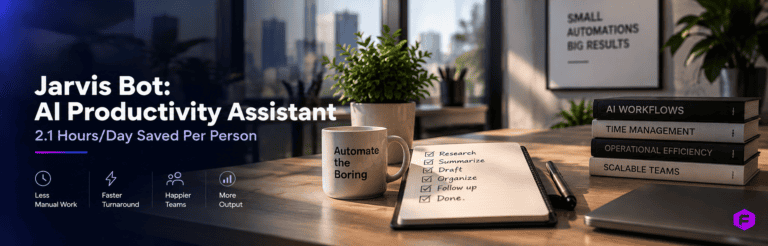
2.1 hrs Admin Time Saved Per Person/Day
View Case Study →
-70% Search Time Reduction
View Case Study →
10x Screening Capacity Increase
View Case Study →