Media and entertainment software and AI content systems support audience engagement, content production, and distribution for media companies competing for shrinking attention spans. The global AI in media and entertainment market is projected to grow from $28.32 billion in 2025 to $87.44 billion by 2030, a 25% CAGR. Foreignerds builds systems for that growth curve, focused on audience retention metrics that actually move revenue.
Tell us what's going on — a real person replies within 1 business day, not an autoresponder.
That approach produces platforms that technically personalize content and still lose audience attention to competitors doing it with real data depth.
We build media and entertainment systems around genuine audience data and production efficiency — because in a market growing at 25% CAGR, generic personalization isn't a differentiator, it's table stakes.
Get a Real Assessment of Your Project →This is built for content platform product leads and media company marketing directors who need genuine audience-data-driven personalization and production efficiency, not a generic recommendation widget bolted onto an existing CMS.
AI adoption in media and entertainment currently sits at 22% of the sector's share of the broader AI market — meaningfully behind technology/communications (32%), automotive (29%), and financial services (28%), suggesting real headroom for organizations that move now rather than later. Sales and marketing applications led the market with a 22.1% revenue share in 2025.
The production-efficiency case is direct: AI-powered tools now handle automated content generation spanning scriptwriting to video editing, making production processes measurably faster. Predictive analytics for audience-preference modeling is driving more personalized content delivery at a scale manual curation can't match. Regional and platform data adds texture: Asia Pacific holds the largest regional share of the AI media and entertainment market at 32.5% (2025), driven heavily by investment in AI-powered recommendation engines, content personalization, virtual production, and automated video editing. Major platform players (Amazon, Alphabet, Microsoft) are driving significant infrastructure investment that smaller media organizations can now access through vendor and API relationships rather than building from scratch.
It makes sense when: your content recommendation and personalization engine is generic or absent, in a category where AI-driven personalization is becoming the baseline expectation; your production workflow still relies heavily on manual editing and content generation that AI-assisted tools can now genuinely accelerate; or your audience-facing digital presence isn't showing up when audiences research content or platforms through AI assistants.
It's equally worth being honest about when this is premature. A very early-stage content platform with minimal audience or content-catalog depth may get limited value from advanced personalization infrastructure that needs real behavioral data to perform well. A useful gut check: if you don't have clean, structured audience-engagement data today, AI personalization layered on top will underperform, not overperform. What Happens If You Wait: There's no single dramatic failure point — most media organizations don't notice audience attention shifting to AI-personalized competitors in real time. The gap compounds quietly instead: with the sector's AI adoption share (22%) trailing several comparable industries, organizations investing now are positioned to close that gap ahead of a market growing at 25% CAGR, rather than catching up once personalization becomes fully commoditized. The production-cost case compounds too: as AI-assisted content generation and editing tools mature, organizations still relying entirely on manual production workflows face a widening cost and speed disadvantage against competitors who've adopted AI-assisted production — not a hypothetical future gap, but a present and growing one given the market's 25% CAGR trajectory.
Audience-preference modeling and content-recommendation engines built on real, structured behavioral data, in a category where customer-service applications represent 56% of enterprise AI use broadly. Selected from Foreignerds' full service catalog based on genuine Media & Entertainment relevance — not a generic list reused across every industry page.
Production-assist tooling spanning scriptwriting support to automated video-editing workflows. Custom Software Development & SaaS Development — content management and distribution platforms beyond generic templates.
Connecting content, audience, and distribution data into one coherent operating system. Conversion Rate Optimization — structured improvement of audience acquisition and retention funnels.
For organic and paid audience acquisition that actually converts to engaged viewers or subscribers. Generative Engine Optimization (GEO) & Answer Engine Optimization (AEO) — positioning for audiences discovering content and platforms through AI assistants directly.
A direct diagnostic of whether your platform or content appears when audiences ask AI assistants for recommendations. Reputation Management & Social Media Marketing — brand and platform sentiment management directly influencing audience trust and discovery.
Content management and distribution platform integrations. AI/ML platforms for audience-preference modeling and recommendation engines. AI-assisted production tooling spanning scriptwriting support to automated video editing. Media-specific SEO, GEO, AEO, and AI Visibility Audit tooling.
The audience-data pattern is the real, documented lever: in a market growing at 25% CAGR with current adoption at only 22%, organizations investing in genuine personalization now are positioned ahead of a rapidly compressing adoption curve.
Audiences increasingly discover content and platforms through AI-assisted search and recommendation, following the same broader research-behavior shift seen across other consumer decisions, rather than relying purely on traditional search or platform-native discovery alone. This changes what needs to be true about a media brand's or platform's online presence. Traditional SEO optimizes to rank in search results. GEO and AEO optimize for being the source an AI system cites or recommends when someone asks about content, genres, or platforms directly — genuinely different from how media marketing has traditionally been built around platform algorithms and paid promotion alone.
Adoption is accelerating from a genuinely lower current base than several comparable industries, but the market itself is growing at 25% CAGR.
Adoption is accelerating from a genuinely lower current base than several comparable industries — media and entertainment's 22% AI-adoption share trails technology/communications (32%), automotive (29%), and financial services (28%) — but the market itself is growing at 25% CAGR, among the fastest of any sector in this research, meaning the adoption curve is compressing rapidly even from a lower starting point.
The clearest current applications are production-focused and audience-focused simultaneously: automated content generation (scriptwriting to video editing) is making production measurably faster, while predictive analytics for audience preferences is driving more personalized content delivery — the two halves of the value equation moving together rather than independently.
Tell us what's going on in one line — we'll take it from there.
Content platforms carry standard copyright and licensing compliance obligations (DMCA takedown processes for user-generated or AI-assisted content), and an active, fast-moving wave of state-level AI-content-disclosure and synthetic-media laws is directly relevant given the sector's growing reliance on AI-generated and AI-assisted content.
This is a composite, illustrative example built from common, well-documented patterns in media AI deployment, not a specific named client.
A mid-size digital media platform had generic, engagement-agnostic content recommendations that hadn't meaningfully changed as the audience grew.
Building genuine audience-preference modeling on structured behavioral data, then layering AI-assisted production tooling to increase content velocity, moved engagement metrics meaningfully within a measured period — consistent with the documented pattern where structured audience data, not recommendation-algorithm sophistication alone, determines whether personalization actually improves retention.
Real audience and production auditing, personalization-engine and production tooling built on structured data, plus ongoing refinement and marketing.
Honest evaluation of current audience-data structure, production workflow efficiency, and where AI would genuinely improve engagement or output.
Real personalization-engine and production-tooling built on structured data, integrated with existing content and distribution systems.
Continuous engagement-metric refinement, plus audience-acquisition marketing — including GEO/AEO — built around how audiences actually discover content now.
Recommendation-engine sophistication and content-personalization depth are the primary competitive levers.
AI-assisted production tooling (scriptwriting support, automated editing) drives the clearest efficiency gains.
Audience-acquisition and content-discovery marketing, including GEO/AEO for editorial content specifically.
A genuinely distinct AI adoption pattern given real-time personalization and player-behavior modeling needs.
Audience engagement and ticketing/marketing automation, distinct from content-platform needs.
Without real, structured audience-behavior data underneath it, producing shallow personalization that doesn't move engagement.
Rather than a genuine efficiency lever, despite documented production-speed gains from automated content-generation workflows.
Even as discovery behavior shifts toward AI-assisted search broadly.
When vendor and API relationships now make comparable capability accessible to mid-size organizations.
A 25% CAGR market where the current 22% adoption share represents real, currently-open opportunity, not a mature, saturated category.
The documented prerequisite for AI recommendation engines to actually perform.
Selected per project based on the task — not a fixed default stack.
Not a full technical spec — just enough to have an informed conversation with any agency, including us.
If two or more of these are true, this is very likely worth exploring.
These four questions are worth answering honestly before any AI investment — the audit will help you answer them with certainty.
We don't list a price here for the same reason across every page: a number before an assessment is a guess, and in media and entertainment specifically, scope depends heavily on audience scale and content-catalog depth. Your actual scope will determine cost after the audit.
Claim Your Free Media & Entertainment AI Visibility Audit
Yes — real integration work is core to these projects. Scope depends on your specific platform.
The underlying mechanism is real — structured audience data feeding a genuine recommendation engine drives measurable engagement gains, though it does require real behavioral data volume to perform well.
Audience-data-first development and real personalization/production-AI experience, not standard CMS functionality with a recommendation widget added.
This is common, and a legitimate starting point — data structuring is usually the necessary first step, and we'll say so honestly during the audit.
Depends heavily on audience scale and content-catalog complexity — the audit in Week 1 gives an honest, specific timeline.
Yes — the sub-vertical breakdown above reflects genuinely different needs we scope separately.
Yes, with real evidence — automated content-generation and editing tools are documented as making production processes measurably faster industry-wide.
This is exactly where vendor and API-based AI infrastructure matters most — you can access comparable capability without building it from scratch.
Asia Pacific holds the largest regional share at 32.5% in 2025, driven heavily by investment in recommendation engines, content personalization, and virtual production.
Sales and marketing applications led the market with the largest single revenue share at 22.1% in 2025, ahead of production-focused applications.
GEO is optimizing your content so AI systems cite or recommend your platform or specific content directly when someone asks for recommendations.
AEO structures your content to be pulled as a direct answer by AI-driven search features, rather than only ranking in a traditional search results page.
A direct diagnostic of whether and how your platform or content currently appears when someone asks an AI assistant for recommendations in your category.
Increasingly yes, following the same broader research-behavior shift seen across other consumer decisions, rather than relying purely on traditional search or platform-native discovery alone.
Directly — trust and sentiment signals influence how AI systems weigh recommendations, making reputation management a genuine discovery lever.
Yes — this shift is broad-based, and smaller organizations invisible to AI discovery risk losing exactly the audiences already researching this way.
Through recurring AI Visibility Audits tracking citation and recommendation frequency, alongside traditional audience-acquisition and engagement metrics.
Yes, under one roof — personalization engines, production tooling, SEO, GEO/AEO, and AI Visibility auditing together.
Not anymore — audience discovery behavior is shifting broadly, following the same pattern seen across other content and consumer categories.
Book a call — the audit gives you an honest picture of your current audience-data structure, production efficiency, and AI search visibility.
Real projects. Real, sourced results.
Delivered media, entertainment, and broader AI work sits alongside our 1,250+ project history — verifiable, not invented, and available to discuss specifically on the call.
15-20 minutes, focused on your actual situation, not a generic pitch.
15-20 minutes, focused on your actual situation, not a generic pitch.
We tell you honestly if foundational work needs to happen before AI adds real value.
You leave with a specific, scoped next step — not a vague proposal.
100+ case studies live here

-90% Monitoring Time (15 hrs → 1.5 hrs)
View Case Study →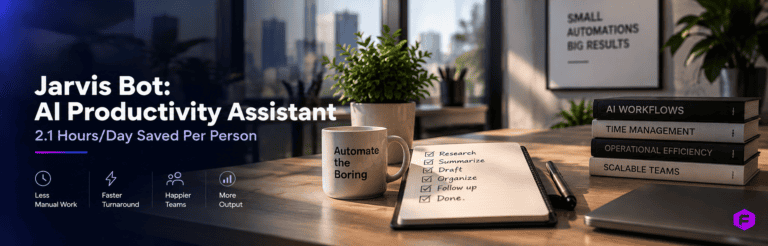
2.1 hrs Admin Time Saved Per Person/Day
View Case Study →
-70% Search Time Reduction
View Case Study →
10x Screening Capacity Increase
View Case Study →