Non-profit and advocacy software with AI donor systems support fundraising, donor tracking, and outreach for nonprofit organizations running lean development teams. 92% of nonprofits now use AI in some capacity, yet only 7% report major improvements in organizational capability — researchers call this an efficiency plateau. Foreignerds builds systems that break past that plateau, tying donor outreach to real giving patterns instead of a generic mass email.
Tell us what's going on — a real person replies within 1 business day, not an autoresponder.
That approach explains exactly why 92% adoption produces only 7% real organizational impact — individual efficiency without structural change.
We build nonprofit systems around genuine capability expansion, not just individual task acceleration — because 81% of nonprofits currently use AI individually and ad hoc, without shared workflows, and that's precisely the pattern that produces plateaued impact instead of real transformation.
Get a Real Assessment of Your Project →This is built for nonprofit executive directors and development leads who've already adopted AI tools informally across their team but are stuck at what the data calls an "efficiency plateau" — faster at existing tasks, but not fundamentally expanding what the organization can accomplish.
85% of nonprofits are actively exploring AI (TechSoup/Tapp Network 2025 AI Benchmark Report), and adoption reached 92% by the 2026 Nonprofit AI Adoption Report from Virtuous and Fundraising.AI, surveying 346 organizations. But only 24% have a formal AI strategy, and just 7% report major improvements in organizational capability — the efficiency plateau is real and well-documented across multiple independent studies.
Specific application adoption remains genuinely low despite the headline 92% figure: only 4.5% of nonprofits use AI-powered smart donation forms, just 2.3% use predictive AI to identify likely mid-level or major donors, and only 1.2% use agentic AI software for fundraising at all (Nonprofit Tech for Good 2025 survey). The donor-trust dimension is real and worth naming directly: 67% of donors are comfortable with nonprofits using AI for fundraising and administrative work, but 31% say they'd be less likely to donate if AI use became apparent, and 23% of foundations currently won't accept AI-generated grant application content while 67% remain undecided. This isn't settled donor sentiment — it's actively forming.
It makes sense when: your team already uses AI tools informally without shared workflows — the exact pattern the data shows produces plateaued rather than transformational impact; grant writing or donor follow-up consistently falls through the cracks due to genuine capacity constraints (24% already use AI here, with 60% expressing strong interest); or your current digital presence isn't showing up when donors or partner organizations research your nonprofit through AI assistants.
It's equally worth being honest about when this is premature. A very small organization with limited donor volume may get more value from foundational CRM and donor-tracking systems before investing in advanced AI personalization built for scale it doesn't have yet. A useful gut check: if your organization has no formal AI policy (the situation for 76-81% of nonprofits across multiple studies), building real governance should come before scaling AI use further, not after. What Happens If You Wait: There's no single dramatic failure point — most nonprofits don't notice a specific donor or grant lost to slower AI adoption in real time. The gap compounds quietly instead: 92% adoption with only 7% real capability improvement means most organizations are already "using AI" in the shallow sense, and the ones that break through to genuine transformation now are building a real, compounding advantage over peers stuck at the same plateau. The governance gap is itself a real, current risk, not just a missed opportunity: with 76-81% of nonprofits reporting no formal AI policy across multiple 2025-2026 studies, and donor data specifically at stake, organizations without governance are accumulating real trust and compliance exposure with every ungoverned AI use — precisely the kind of exposure that could damage the donor trust 67% of supporters currently extend conditionally.
Donor-identification and engagement systems addressing the documented gap where only 2.3% of nonprofits currently use predictive donor AI despite real, available value. Selected from Foreignerds' full service catalog based on genuine Non-Profit & Advocacy relevance — not a generic list reused across every industry page.
Organization-wide, shared workflow automation designed specifically to move beyond the individual, ad-hoc AI use pattern behind the efficiency plateau. AI Governance Consulting — the formal AI policy infrastructure 76-81% of nonprofits currently lack, addressing both donor-data protection and foundation grant-content variability.
Donor-relationship and fundraising platforms integrated with existing nonprofit systems, not disconnected point tools. Content Marketing & Writing — grant-writing and donor-communication support built with genuine awareness of foundation AI-content policies.
For nonprofits and advocacy organizations competing for donor and community visibility. Generative Engine Optimization (GEO) & Answer Engine Optimization (AEO) — positioning for donors and partner organizations researching nonprofits through AI assistants.
A direct diagnostic of how your organization appears when donors or partners ask AI assistants for recommendations. Email Marketing & Marketing Automation — donor communication and stewardship built for genuine, personalized engagement at scale.
Nonprofit CRM and donor-management platform integrations. AI/ML platforms for predictive donor identification and engagement personalization. Grant-writing and content-generation tools built with foundation-policy awareness. Nonprofit-specific SEO, GEO, AEO, and AI Visibility Audit tooling.
The capability-expansion pattern is the real path beyond the plateau: organizations moving from individual task acceleration to shared, organization-wide workflows are joining the 7% reporting major capability improvement — not the 92% stuck at broad, shallow adoption.
Donors and partner organizations increasingly research nonprofits through AI assistants during evaluation, following the same broader research-behavior shift affecting consumer and B2B decisions generally. This changes what needs to be true about a nonprofit's online presence. Traditional SEO optimizes to rank in search results for cause-related queries. GEO and AEO optimize for being the source an AI system cites or recommends when a potential donor or partner asks about organizations working in a specific cause area directly.
Adoption has reached near-universal breadth extremely fast — but the depth of that adoption is the real story.
Adoption has reached near-universal breadth extremely fast: 92% of nonprofits now use AI in some capacity, up from a starting point most studies place well below 50% just two to three years ago — a genuinely rapid, broad-based shift.
But the depth of that adoption is the real story: just 7% report major improvements in organizational capability, 65% characterize their AI use as reactive and individual rather than strategic, and specific high-value applications remain rare — only 1.2% use agentic fundraising AI, only 2.3% use predictive donor-identification AI. The organizations moving from the shallow-adoption majority to genuine capability expansion are the ones building real, compounding advantage.
Tell us what's going on in one line — we'll take it from there.
Nonprofit AI use intersects with donor-data privacy obligations under state privacy laws, and a genuinely material, nonprofit-specific consideration: 23% of foundations will not currently accept grant applications containing AI-generated content, while only 10% explicitly will — with 67% still undecided (Candid.org). Any AI-assisted grant-writing workflow needs to account for this real, foundation-by-foundation variability rather than assuming AI-generated content is universally acceptable.
This is a composite, illustrative example built from common, well-documented patterns in nonprofit AI deployment, not a specific named client.
A mid-size nonprofit had one development staffer using ChatGPT informally to draft donor appeals faster, while the rest of the team continued manual, disconnected processes — exactly the efficiency-plateau pattern the research documents.
Building a shared, organization-wide donor-engagement workflow instead — with genuine predictive donor-identification and transparent AI-assisted communication — moved the organization from individual task acceleration toward the kind of real capability expansion only 7% of nonprofits currently report.
Real adoption and governance auditing, shared organization-wide AI workflows built with formal governance from the start, plus ongoing optimization and marketing.
Honest evaluation of current AI use (individual vs. shared), donor-data protection posture, and where the organization sits on the efficiency-plateau spectrum.
Shared, organization-wide AI workflows for donor engagement or grant writing, integrated with existing CRM systems, with formal governance built in from the start.
Continuous refinement as donor sentiment and foundation AI-content policies evolve, plus donor and partner-acquisition marketing — including GEO/AEO.
Donor identification, engagement, and grant-writing AI are the primary current levers.
Content and campaign automation, distinct from direct-fundraising-focused needs.
A genuinely distinct position given the foundation side of the AI-generated-content acceptance question.
Program delivery and impact-measurement AI, less fundraising-centric than donor-focused organizations.
Engagement and retention AI with dynamics closer to subscription businesses than pure fundraising.
The pattern behind 81% of current nonprofit AI use and the documented efficiency plateau.
When 23% of foundations currently reject it and 67% remain undecided, without checking specific foundation policies.
Despite 31% of donors saying they'd give less if AI use became apparent without context.
The current state for 76-81% of nonprofits across multiple studies — creating real donor-data and compliance exposure.
One staffer using ChatGPT is not organizational transformation — the exact distinction the efficiency-plateau research identifies.
Even as this research pattern shifts broadly across consumer and B2B decisions.
Selected per project based on the task — not a fixed default stack.
Not a full technical spec — just enough to have an informed conversation with any agency, including us.
If two or more of these are true, this is very likely worth exploring.
These four questions are worth answering honestly before any AI investment — the audit will help you answer them with certainty.
We don't list a price here for the same reason across every page: a number before an assessment is a guess, and in the nonprofit sector specifically, scope depends heavily on organization size and current donor-data infrastructure. Your actual scope will determine cost after the audit.
Claim Your Free Non-Profit & Advocacy AI Visibility Audit
Yes — real integration work is core to these projects. Scope depends on your specific platform.
It's the current pattern for 81% of nonprofits, and the data is direct about the result — 92% adoption but only 7% report major capability improvement, because individual, ad hoc use doesn't produce the same impact as shared, organization-wide workflows.
Capability-expansion-first development, not standard CRM functionality with an AI feature added without addressing the shared-workflow gap that actually drives real impact.
It's a real, legitimate concern given 31% of donors say they'd give less if AI use became apparent — which is exactly why we build transparency and thoughtful disclosure into any donor-facing AI work, not a reason to avoid AI that could genuinely expand your capacity.
Depends heavily on organization size and current donor-data infrastructure — the audit in Week 1 gives an honest, specific timeline.
Yes — the sub-vertical breakdown above reflects genuinely different needs we scope separately.
We build grant-writing support with real awareness that 23% of foundations currently reject AI-generated content while 67% remain undecided — checking specific foundation policies rather than assuming universal acceptance.
This is the current situation for 76-81% of nonprofits — we help build real governance alongside any tools we deploy, not tools without the structure around them.
Just 2.3%, according to Nonprofit Tech for Good's 2025 survey — a genuinely low figure relative to 92% overall AI adoption, and a real, specific opportunity most organizations haven't captured yet.
It means broad AI adoption (92%) coexists with minimal organizational transformation (only 7% report major capability improvement) — most organizations are faster at existing tasks, not fundamentally more capable.
GEO is optimizing your content so AI systems cite or recommend your organization directly when a donor or partner researches causes or organizations.
AEO structures your content to be pulled as a direct answer by AI-driven search features during donor or partner research.
A direct diagnostic of whether and how your organization currently appears when someone asks an AI assistant for recommendations in your cause area.
Increasingly yes, following the same broader research-behavior shift affecting consumer and B2B decisions generally across the industries covered in this research.
Directly — given real donor sensitivity to AI use (31% say it would reduce giving), transparent, well-communicated AI adoption matters more to trust than avoiding AI use entirely.
Yes — this shift is broad-based, and smaller organizations invisible to AI discovery risk losing exactly the donor and partner consideration set larger nonprofits are already capturing.
Through recurring AI Visibility Audits tracking citation and recommendation frequency, alongside traditional donor-acquisition and engagement metrics.
Yes, under one roof — donor systems, governance, SEO, GEO/AEO, and AI Visibility auditing together.
Not anymore — donor and partner research behavior is shifting broadly, following the same pattern seen across other consumer-facing and B2B industries.
Book a call — the audit gives you an honest picture of your current AI-adoption pattern, governance posture, and AI search visibility.
Real projects. Real, sourced results.
Delivered nonprofit, advocacy, and broader AI work sits alongside our 1,250+ project history — verifiable, not invented, and available to discuss specifically on the call.
15-20 minutes, focused on your actual situation, not a generic pitch.
15-20 minutes, focused on your actual situation, not a generic pitch.
We tell you honestly if foundational work needs to happen before AI adds real value.
You leave with a specific, scoped next step — not a vague proposal.
100+ case studies live here
-90% Monitoring Time (15 hrs → 1.5 hrs)
View Case Study →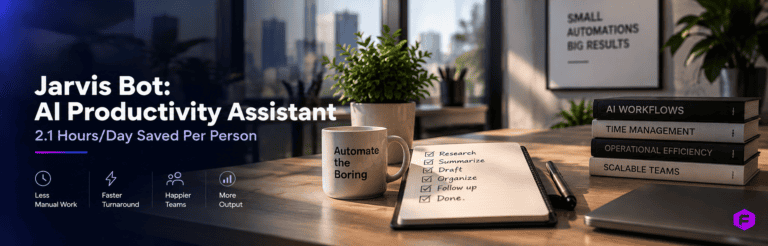
2.1 hrs Admin Time Saved Per Person/Day
View Case Study →
-70% Search Time Reduction
View Case Study →
10x Screening Capacity Increase
View Case Study →