E-commerce and retail software with AI personalization support product recommendations, chat-based shopping, and conversion optimization for online retailers competing on discovery, not just price. 89% of retail and CPG companies now use or pilot AI, and AI-referred traffic to US retail sites grew 4,700% year over year. Foreignerds builds systems for that structural shift in shopper discovery, optimizing for how customers now actually find products.
Tell us what's going on — a real person replies within 1 business day, not an autoresponder.
Swap a theme, add a chatbot widget, call it done. That approach produces stores that look modern and convert like they're standing still.
We build e-commerce systems around real conversion data and genuine AI personalization — because a beautiful store that doesn't convert isn't actually a store.
Get a Real Assessment of Your Project →This is built for e-commerce brand owners and marketing directors who need real AI personalization and conversion infrastructure, and who are carrying genuine, currently-active ADA accessibility litigation exposure they haven't yet addressed.
The global AI in eCommerce market is valued between $9.70-11.21 billion in 2026 depending on methodology, projected to reach $47-75 billion by the early 2030s. AI personalization drives a documented 5-40% revenue lift depending on source and implementation depth, with top performers reaching 25% gains from McKinsey's research alone.
The conversion data is specific and dramatic: shoppers who engage with AI chat convert at 12.3%, nearly four times the 3.1% rate of those who don't. Retail chatbots increase sales by up to 67%. Personalized product recommendations already contribute 25-35% of total e-commerce revenue — this isn't experimental, it's already load-bearing. The U.S. dominates global AI e-commerce spending with roughly 39% of the market, and 38% of US consumers have already used generative AI for online shopping specifically, with 58% of Gen Z already relying on AI for product discovery. Retailers now expect to allocate 59% of their marketing budget toward personalization overall (Deloitte), and email campaigns with AI product recommendations lift click rates to 3.75% on average, reaching 8.79% for top performers.
It makes sense when: your current conversion rate sits meaningfully below the AI-chat-engaged 12.3% benchmark; your product discovery and recommendation experience is generic rather than personalized; or your brand isn't showing up when shoppers research products through AI assistants directly.
It's equally worth being honest about when this is premature. A very early-stage store with minimal traffic or product catalog depth may need to prove core demand before investing in advanced personalization infrastructure that needs real data volume to work well. A useful gut check: if you don't have clean customer and product data today, AI personalization built on top of it will underperform, not overperform. What Happens If You Wait: There's no single dramatic failure point — most retailers don't notice AI-driven traffic shifting away from them in real time. The gap compounds quietly instead: AI-referred traffic to US retail sites grew 4,700% year over year, meaning stores invisible to AI discovery are losing a channel that's scaling faster than almost any other acquisition source right now. 84% of e-commerce businesses now rank AI as their top strategic priority, and 71% plan to hire dedicated AI staff within 12 months. Competitors moving now are building infrastructure and internal capability that becomes harder to catch up to the longer the gap runs. The revenue math is also direct and current: personalized product recommendations already contribute 25-35% of total e-commerce revenue, and organizations that build AI genuinely into their business strategy earn an average of 10-12% more revenue than those that don't. Every quarter without real personalization infrastructure is a quarter of that gap compounding against a brand's baseline.
Shopping assistants that convert at documented higher rates (12.3% vs 3.1%) than standard browsing, handling product questions, sizing, and order status without human intervention. Selected from Foreignerds' full service catalog based on genuine E-commerce & Retail relevance — not a generic list reused across every industry page.
Product recommendation engines and personalization built on real, unified customer data, covering lifecycle marketing, on-site recommendations, and behavioral-based paid media targeting. E-commerce Platform Integration & System Integration Services — real integration with existing catalog, inventory, and payment systems across Shopify, WooCommerce, Magento, and custom platforms.
Custom storefronts and internal tooling beyond template limitations, including inventory and logistics automation that documented AI deployments cut by 20-30% and 5-20% respectively. Conversion Rate Optimization — structured, data-driven testing addressing specific leverage points like the 70.22% average cart-abandonment rate, not guesswork redesigns.
For organic and paid acquisition that actually converts. Generative Engine Optimization (GEO) & Answer Engine Optimization (AEO) — positioning for the surging share of AI-driven product research.
A direct diagnostic of whether your brand appears when shoppers ask AI assistants for product recommendations. eCommerce Marketing & Email Marketing — full-funnel acquisition and retention built around real behavioral data, including AI-personalized recommendation emails that lift click rates to 3.75% on average.
Directly material given how heavily reviews influence purchase decisions, and how directly AI shopping assistants weigh review sentiment when recommending products. AI Predictive Analytics builds product recommendation engines on real, unified customer data.
E-commerce platform integrations (Shopify, WooCommerce, Magento, and custom platforms) built for real interoperability. AI/ML platforms for product recommendation and personalization engines. Conversational commerce and shopping-assistant chatbot infrastructure. Retail-specific SEO, GEO, AEO, and AI Visibility Audit tooling.
Personalized product recommendations already contribute 25-35% of total e-commerce revenue, and organizations that build AI genuinely into their business strategy earn an average of 10-12% more revenue than those that don't. Retail chatbots increase sales by up to 67%, and AI cuts inventory levels by 20-30% while reducing logistics costs by 5-20%. Every quarter without real personalization infrastructure is a quarter of that gap compounding against a brand's baseline.
38% of US consumers have already used generative AI for online shopping, and 58% of Gen Z already use AI for product discovery specifically. 79% of brands say AI-driven conversational commerce has increased sales. This changes what needs to be true about a retail brand's online presence. Traditional SEO optimizes to rank in a list of links. GEO and AEO optimize for being the product an AI system recommends when a shopper asks directly — often skipping the traditional search results page entirely. Given AI-referred traffic to US retail sites grew 4,700% year over year, this is no longer an experimental channel.
Adoption has moved from experimentation to infrastructure — but the gap between brands deploying AI well versus poorly is widening.
Adoption has moved from experimentation to infrastructure: 96% of online retailers already use AI in some form, and 97% plan to increase AI spending in the next fiscal year. AI resolves 93% of customer service questions without human help.
But adoption is wide and shallow in many cases: 71% of merchants say AI merchandising tools have had limited to no effect on their business so far, and the AI talent shortage has risen from 31% to 46% as the top implementation barrier in a single year. A separate, often-overlooked risk is compounding alongside the AI opportunity: e-commerce is now the single most-targeted sector for ADA website accessibility litigation, with real, documented case precedent — including the Domino's Pizza case, where courts ruled that blind users being unable to order through a screen reader constituted an ADA violation, a precedent now regularly cited against online retailers.
Tell us what's going on in one line — we'll take it from there.
E-commerce is the single most-targeted sector for ADA Title III website accessibility litigation, with over 5,100 lawsuits filed in 2025 alone and nearly 70% specifically targeting online stores. WCAG 2.1 Level AA is the technical standard courts consistently reference, with exposure extending beyond the homepage to checkout flows, product pages, and mobile apps. PCI-DSS compliance applies directly to any payment-processing infrastructure.
This is a composite, illustrative example built from common, well-documented patterns in e-commerce AI deployment, not a specific named client.
A mid-size DTC brand had generic, rules-based product recommendations that hadn't changed in years — conversion sat well below the AI-chat-engaged benchmark.
Rebuilding personalization on genuinely unified customer data, then adding a conversational shopping assistant, moved conversion meaningfully closer to documented AI-engaged benchmarks within a measured testing period. The technical sequence mattered: unifying customer, product, and behavioral data first, then layering personalized recommendations across product pages and cart, and only then adding conversational commerce on top of that foundation — reversing the order is the documented pattern behind the 71% of merchants who report limited effect from AI merchandising tools.
Real data and conversion auditing, real personalization and chat infrastructure built on unified customer data, integrated with existing catalog and payment systems, plus continuous CRO testing.
Honest evaluation of current data unification, personalization maturity, and where AI would genuinely move conversion.
Real personalization and chat infrastructure built on unified customer data, integrated with existing catalog and payment systems.
Continuous CRO testing, plus acquisition marketing — including GEO/AEO — built around real behavioral data.
Personalization, retention marketing, and conversion optimization are the primary levers, in a segment where AI personalization already drives up to 40% higher revenue for well-executed implementations.
AI-powered PPC and marketplace-specific optimization dominate, distinct from owned-storefront strategy.
Local SEO and inventory-integration needs layer on top of standard e-commerce needs, requiring both digital and physical-location visibility.
Longer sales cycles, account-based personalization, and meaningfully different conversion patterns than B2C, even as the same underlying AI infrastructure applies.
Retention and churn-prediction AI matter more than acquisition alone, given AI cuts inventory levels by 20-30% and logistics costs by 5-20% against a recurring demand base.
Over 5,100 ADA website accessibility lawsuits were filed in 2025 alone, a 37% year-over-year increase, with nearly 70% specifically targeting online stores — a live, current legal exposure, not a theoretical one.
Producing shallow personalization that underdelivers relative to documented benchmarks.
Instead of continuous, data-driven testing — the pattern behind most brands that plateau after an initial redesign.
Even as AI-referred traffic grew 4,700% year over year — a channel most brands are structurally unprepared to capture.
71% of merchants report limited effect from AI merchandising tools, often for exactly this reason.
Relative to acquisition spend, despite documented 25-35% revenue contribution from recommendations alone and a 70.22% average cart-abandonment rate representing real, recoverable revenue.
Smaller catalogs need different approaches than large ones, and a one-size template rarely fits both.
The shortage of staff who can actually operate AI merchandising tools has risen from 31% to 46% as the top implementation barrier in a single year, meaning tooling alone doesn't close the gap.
AI shopping assistants surface stale information just as readily as accurate information, and the trust cost of the former is real.
Selected per project based on the task — not a fixed default stack.
Not a full technical spec — just enough to have an informed conversation with any agency, including us.
If two or more of these are true, this is very likely worth exploring.
These four questions are worth answering honestly before any AI investment — the audit will help you answer them with certainty.
We don't list a price here for the same reason across every page: a number before an assessment is a guess, and in e-commerce specifically, scope depends heavily on your current data infrastructure and catalog complexity. Your actual scope will determine cost after the audit.
Claim Your Free E-commerce & Retail AI Visibility Audit
Yes — real integration work with Shopify, WooCommerce, Magento, and custom platforms is core to these projects, not a separate add-on.
The data is real and specific — AI chat converts at 12.3% versus 3.1% for non-engaged shoppers, and personalized recommendations already contribute 25-35% of e-commerce revenue.
This is common, and a legitimate starting point — data unification is often the necessary first step before real personalization can work, and we'll say so directly during the audit.
Conversion-data-first development and real AI personalization experience, not general storefront competence with an AI feature bolted on.
Depends on catalog complexity and current data infrastructure — the audit in Week 1 gives an honest, specific timeline.
Yes — the sub-vertical breakdown above reflects genuinely different needs we scope separately.
We'll tell you honestly whether you have enough data volume for AI personalization to work well yet, or whether foundational growth needs to come first.
Ongoing — conversion rate optimization is continuous, data-driven work, not a one-time launch checklist.
GEO is optimizing your content so AI systems cite or recommend your products directly when a shopper asks — directly relevant given AI-referred retail traffic grew 4,700% year over year.
AEO structures your product content to be pulled as a direct answer by AI-driven search and shopping features, not just ranked in a list of links.
A direct diagnostic of whether and how your brand and products currently appear when shoppers ask ChatGPT, Claude, or Google AI Overviews for recommendations.
38% of US consumers have used generative AI for online shopping, and 58% of Gen Z already use AI for product discovery specifically.
Increasingly yes — 79% of brands report AI-driven conversational commerce has already increased sales.
A basic chat widget answers FAQs; genuine conversational commerce recommends products and drives purchase decisions, converting at the documented 12.3% rate versus 3.1% for non-engaged shoppers.
Yes — this shift is broad-based, not limited to large retailers, and a smaller brand invisible to AI discovery risks losing exactly the fastest-growing acquisition channel.
Through recurring AI Visibility Audits tracking citation and recommendation frequency across AI assistants, alongside traditional organic and conversion metrics.
Yes, under one roof — development, personalization, SEO, GEO/AEO, and AI Visibility auditing together.
Fragmented, disconnected customer data — 71% of merchants report limited effect from AI merchandising tools, and this is usually the underlying cause.
Not anymore — the 4,700% year-over-year growth in AI-referred retail traffic reflects a broad structural shift, not just large-retailer behavior.
Book a call — the audit gives you an honest picture of your current data infrastructure, conversion benchmarks, and AI visibility.
Real projects. Real, sourced results.
Delivered e-commerce and broader AI work sits alongside our 1,250+ project history — verifiable, not invented, and available to discuss specifically on the call.
15-20 minutes, focused on your actual situation, not a generic pitch.
15-20 minutes, focused on your actual situation, not a generic pitch.
We tell you honestly if foundational work needs to happen before AI adds real value.
You leave with a specific, scoped next step — not a vague proposal.
100+ case studies live here

-90% Monitoring Time (15 hrs → 1.5 hrs)
View Case Study →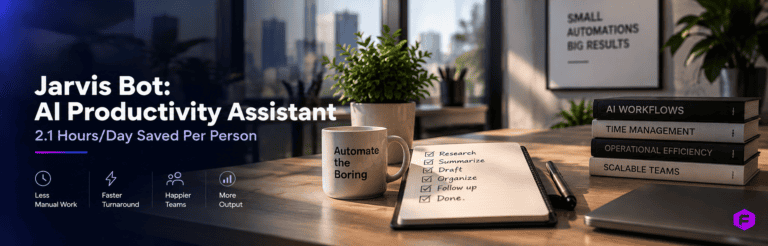
2.1 hrs Admin Time Saved Per Person/Day
View Case Study →
-70% Search Time Reduction
View Case Study →
10x Screening Capacity Increase
View Case Study →