Financial and wealth advisory software with AI client systems support portfolio management, client communication, and relationship tracking for advisory firms. $124 trillion in assets will transfer over the next 25 years, the largest generational wealth transfer in history, with Millennials receiving the largest single share. Foreignerds builds systems for firms positioning ahead of that shift.
Tell us what's going on — a real person replies within 1 business day, not an autoresponder.
With a portfolio-tracking feature. That approach ignores the real, current inflection point: the wealth transferring to a fundamentally different generation of clients with different expectations for how advisory relationships work.
We build wealth advisory systems around fiduciary-compliant AI from day one — because 40% of investment adviser firms have already implemented AI tools internally, but 44% of those firms have no formal testing or validation of their outputs, a real, documented compliance gap regulators are actively examining.
Get a Real Assessment of Your Project →This is built for wealth management and financial advisory firm leaders positioning for the largest generational wealth transfer in history — $124 trillion moving over 25 years — who need AI-driven client engagement and fiduciary-compliant automation, not generic fintech software repositioned for advisors.
95% of wealth and asset management firms have scaled generative AI to multiple use cases (EY survey of 100 firms) — a genuinely high adoption ceiling. Within fintech broadly, AI accounted for 58% of all fintech venture capital funding, with global fintech VC funding reaching $51.8 billion in 2025, up 27% from 2024 (Crunchbase).
The wealth-transfer context is dated and specific: Cerulli Associates' June 2025 research projects $124 trillion transferring over 25 years, with Millennials receiving $45.6 trillion versus Gen X's $39 trillion — meaning the client base wealth advisory firms serve is undergoing a structural generational shift. The compliance-gap data is the defining tension in this market: 40% of investment adviser firms have implemented AI internally, but 44% of those firms report no formal testing or validation of AI outputs — precisely the gap the SEC's 2026 Examination Priorities are designed to surface, given the Division's explicit focus on "AI washing" and adequate AI governance policies.
It makes sense when: your firm needs genuine, fiduciary-compliant AI infrastructure to serve an evolving client base through the ongoing wealth transfer; your current AI use (if any) lacks the formal testing and validation 44% of adopting firms are missing, in a regulatory environment actively examining exactly that gap; or your current digital presence isn't showing up when prospective clients research wealth advisory firms through AI assistants.
It's equally worth being honest about when this is premature. A very small advisory practice with a stable, long-tenured client base may get more value from foundational digital infrastructure before investing in advanced AI-driven portfolio and client-engagement tooling built for larger-scale complexity. A useful gut check: if you can't currently document how an AI-assisted recommendation was reached, deploying more AI on top of that gap increases regulatory exposure rather than reducing it. What Happens If You Wait: There's no single dramatic failure point — most firms don't fail an SEC examination over a single undocumented AI decision in a visible way. The gap compounds quietly instead: with the SEC's 2026 Examination Priorities explicitly naming AI washing and adequate governance as focus areas, firms without documented, defensible AI practices are accumulating real examination risk with every AI-assisted client interaction, not a hypothetical future concern. The generational-transition case is a live, current opportunity cost: with $124 trillion transferring over 25 years and Millennials receiving the largest single share, firms not building the digitally-native, AI-assisted client engagement this generation expects are positioning to lose relationship continuity precisely when the assets they're advising on are changing hands to a client generation with fundamentally different expectations.
Client-portfolio and advisory-recommendation tooling built with documented testing and validation, addressing the exact gap 44% of adopting firms currently have. Selected from Foreignerds' full service catalog based on genuine Financial & Wealth Advisory relevance — not a generic list reused across every industry page.
Fiduciary-compliant AI governance addressing SEC "AI washing" scrutiny and Regulation S-P requirements directly. Custom Software Development & Enterprise Software Development — client-engagement and portfolio-management platforms built for genuine fiduciary-grade documentation and auditability.
Real integration with existing custodial, portfolio, and client-relationship systems, not standalone tools. Managed IT Services & Backup and Disaster Recovery — uptime and data-recovery standards appropriate for systems handling client financial data.
For wealth advisory firms competing for both local and high-net-worth client search. Generative Engine Optimization (GEO) & Answer Engine Optimization (AEO) — positioning for prospective clients, especially the next generation of wealth holders, researching advisory firms through AI assistants.
A direct diagnostic of how your firm appears when potential clients ask AI assistants for wealth advisory recommendations. Reputation Management — directly material given how heavily trust signals affect wealth advisory client acquisition and retention through generational transitions.
Directly material given how heavily trust signals affect wealth advisory client acquisition and retention through generational transitions. AI Governance Consulting addresses SEC "AI washing" scrutiny and fiduciary-compliant AI governance directly.
Custodial platform, portfolio-management, and CRM integrations built for real interoperability. AI/ML platforms for portfolio analytics and client-recommendation support, built with documented testing and validation. Fiduciary-grade AI governance and audit-trail tooling aligned with SEC examination expectations. Wealth-advisory-specific SEO, GEO, AEO, and AI Visibility Audit tooling.
Adoption has reached a genuinely high ceiling fast: 95% of wealth and asset management firms have scaled generative AI to multiple use cases, and 75% of firms are budgeting AI investments exceeding $11 million — reflecting real, substantial capital commitment, not experimental pilots. Within fintech broadly, AI accounted for 58% of all fintech venture capital funding, with global fintech VC funding reaching $51.8 billion in 2025, up 27% from 2024.
Prospective clients, especially the Millennial generation now beginning to receive the largest share of the ongoing wealth transfer, increasingly research wealth advisory firms through AI assistants during evaluation, following the same broader research-behavior shift affecting financial-services selection generally. This changes what needs to be true about a wealth advisory firm's online presence. Traditional SEO optimizes to rank in search results for advisory services. GEO and AEO optimize for being the source an AI system cites or recommends when a prospective client asks about wealth advisory or financial planning capabilities directly.
Adoption has reached a genuinely high ceiling fast — but governance is lagging in a way regulators are now actively examining.
Adoption has reached a genuinely high ceiling fast: 95% of wealth and asset management firms have scaled generative AI to multiple use cases, and 75% of firms are budgeting AI investments exceeding $11 million — reflecting real, substantial capital commitment, not experimental pilots.
But governance is lagging adoption in a way regulators are now actively examining: 40% of investment adviser firms have implemented AI internally, yet 44% of those firms report no formal testing or validation of AI outputs — precisely the gap the SEC's 2026 Examination Priorities target through explicit scrutiny of "AI washing" and adequate AI governance policies.
Tell us what's going on in one line — we'll take it from there.
The SEC's Fiscal Year 2026 Examination Priorities explicitly scrutinize "AI washing" — misleading claims about a firm's AI capabilities — alongside continued focus on fiduciary standards of conduct and the 2024 amendments to Regulation S-P. Investment advisers using AI in portfolio management or client recommendations must apply existing fiduciary obligations to AI-assisted decisions; the SEC is not creating new AI-specific rules but is examining whether current AI use complies with standards already in place. A February 2026 federal ruling (United States v. Heppner) held that public AI chatbot conversations carry no privilege protection, and standard E&O insurance policies added absolute AI exclusions effective January 1, 2026.
This is a composite, illustrative example built from common, well-documented patterns in wealth-advisory AI deployment, not a specific named client.
A mid-size RIA had advisors using AI tools informally for research and client-communication drafting, with no formal testing, validation, or documentation behind that usage — precisely the pattern 44% of AI-adopting firms currently show.
Building genuine fiduciary-compliant AI governance — documented testing, clear escalation for AI-assisted recommendations, and defensible audit trails — closed the exact gap SEC examiners are now scrutinizing, while the underlying AI-assisted client engagement continued delivering real efficiency gains, following the documented pattern where governance and capability aren't actually in tension when built correctly from the start.
Real fiduciary and AI-usage auditing, fiduciary-compliant client-engagement and portfolio-analytics AI built with documented testing and validation, plus continuous compliance monitoring as SEC priorities evolve.
Honest evaluation of current AI use (formal vs. informal), existing testing and validation practices, and applicable SEC/FINRA requirements.
Fiduciary-compliant client-engagement and portfolio-analytics AI built with documented testing and validation from the architecture stage.
Continuous compliance monitoring as SEC examination priorities evolve, plus client-acquisition marketing — including GEO/AEO — built around the ongoing generational wealth transfer.
Fiduciary-compliant AI governance and client-engagement tooling are the primary current levers.
A genuinely distinct regulatory and compliance context given FINRA oversight alongside SEC requirements.
High-touch, high-complexity client engagement given the ultra-high-net-worth client base and generational-transfer focus.
Often building AI-native from the start, but need genuine fiduciary-governance credibility built in.
A distinct sub-vertical given additional insurance-specific compliance layered on top of fiduciary standards.
The current state for 44% of adopting firms, and precisely what SEC examiners are now scrutinizing.
In marketing materials or Form ADV disclosures — the specific "AI washing" behavior the SEC's 2026 priorities target directly.
Risking both compliance gaps and post-Heppner confidentiality waiver.
Risking relationship continuity as assets move to digitally-native inheritors.
Rather than the ongoing, documented, examined practice regulators now expect.
Especially younger wealth inheritors, even as this research pattern shifts broadly across financial services.
Selected per project based on the task — not a fixed default stack.
Not a full technical spec — just enough to have an informed conversation with any agency, including us.
If two or more of these are true, this is very likely worth exploring.
These four questions are worth answering honestly before any AI investment — the audit will help you answer them with certainty.
We don't list a price here for the same reason across every page: a number before an assessment is a guess, and for wealth advisory firms specifically, scope depends heavily on AUM complexity and current compliance posture. Your actual scope will determine cost after the audit.
Claim Your Free Financial & Wealth Advisory AI Visibility Audit
Yes — real integration work is core to these projects. Scope depends on your specific platform.
No — the SEC's own 2026 priorities focus on whether AI use complies with existing fiduciary obligations and whether AI capabilities are accurately represented, not on penalizing AI adoption itself.
Fiduciary-compliance-first development, not standard CRM functionality with an AI feature added without documented testing and validation behind it.
This is the current state for a large share of adopting firms — we help formalize and govern that usage with documented testing and validation, closing the exact gap SEC examiners now scrutinize.
Depends heavily on AUM complexity and current compliance posture — the audit in Week 1 gives an honest, specific timeline.
Yes — the sub-vertical breakdown above reflects genuinely different regulatory and operational needs we scope separately.
Directly — with $124 trillion transferring over 25 years and Millennials receiving the largest single share, AI-driven, digitally-native client engagement is specifically positioned to serve the expectations of this incoming client generation.
We build documented, defensible AI-usage practices with this directly in mind — the exclusions make governance a genuine liability question for advisory firms, and we treat it accordingly.
$124 trillion over 25 years, per Cerulli Associates' June 2025 research — the largest such transfer in history, with Millennials receiving the largest single share at $45.6 trillion.
The 2026 Examination Priorities name "AI washing" — misleading claims about a firm's AI capabilities — and adequate AI governance policies as explicit focus areas, alongside continued fiduciary-standard scrutiny.
GEO is optimizing your content so AI systems cite or recommend your firm directly when a prospective client researches wealth advisory services.
AEO structures your content to be pulled as a direct answer by AI-driven search features during advisory-firm research.
A direct diagnostic of whether and how your firm currently appears when a prospective client asks an AI assistant for wealth advisory recommendations.
Increasingly yes, especially among younger wealth inheritors, following the same broader research-behavior shift affecting financial-services selection generally.
Directly — trust and fiduciary credibility signals matter significantly in wealth management, and AI systems weigh these signals when forming recommendations.
Yes — this shift is broad-based, and smaller firms invisible to AI discovery risk losing exactly the next-generation client consideration set larger firms are already capturing.
Through recurring AI Visibility Audits tracking citation and recommendation frequency, alongside traditional client-acquisition metrics.
Yes, under one roof — portfolio and client-engagement AI, governance, SEO, GEO/AEO, and AI Visibility auditing together.
Not anymore — wealth advisory research behavior is shifting broadly, particularly among the incoming generation of wealth holders.
Book a call — the audit gives you an honest picture of your current AI-governance posture, compliance readiness, and AI search visibility.
Real projects. Real, sourced results.
Delivered financial services and broader AI work sits alongside our 1,250+ project history — verifiable, not invented, and available to discuss specifically on the call.
15-20 minutes, focused on your actual situation, not a generic pitch.
15-20 minutes, focused on your actual situation, not a generic pitch.
We tell you honestly if foundational work needs to happen before AI adds real value.
You leave with a specific, scoped next step — not a vague proposal.
100+ case studies live here

-90% Monitoring Time (15 hrs → 1.5 hrs)
View Case Study →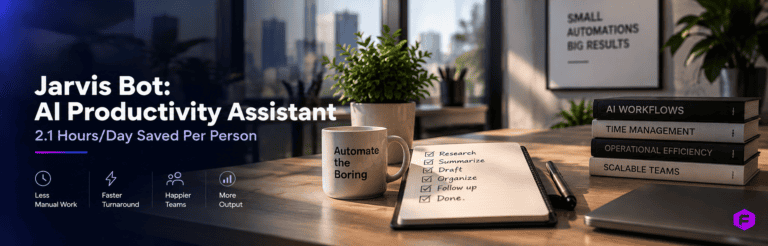
2.1 hrs Admin Time Saved Per Person/Day
View Case Study →
-70% Search Time Reduction
View Case Study →
10x Screening Capacity Increase
View Case Study →