Supply chain and warehousing software with AI operations connect analytics to actual warehouse work, purchase orders, and production plans instead of sitting in a dashboard. 83% of supply chain organizations have deployed or are piloting AI in supply chain intelligence, yet insight-to-action remains the real bottleneck. Foreignerds builds systems that close that specific gap, turning a forecast into an actual purchase order automatically, not a report someone has to act on manually.
Tell us what's going on — a real person replies within 1 business day, not an autoresponder.
That approach explains why AI adoption is concentrated in planning and analytics — the functions where AI can generate insight without immediately changing a physical transaction — while warehouse-floor execution lags behind.
We build supply chain systems that connect AI recommendations directly to warehouse work — because the warehouse automation market specifically is valued at $21.84 billion in 2025, projected to reach $71.25 billion by 2033, precisely because physical execution, not just planning insight, is where the real remaining value sits.
Get a Real Assessment of Your Project →This is built for warehouse operations leaders and supply chain executives whose planning and analytics teams have already adopted AI, but whose physical warehouse and fulfillment operations remain disconnected from those insights — the gap between AI-generated recommendations and actual warehouse work.
The AI in supply chain market is valued at $9.94 billion in 2025, projected to reach $236.42 billion by 2035 at a 37.3% CAGR (Precedence Research). The narrower supply chain management AI segment specifically is valued at $40.4 billion (2025), projected to reach $101.8 billion by 2033. The warehouse automation market — a genuinely distinct, physically-focused segment — is valued at $21.84 billion (2025), projected to reach $71.25 billion by 2033.
Adoption is broad in planning functions specifically: 83% of organizations have deployed or piloted AI in supply chain intelligence and analytics, 74% report AI capabilities in sales and operations planning, and 72% report them in advanced planning and scheduling (Hackett Group's 2026 Supply Chain Key Issues Study). 94% of procurement executives now use generative AI tools at least weekly, up 44 percentage points year-over-year. The insight-to-action gap is the defining pattern in this data: while planning and analytics adoption runs 72-83%, the actual translation into warehouse-floor action remains the harder, later stage. MHI and Deloitte's 2026 Annual Industry Report found 71% of manufacturing and supply chain leaders view AI as disruptive, but only 24% categorize its impact as truly transformational — a real gap between recognizing disruption and achieving it operationally.
It makes sense when: your planning and analytics teams already generate AI-driven insights that aren't consistently translating into warehouse-floor action or purchase-order changes; your warehouse operations still rely on manual inventory and fulfillment processes in a market where automation is documented at $21.84 billion and growing rapidly; or your current systems can't connect demand forecasting directly to physical warehouse execution.
It's equally worth being honest about when this is premature. A very small warehouse operation with simple, low-volume fulfillment may get more value from foundational systems before investing in advanced AI-driven automation built for larger-scale complexity. A useful gut check: if your planning insights and warehouse execution systems are currently disconnected, AI on either side alone won't close that gap — the integration itself is the real work. What Happens If You Wait: There's no single dramatic failure point — most supply chain organizations don't lose a specific shipment or margin point to a competitor's AI adoption in a visible way. The gap compounds quietly instead: with 71% of leaders viewing AI as disruptive but only 24% achieving transformational impact, most organizations remain stuck in the same insight-generation-without-action pattern, and the ones that close the gap first build a real, compounding operational advantage. The worker-monitoring regulatory landscape is a live, developing risk worth addressing proactively: as more states introduce warehouse worker-monitoring disclosure requirements in response to real concerns about algorithmic management, organizations deploying AI-driven productivity tracking without transparency and fairness safeguards are building compliance exposure alongside any efficiency gains.
Demand forecasting and inventory optimization built to connect directly to warehouse execution, not just generate isolated planning insight. Selected from Foreignerds' full service catalog based on genuine Supply Chain & Warehousing relevance — not a generic list reused across every industry page.
The specific insight-to-action translation layer connecting planning-stage AI recommendations to purchase orders, warehouse work, and fulfillment decisions. Custom Software Development & System Integration Services — warehouse management system (WMS) and supply-chain-visibility platforms integrated with existing operations, not disconnected dashboards.
Worker-monitoring disclosure and fairness safeguards for AI-driven productivity and performance-tracking systems. System Integration Services — connecting fragmented planning, procurement, and warehouse-execution data into one coherent operating system.
For supply chain and warehousing providers competing for B2B customer acquisition. Generative Engine Optimization (GEO) & Answer Engine Optimization (AEO) — positioning for procurement teams and shippers researching supply chain and warehousing partners through AI assistants.
A direct diagnostic of how your company appears when potential partners ask AI assistants for supply chain or warehousing recommendations. Reputation Management — directly material for B2B supply chain relationships built on reliability and operational trust signals.
Warehouse management system (WMS) and supply-chain-visibility platform integrations. AI/ML platforms for demand forecasting, inventory optimization, and warehouse task automation. Worker-monitoring and productivity-tracking tools built with disclosure and fairness safeguards. Supply-chain-specific SEO, GEO, AEO, and AI Visibility Audit tooling.
The insight-to-action pattern is the real path to transformational impact: while planning and analytics adoption runs 72-83%, only 24% of leaders describe AI's impact as truly transformational despite 71% recognizing it as disruptive — the integration layer connecting insight to warehouse execution, not additional planning sophistication, is what closes that gap.
B2B procurement teams and shippers increasingly research and evaluate supply chain and warehousing partners through AI assistants during vendor selection, following the same broader research-behavior shift affecting B2B buying generally. This changes what needs to be true about a supply chain or warehousing company's online presence. Traditional SEO optimizes to rank in search results for logistics and warehousing services. GEO and AEO optimize for being the source an AI system cites or recommends when a procurement team asks about supply chain partners with specific capabilities or reliability track records directly.
Adoption is genuinely concentrated in planning and analytics, precisely because those functions can generate insight without immediately changing a physical transaction.
Adoption is genuinely concentrated in planning and analytics, precisely because those functions can generate insight without immediately changing a physical transaction: 83% have deployed or piloted AI in supply chain intelligence, 94% of procurement executives use generative AI weekly, and this represents real, fast, broad-based movement.
But the harder, later stage — connecting AI recommendations to purchase orders, warehouse work, and production plans — remains where most organizations stall: only 24% of leaders describe AI's impact as truly transformational despite 71% recognizing it as disruptive.
Tell us what's going on in one line — we'll take it from there.
Warehouse operations carry standard OSHA workplace-safety requirements, with growing scrutiny of AI-driven worker-monitoring and productivity-tracking systems specifically — several states have introduced or passed warehouse worker-monitoring disclosure requirements given real concerns about algorithmic management affecting injury rates and working conditions. Any AI system touching worker performance data should be built with these disclosure and fairness considerations in mind, not just efficiency optimization.
This is a composite, illustrative example built from common, well-documented patterns in supply chain AI deployment, not a specific named client.
A mid-size fulfillment operation had a planning team generating sophisticated AI-driven demand forecasts, but warehouse staff continued working from separate, disconnected pick-and-pack systems that didn't reflect those forecasts in real time.
Building the integration layer connecting forecast output directly to warehouse task prioritization and inventory placement closed the insight-to-action gap, following the documented pattern where the harder, later-stage integration — not additional planning sophistication — is what actually produces transformational rather than merely disruptive impact.
Real insight-to-action auditing, the specific translation layer connecting planning AI to warehouse execution, plus ongoing optimization and marketing.
Honest evaluation of where planning-stage AI insights currently stall before reaching warehouse execution, and the specific integration gap most limiting operational impact.
The specific translation layer connecting AI-driven planning and forecasting directly to warehouse management systems and fulfillment execution.
Continuous refinement as demand patterns and operational scale evolve, plus B2B partner-acquisition marketing — including GEO/AEO.
The insight-to-action integration gap is most acute here, given direct physical execution needs.
B2B visibility and client-facing reporting automation, given the trust signals that drive partner selection.
Procurement and production-planning AI, distinct from pure warehousing/fulfillment needs.
Demand-driven inventory optimization at high volume and speed.
Often building AI-native from the start, but need genuine warehouse-execution integration depth.
While the real bottleneck is the disconnect between insights and actual warehouse execution.
Risking both morale and emerging regulatory compliance issues.
71% recognize AI as disruptive, but only 24% achieve transformational impact — recognizing disruption doesn't automatically produce change.
That generate more data without closing the specific gap between AI recommendations and physical warehouse action.
Despite this being a genuinely distinct, fast-growing $21.84 billion (2025) market segment separate from broader supply chain AI.
Even as procurement research behavior shifts toward AI-assisted evaluation broadly.
Selected per project based on the task — not a fixed default stack.
Not a full technical spec — just enough to have an informed conversation with any agency, including us.
If two or more of these are true, this is very likely worth exploring.
These four questions are worth answering honestly before any AI investment — the audit will help you answer them with certainty.
We don't list a price here for the same reason across every page: a number before an assessment is a guess, and in supply chain and warehousing specifically, scope depends heavily on operational scale and current planning-to-execution integration. Your actual scope will determine cost after the audit.
Claim Your Free Supply Chain & Warehousing AI Visibility Audit
Yes — real integration work is core to these projects. Scope depends on your specific platform.
This is the documented pattern industry-wide — 71% of leaders recognize AI as disruptive, but only 24% report truly transformational impact, because planning insight alone doesn't change warehouse-floor execution without a real integration layer connecting the two.
Insight-to-action-first development, not standard tracking-dashboard functionality that generates more analysis without closing the execution gap.
This is common, and a legitimate starting point — we'll be honest about what foundational systems need to be in place before advanced AI automation can add real value.
Depends heavily on operational scale and current planning-to-execution integration — the audit in Week 1 gives an honest, specific timeline.
Yes — the sub-vertical breakdown above reflects genuinely different needs we scope separately.
We build any performance-tracking AI with transparency and fairness safeguards in mind from the start, given real and growing state-level disclosure requirements around algorithmic warehouse management.
Yes — it's valued at $21.84 billion in 2025 specifically, growing to a projected $71.25 billion by 2033, reflecting genuinely distinct physical-execution investment separate from planning and analytics.
94% use generative AI tools at least weekly, up 44 percentage points year-over-year — a genuinely fast, recent adoption curve, not a gradual shift.
Substantial — 71% of manufacturing and supply chain leaders view AI as disruptive, but only 24% categorize its actual impact as transformational, the defining gap this page addresses directly.
GEO is optimizing your content so AI systems cite or recommend your company directly when a procurement team researches supply chain or warehousing partners.
AEO structures your content to be pulled as a direct answer by AI-driven search features during B2B partner research.
A direct diagnostic of whether and how your company currently appears when a procurement team asks an AI assistant for supply chain or warehousing recommendations.
Increasingly yes, following the same broader B2B research-behavior shift affecting procurement generally, with 94% of procurement executives already using generative AI tools at least weekly.
Directly — reliability and execution track record are central to partner selection, and AI systems weigh these signals when forming recommendations.
Yes — B2B research behavior is shifting broadly, and smaller operators invisible to AI discovery risk losing exactly the partner-selection consideration larger competitors are already capturing.
Through recurring AI Visibility Audits tracking citation and recommendation frequency, alongside traditional B2B lead-generation metrics.
Yes, under one roof — insight-to-action integration, warehouse automation, SEO, GEO/AEO, and AI Visibility auditing together.
Not anymore — B2B partner-research behavior is shifting broadly, following the same pattern seen across other procurement-driven industries.
Book a call — the audit gives you an honest picture of your current insight-to-action gap, warehouse automation readiness, and AI search visibility.
Real projects. Real, sourced results.
Delivered supply chain, warehousing, and broader AI work sits alongside our 1,250+ project history — verifiable, not invented, and available to discuss specifically on the call.
15-20 minutes, focused on your actual situation, not a generic pitch.
15-20 minutes, focused on your actual situation, not a generic pitch.
We tell you honestly if foundational work needs to happen before AI adds real value.
You leave with a specific, scoped next step — not a vague proposal.
100+ case studies live here
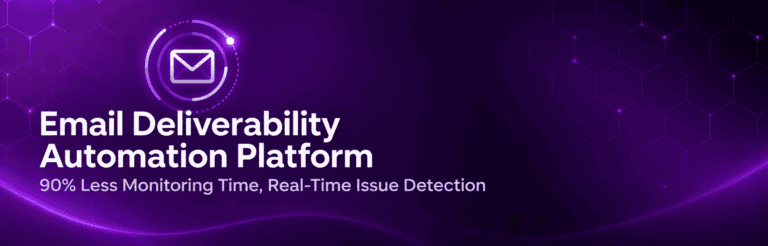
-90% Monitoring Time (15 hrs → 1.5 hrs)
View Case Study →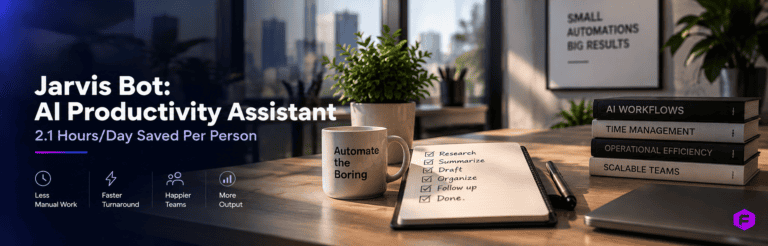
2.1 hrs Admin Time Saved Per Person/Day
View Case Study →
-70% Search Time Reduction
View Case Study →
10x Screening Capacity Increase
View Case Study →