Custom software development builds applications engineered specifically around a business's real workflows, data, and constraints — not adapted from a generic off-the-shelf template. The custom software market is growing at 22.71% annually, nearly double the broader software market's growth rate, as businesses hit real limits with rigid, one-size-fits-all tools. Foreignerds builds software for the specific workflows off-the-shelf platforms can't handle, scoped against a real business case first.
Tell us what you're building — a real person replies within 1 business day, not an autoresponder.
In the scoping, not the building. Our free Feasibility Scope validates your idea, maps the real requirements, and tells you honestly what it would actually take to build — before you commit budget to the wrong plan.
20 minutes. Zero cost. A real answer either way.
Get My Free Scope →"Custom software" sounds like a modern category, but the discipline is genuinely old — old enough that most of its foundational problems were named and studied before personal computers existed. Software as an independent commercial category traces to a specific, dated event: in 1969, under antitrust pressure, IBM "unbundled" its software from its hardware, selling programs separately for the first time instead of giving them away to sell machines. That single regulatory decision is what created an independent software industry at all — before it, software wasn't really a product a business could buy custom-built, because it wasn't sold separately from the computer it ran on. The industry's core challenges were named almost as early. The NATO Software Engineering conferences of 1968 and 1969 coined the term "software crisis" to describe a gap that, honestly, still exists today in a different form: the widening distance between what hardware and infrastructure could technically support and what development teams could reliably, predictably build and ship. Fifty-plus years later, the specific technology has changed completely. The underlying problem — scoping realistic software against real constraints — has not.
Custom software development and outsourcing grew up together, and the path wasn't smooth or obvious in hindsight. Modern IT outsourcing is often dated to the late 1980s, when IBM designed and managed a full datacenter for Eastman Kodak, transferring hundreds of Kodak's own staff to IBM in the process — a genuinely radical idea at the time, since most companies still assumed core IT had to stay fully in-house.
The real acceleration came from an unlikely source: the Y2K scare. As the year 2000 approached, Western companies faced a genuine shortage of programmers who could audit and fix decades-old code written with two-digit year fields, and needed that expertise fast, at scale. India's IT services sector — which Western firms had mostly ignored through the 1990s, assuming it could only handle basic mainframe maintenance — stepped into that exact gap. It's a useful historical footnote: the event that proved offshore development could handle serious, high-stakes work was a deadline nobody could push back, not a cost-cutting initiative someone chose voluntarily.
The tooling that makes distributed development actually workable is younger than the outsourcing model itself. Git, the distributed version control system nearly all modern software development runs on, was created by Linus Torvalds in 2005 — meaning reliable, real-time collaborative coding across time zones is barely two decades old as standard practice, even though outsourced development itself is considerably older. Before that, remote teams genuinely depended on emailed file versions and hoping nobody overwrote someone else's work. Access to talent went through its own transformation in the 2000s, as freelance marketplace platforms emerged and matured, giving businesses of any size direct access to vetted developers globally — a genuine democratization from an era when only large enterprises had the relationships needed to find offshore talent at all. Then in 2010, cloud computing hit mainstream enterprise adoption, triggering a surge in SaaS demand that reshaped what "custom software" even meant — from primarily internal tools to increasingly customer-facing products built to scale from day one.
If your current tools handle 90% of your workflow adequately and the remaining 10% is a minor inconvenience, custom development may not be worth it yet. It becomes worth it when that 10% is costing real time or money every single day, when you're stitching together multiple tools with manual work in between, or when your business model itself depends on a capability no existing software offers.
Custom development starts making sense when: you're paying for multiple tools that don't talk to each other, your team does real manual work bridging gaps between systems, your workflow has genuine exceptions off-the-shelf software can't handle, or your competitive advantage depends on doing something no existing tool supports.
This applies whether you hire us or another agency. Ask every agency these questions before signing anything:
Full-cycle build of internal tools, dashboards, and operational systems — starting with mapping your actual workflow and its real exceptions, designing the interface around how your team actually works day to day, building the backend and data layer to match, and testing against real usage scenarios rather than idealized happy-path demos.
Connecting existing tools and legacy systems that were never designed to talk to each other — including building the API bridges or middleware needed, migrating data safely where required, and phasing modernization work so critical systems stay operational throughout rather than requiring risky downtime.
End-to-end product build — architecture planning for the scale you're actually targeting, not just an MVP that needs rebuilding at the first sign of real traction, multi-tenant data design where relevant, and a genuine testing and QA process before launch, not a rushed release with bugs discovered by paying customers.
Using AI coding assistants deliberately on the parts of a build where they genuinely help — boilerplate code, test generation, routine refactoring — while keeping senior human review, architecture decisions, and testing discipline fully intact, so speed gains never come at the cost of long-term code quality.
There's a real irony in where custom software sits today, and it's worth naming directly. Academic research on the software industry's history notes that software itself has existed since 1948, when researchers Williams and Kilburn ran the first stored program on the Manchester "Baby" machine — but for its first two decades, software wasn't something a business bought custom-built at all. It was inseparable from the hardware it ran on. The 1969 unbundling changed that, and then the personal computer revolution of the 1980s pushed the industry the opposite direction, transforming software from a bespoke, one-off service back into a mass-market, shrink-wrapped product sold on store shelves.
Custom development, in other words, isn't a modern reaction against mass-market software — it's closer to the industry's original default, temporarily overshadowed by decades of successful off-the-shelf products, and now resurging specifically where those mass-market products hit their real limits. Understanding that history matters practically: it's why "custom" doesn't mean experimental or unproven. It means returning to how software addressed real business problems before there was a large enough market to build one-size-fits-all products for every use case.
Real, current research — not projections.
The custom software segment is expanding fast relative to the wider industry. Multiple 2026 market analyses put the global custom software development market at roughly $126 billion, growing at 11.5% annually, while separate research tracking the segment's growth against the broader $823.92 billion software market found custom development expanding at 22.71% CAGR — nearly double the wider market's 11.8% growth rate.
AI is now standard practice inside development delivery itself, not an experiment. Industry research found 92% of software outsourcing providers already use AI in their service delivery as of 2026, with productivity gains in the 20-45% range reported across embedded AI tooling and coding assistants. Deloitte's Global Outsourcing Survey found 72% of organizations now outsource at least part of their software development — a figure worth reading alongside the historical context above. The specific reasons companies outsource have shifted generation to generation, from Y2K's forced urgency, to 2000s cost arbitrage, to today's talent scarcity in AI and specialized engineering — but the underlying pattern has stayed remarkably constant across 25+ years.
Custom development is a genuinely global discipline today, and the geography is worth understanding rather than assuming. Industry data shows the U.S. and India together are home to roughly 45% of the world's software development outsourcing firms, with India specifically dominating the lower end of project budgets — around 57% of Indian outsourcing firms accept projects priced under $10,000, reflecting a market built for accessible entry points as much as enterprise-scale engagements. The Asia-Pacific region overall leads global growth in this space, expanding at roughly an 11% compound annual rate — faster than Europe's outsourcing market, which grows closer to 7% annually. None of this means geography alone determines quality; it means the talent pool genuinely spans continents now, in a way it simply didn't during the industry's early Y2K-driven growth phase, when a handful of specific regions absorbed nearly all of the sudden new demand.
One real, often-overlooked factor shaping why outsourced and custom development exists at the scale it does: US visa policy for skilled technical workers has stayed structurally tight for decades. The H-1B visa program has operated under an annual cap of 65,000 visas plus 20,000 reserved for advanced-degree holders for years — a hard ceiling that hasn't scaled anywhere close to actual US demand for specialized technical talent, particularly in AI and advanced software engineering. That structural gap is a genuine, policy-driven reason custom development partnerships exist, not just a cost consideration.
Tell us what you're working with in one line — we'll take it from there.
This is a composite, illustrative example, not a specific client.
Say a 200-person company has a legacy inventory system and a board asking for an AI-powered demand forecasting tool by next quarter. The internal dev team is eight people, fully committed to keeping existing systems running — hiring specialized AI/ML engineers would take four to six months if qualified candidates can even be found, a timeline the H-1B cap only makes more constrained. Week 1 scopes the real requirement: what data actually exists, what the forecasting tool needs to integrate with, and what "done" genuinely looks like for the board's ask. Weeks 2-8 build the tool as a standalone system that reads from the existing inventory data without requiring the legacy system to be touched or destabilized. It launches on the board's timeline, integrated cleanly, without pulling the core team off their existing commitments for months.
The same standard applied whether the project is a focused internal tool or a full customer-facing platform.
Real requirements gathering and technical scoping before any commitment — including telling you honestly if the idea needs rethinking.
Development in scoped phases with regular check-ins, not a black box that reappears months later with a surprise.
Real testing against real use cases before go-live, not a rushed release with problems discovered by users first.
Ongoing — Support & Iteration. Software needs maintenance and evolves with your business — an option, not an assumption, but available when needed.
Custom systems for compliance-specific workflows and reporting requirements that generic finance software wasn't built to handle, particularly where regulatory requirements shift faster than a mass-market provider's release cycle can accommodate.
Custom scheduling, records, and workflow tools built around how a specific practice or facility actually operates clinically, integrated with existing systems rather than replacing them wholesale.
Custom tracking and coordination tools for operational patterns too specific and too tightly interwoven with existing processes for generic logistics platforms to accommodate without significant, costly workarounds.
Custom client and case management systems built around how a specific practice actually operates day to day, rather than a generic CRM retrofitted with workarounds to approximate a fit it was never designed for.
Custom inventory, production tracking, and order management tools connecting shop-floor operations to business systems in ways off-the-shelf ERP add-ons rarely handle cleanly.
The honest version of this industry's history includes real, publicly documented failures, not just steady growth. Dell was one of the earliest and most visible names in outsourced technical support, routing customer service calls to Bangalore starting in 2001 — and Dell itself later pulled some of that work back in-house after visible customer dissatisfaction with the arrangement, a widely reported reversal at the time. That episode became something of a cautionary reference point for the entire outsourcing industry: distance and cost savings alone don't guarantee a good customer or client experience, and companies that treated outsourcing as a pure cost lever, without real quality oversight, often learned that the hard, public way.
The lesson embedded in that history is still directly relevant today. Cost is a legitimate factor in choosing a development partner, but it has never been sufficient on its own — the agencies and partnerships that lasted through the 2000s and 2010s were the ones that treated outsourced work with the same scoping discipline and quality standards as in-house development, not the ones that treated distance as a shortcut around rigor.
An agency that quotes before genuinely understanding requirements is setting up a scope-change conversation later, usually at a worse price.
If mature off-the-shelf software already does the job well, custom development is often unnecessary cost and risk for no real advantage.
Code and IP ownership should be explicit in writing before the project starts, not assumed or negotiated after the relationship sours.
Software needs maintenance, security updates, and evolution as the business changes — a plan that ends at launch is an incomplete plan.
AI-accelerated coding is genuinely useful, but only paired with real review, testing, and architecture discipline — not as an excuse to skip them.
A significantly lower quote often means significantly less scoping rigor or senior oversight — the gap tends to surface expensively later, in rework or missed requirements.
None of these mistakes are exotic — they're ordinary, avoidable gaps most rushed projects share.
Every One Is Fixable With Proper Scoping — Get the Free Scope →AI coding assistants are now a normal part of how software gets built, not an experimental add-on — industry research puts adoption among outsourcing providers at 92% as of 2026, with reported productivity gains in the 20-45% range on the parts of development where AI assistance genuinely helps: boilerplate code, test generation, and routine refactoring.
What it doesn't change is the need for real architecture decisions, real code review, and real testing discipline. An AI assistant can write code faster; it can't decide whether a particular architecture will scale to your actual usage patterns, and it won't catch a subtle logic error rooted in a misunderstanding of your specific business rules. Agencies who present "AI-powered development" as a replacement for senior engineering judgment, rather than an accelerant for it, are selling speed at the expense of the judgment that actually prevents expensive mistakes.
Four honest signals — if two or more sound like you, custom development is worth scoping.
The real categories involved — not a build recipe, just enough to ask any agency the right questions.
Selected per project based on the task — not a fixed default stack.
Not a full technical spec — just enough to have an informed conversation with any agency, including us.
Still unsure what applies to your business?
That's Exactly What the Free Scope Is For →Code ownership sounds like a simple point, but it has real practical consequences worth spelling out. Full ownership means you can move the code to a different host, hand it to a different development team, or modify it without permission, at any point, for any reason. Some agencies quietly retain rights to reuse core components across other clients' projects, or structure agreements so switching providers later means rebuilding significant parts of the system from scratch. Neither of those is inherently dishonest, but both should be explicit terms you understand and agree to upfront, not details discovered later when you actually try to make a change.
None of these are permanent conditions — they're simply signs to revisit custom development once the real need genuinely outgrows simpler options.
Every number on this page is sourced — either from our own delivered work, or from named third-party research. Nothing here is invented to sound more impressive.
No pressure. The assessment and the first call are both free, with zero obligation.
15-20 minutes. Not an hour-long pitch. Here's exactly what we cover:
Not an hour-long pitch.
Your actual problem, not a generic pitch.
Not a forced yes — if a simpler tool solves it, we'll say so.
We don't list a price here for the same reason across every page: a number before real scoping is a guess. A focused internal tool and a full customer-facing SaaS product are fundamentally different projects.
That variation is real, not a hedge. A focused internal tool serving one team and a customer-facing platform built to scale across thousands of users are genuinely different scopes of engineering work, and pricing them identically would mean either overcharging the smaller project or underscoping the larger one.
The same standard used across serious software engagements.
Answer a few quick questions and we'll walk into the call already understanding what you need — not starting from scratch.
From AI voice outreach platforms to custom software and full-funnel marketing programs — every case study comes with numbers you can verify.
⟷ Drag to explore, or auto-scrolls — 100+ case studies live here78% Increase in Organic Revenue
View Case Study →79% Increase in Purchases
View Case Study →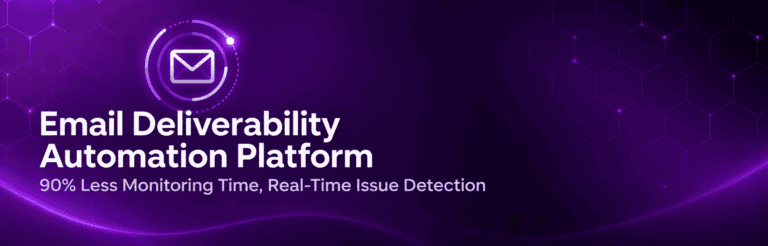
-90% Monitoring Time (15 hrs → 1.5 hrs)
View Case Study →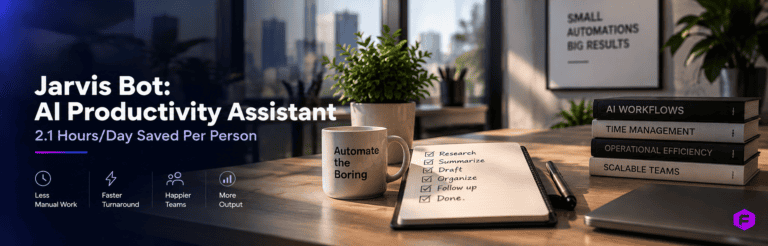
2.1 hrs Admin Time Saved Per Person/Day
View Case Study →
Off-the-shelf software is built for the average customer of that specific tool. Custom software is built around your actual workflow, data, and requirements from the ground up — worth the added cost specifically when your needs have genuinely outgrown generic tools.
Through real scoping before any work starts, phased development with regular check-ins, and a clear, documented process for handling any scope changes if and when they arise.
We only publish verifiable case studies, never invented statistics — ask on the call for the one most relevant to your situation.
It depends heavily on scope — a focused internal tool might take 6-8 weeks, while a full customer-facing product can run several months.
A very common situation. We audit what already exists, assess the real state of the codebase honestly, and provide a genuine recommendation on whether to continue building or rebuild the problematic parts.
Yes, where it genuinely accelerates delivery — but always paired with real code review and testing discipline, never as a substitute for them.
You do, fully — confirmed in writing before the project starts, not left as an assumption to resolve later.
Most projects integrate with and build around existing systems rather than replacing everything — we scope exactly what needs to change during the feasibility phase.
We tell you directly, on the free scope call, before any money changes hands — including recommending a simpler off-the-shelf approach if that genuinely solves the problem better.
It depends on scope, complexity, and integration requirements. We scope and price honestly after the free feasibility call.
Yes, as an available option — we scope ongoing support based on your actual needs rather than assuming every project requires the same package.
Financial services, healthcare administration, logistics, and professional services, among others — the specific approach adapts to each industry's real requirements.
Yes. We audit the existing codebase honestly, diagnose what's salvageable, and take over from there rather than assuming a full rebuild is always necessary.
Partly economics, but partly a real, structural talent gap — US visa programs like H-1B have operated under a fixed annual cap for years, well below actual market demand for specialized engineering talent.
Claim the free Software Feasibility Scope, or book a strategy call directly if you already know what you're building.