Law firm software and AI case management combine legal-specific automation for client intake, document review, and case tracking. A February 2026 federal ruling (United States v. Heppner) held that public AI chatbot conversations carry no attorney-client privilege. Foreignerds builds compliant AI systems for firms without a formal AI usage policy — a gap affecting over half of small firms.
Tell us what's going on — a real person replies within 1 business day, not an autoresponder.
And treat AI as an add-on chat feature, ignoring the real, current privilege risk that specific implementation creates. That approach produces tools attorneys either avoid using on real matters or use in ways that quietly waive the exact protections the practice of law depends on.
We build law firm systems around privilege preservation from the architecture stage — because following the Heppner ruling, the distinction between a properly-implemented, counsel-directed AI tool and a consumer chatbot isn't a technicality, it's the difference between a protected work product and a waived one.
Get a Real Assessment of Your Project →This is built for law firm partners and practice leaders who need genuine case-management and practice-operations AI built with real privilege protection in mind, following a February 2026 federal ruling that changed what confidentiality actually requires when AI is involved.
71% of solo practitioners and 75% of small firms report using AI in their work (2026 research on solo and small firms) — genuinely high adoption at the smallest end of the market. But more than half of solo and small law firms lack any formal policy governing that AI use.
The case-management software market itself is active and competitive, with established players (Clio, MyCase, Filevine, PracticePanther) competing directly on AI-assisted case organization, document management, and billing — meaning firms evaluating AI-driven practice tools are choosing among genuinely mature, AI-native options, not deciding whether to adopt AI features at all. The privilege risk is now dated and specific, not theoretical: the Heppner ruling landed February 17, 2026, and directly establishes that a defendant's own unsupervised use of a public AI chatbot — without counsel's direction — waived both privilege and work product protection. Standard E&O insurance carriers added absolute AI exclusions to their policies effective January 1, 2026, meaning the insurance backstop many firms assumed covered AI-related errors no longer does by default.
It makes sense when: your firm or staff use AI tools informally on case matters without counsel-directed, privilege-preserving implementation — precisely the pattern the Heppner ruling now makes a documented risk; your case-management operations still rely on manual, disconnected systems when AI-assisted case management is now a mature, competitive category; or your current digital presence isn't showing up when prospective clients research law firms through AI assistants.
It's equally worth being honest about when this is premature. A very small practice with minimal case volume may get more value from foundational case-management systems before investing in advanced AI-assisted document review or case-strategy tooling built for higher volume. A useful gut check: if you can't currently document who directed a given AI-assisted work product and why, that gap is itself the privilege risk the Heppner ruling highlights — closing it should come first. What Happens If You Wait: There's no single dramatic failure point — most firms don't lose privilege on a specific matter in a visible, immediately obvious way. The gap compounds quietly instead: with more than half of solo and small firms lacking any AI policy despite 71-75% adoption, informal, ungoverned AI use is already the norm at the smallest end of the market, and every unsupervised use on a real matter carries the same waiver risk Heppner just made concrete and citable. The insurance backstop has already changed, not pending change: standard E&O policies excluded AI-related claims starting January 1, 2026, meaning firms currently relying on informal AI use are carrying real, current, uninsured exposure with every matter touched by ungoverned AI tools — not a future risk to plan around, a present one.
Client-intake automation built with clear escalation to human attorneys, not autonomous legal advice, preserving the counsel-direction the Heppner ruling makes essential. Selected from Foreignerds' full service catalog based on genuine Law Firms & Legal Practices relevance — not a generic list reused across every industry page.
Document review, case-research assistance, and conflict-checking systems implemented as counsel-directed tools, not public AI chatbots, specifically to preserve privilege and work product protection. AI Governance Consulting — the formal AI-usage policy infrastructure more than half of solo and small firms currently lack, addressing both privilege preservation and E&O exposure directly.
Case-management platforms integrated with existing practice-management systems, competing directly with mature options like Clio and MyCase on AI-assisted capability. System Integration Services — connecting intake, case-management, and billing systems into one coherent, privilege-aware operation.
Critical given how heavily local search drives legal-client acquisition. Generative Engine Optimization (GEO) & Answer Engine Optimization (AEO) — positioning for prospective clients researching legal help through AI assistants.
A direct diagnostic of how your firm appears when someone asks an AI assistant for legal help in your practice area. Reputation Management — directly material given how heavily trust signals affect legal-client decision-making.
Trust signals directly affect legal-client decision-making, especially given how much confidentiality and credibility matter in this profession. AI Chatbot Development addresses client-intake automation with clear human-attorney escalation, preserving essential counsel-direction.
Case management and legal practice management platform integrations built for real interoperability. AI/ML platforms for document review and legal research, implemented with counsel-directed, privilege-preserving architecture. Conversational AI for client intake with clear human-attorney escalation paths. Legal-specific SEO, Local SEO, GEO, AEO, and AI Visibility Audit tooling.
The insurance backstop has already changed, not pending change: standard E&O policies excluded AI-related claims starting January 1, 2026, meaning firms currently relying on informal AI use are carrying real, current, uninsured exposure with every matter touched by ungoverned AI tools — not a future risk to plan around, a present one. The case-management software market itself is active and competitive, with established players (Clio, MyCase, Filevine, PracticePanther) competing directly on AI-assisted case organization, meaning firms evaluating AI-driven practice tools are choosing among genuinely mature, AI-native options.
Prospective clients increasingly research legal questions and compare firms through AI assistants before ever visiting a website directly, following the same broader shift affecting professional services generally. This changes what needs to be true about a firm's online presence. Traditional SEO optimizes to rank in legal directories and search results. GEO and AEO optimize for being the source an AI system cites or recommends when someone asks about a legal issue or searches for a firm in a specific practice area directly.
Adoption at the smallest end of the market is genuinely high — but running well ahead of governance.
Adoption at the smallest end of the market is genuinely high: 71% of solo practitioners and 75% of small firms report using AI in their work — but this adoption is running well ahead of governance, with more than half of solo and small firms lacking any formal AI usage policy.
The Heppner ruling is the real, current disruption event this page is built around: a February 2026 federal decision that directly and concretely establishes what many firms had only assumed — that unsupervised, consumer AI chatbot use on case matters can waive privilege and work product protection — combined with E&O insurers removing the safety net for exactly this kind of exposure starting the same year.
Tell us what's going on in one line — we'll take it from there.
A February 2026 federal ruling (United States v. Heppner, S.D.N.Y.) held that a defendant's communications with a public, consumer AI chatbot were protected by neither attorney-client privilege nor the work product doctrine, because the tool is not an attorney and public AI platforms' terms of use give the operator access to the exchange — constituting disclosure to a third party. Standard E&O insurance policies added absolute AI exclusions effective January 1, 2026. State bar associations continue to require competence in the technology attorneys use, and solo/small-firm AI adoption (71-75%) significantly outpaces formal AI policy adoption, with more than half of solo and small firms lacking any AI usage policy. We build with the same data-governance standard leading legal-AI vendors now market as a baseline trust requirement: client data is never used to train external models.
This is a composite, illustrative example built from common, well-documented patterns in legal-practice AI deployment, not a specific named client.
A small firm had several attorneys using a public AI chatbot informally for legal research and draft preparation on active matters, with no formal policy, no counsel-direction documentation, and no confidentiality safeguards beyond assuming the interaction was private.
Following the Heppner ruling, rebuilding that research and drafting workflow as a counsel-directed, privilege-preserving tool — with clear documentation of who directed the AI-assisted work and why — closed the exact exposure the ruling identifies, while attorneys kept the real efficiency gains they'd already found valuable.
Real privilege and AI-usage auditing, counsel-directed and privilege-preserving AI tools, integrated with existing case-management systems, plus continuous governance as case law and E&O terms evolve.
Honest evaluation of current AI use across the firm, existing (or absent) formal policy, and specific privilege-exposure points given the Heppner precedent.
Counsel-directed, privilege-preserving AI tools for intake, research, or document review, integrated with existing case-management systems.
Continuous policy refinement as case law and E&O terms evolve, plus client-acquisition marketing — including GEO/AEO.
The highest-adoption, lowest-governance segment, where formal AI policy and privilege-preserving tooling matter most urgently.
Case-management platform sophistication and firm-wide policy standardization across many attorneys.
Contract review and compliance automation, distinct needs from client-facing firms.
Often building AI-native from the start, but need genuine privilege-preservation architecture built in.
A distinct sub-vertical given the direct relevance of document review and discovery-adjacent AI use to case strategy.
Without counsel-direction — the exact pattern the Heppner ruling establishes as a real privilege risk.
When Heppner establishes a distinct, equally serious privilege-waiver risk from tool choice and implementation alone.
The current state for more than half of solo and small firms — leaving informal use ungoverned across an entire practice.
To AI-related errors after the January 2026 policy exclusions took effect.
Without evaluating whether its AI features are actually implemented to preserve privilege.
Even as legal-client research behavior shifts toward AI-assisted evaluation broadly.
Selected per project based on the task — not a fixed default stack.
Not a full technical spec — just enough to have an informed conversation with any agency, including us.
If two or more of these are true, this is very likely worth exploring.
These four questions are worth answering honestly before any AI investment — the audit will help you answer them with certainty.
We don't list a price here for the same reason across every page: a number before an assessment is a guess, and for law firms specifically, scope depends heavily on practice area and current AI-governance maturity. Your actual scope will determine cost after the audit.
Claim Your Free Law Firms & Legal Practices AI Visibility Audit
Yes — real integration work is core to these projects, competing directly with mature options like Clio and MyCase on AI-assisted capability. Scope depends on your specific platform.
A federal court held that a defendant's own unsupervised communications with a public, consumer AI chatbot were protected by neither attorney-client privilege nor the work product doctrine, because the tool isn't an attorney and the platform's own terms of use give the operator access to the exchange.
Privilege-preservation-first development, not standard practice-management functionality with AI features that don't address how tool implementation affects privilege.
Very common — 71-75% of solo and small-firm attorneys already do — and it's exactly the exposure worth addressing directly given the Heppner precedent, not a minor informality.
Depends heavily on practice area and current AI-governance maturity — the audit in Week 1 gives an honest, specific timeline.
Yes — the sub-vertical breakdown above reflects genuinely different needs we scope separately.
Yes — client-intake automation built with clear escalation to human attorneys addresses response-time gaps directly while preserving the counsel-direction that matters for downstream privilege on any resulting engagement.
We build counsel-directed, documented AI workflows with this directly in mind — the exclusions make privilege-preserving implementation a genuine liability question, not just a best practice.
Yes — conflict checking through unified contact and matter search is a real, specific capability we build in alongside document review and research assistance, not treated as a separate afterthought.
No — we build to the same data-governance standard leading legal-AI vendors now market as a baseline trust requirement: client data is never used to train external models.
GEO is optimizing your content so AI systems cite or recommend your firm directly when someone asks a legal question or searches for help in your practice area.
AEO structures your content to be pulled as a direct answer by AI-driven search features, rather than only ranking in a legal directory.
A direct diagnostic of whether and how your firm currently appears when someone asks an AI assistant for legal help in your practice area.
Increasingly yes, following the same broader shift affecting professional services generally, as prospective clients research legal questions and compare firms through AI assistants.
Directly — trust and credibility signals matter significantly in legal services, and AI systems weigh review sentiment and professional standing when forming answers about firms.
Yes — solo and small-firm segments already show the highest AI adoption rates, and clients researching legal help increasingly use the same tools.
Through recurring AI Visibility Audits tracking citation and recommendation frequency across AI assistants, alongside traditional local SEO and intake metrics.
Yes, under one roof — counsel-directed AI tooling, governance, SEO, GEO/AEO, and AI Visibility auditing together.
Not anymore — legal-client research behavior is shifting broadly, following the same pattern seen across other professional services.
Book a call — the audit gives you an honest picture of your current AI-governance maturity, privilege-exposure points, and AI search visibility.
Real projects. Real, sourced results.
Delivered legal and broader AI work sits alongside our 1,250+ project history — verifiable, not invented, and available to discuss specifically on the call.
15-20 minutes, focused on your actual situation, not a generic pitch.
15-20 minutes, focused on your actual situation, not a generic pitch.
We tell you honestly if foundational work needs to happen before AI adds real value.
You leave with a specific, scoped next step — not a vague proposal.
100+ case studies live here

-90% Monitoring Time (15 hrs → 1.5 hrs)
View Case Study →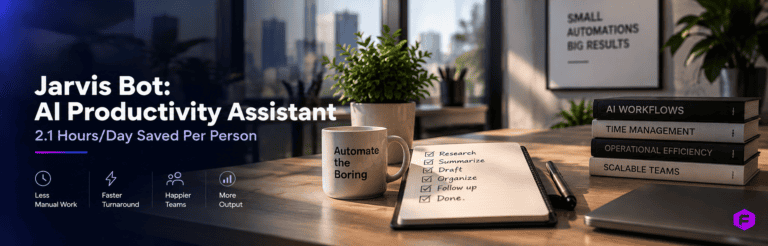
2.1 hrs Admin Time Saved Per Person/Day
View Case Study →
-70% Search Time Reduction
View Case Study →
10x Screening Capacity Increase
View Case Study →