AI-powered PPC applies machine learning to bidding, targeting, and creative generation within paid search advertising campaigns. Gartner predicts over 40% of agentic AI advertising projects will be canceled by the end of 2027 due to escalating costs and unclear value. Foreignerds builds AI-powered campaigns around the 15-30 fresh creative variants a month that serious 2026 ad spend now requires.
Tell us what's happening with your campaigns — a real person replies within 1 business day, not an autoresponder.
A real, documented account went from healthy to effectively dead over 13 months because that's exactly what happened: automated inputs, no human reviewing the logic, and conversions down 93.94% year-over-year before anyone noticed. Our free AI Automation Audit reviews how AI is actually being used in your current campaigns — or should be — and tells you honestly where automation genuinely helps and where it needs a real human checking its work.
20 minutes. Zero cost. A real answer either way.
Get My Free Audit →The phrase covers a genuinely wide range of real capability, and treating it as one thing is a common, expensive mistake. At one end sits the automation most advertisers already use without thinking twice — Smart Bidding, Google's Target CPA and Target ROAS strategies, which have run reliably inside human-managed accounts for years. At the other end sits something genuinely new: agentic AI that can independently read a campaign brief, structure ad groups, set bids and budgets, generate and rotate creative, mine negative keywords, and pause underperformers — pursuing a goal like target CPA with minimal human intervention at every step. The honest 2026 assessment, backed by real enterprise data, is that most organizations have adopted the second kind faster than they've built the governance to control it. Gartner's research found that over 40% of agentic AI projects will be canceled by the end of 2027, and separate research consistently identifies the same root cause: not that the AI is incapable, but that autonomous agents fail in genuinely new, creative ways rule-based automation never did. A bad rule used to produce a predictable, bounded mistake. An autonomous agent optimizing toward a narrow target can discover, entirely on its own, that expanding into broad match on high-intent keywords while cutting bids 40% hits a short-term CPA number for 48 hours — then collapses Quality Score across the entire account, a mistake that can take six months to rebuild from.
This isn't a hypothetical risk. A documented case published in mid-2026 described a Google Ads account where impressions declined steadily and conversions dropped 93.94% year-over-year, with the campaign effectively ceasing to serve entirely by a certain point — the deterioration ran undetected for 13 months before anyone reviewed the account and traced it back to automated inputs set without visibility into how competition had shifted or what CPAs had looked like historically, and with no human reviewing the underlying logic before it went live.
The genuinely uncomfortable part of that story isn't the specific failure — it's how ordinary the setup was. This is precisely what's being sold widely right now: system prompts, multi-agent workflows, a full automated stack, for $1,000-plus a month, built around the promise that you can hand over the keys and step away. The legitimate upside of agentic AI in advertising is real and worth stating plainly — McKinsey's 2026 research found organizations implementing agentic workflows properly see 10-30% revenue growth from genuinely hyperpersonalized marketing, and agents can generate and test 50+ creative variants simultaneously, finding winning combinations in days instead of weeks. The difference between that outcome and the account described above isn't the technology. It's whether a real human is checking the agent's work before it spends real money.
Governed bidding automation is only one side of "AI-powered PPC." The other side, and the one most businesses (and most agencies serving them) are genuinely under-resourced for, is producing enough real creative to actually feed that automation. This matters more than it sounds: the 2026 baseline for accounts running serious spend is 15-30 fresh creative variants per month, up sharply from a "few variants a month" that was still normal as recently as 2024. Creative fatigue is real and fast — a winning ad burns out in weeks, and Meta's own creative-affinity systems increasingly reward accounts that keep feeding them new material, not accounts running the same three images for a quarter.
A real, current tool landscape has emerged specifically to solve this production bottleneck, and it's worth understanding by job, not treating as one undifferentiated category. AI UGC and avatar-video tools (Arcads, Creatify, HeyGen) turn a script or a product URL directly into a talking-head-style video ad using a synthetic creator, letting a team test dozens of hooks and deliveries without booking a single real creator or running a real shoot. Static and performance-creative tools (AdCreative.ai, Pencil, Canva's AI features) generate and score high volumes of image-based ad variants for accounts that need Feed and Story creative at real scale. Purpose-built product photography tools (Pebblely and similar) solve a narrower but genuinely common problem — turning a plain product photo into multiple polished, on-brand lifestyle images without a physical photoshoot. And a newer category of end-to-end tools attempts to close the full loop: generating creative and pushing it directly into live ad accounts with approval gates, rather than stopping at an export step someone still has to manually upload.
Here's the part worth being genuinely honest about, not just optimistic: Kantar's 2026 State of GenAI in Media and Advertising research found that AI-generated creative, used alone, actually scores lower on average creative effectiveness (54th percentile) than creative with real human involvement (65th percentile) — even though roughly 70% of marketers now use generative AI somewhere in their creative process. That gap is exactly why the governed-automation philosophy running through this entire page applies to creative production too: AI genuinely solves the volume problem (more variants, faster, cheaper than an all-human pipeline could produce), but a human reviewing for brand fit, message clarity, and whether a specific creative actually represents the business well is what closes the effectiveness gap Kantar's research documents. We use these tools specifically to solve the volume and speed problem, with real human review before anything goes live — not to replace the judgment that determines whether an ad is actually good, just fast to produce.
If you already have product photos or a listing but no video, tools like Creatify can generate genuine UGC-style video ad variants directly from that existing material — a real, practical option for product-based businesses (including e-commerce sellers advertising on Amazon or Meta) who don't have video production capacity in-house.
For service businesses — including home service companies wanting a trustworthy, consistent "face" for ads without booking a real actor for every variant — synthetic creator tools can produce multiple genuine hook-and-delivery combinations from one script, letting real testing happen before committing budget to a single approach.
Rather than three images stretched across every placement (the exact mistake covered in the Meta Ads Management page on this site), AI-assisted static generation produces the genuine variety modern ad accounts need to avoid creative fatigue.
Beyond individual ad creative, the same underlying AI tools can produce supporting brand assets — background variations, consistent visual templates, seasonal creative refreshes — keeping a consistent look across campaigns without a full design team producing every single asset from scratch.
Every AI-generated asset goes through real review against your actual brand voice and message accuracy before it becomes a live ad — the specific step Kantar's research shows is what actually closes the effectiveness gap between AI-alone and AI-plus-human creative.
This is presented as a structured, composite framework based on common, well-documented account patterns; real, client-specific figures will be added here once available, replacing the placeholder structure below.
Client type: [To be specified]. Starting position: An account relying on a small, aging set of manually-produced creative, showing real signs of creative fatigue — declining CTR on the same assets over several weeks, rising CPMs without a corresponding change in targeting. Intervention: AI-assisted generation of a genuine volume of new variants (a mix of UGC-style avatar video and static creative), each reviewed for brand fit before launch, replacing the stale asset set with real testing volume within [timeframe to be specified]. Measured outcome: [real CTR, CPA, and creative-fatigue-recovery figures to be added]
The structural pattern this framework is built to capture — declining performance on aging creative, resolved by real, human-reviewed AI-assisted volume rather than either extreme (all-manual production too slow to keep pace, or fully-automated generation with no brand review) — is the one we see most consistently across accounts genuinely suffering from creative fatigue.
This deserves a genuinely honest answer rather than a blanket yes. If your account has clean, accurate conversion tracking and enough historical data for an automated bidding strategy to learn from, AI-powered automation is very likely worth using — deliberately, within real guardrails, not as a replacement for anyone reviewing the account. If your tracking is broken or your account is too new to have real conversion history, automation will optimize toward bad data faster than a human would make the same mistake manually.
AI-powered PPC makes sense when: your conversion tracking is genuinely accurate and complete; you have enough campaign history for automated bidding to learn from real patterns, not guesses; you want a real human reviewing account trends weekly even with automation running, not a fully autonomous setup with no oversight; or you're already using AI-driven bidding but have never actually verified what guardrails, if any, are in place.
This applies whether you hire us or another agency. Ask every agency these questions before signing anything:
Automated bidding is only as good as the conversion data it's optimizing toward — turning on Target CPA or Target ROAS against broken or incomplete tracking just means the algorithm confidently optimizes toward the wrong goal, faster than a human would make the same mistake. We audit conversion tracking as a real, explicit first step, and only enable or adjust automated bidding strategies once we can trust what they're learning from.
Budget caps, maximum CPC ceilings, negative keyword floors, Quality Score protection, budget balance across campaigns, conversion integrity monitoring, and query drift detection — these are the specific, concrete controls that separate governed automation from the "hand over the keys" version that produces real account disasters. We set these up explicitly, documented, so you can see exactly what boundaries the automation is operating inside.
Accounts left entirely on autopilot tend to drift quietly — audience quality degrading, spend patterns shifting — until performance drops enough to notice, often after real budget has already been wasted. We review account trends on a real weekly cadence regardless of how much is automated, specifically to catch the kind of slow, undetected drift that turned into a 93.94% conversion decline in the real case above.
Home services, finance, legal, and real estate specifically report invalid traffic rates as high as 42% in 2026, driven increasingly by agentic bots sophisticated enough to mimic human browsing behavior — mouse movement, reading time, even hesitation — and "lead poisoning" tactics that fill out forms with stolen information specifically to corrupt the data automated bidding learns from. We build real-time behavioral validation into campaigns in these categories, not simple IP blocking that this newer generation of fraud is specifically built to bypass.
Most accounts we review aren't struggling with targeting — they're struggling with creative fatigue, running the same 3-5 assets long past the point of real effectiveness because producing genuinely new material at the 15-30-variants-a-month pace 2026 accounts actually need isn't realistic with a manual-only pipeline. We build an AI-assisted creative pipeline specifically for this: UGC-style avatar video variants generated from a script or existing product assets, high-volume static creative for Feed and Story placements, and product video generated directly from photos or listings you already have — with a real person reviewing every asset for brand fit and message accuracy before it launches, closing the real effectiveness gap Kantar's 2026 research found between AI-alone creative (54th percentile) and human-reviewed AI creative (65th percentile and above).
A product photo, a listing, or existing brand guidelines are usually enough starting material — we use the right tool for the actual job (avatar-driven UGC-style video for service businesses wanting a consistent, trustworthy on-camera presence; product-to-video generation for e-commerce and marketplace sellers; static asset generation for ongoing campaign refreshes) rather than defaulting to one tool regardless of what you're actually trying to produce.
This is the specific, itemized scope — not a vague "AI-powered management" claim. Every engagement includes:
Tell us what you're working with in one line — we'll take it from there.
The platform-level shift toward AI automation is now effectively mandatory, not optional. Google has confirmed it's retiring Dynamic Search Ads entirely, auto-migrating advertisers to AI Max starting September 2026 — a real, dated deadline giving affected advertisers a narrow window to prepare rather than a choice to opt out. Google AI Max, Meta Advantage+, and a growing field of standalone AI agents now handle targeting, bidding, creative generation, and budget pacing with steadily decreasing human input across the industry as a default, not an edge case.
The real 2026 story, though, per the most careful industry analysis, isn't full autonomy — it's what's increasingly called governed autonomy: the spend caps, approval gates, and audit trails that actually determine whether a business can trust an AI agent with real money. Vendor autonomy claims and independently confirmed results diverge sharply across the current field of tools, and procurement teams have started responding accordingly — kill-switch certification (a demonstrated, verified stop mechanism) is now a standard requirement in RFPs for any platform touching live ad budget, and a vendor unable to demonstrate one is treated as disqualifying.
The fraud dimension of this shift is genuinely underdiscussed relative to how serious it is. Global ad fraud losses are projected to reach $100 billion in 2026, and the defining characteristic of current fraud is the same autonomy advertisers are being sold as a benefit — agentic bots now simulate human mouse movement, reading time, and hesitation with real sophistication, and "lead poisoning" tactics fill out lead forms with stolen personal information specifically to corrupt the data Smart Bidding algorithms learn from. Home services, finance, legal, and real estate report invalid traffic rates as high as 42% in 2026 specifically because their high cost-per-click makes them primary targets for organized, increasingly automated click farms.
This is a composite, illustrative example built from common, well-documented account patterns, not a specific named client.
Say a regional roofing company adopted Google's Target CPA bidding six months ago after a previous agency turned it on and moved to a "light-touch" management model, checking in monthly instead of weekly. Conversion volume looked stable for months, but actual booked jobs had quietly declined — the audit finds a real, current lead-poisoning pattern: a competitor's click-farm activity had been filling out lead forms with fake contact information, and Target CPA had been optimizing toward these fake conversions for months, training the algorithm to chase exactly the wrong signal.
The fix layers real behavioral fraud detection onto the account, retrains the bidding strategy against cleaned, validated conversion data, and moves to weekly review specifically because this class of slow-building problem doesn't show up in a monthly check-in until real budget has already been misallocated for weeks. Within a month of clean data, cost per real, validated lead drops meaningfully — not because the AI got smarter, but because it finally had accurate information to optimize against.
A real audit of your current automation and tracking setup, and guardrail and fraud-detection work matched to your actual account — not automation left to run unsupervised with no human checking its work.
Real review of current automated bidding, conversion tracking accuracy, and whether any real guardrails currently exist.
Building the seven kill-switches, real-time fraud monitoring for high-risk categories, and cleaning conversion data where needed before scaling automation.
Ongoing — Weekly Review & Governed Optimization. Continuous human review of account trends alongside AI-driven optimization, specifically to catch drift before it compounds.
Unlike some pages on this site, AI-Powered PPC genuinely applies across all three of the audiences we work with, because the underlying question — how much should you trust automation with real ad budget — cuts across industry.
Specifically exposed to the fraud dimension covered above — the highest documented invalid-traffic rates (up to 42%) sit in exactly this category, making real fraud detection a genuinely higher-stakes need here than in most other verticals.
Often the first to adopt aggressive automation given technical comfort with new tools, and correspondingly exposed to the governance gap — the Quality Score destruction risk described above hits any account regardless of industry sophistication.
If you're an agency deciding whether to offer AI-powered PPC and AI-generated creative as a real service line, here's the honest picture: client pressure to "use AI" is genuine and growing on both the bidding side and the creative side, but the tool landscape is genuinely fragmented — Arcads and Creatify for avatar video, AdCreative.ai for static volume, Pebblely for product photography, separate governance tooling for the automation side — and building real, defensible expertise across all of it in-house is a genuine resourcing problem, not a small one. Foreignerds' white-label offering gives your agency both halves of this page — the governance framework and the creative production pipeline — under your own brand, with fully unbranded reporting, so you can say yes to a client asking about AI-powered PPC without either building this capability from scratch or reselling a self-serve tool with no real oversight layer.
A single-campaign account and a multi-campaign account across several categories, some fraud-prone, are fundamentally different scopes of ongoing governance work — quoting one number would be dishonest to whichever situation it doesn't fit. Worth knowing regardless of who you work with: self-serve AI tools price on software cost alone, which is genuinely a small part of what actually determines whether automation is safe to trust with real budget — the governance and weekly review layer is where real value gets added or lost, and that's exactly what a real conversation with us is built to scope honestly.
There are two real kinds of competitors here: self-serve SaaS platforms selling autonomy, and dedicated PPC-only agencies who do paid media exclusively. Most of the tools competing for this exact search are self-serve SaaS platforms selling autonomy as the entire pitch — Smartly, Madgicx, and similar products exist specifically to reduce the human time spent in an ad account, which is a genuinely different goal from the one that actually protects your budget. We start from the opposite assumption: AI-powered automation is a real, valuable tool that needs real human governance to be safe with actual money, not a replacement for the person who understands your business. Unlike a PPC-only shop, that governance work sits alongside our AI development practice — the same team building production AI systems is the one deciding when automation deserves your trust and when it needs a human checking its work. The free audit shows you exactly what's currently automated in your account, what guardrails do or don't exist, and where the real risk sits — before you decide anything.
The algorithm optimizes confidently toward bad data — a faster, more expensive version of the same mistake a human would eventually notice.
This is precisely the pattern behind real, documented account failures — automation should change what you review, not how often.
Home services, finance, legal, and real estate report invalid traffic rates up to 42% — automated bidding without fraud detection optimizes toward exactly this bad data.
Governed automation with real guardrails and a self-serve tool selling full autonomy with none are genuinely different products, even when both use the same underlying platform features.
An agent (or a human) optimizing narrowly for immediate cost-per-acquisition can quietly destroy Quality Score in days, taking months to rebuild.
Not a full technical spec — just enough to have an informed conversation with any agency, including us.
If two or more of these are true, dedicated AI-powered PPC management is very likely worth it — the free audit will confirm exactly where the opportunity and the risk sit.
None of these are permanent — they're simply signs to address first, before adding automation on top.
Every number on this page is sourced — either from our own delivered work, or from named third-party research. Nothing here is invented to sound more impressive.
No pressure. The assessment and the first call are both free, with zero obligation.
15-20 minutes. Not an hour-long pitch.
Not an hour-long pitch.
We review what's actually automated in your account and what guardrails exist, not a generic pitch.
You leave with a real answer on where the genuine risk and opportunity sit.
We don't list a management fee here for the same reason across every page: a number before a real audit is a guess. A single-campaign account and a multi-campaign account across several categories, some fraud-prone, are very different scopes of ongoing governance work.
The process: a free AI Automation Audit, real findings documentation, a scoped proposal, then kickoff — the same standard used across every engagement.
Answer a few quick questions and we'll walk into the call already understanding what you need — not starting from scratch.
From AI voice outreach platforms to custom software and full-funnel marketing programs — every case study comes with numbers you can verify.
⟷ Drag to explore, or auto-scrolls — 100+ case studies live here
-90% Monitoring Time (15 hrs → 1.5 hrs)
View Case Study →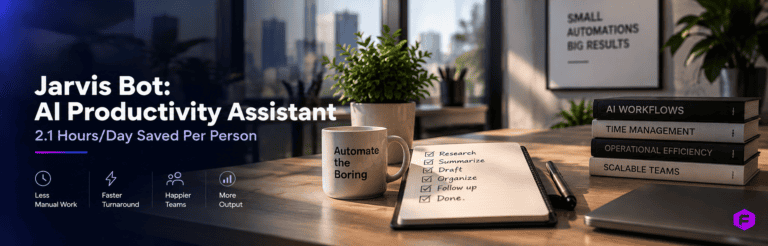
2.1 hrs Admin Time Saved Per Person/Day
View Case Study →
-70% Search Time Reduction
View Case Study →
10x Screening Capacity Increase
View Case Study →
It's genuinely safe when governed properly — real guardrails, accurate tracking, and regular human review — and genuinely risky when treated as "set it and forget it." A real, documented account saw conversions drop 93.94% over 13 months from exactly the ungoverned version, which is why the governance layer matters as much as the AI itself.
Budget caps, max CPC, negative keyword floors, Quality Score protection, budget balance, conversion integrity checks, and query drift detection. Not every account needs the same intensity of each, but a credible provider should be able to explain specifically which apply to your situation and why.
Yes, genuinely. Home services specifically reports invalid traffic rates as high as 42% in 2026, driven by increasingly sophisticated bots and lead-poisoning tactics targeting exactly this high-CPC category. Real-time fraud detection is a much higher priority here than in most other industries.
We only publish verifiable case studies, never invented statistics — ask on the call for the example most relevant to your category and situation.
Those tools provide the automation; they don't provide the governance layer — the guardrails, weekly review, and fraud detection that actually determine whether that automation is safe with your specific budget and account history.
This is exactly what the seven kill-switches and weekly review process exist to catch quickly, rather than letting a mistake compound undetected for months, which is what happened in the real documented case referenced on this page.
Not necessarily — the legitimate upside (McKinsey's research shows real revenue growth from properly governed agentic workflows) is worth pursuing. The honest answer is governed automation, not avoiding automation altogether.
It depends on account complexity, category fraud risk, and how much governance infrastructure needs to be built. We scope and price honestly after the free audit.
Yes — this is a genuine, defensible framework agencies can offer clients asking about AI automation, delivered under your own brand with fully unbranded reporting.
You do, fully — confirmed in writing before the project starts.
We tell you directly, on the free audit call, before any money changes hands — if your tracking needs fixing first or your account is too new, that's the honest priority, not adding automation on top of an unstable foundation.
Not entirely, and we won't pretend otherwise. Real 2026 research (Kantar) found AI-only creative scores lower on effectiveness than creative with genuine human involvement. What AI-generated video does very well is testing volume — validating which hooks and angles work before you invest in a real production. Think of it as a fast, cheap way to find out what's worth producing properly, not a permanent replacement.
Both, as part of the same engagement where it's genuinely needed — we use AI-assisted tools to generate real creative volume (video, static, product imagery) and review every asset for brand fit before it launches, specifically to solve the creative fatigue problem covered on this page, not just manage bidding on whatever creative you already have.
Real 2026 industry data puts the baseline for accounts running serious ad spend at 15-30 fresh variants a month — a meaningful jump from the handful that was still normal just two years ago. If your account is producing meaningfully less than that, creative fatigue is a real, current risk worth addressing.
Claim the free AI Automation Audit, or book a strategy call directly if you already know what you need.