AI predictive analytics combines established statistical forecasting methods with AI-driven processing to find patterns in real, historical business data rather than relying on intuition. 72% of large enterprises now run AI in production, up from just 20% in 2020, with well-scoped predictive initiatives reporting 3.7x to 5.8x ROI. Foreignerds builds forecasts on a business's own validated data, not generic industry assumptions or guesswork.
Tell us what you're building — a real person replies within 1 business day, not an autoresponder.
The underlying data wasn't actually ready. A sophisticated model built on incomplete, inconsistent, or poorly-labeled data produces confident-sounding predictions that are quietly wrong — often the most dangerous kind of failure, since it doesn't look broken. Our free Readiness Check reviews your actual data quality and the question you're trying to answer, and tells you honestly whether you're ready to build.
20 minutes. Zero cost. A real answer either way.
Get My Free Check →Predictive analytics itself is not new — real statistical forecasting and data mining techniques have existed for decades, well before "AI" became the current framing. What's changed is the engine underneath it: machine learning and AI can now process far more variables simultaneously, update predictions continuously as new data arrives, and surface patterns a human analyst working with spreadsheets would realistically never find. That's a meaningful upgrade to an established discipline, not a brand-new invention.
The honest, current adoption picture reflects real momentum across the broader AI landscape this discipline sits inside: 72% of large enterprises now have at least one AI workload in production, and organizations report ROI in the 3.7x-5.8x range when AI initiatives — predictive analytics included — are scoped against a validated business question rather than deployed generically.
If you don't have a specific question you're trying to forecast, or you don't have enough historical data to meaningfully train against, predictive analytics is very likely premature — and a credible partner should tell you that directly rather than starting a build against data that isn't ready. It earns its cost when you have a recurring forecasting need and genuine historical data to learn from.
It makes sense when: you have a specific question (churn risk, demand forecasting, maintenance timing) rather than a vague "predict the future" mandate; you have enough real historical data to train against; you've validated the underlying data is actually clean and consistent; or you're currently forecasting manually and know it's costing real accuracy or time.
This applies whether you hire us or another agency. Ask every agency these questions before signing anything:
If you don't know whether your data is actually ready, we assess that honestly before building anything.
Most failed predictive analytics projects trace back to data readiness, not model sophistication — we assess your actual data quality, completeness, and consistency first, and tell you directly if it needs work before a model can be trained against it reliably.
If your forecasting need is specific, we build the model around your question, not a generic template.
Churn risk, demand forecasting, equipment maintenance timing, and inventory needs are different problems requiring different real approaches — we build around your actual, specific question rather than applying one generic predictive framework to everything.
If your predictions need to stay accurate as real conditions change, we build real retraining into the system from day one.
A model trained once on last year's data quietly drifts as real conditions shift — we build ongoing retraining and monitoring into every engagement, not a one-time deliverable that degrades silently.
If you need to trust the confidence behind a prediction, we build honest uncertainty reporting into every output.
A prediction with no stated confidence range is more dangerous than useful — we build models that report real confidence levels, not false precision that hides how uncertain a forecast actually is.
If you need predictions explained in plain language your team can actually act on, we build interpretability into the model itself.
A prediction nobody understands or trusts doesn't get acted on, regardless of its real accuracy — we build models with explainable reasoning behind each prediction (which factors drove this specific forecast, and how much each one mattered), so your team can act on it with genuine confidence rather than treating it as an opaque number from a black box.
If your forecasting need touches multiple real business functions, we build a system that serves all of them consistently.
Sales, operations, and finance often want different views of the same underlying prediction — we build role-specific reporting on top of one consistent underlying model, so every team gets what it actually needs without maintaining separate, potentially conflicting forecasts.
This is the specific, itemized scope — not a vague claim. Every engagement includes:
Tell us what you're building in one line — we'll take it from there.
Predictions that live in a standalone dashboard nobody checks don't change real business outcomes. We build real connections into the systems your team actually works in — feeding predictions directly into your CRM (Salesforce, HubSpot) for sales forecasting, your inventory or ERP system for demand planning, or your BI tool (Tableau, Power BI, Looker) so the people making real decisions see predictions where they already work, not in a separate tool they have to remember to check. Where your data lives in a cloud warehouse (Snowflake, BigQuery, Redshift), we build directly against it rather than requiring a separate, duplicated data pipeline.
The economic case is direct: businesses making decisions off of stale, manual forecasting methods are systematically reacting to problems (stockouts, churn, equipment failure) after they've already started, rather than anticipating them. A well-built predictive system shifts that timing — current AI initiatives report ROI in the 3.7x-5.8x range specifically because they change decisions before an outcome happens rather than just reporting on it afterward. The value compounds specifically the more decisions get made on current predictions rather than last quarter's static report.
This is worth addressing directly, since current buyer behavior increasingly includes asking AI assistants — ChatGPT, Claude, Perplexity, Gemini, Microsoft Copilot — questions like "is predictive analytics worth it for a mid-size business" before ever contacting a vendor. Current AI-answer systems favor specific, sourced accuracy and ROI data over vague "AI-powered insights" language, which is why this page leads with checkable figures rather than generic positioning.
Predictive analytics benefits directly from the broader enterprise AI adoption wave.
The current context sits inside the broader enterprise AI adoption wave this discipline benefits from directly: 72% of large enterprises now run at least one AI workload in production, up from just 20% in 2020, and reported ROI on well-scoped AI initiatives ranges from 3.7x to 5.8x depending on methodology. Predictive analytics specifically benefits from a structural advantage over newer AI application categories — the underlying statistical techniques are decades-proven, so the risk sits almost entirely in data readiness and question-scoping, not in unproven technology.
The honest risk data matters here too: nearly 85% of organizations misestimate AI project costs by more than 10%, a pattern that applies directly to predictive analytics projects scoped without a data-readiness assessment first. The businesses seeing genuine forecasting value consistently validate both the specific question and the underlying data quality before committing to a build, rather than assuming sophistication in the model can compensate for weak underlying data.
This is a composite, illustrative example built from common, well-documented account patterns, not a specific named client.
Say a business wants to predict customer churn but has never systematically tracked the signals that precede it — the data exists across multiple disconnected systems, inconsistently labeled. The readiness check finds the specific gap: enough historical data exists, but it's scattered and needs real consolidation before any model could learn from it reliably.
The fix consolidates and cleans the data first, then builds a model around the specific churn-prediction question with honest confidence reporting built in, plus ongoing retraining as customer behavior shifts over time. Within the following months, the business has actionable churn predictions with stated confidence levels — not a black-box score nobody trusts, but a system whose accuracy is actively tracked against real outcomes.
An honest assessment of whether your data supports the specific forecasting question you have, real model-building matched to your actual question, and continued retraining as real conditions change — not a one-time deliverable that quietly degrades.
Honest assessment of whether your data supports the specific forecasting question you have.
Building the model around your specific question, with honest uncertainty reporting from the start.
Connecting predictions to your existing systems and testing against real historical outcomes.
Continuous, real retraining as conditions change, with honest reporting on actual forecasting accuracy over time.
Demand forecasting and inventory prediction built on real transaction and seasonality data.
Predictive maintenance timing built on real sensor and equipment data, reducing unplanned downtime.
Risk and fraud-pattern prediction, where accuracy and honest confidence reporting carry genuine regulatory weight.
Client churn and demand forecasting built on engagement and billing data most firms already have but rarely use predictively.
The single most common, most preventable cause of failed predictive analytics projects.
Real forecasting value comes from a specific, validated question, not a general aspiration.
A prediction presented as certain when it isn't is more dangerous than no prediction at all.
Real conditions change — a model that's never retrained quietly drifts out of accuracy.
It can't — data quality is the actual foundation everything else depends on.
Selected per project based on the task — not a fixed default stack.
Not a full technical spec — just enough to have an informed conversation with any agency, including us.
Delivered AI predictive analytics work sits alongside our broader 1,250+ project history — verifiable, not invented, and available to discuss specifically on the call.
⟷ Drag to explore, or auto-scrolls — 100+ case studies live here
-90% Monitoring Time (15 hrs → 1.5 hrs)
View Case Study →
2.1 hrs Admin Time Saved Per Person/Day
View Case Study →
-70% Search Time Reduction
View Case Study →
10x Screening Capacity Increase
View Case Study →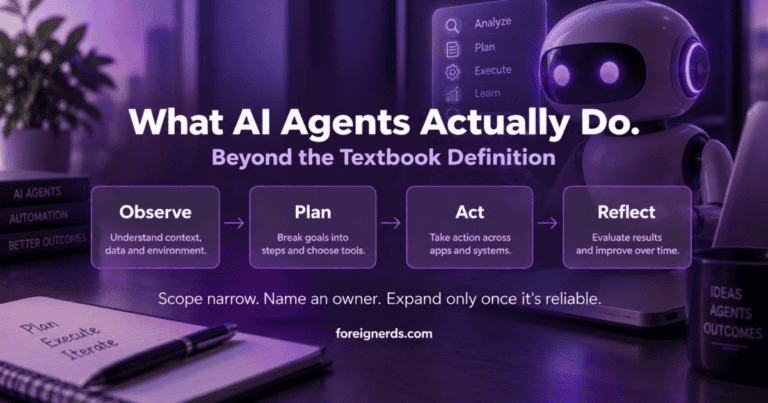
If two or more of these are true, dedicated predictive analytics work is very likely worth it — the free check will confirm exactly where you stand.
None of these are permanent — they're honest signs to address first, and we'll tell you directly if that's where you are.
We don't list a price here for the same reason across every page: a number before a real readiness check is a guess. A focused single-question model and an ongoing, multi-model forecasting system are very different scopes of work. The process: a free Readiness Check, real findings, a scoped proposal, then kickoff.
That's exactly what the free Readiness Check assesses honestly — data quality and completeness, not an assumption that more data automatically means better predictions.
Predictive analytics uses real statistical and machine learning methods to forecast specific future outcomes with a stated confidence level, rather than simply describing what already happened.
We only reference verifiable results, never invented statistics — ask on the call for the example most relevant to your industry and use case.
It depends on your specific question and data quality. We report honest confidence levels rather than a single misleading accuracy number, and we'll set realistic expectations during the readiness check.
Ongoing retraining is built into every engagement from day one — models don't get left to quietly drift as conditions shift.
A BI dashboard shows you what already happened. Predictive analytics forecasts what's likely to happen next, with a stated confidence level.
It depends on your specific forecasting question — we assess this honestly during the free readiness check rather than assuming more is always necessary.
It depends on scope. We scope and price honestly after the free readiness check rather than quoting a number before understanding your actual question and data.
You do, fully — confirmed in writing before the project starts.
Yes — predictive analytics is a natural capacity extension for agencies needing real, technical depth, delivered under your own brand.
That's a common starting point, not a disqualifier — the free readiness check helps identify the specific, answerable question worth building around.
Claim the free Readiness Check, or book a strategy call directly if you already know your forecasting need.
We build real interpretability into every model — which factors drove a specific forecast, and how much each one mattered — so your team can act on it with genuine confidence, not treat it as an opaque number.
Common, and something the readiness check specifically assesses — data consolidation is sometimes a necessary first step before a model can be trained reliably.
We bring a full team with production deployment, ongoing retraining, and integration experience, not just model-building in isolation — and we're honest about when a smaller, direct hire might actually serve you better.
Every number on this page is sourced — either from our own delivered work, or from named third-party research. Nothing here is invented to sound more impressive.
No pressure. The Readiness Check and the first call are both free, zero obligation.
15-20 minutes. Not an hour-long pitch.
We review your actual forecasting need and data, not a generic pitch.
You leave with an answer on whether you're ready to build.
No pressure, either way.