Author: Laura Mitchell

Marketing Automation: The Complete Guide

Marketing automation is the use of software to trigger, sequence, and personalize marketing actions — emails, SMS, ad audiences, lead scoring, CRM updates — based on a contact’s behavior, without a human manually sending each one. Done well, it turns a static list of leads into a system that nurtures every contact on its own schedule, hands sales only the leads worth calling, and keeps customers engaged after the sale closes. Done poorly, it’s an expensive email tool nobody customized past the default templates. This guide covers what marketing automation actually does, what it’s worth, where most implementations go wrong, and how to build one that pays for itself.

What Marketing Automation Actually Does

At its core, marketing automation replaces three manual jobs with rules: deciding who gets contacted, deciding when, and deciding what they see. A platform sits on top of your website, CRM, and ad accounts, watches for triggers — a form fill, a pricing-page visit, a cart abandonment, an inactive 90 days — and fires a pre-built sequence in response. The categories that matter for most businesses are:

  • Lead nurturing: multi-step email/SMS sequences that move a new lead from “just downloaded a guide” to “booked a call,” without a rep touching it until it’s warm.
  • Lead scoring and routing: assigning points for behavior (page visits, email opens, form fills) so sales only gets pinged when a lead crosses a real threshold, instead of every form submission.
  • Lifecycle and retention marketing: onboarding sequences, renewal reminders, win-back campaigns for lapsed customers, review requests after a job completes.
  • Ad audience automation: syncing your CRM segments (past customers, high-intent leads, churned accounts) into Meta and Google as living audiences instead of manually uploaded lists.
  • Internal workflow automation: auto-creating CRM tasks, notifying a rep by Slack or SMS, updating a deal stage — the operational glue most people don’t think of as “marketing” but is where automation saves the most staff hours.

If you already have a lead generation engine bringing in volume, automation is what decides whether those leads convert or go cold in an inbox nobody’s watching.

What It’s Actually Worth: The Real Numbers

Marketing automation is one of the more evidence-backed categories in digital marketing — the data isn’t hype, and it doesn’t require guessing:

  • Forrester Research has found that B2B organizations using marketing automation to nurture leads generate $5.44 to $6.10 in ROI for every $1 spent on the platform.
  • Companies that nurture leads with automated sequences see a 451% increase in qualified leads compared to sending a single generic follow-up.
  • Automated, behavior-triggered emails generate 320% more revenue than one-off broadcast emails sent to an entire list at once.

Those numbers hold up because automation fixes the specific failure mode most small and mid-sized businesses have: leads come in, get one follow-up email or call, and then nothing happens unless someone remembers to circle back. Automation removes the “remembering” step entirely.

The Platform Landscape

Marketing automation platforms fall into three tiers, and picking the wrong tier is the single most common expensive mistake:

Tier Examples Best fit Typical monthly cost
All-in-one CRM + automation HubSpot, GoHighLevel, ActiveCampaign Home services, small B2B, agencies managing multiple clients $50–$800+
E-commerce-focused Klaviyo, Omnisend DTC and e-commerce brands running abandoned-cart and post-purchase flows $45–$1,000+ (scales with contacts)
Enterprise marketing clouds Marketo, Salesforce Marketing Cloud, Pardot Larger orgs with dedicated marketing ops staff $1,000–$15,000+

Most home services businesses, CPAs, law firms, and consultants are correctly served by an all-in-one platform — they need automation bundled with a CRM and pipeline, not a standalone email tool that requires a separate system for everything else. Agencies managing several client accounts often standardize on one all-in-one platform (commonly GoHighLevel) specifically because it supports white-labeling and sub-account management.

The Mistakes That Waste the Investment

Most failed marketing automation projects don’t fail because of the software — they fail because of how it was implemented:

  • Automating a broken process. If your sales follow-up is inconsistent, automation just makes the inconsistency happen faster and at scale. Fix the process, then automate it.
  • No lead scoring, so sales drowns in noise. Every form fill hitting a rep’s phone trains them to ignore the automation entirely within a month.
  • Set-and-forget sequences. A nurture sequence built once and never revisited decays as your offers, pricing, and messaging change. Automation still needs a quarterly review.
  • Buying enterprise software for a five-person team. Marketo and Salesforce Marketing Cloud are built for dedicated marketing ops departments — a small business buying one usually uses 10% of the platform and pays for the other 90%.
  • Treating automation as “set it and it replaces marketing.” Automation amplifies content and offers that already work. It does not generate demand on its own — that’s the job of content marketing, paid media, and SEO feeding the top of the funnel.

A Practical Implementation Framework

The businesses that get the Forrester-level returns follow roughly the same build order:

  1. Map the actual customer journey first. Write down every stage a real lead goes through — first touch, quote/consultation, decision, onboarding, renewal or repeat purchase — before opening any software.
  2. Start with the highest-leverage sequence, not the whole system. For most businesses that’s new-lead nurture (the gap between form-fill and first contact) or cart/quote abandonment. Build one sequence well, measure it, then expand.
  3. Build lead scoring around actual buying signals — pricing page visits, demo requests, repeat site visits — not vanity engagement like email opens alone.
  4. Connect the CRM and ad platforms so segments sync automatically. A “closed-won” list that updates your Meta and LinkedIn exclusion audiences in real time stops you from paying to re-target people who already bought.
  5. Set a review cadence. Sequences, scoring thresholds, and copy get revisited quarterly — automation is infrastructure, not a one-time project.
  6. Measure against revenue, not opens. Open rate and click rate are diagnostic metrics. The metric that matters is leads converted to booked calls/quotes and dollars closed per sequence.

Build, Buy, or Managed?

Three ways to get a marketing automation system running:

  • DIY inside an existing tool. Works if you already have marketing staff with time to build and maintain sequences. Most small teams underestimate the ongoing maintenance and let it decay after month two.
  • Buy and configure with an agency. An agency sets up the platform, builds the initial sequences and scoring model, and hands over a working system with documentation — the most common path for businesses without a dedicated marketing ops person.
  • Fully managed. The agency owns ongoing sequence updates, A/B testing, and reporting as part of a retainer — best for businesses that want the ROI without building internal automation expertise. This is how Foreignerds runs marketing automation and growth marketing engagements: platform setup, sequence build, and ongoing optimization bundled together rather than sold as a one-time configuration.

How to Measure Whether It’s Working

Track these, in this order of importance:

  • Lead-to-qualified-lead rate before and after implementing scoring — this is where the 451% figure shows up in practice.
  • Sequence-attributed revenue — dollars closed from contacts who went through an automated nurture path versus those who didn’t.
  • Response time to new leads — automation should cut the gap between form-fill and first meaningful contact from hours/days to minutes.
  • Sequence completion and drop-off — where in a nurture flow people unsubscribe or stop engaging, which tells you where the messaging is off.
  • Customer lifetime value for automated vs. manual onboarding/retention cohorts, once you have enough volume to compare.

These should tie back into the same reporting used for conversion rate optimization — automation and CRO are solving the same problem (more revenue from the same traffic) from different ends of the funnel.

Marketing Automation by Business Type

The right sequences differ meaningfully by vertical:

  • Home services (HVAC, plumbing, roofing): the highest-value automation is missed-call and quote-follow-up sequences — a lead who doesn’t get a callback within minutes typically calls a competitor next. Seasonal maintenance reminders and review-request sequences after job completion are the next highest-leverage builds.
  • Small B2B professional services (CPAs, law firms, consultants): automation centers on intake-to-consultation nurture, deadline-driven campaigns (tax season, renewal periods), and client onboarding sequences that reduce the manual admin load on a small team.
  • Agencies and white-label partners: automation is the product as much as the marketing — a platform like GoHighLevel with sub-accounts lets an agency deliver automation as a packaged service to its own clients while managing dozens of accounts from one system.

Key Takeaways

  • Marketing automation returns $5.44–$6.10 per $1 spent when built around real buying signals, per Forrester — but only when the underlying process being automated already works.
  • Automated nurture sequences produce a 451% increase in qualified leads and automated triggered emails generate 320% more revenue than one-off broadcasts.
  • Match the platform tier to team size: all-in-one CRM platforms fit most home services and small B2B businesses; enterprise marketing clouds are usually overkill below a dedicated marketing ops team.
  • Start with one high-leverage sequence (new-lead nurture or abandonment recovery), measure it, then expand — building the whole system at once is how most implementations stall.
  • Measure sequence-attributed revenue and lead-to-qualified-lead rate, not email opens, to know if it’s actually working.

OpenAI Is Cutting Cursor Off in November. The Real Lesson Is About Every AI Vendor You Depend On.

Our earlier piece on MCP and A2A governance looked at the open standards that decide how agents connect to tools and to each other. This one looks at the layer underneath those standards, which is the model itself, and at a recent event that shows how quickly access to that layer can change for reasons that have nothing to do with your product.

On August 28, 2026, OpenAI announced that it will end Cursor’s access to its models on November 12. The immediate story is about two companies and an acquisition. The lasting story is about every business that has built a workflow on top of someone else’s model. Here is what is confirmed, what is disputed, and what a sensible response looks like.

What is confirmed

The sequence is short. SpaceX acquired Anysphere, the company behind the Cursor coding editor, in an all-stock deal reported at $60 billion, which closed on August 14, 2026. Two weeks later, on August 28, OpenAI published a post explaining its decision to end Cursor’s access to OpenAI models, with November 12, 2026 as the date.

OpenAI’s stated reason is trust. It said it cannot be confident that SpaceX will use its technology within OpenAI’s terms of service, and it pointed to a history of contract disputes involving Elon Musk’s companies, including, in OpenAI’s account, xAI’s violation of OpenAI’s own service terms. OpenAI also said it was giving the maximum notice its agreement allowed, which works out to a little over ten weeks, and that its contract included a limited window to cancel after a change of control.

OpenAI’s help center article adds practical detail. It describes November 12 as the end of a transition period and says the formal termination date will be confirmed later. The affected features are the local Chat and Agent modes that currently offer OpenAI models. The unaffected features are Cursor Tab and autocomplete, Auto model selection, Cloud and Background Agents, Automations, the Cursor CLI, and the Cursor API and SDK, all of which continue to use models supplied by Cursor.

Users who want to keep using OpenAI models have three routes. They can bring their own OpenAI API key, which is billed separately from any Cursor or ChatGPT subscription. They can install OpenAI’s Codex extension and sign in with a ChatGPT plan or an API key. Or they can connect through an AI gateway their organization already manages, such as Amazon Bedrock or Azure. One detail matters for budgets: a ChatGPT subscription does not include API usage, so a team that switches routes may see a new line item.

Anthropic responded quickly. Co-founder and Chief Compute Officer Tom Brown said the company will keep increasing compute to support Claude models in Cursor.

What is disputed or still unclear

Several points are less settled than the headlines suggest, and they are worth separating from the confirmed facts.

Cursor CEO Michael Truell said OpenAI models account for only about 5% of Cursor’s traffic. That is Cursor’s own claim, not an independent measurement, and DevOps.com reported that it was widely questioned on social media. Treat it as Cursor’s position, not as an established number.

Truell also said Cursor was in talks with OpenAI to find a solution. Nothing in the sources reviewed shows that those talks have produced an outcome, and no response from SpaceX appears in the coverage we could verify. The November 12 date could still change, either through negotiation or through the formal notice OpenAI’s help article mentions.

The $60 billion price and the August 14 closing date come from reporting on the deal. The OpenAI post and the help article do not discuss the price. So the accurate framing is that the deal was reported at that value.

None of this changes the central lesson. Even if OpenAI models are a small share of Cursor’s traffic, the event shows how a change of ownership can turn a supplier into a gatekeeper overnight.

Why this is not really a Cursor story

Every company that builds on a third-party model has the same exposure Cursor just discovered. The contract you signed can be ended by the supplier under conditions you do not control, and an acquisition, on either side, is one of the most common triggers. In this case the acquired party was the customer. It could as easily be the supplier, whose new owner may reprice, restrict, or retire the product you rely on.

There is also a competitive dimension. Within hours of OpenAI’s announcement, a rival lab publicly reaffirmed its support for Cursor. That is good news for the customer in the short term, but it moves the dependency instead of removing it. A team that swaps one model vendor for another is still exposed to the same category of risk, only with a different counterparty.

Treat model access the way finance teams treat any critical supplier. Ask who owns the vendor, what happens if that changes, how much notice the contract requires, and what your fallback is. Most engineering roadmaps never ask these questions, because the model feels like infrastructure. It is closer to a contract that can be ended.

Switching models is not a configuration change

The technical half of the risk is easy to underestimate. Standards like MCP and A2A make it easier to connect an agent to tools and to other agents. They do not make one model behave like another.

Analysts quoted by CIO made this point directly. Manoj Chandra Jha of Nord-IQ Research said prompts and agent instructions that work well with OpenAI models can produce different results with another model, which forces enterprises to retune both prompts and evaluations. Abhishek Satapathy of Avasant listed where the differences show up in coding agents: repository-level work, debugging, refactoring, test generation, multi-file changes, and tasks where an agent must inspect a codebase, make changes, run tests, and correct its own errors.

That list should look familiar to anyone doing AI agent development. Agents chain many steps together, so a small difference in how a model interprets an instruction can compound across a workflow. A prompt that produced clean output on one model can drift on another, with tool calls made in a different order, formats interpreted differently, or errors handled in a different way.

CIO also quoted Pareekh Jain, who advised enterprises to support multiple models, test alternatives regularly, and “avoid making important workflows too dependent on one model.” The word regularly matters. A fallback model that has never been tested is only a hope.

What resilience looks like

Cursor itself offers a useful example of preparation. Most of its product does not depend on OpenAI’s models at all. Tab completion, Auto selection, cloud agents, automations, the CLI, and the API all continue on Cursor-supplied models. A Forbes analysis argued that this reflects deliberate investment in its own coding model, Composer 2.5, built on open-source checkpoints, which lets Cursor treat frontier model access as something it can substitute. That is an analyst’s interpretation rather than a confirmed account of Cursor’s strategy, but the product structure supports the point. The features most exposed are the ones where users chose an OpenAI model by name.

Very few companies can train their own model. The principle still applies at smaller scale: keep the part of your product that users experience separate from the part that depends on a single supplier. For teams working on AI agent development, that usually means keeping business logic, tool definitions, and evaluation data in your own repository, and treating the model as a component you can replace. Prompts written for one model should be documented as model-specific, so nobody assumes they will transfer.

A practical checklist for model dependency

Whether you are building internal tools, customer-facing agents, or a full product, the same steps reduce the risk. This is the kind of work that belongs in any serious AI development plan from the start.

Inventory every model dependency. List each workflow, which model it calls, through which route, and under which contract. Include shadow usage, such as teams running personal API keys.

Put an abstraction layer between your application and the model. Route calls through one internal interface so that changing the model is a change in one place, not a rewrite.

Build an evaluation suite before you need it. A set of representative tasks with expected outcomes lets you compare a replacement model on evidence instead of impressions. This is the piece Jha’s comment points to, and it is the one teams most often skip.

Test a fallback model on a schedule. Run the evaluation suite against at least one alternative every quarter, and keep prompts tuned for it, not only for your primary.

Read the contracts. Look for change-of-control clauses, notice periods, usage restrictions, and pricing terms. Note who can end the agreement and under what conditions.

Understand the billing routes. As the Cursor case shows, subscriptions and API access are often billed separately. Know which one each workflow actually uses.

Assign an owner. Model dependency is a business risk, so it needs an owner outside the engineering team who reviews it alongside other supplier risks.

Where this leaves you

OpenAI’s decision on Cursor is confirmed, with November 12 as the announced end date, though the formal termination date and the outcome of talks remain open. The claim that OpenAI models are 5% of Cursor’s traffic is Cursor’s own. The wider point does not depend on either detail. Access to a model is a supplier relationship, and supplier relationships change when ownership changes.

For teams investing in generative AI development and agent workflows, the response is measured, not alarmed. Inventory the dependencies, build the evaluation suite, test the fallback, and review the contracts. The cost is a few weeks of engineering time. The alternative is discovering your dependency on a Tuesday afternoon with a ten week clock running.

Frequently Asked Questions

1. When does OpenAI stop providing models to Cursor?
Answer: OpenAI announced on August 28, 2026 that access ends on November 12, 2026. Its help center describes that date as the end of a transition period and says the formal termination date will be confirmed later.

2. Why did OpenAI end the agreement?
Answer: OpenAI said it cannot be confident SpaceX will use its technology within its terms of service, following SpaceX’s acquisition of Cursor’s parent company. It cited a history of contract disputes involving Elon Musk’s companies.

3. What still works in Cursor after the cutoff?
Answer: Cursor Tab, Auto model selection, Cloud and Background Agents, Automations, the CLI, and the API and SDK continue on Cursor-supplied models. The affected features are local Chat and Agent modes that offer OpenAI models.

4. Can developers keep using OpenAI models in Cursor?
Answer: Through other routes, yes. OpenAI lists bringing your own API key, using the Codex extension, or connecting through an AI gateway such as Amazon Bedrock or Azure. API usage is billed separately from a ChatGPT subscription.

5. Is it true that OpenAI models are only 5% of Cursor’s traffic?
Answer: That is what Cursor CEO Michael Truell said, but it is Cursor’s own figure and was questioned publicly. It has not been independently verified.

6. How can my business reduce model dependency risk?
Answer: Inventory every model dependency, put an abstraction layer between your application and the model, build an evaluation suite, test a fallback model regularly, and review supplier contracts for change-of-control terms.

If you want to know how exposed your own workflows are to a single vendor, that is exactly what we look at in a free AI Readiness Audit.

Only 11% of Domains Get Cited by Both ChatGPT and Perplexity. If You Track One, You Are Blind to the Other.

This is the third piece in our series on how AI platforms decide who gets cited. The first looked at how much AI referral traffic ChatGPT controls. The second looked at how selective it is about which sources it trusts. This one asks the practical follow-up: if two of the biggest AI platforms disagree this much about sources, what does that do to the way you measure visibility?

The headline number is that only about 11% of domains are cited by both ChatGPT and Perplexity. It has been repeated in dozens of articles this year, usually with a sentence claiming that single-platform tracking leaves 89% of your visibility invisible. That last part goes further than the data supports. The 11% figure is real and worth acting on, but it is also easy to misread, and several of the studies stacked underneath it measure different things. Here is what each one actually found, and what it means for how you track your brand.

Where the 11% comes from

The figure appears in three related but distinct places, and they are not the same study repeated three times.

The first is a dataset of 680 million citations covering August 2024 to June 2025, analyzed by Profound and cited in Averi’s B2B SaaS benchmark report. Averi’s report states that only 11% of domains are cited by both ChatGPT and Perplexity. Worth noting: the 680 million analysis is Profound’s work, and Averi uses it as a supporting reference rather than presenting original research of its own. Several articles online attribute the analysis to Averi directly, which is a small but real attribution error.

The second is a Qwairy analysis of 118,000 AI responses collected between January and March 2026 across ChatGPT, Perplexity, Google AI Mode, and Claude, which Whitehat SEO cites in its own comparison. It found that only 11% of cited domains appeared across multiple platforms. That is a slightly different measurement from the first one. It looks across four platforms at once instead of comparing ChatGPT and Perplexity as a pair, so the matching 11% is a coincidence of two different methods, not one result confirmed twice.

The third is a Wellows study of 22.7 million citations across 1.15 million questions, covering January to June 2026. It approaches the same question from the opposite direction and reports that 89% of websites ChatGPT cited on a given question were never cited by Perplexity on that same question. That is essentially the mirror image of the 11% figure, measured at the website level, on identical questions.

So three datasets, three time windows, and two different definitions of overlap all point the same way: the two platforms draw on substantially different sets of sources. That agreement is the meaningful finding. The exact percentage matters less than the direction.

What the 11% does and does not mean

Now for the overreach. A low overlap between two platforms’ cited domains does not mean 89% of your potential visibility is hidden from you. Authority Tech, which curates and compares these studies, states explicitly that the figure does not imply that. There are three reasons.

First, the overlap is measured across all domains cited, not across your domain. Your brand could appear consistently on both platforms while the rest of the web fragments around you. The 11% describes the whole citation landscape, and your own footprint inside it is a separate question.

Second, Wellows itself is careful about this. Its authors describe the gap as a different candidate pool rather than a more unpredictable engine, and they point out that the number measures which sources answer a particular question, not which websites are permanently available to each platform.

Third, overlap depends heavily on how strictly you match. Wellows reports different results at website level, page level, and with different levels of address cleanup. A percentage that moves that much with the matching rule should be read as a range, not a fixed law.

The accurate version of the claim is narrower and still useful: if you only measure one platform, you are measuring a different slice of the web than the one your buyers see on the other. That alone is reason enough to change how you track.

A different 12% that gets mixed in

Ahrefs published a widely quoted 12% figure that often gets bundled into this conversation, and it deserves separating out. Ahrefs analyzed 15,000 long-tail queries in a study published on August 11, 2025, and found that only 12% of URLs cited by ChatGPT, Gemini, and Copilot also ranked in Google’s top 10 for the same prompt. The measurement compares AI citations with Google rankings. It does not compare one AI platform with another.

The Ahrefs data does contain a useful platform-level detail, though. Perplexity’s overlap with Google’s top 10 was 28.6%, far higher than ChatGPT at around 8%. So Perplexity leans on pages that also rank well in traditional search, while ChatGPT draws more heavily from pages that do not. Placed next to the 11% cross-platform figure, that goes a long way toward explaining why the two platforms disagree. They are retrieving from different places.

For anyone doing search engine optimization alongside AI visibility work, this is the important takeaway. Ranking well in Google helps you with Perplexity noticeably more than it helps you with ChatGPT. Treating them as one channel with one strategy will over-serve one and under-serve the other.

The same brand, very different results

Two more datasets show what this looks like at the brand level, and both are better evidence for multi-platform tracking than the 11% headline.

Superlines analyzed 34,234 AI responses across 10 platforms between January 14 and February 13, 2026, and reported a 615x gap in citation volume between the highest-citing platform, Grok at a 27.01% citation rate, and the lowest, Claude, at close to zero. The number is striking, but it needs context. It reflects how differently each platform handles linking out to commercial brand sites, which is partly a product design difference and not purely a measure of how much each platform likes any given brand.

Slate HQ published a 90-day study on March 30, 2026, tracking six B2B SaaS brands across ChatGPT, Perplexity, Gemini, Claude, Google AI Overview, and Google AI Mode, with more than 300,000 citation data points. Its central finding is that 76.3% of all citations went to domains that were neither the brand nor its direct competitors. Most of the visibility lives on third-party sources.

The per-platform breakdown Slate published for one email security client illustrates the spread. Brand-owned citation share was 10.2% on Google AI Mode, 10.0% on Google AI Overview, 9.1% on Claude, 6.9% on Gemini, 6.8% on Perplexity, and 4.5% on ChatGPT. Those are the numbers for one client, not an average across all six brands, and it would be wrong to say ChatGPT was the weakest platform for every company studied. But the spread within that single brand, more than double between the highest and lowest platform, makes the point clear. The same company can look strong on one platform and weak on another during the same 90 days.

Slate also found that Claude had the narrowest external source pool at 54% unidentified sources, while Perplexity cast the widest net at 67.7%. Different platforms are not just citing different pages. They are behaving differently in how broadly they search.

What to do with this

The practical response is not to panic about an invisible 89%. It is to stop treating AI visibility as a single number.

Track each platform separately. A blended score hides exactly the variation the studies above describe. At a minimum, report ChatGPT, Perplexity, Google AI Overviews, and Claude as separate lines, and watch each for movement independently. This is the foundation of any serious generative engine optimization program.

Identify which sources each platform trusts in your category. Since most citations go to third-party domains, your visibility depends on where you are mentioned as much as on what you publish. Check which review sites, directories, and community platforms each engine leans on for your topics, then look at whether you are present there.

Match your optimization to the platform. Because Perplexity correlates more strongly with Google rankings, traditional ranking work supports it. ChatGPT draws from a broader mix, so entity clarity, third-party mentions, and presence on the sources it favors carry more weight. This is where generative engine optimization and answer engine optimization diverge in practice, even though they are often discussed as one thing.

Set a baseline before changing anything. Record your citation presence per platform for a fixed set of prompts this week, then repeat monthly. Without a starting point, you cannot tell whether a change came from your work or from platform variability.

Treat every overlap statistic as a range. Different matching rules produce different percentages, and the sample sizes, time windows, and definitions vary. Use the studies to understand direction, then validate against your own prompts.

Where this leaves you

Only 11% of domains being cited by both platforms is a real signal, backed by three independent datasets using different methods. It does not mean 89% of your visibility is lost, and it is not the same as the Ahrefs 12% figure, which compares AI citations with Google rankings. What it does show is that ChatGPT and Perplexity behave like separate channels with separate source preferences, and that measurement built around one will miss what the other is doing. Track them separately, benchmark against a baseline, and treat the percentages as direction, not precision. That is the discipline answer engine optimization now demands.

Frequently Asked Questions

1. Is it true that only 11% of domains are cited by both ChatGPT and Perplexity?
Answer: Yes, that figure appears in several studies, including a 680 million citation dataset analyzed by Profound and a Qwairy analysis of 118,000 responses. Definitions differ slightly between studies, so treat 11% as an approximate indicator of low overlap, not an exact constant.

2. Does this mean 89% of my AI visibility is hidden if I only track one platform?
Answer: Not exactly. The 11% describes overlap across all cited domains, not your own brand. It does show that each platform draws on a different pool of sources, so single-platform tracking gives you an incomplete picture.

3. Is the Ahrefs 12% the same statistic?
Answer: No. Ahrefs found that only 12% of URLs cited by ChatGPT, Gemini, and Copilot also rank in Google’s top 10 for the same prompt. That compares AI citations with Google rankings, not one AI platform with another.

4. Which platform gives brands the highest citation share?
Answer: It depends on the brand and category. In Slate HQ’s example for one email security client, Google AI Mode and AI Overview were highest and ChatGPT was lowest. That is a single-client result and should not be generalized to every company.

5. What does the 615x citation gap mean?
Answer: Superlines found a 615x difference in citation volume between the highest platform, Grok, and the lowest, Claude, across 34,234 responses. It reflects how differently platforms link to commercial sites, so it shows platform behavior more than brand preference.

6. What should I track first?
Answer: Start with a fixed list of prompts your buyers actually ask, then record whether your brand is cited on ChatGPT, Perplexity, Google AI Overviews, and Claude separately. Repeat monthly and compare against that baseline.

If you want to see where your brand stands on each platform, not just one, that is exactly what we cover in a free AI Visibility Audit.

Google’s AI Overviews Now Expand Automatically. The “Show More” Button Is Disappearing.

On August 27, SEO consultant Chris Long spotted something new in live search results and posted it immediately: “Holy moly SEOs: Google is now revealing the AI Mode prompt box BY DEFAULT for some queries.” His reading was blunt. “This is how Google continues to push AI Mode as the default search experience.”

Google confirmed it the next day. In a statement to Search Engine Roundtable, the company said: “For some queries, AI Overviews may dynamically expand for topics where our systems determine it’s most useful for people. Our research has shown that with this dynamic experience, users find Search more helpful and engage deeper in follow-up exploration.” Robby Stein, VP of Product for Google Search, added a detail that matters if you’re mid-read: “If you’ve already started scrolling, the expansion stops to keep your place.”

What actually changed is this. An AI Overview used to load as a short snippet, with a manual “Show More” click needed to see the full answer. For some queries now, it loads fully expanded from the start, with an open “Ask anything” box sitting underneath it, the same interface AI Mode uses. Google has not said which share of queries trigger this, whether that share will grow, or when the behaviour might change again. Stein was explicit that it’s still being tuned: “We’re always testing and tuning these experiences, so we’ll continue to refine based on user feedback.”

A related change, one week earlier

A week before dynamic expansion, on August 19, Google rolled out a related but separate change: generative UI moving from AI Mode into AI Overviews. This is the feature that builds a custom interactive tool for a query instead of describing an answer in text. Google’s own example is searching “ph scale” and getting an interactive visual built on the spot inside the overview, not a paragraph explaining one. Practice quizzes for exam prep, custom document generation, and a homework-helper feature using Lens all shipped alongside it.

These two changes are easy to conflate because they’re pushing the same direction, but they were confirmed on different dates for different reasons, and it’s worth keeping them separate when you’re explaining this to a client. Generative UI changes what the answer looks like. Dynamic expansion changes how much of it you see before doing anything at all.

Neither is really a standalone event either. Both sit inside a longer arc that started at Google’s I/O in May 2026, when AI Overviews and AI Mode formally merged into one integrated search experience running on Gemini 3.5 Flash. Everything since then, including this, has been Google steadily erasing the line between a summary above the results and a conversation instead of the results.

The 48% and the 58% are not the same statistic

Coverage of this topic has been sloppy about one thing, and it’s worth being precise here because it’s an easy stat to misquote. BrightEdge found, in March 2026, that AI Overviews appear on roughly 48% of tracked queries, with the rate far higher in specific verticals: 88% for healthcare, 83% for education, 82% for B2B technology. Separately, Ahrefs found in February 2026 that when an AI Overview appears, the top organic result’s click-through rate falls by 58%. One is a prevalence number. The other is a click-loss number. They come from different studies, measuring different things, and citing them together as one connected trend, the way they often get repeated, overstates what either study actually claims on its own.

What both numbers agree on, independently, is the direction. AI Overviews show up on a large and growing share of searches, and when they do, fewer people click through afterward. Two separate, peer-reviewed studies this year support the second half of that. Pew Research found clicks on 8% of visits where an AI Overview appeared, against 15% where it didn’t, a gap that held even after controlling for query length and individual searcher habits. A randomized field experiment in July found that hiding AI Overviews entirely lifted outbound clicks by roughly 40% per search. A second randomized experiment in August found a smaller but still real 8.8 percentage point lift, and a genuinely interesting null result alongside it: removing the AI Overview didn’t measurably change how satisfied or trusting people felt about their search. The benefit Google says it delivers isn’t showing up in what users report either way.

Why “position” barely means what it used to

Here’s the detail most content advice skips, and it’s the one that should change how you think about your own reporting. Google’s own Search Console documentation states that an AI Overview occupies a single position in search results, and every link inside that overview is assigned that same shared position. There is no internal ranking. You cannot see whether your link sat first or fourth inside the answer, only that the whole block sat wherever it sat. This is exactly why treating an AI Overview citation as a traditional search engine optimization ranking problem misses the point, there is no position left to optimize toward once you’re inside the block.

The impression rule is stricter too. A normal search result counts as an impression once it’s served on the page. A link inside an AI Overview only counts once it’s actually scrolled or expanded into view. Two links from the same site inside one overview count as a single impression on the chart-level view, though they’re counted separately on the page-level table, which means the two numbers in your own Search Console won’t always add up to each other, and that’s not a bug, it’s two different ways of aggregating the same event.

There’s a real attribution problem sitting underneath all of this too. One publisher who tracked this properly, using a custom GA4 dimension that catches the text-fragment links Google sometimes appends to AI Overview citations, found that 22.4% of that traffic was landing in their analytics as Direct, not Organic Search. Nothing in a standard analytics setup tells you this is happening. If you get meaningful AI Overview citations, some real share of that traffic is currently invisible to whoever reports on your channels.

The surface nobody’s talking about

There’s one more wrinkle worth knowing if you’re trying to explain the scale of this to a client. A separate but related surface, People Also Ask, has effectively been taken over by the same shift. Independent tracking in early September found 97% of People Also Ask answers are now AI Overviews, up from just 12.6% a year earlier. A second, independently run dataset checking the old snippet endpoint directly found it had stopped returning results at all from August onward. Whatever you think dynamic expansion means for search results generally, the box that used to sit quietly beneath a query with a handful of related questions has already, almost entirely, become the same AI-generated surface this whole piece is about.

What to actually check on your own site

Pull Search Console and look at click-through rate by query, not just average position. A page holding position one or two with a falling CTR on an informational query is a strong sign an AI Overview is intercepting the click before your listing is ever really seen, whatever the position column says.

Separate your query types honestly. Local, transactional, and highly specific searches remain far harder for an AI Overview to fully resolve on its own, and that’s still where organic clicks convert. Simple factual and broad comparison queries are exactly the ones dynamic expansion is built for, and they’re the ones where you should expect this to get worse before it gets better.

Check whether your content is actually being cited inside the overview for your target terms, separate from whether you rank underneath it. Under dynamic expansion, being the source Google pulls from now matters more than the position of the blue link sitting below a fully expanded answer nobody has to click to read. This is the whole premise behind generative engine optimization and answer engine optimization as disciplines distinct from traditional ranking work, earning the citation itself rather than the position beneath it.

And don’t chase this as if it were a ranking algorithm problem, because it isn’t one. This is an interface change, not a core update. Rewriting content to win back a click that an interface decision is now suppressing by design treats the wrong layer of the problem.

What this means going forward

Google’s Search Console rolled its generative AI performance reports out to every property worldwide on August 31, closing the gap for site owners who previously had no visibility into any of this at all. It’s worth using, even with its limits: impressions only, no clicks, no queries, and the counting quirks above. It’s still the closest thing to a first-party signal you’ll get for how often your content actually surfaces inside these expanding answers.

The broader shift is straightforward to state and harder to act on. A “Show More” click used to be a small piece of friction that gave your listing a chance to be seen before someone gave up and left. That friction is being removed, query by query, and Google has told you plainly that it intends to keep tuning the removal rather than reverse it. Structuring content so it earns the citation inside the answer, not just a ranking beneath it, through deliberate answer engine optimization and generative engine optimization work rather than traditional keyword targeting alone, is no longer a forward-looking recommendation. It’s the baseline for anything you publish from here.

Frequently asked questions

1. Is “dynamic expansion” a new Google algorithm update?
Answer: No. It’s an interface change to how AI Overviews display, confirmed by Google on August 28, not a change to the ranking algorithm. It affects how much of an AI-generated answer a searcher sees automatically, not which pages rank where beneath it.

2. Are the 48% and 58% AI Overview statistics from the same study?
Answer: No, and they measure different things. BrightEdge’s 48% (March 2026) is how often AI Overviews appear across tracked queries. Ahrefs’ 58% (February 2026) is how much the top organic result’s click-through rate falls when an AI Overview appears. They’re often quoted together as if connected, but they come from separate research.

3. Does average position still mean anything if I’m cited inside an AI Overview?
Answer: Less than it used to. Google’s documentation confirms every link inside an AI Overview shares one single position value, with no visibility into internal ordering. Whether you’re cited at all now matters more than where within the overview that citation sits.

4. Why is my AI Overview traffic showing up wrong in my analytics?
Answer: A documented case found 22.4% of one site’s AI Overview traffic was misattributed as Direct rather than Organic Search, due to how citation links are sometimes formatted. Standard analytics setups don’t catch this automatically.

5. What should I actually change first?
Answer: Start with Search Console’s generative AI performance report, live worldwide since August 31, and cross-check it against click-through rate by query in your normal performance report. Prioritise fixing content for the query types AI Overviews answer most fully rather than reacting site-wide.

If you want to know whether your content is actually earning citations inside AI Overviews and AI Mode, or just ranking beneath answers nobody clicks through, that is exactly what we check in a free AI Visibility Audit.

How to Choose an AI Marketing Agency: Pricing, Red Flags, and What to Ask

An AI marketing agency uses machine learning, automated workflows, and data-driven systems to run, optimize, and personalize marketing campaigns faster than a traditional agency working manually. Pricing, actual capability, and genuine AI usage vary enormously between firms using this label, which makes evaluating one harder than the marketing copy on most agency websites suggests.

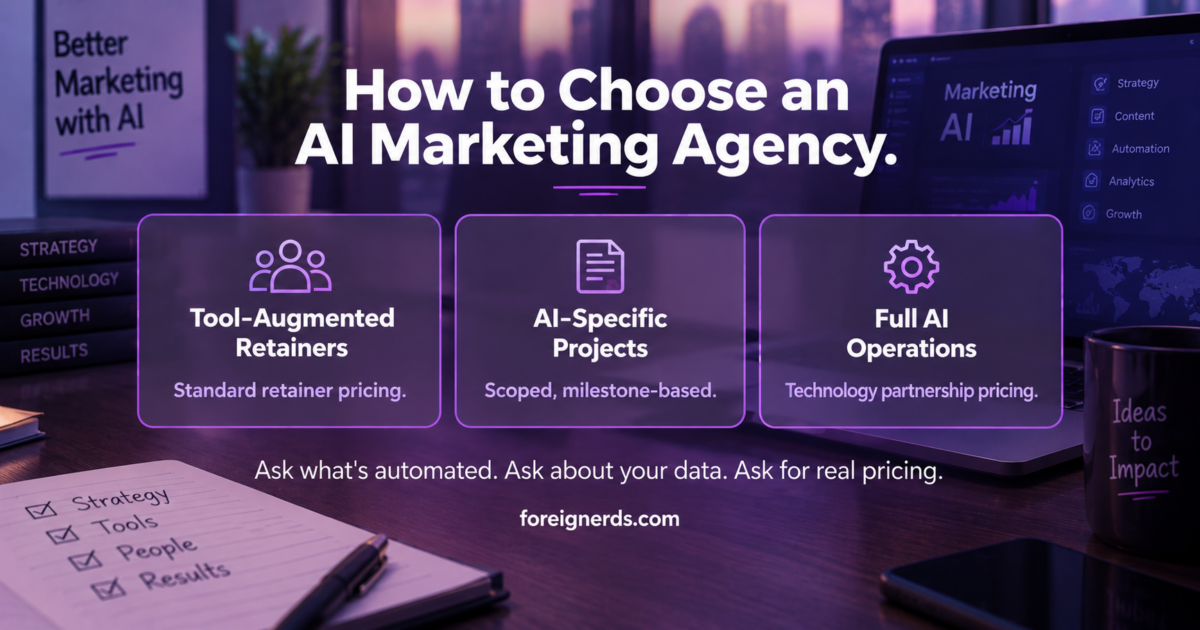
Three pricing tiers for choosing an AI marketing agency: tool-augmented retainers, AI-specific projects, full AI operations

Why This Is Harder to Evaluate Than It Looks

Search for “AI marketing agency” and most of what ranks is either another AI marketing agency describing itself in the best possible terms, or a listicle ranking ten agencies with no disclosed methodology. Neither is a neutral source. The honest starting point is this: “AI marketing agency” is not a regulated or standardized term. Some firms genuinely run AI-driven optimization across live campaigns. Others have simply added the phrase to their homepage after adopting ChatGPT for first drafts, the same as thousands of traditional agencies now do. The label alone tells you very little.

What a Genuinely AI-Driven Agency Actually Does Differently

Based on how the capability is described across the firms actually building it, three things separate a real AI-driven marketing operation from a traditional agency with an AI-adjacent tagline:

  • Real-time optimization — adjusting live ad campaigns automatically based on live performance data, rather than a person reviewing dashboards weekly and manually reallocating budget.
  • Genuine personalization at the individual level — tailoring messaging to an individual user’s behavior rather than broad audience segments, which requires actual data infrastructure, not just a smarter copywriting tool.
  • Workflow automation across repetitive tasks — using AI agents to handle data gathering, first-draft copy, basic design generation, and lead response, freeing human strategists for judgment calls machines genuinely can’t make yet.

A firm doing all three is meaningfully different from a traditional agency. A firm doing none of these but using the phrase in its branding is not — and it’s a completely fair question to ask directly in a first conversation.

What It Actually Costs

This is the question every buyer has and almost no agency website answers directly. Based on how AI-augmented marketing services are typically structured, most engagements fall into one of three tiers:

  • Tool-augmented retainers — a traditional marketing retainer where the agency uses AI tools internally to work faster. Pricing here is usually similar to a standard marketing retainer, since the AI is an efficiency layer for the agency, not a separately billed capability.
  • AI-specific project work — building a specific AI-driven system (a personalization engine, an automated campaign optimization pipeline) as a defined project with its own scope and price, separate from ongoing marketing spend.
  • Full AI-driven marketing operations — an agency running the actual campaign infrastructure with AI at the center, typically priced closer to a technology partnership than a traditional marketing retainer, reflecting the deeper technical build involved.

Any agency unwilling to explain which of these three actually describes their offering, in plain terms, in a first conversation, is a signal worth taking seriously.

A Practical Framework for the Actual Decision

Rather than starting from “which AI marketing agency is best,” a more useful starting question is what specific bottleneck is driving the search in the first place. Three common starting points lead to three different right answers:

Your actual situation What to look for
Campaigns work but take too long to launch and adjust An agency with genuine real-time optimization capability — ask specifically how campaign adjustments happen without a human reviewing dashboards manually
Messaging feels generic, conversion rates are flat An agency with true individual-level personalization infrastructure, not just audience segmentation with an AI label attached
Internal team is overwhelmed by repetitive production work An agency or partner focused on workflow automation for first-draft content, data gathering, and lead response — the mechanical layer, not the strategic one

Naming the actual bottleneck before evaluating any specific agency makes the four-question conversation above far more productive, because it turns a generic capability pitch into a direct answer to a specific problem.

How Agency Pricing Actually Breaks Down in Practice

Beyond the three broad tiers above, a few specific patterns show up consistently across how AI-augmented marketing engagements are actually structured. Tool-augmented retainers tend to track closely with traditional marketing retainer pricing in the same market and vertical, since the AI layer here is an efficiency gain for the agency’s own team rather than a separately built system. AI-specific project work is priced more like a software or data engineering project — scoped deliverables, defined timelines, and a fixed or milestone-based cost — because building an actual personalization or optimization system genuinely resembles a technical build more than a marketing engagement. Full AI-driven marketing operations sit closest to a technology partnership in both pricing structure and the depth of onboarding required, often including a genuine data integration phase before any campaign work begins — which is also why unrealistically fast timelines from a firm offering this tier are worth treating skeptically.

None of these tiers is inherently better — the right one depends entirely on which specific bottleneck from the table above is actually driving the search, and a competent agency in any tier should be able to explain, specifically, which of the three describes their own offering without hedging.

Red Flags Worth Naming Directly

No willingness to show the actual system, only the results

Case studies showing before/after metrics are useful, but a firm that can’t or won’t describe the actual mechanism producing those results — which tools, what data, what’s automated versus human-reviewed — is asking for trust without transparency. A legitimate AI-driven operation can explain its own system.

Every capability is “powered by AI” with no specifics

“AI-powered” attached to every service on a page, with no named tool, model, or specific workflow behind any of them, is usually a branding decision more than a technical one. This isn’t necessarily dishonest — the underlying work might still be good — but it means the AI framing isn’t carrying real information, and that’s worth knowing before evaluating the agency on that basis.

No discussion of what still requires a human

Every genuinely AI-augmented marketing operation still has human strategists making judgment calls current AI can’t reliably make — brand voice decisions, crisis response, creative direction. An agency that implies AI has replaced strategic thinking entirely, rather than accelerated the mechanical parts of it, is overselling.

Questions Worth Asking in a First Call

These four questions, asked directly, surface more real information than most agency sales pages:

  1. “Walk me through exactly what’s automated versus human-reviewed in a typical campaign.” A specific answer, not a general capability list, is the signal to look for.
  2. “What happens to our data, specifically?” — where it’s stored, whether it trains any shared model, who else can see it.
  3. “Can I see an example of the actual output before it was edited by a human?” This surfaces whether the AI layer is doing real work or mostly marketing language.
  4. “What’s your pricing model for this specifically, not your general retainer rate?” A clear, direct answer here is a genuinely good sign.

When a Traditional Agency Is Actually the Better Fit

Not every business benefits more from an AI-first agency than a traditional one. If the marketing need is primarily creative and brand-building — a campaign that depends on a genuinely original creative concept rather than data-driven optimization at scale — a traditional creative agency with strong strategists may outperform an AI-first operation that’s better suited to performance marketing at volume. The honest answer to “should I hire an AI marketing agency” is usually “it depends on whether your bottleneck is creative judgment or optimization at scale,” not a blanket yes.

How This Connects to a Broader AI Adoption Decision

Choosing an AI marketing agency is really a narrower version of a broader question many businesses are working through right now: how to evaluate any AI implementation partner, not just a marketing-specific one. The same evaluation discipline — asking what’s actually automated, what happens to your data, and what the real pricing model is — applies whether you’re hiring for marketing specifically or a broader AI initiative. It’s also worth understanding which specific AI marketing tools actually sit behind an agency’s claims, since a firm’s tool stack is often the most concrete, checkable thing behind an “AI marketing agency” label.

What Good Looks Like Once You’ve Chosen One

The agencies genuinely delivering value here share a pattern: they can explain their own system in plain language without deflecting to case studies, they’re specific about pricing rather than vague, they’re honest about what still requires human judgment, and they treat data handling as a real conversation rather than a line in a contract nobody reads. None of this requires picking the flashiest AI branding — it requires the same due diligence you’d apply to any vendor relationship where the actual mechanism matters more than the marketing language describing it.

How This Differs From Choosing a Traditional Digital Marketing Agency

Traditional agency evaluation focuses heavily on portfolio work, creative sensibility, and cultural fit with the strategist team you’ll work with directly. Those factors still matter with an AI-driven agency, but they sit alongside a second, more technical layer of diligence that traditional agency selection rarely requires: understanding what’s actually automated, what data infrastructure exists behind the personalization claims, and whether the pricing model reflects a technology build or a standard retainer with an AI label attached. Skipping this second layer and evaluating an AI marketing agency purely on the same criteria as a traditional one is the most common mistake buyers make in this specific decision — the portfolio can look identical between a firm doing genuine AI-driven work and one that isn’t, because the difference lives in the mechanism, not the output.

This is also why case studies alone are an incomplete evaluation tool here in a way they aren’t for traditional agency selection. A strong result achieved through genuine automation and a strong result achieved through a talented human team using ChatGPT for first drafts can look identical in a case study. The mechanism behind the result is what determines whether that result is repeatable at the scale and speed an “AI-driven” positioning implies — which is exactly why the four direct questions above matter more than the portfolio review that would normally come first in a traditional agency search.

A Short Glossary for This Space

A few terms come up repeatedly in agency conversations and are worth understanding precisely rather than nodding along to: real-time optimization refers to automated, live adjustments to active campaigns rather than scheduled manual reviews. Hyper-personalization means messaging tailored to an individual user’s behavior, not a broad demographic segment. Workflow automation covers the mechanical, repetitive tasks — data gathering, first-draft copy, lead routing — that AI agents handle so human strategists can focus on judgment calls. None of these terms guarantee quality on their own; they describe capability categories, and the actual evaluation still comes down to whether a specific agency can demonstrate each one concretely rather than simply naming it.

Where the Tool Question Fits Alongside the Agency Question

Part of evaluating any AI marketing agency honestly is understanding what’s actually behind their claims — and a firm’s own tool stack is often the most concrete, checkable evidence available. A practical framework for evaluating AI marketing tools directly is worth reviewing before any agency conversation, since it gives you the vocabulary to ask sharper questions about what’s actually automated versus what’s a person using ChatGPT behind the scenes. The same applies if the specific bottleneck is social content specifically rather than marketing broadly — the tool-selection discipline for social media management runs into nearly identical evaluation traps.

If what you actually need is a genuine marketing automation partner rather than a full agency relationship, that’s worth naming explicitly in a first conversation — the two are related but distinct engagements, and a firm that can’t clearly distinguish which one it’s offering is exhibiting the same vagueness problem described throughout this piece.

None of these distinctions require picking a side before the first conversation — they exist to make that first conversation sharper, so the agency you eventually choose ends up answering the actual question you meant to ask, not the one their pitch deck was built to answer.

Key Takeaways

  • “AI marketing agency” isn’t a regulated term — some firms genuinely run AI-driven optimization across live campaigns, others have simply added the phrase after adopting ChatGPT for first drafts.
  • Three things separate a genuinely AI-driven agency from a traditional one with an AI-adjacent tagline: real-time campaign optimization, individual-level personalization, and real workflow automation.
  • Pricing falls into three tiers — tool-augmented retainers (priced like standard retainers), AI-specific project work (priced like a technical build), and full AI-driven operations (priced like a technology partnership).
  • Four questions surface more real information than any sales page: what’s actually automated versus human-reviewed, what happens to your data, can you see unedited output, and what’s the specific pricing model.

How to Choose an Enterprise AI Implementation Partner: The Complete 2026 Guide

Enterprise AI implementation partners today range from Big 4 consultancies charging $300–$800 an hour to specialized boutiques charging a third of that with senior people doing the actual work. The difference between them isn’t just price — it’s who ends up writing the code, how long the data architecture assumptions go untested, and whether anyone is still accountable six months after the contract is signed. Every provider in this space describes itself the same way in its own marketing — strategic, experienced, outcome-focused — which makes the actual numbers and documented failure patterns far more useful than any pitch deck. Here’s what they actually show.

The Market Right Now

The agentic AI consulting market alone was valued at $5.25–7.55 billion in 2025 and is projected to reach $93–199 billion by 2032–2034. Total AI spending is on track to hit $2.5 trillion in 2026, with AI services specifically accounting for roughly $589 billion of that. Every category of provider wants a piece of it — global consultancies, boutique specialists, systems integrators, and staffing shops all describe themselves the same way in their own marketing. That similarity is exactly what makes this decision harder than it should be, and exactly why the actual numbers behind each option matter more than the pitch.

What “Enterprise AI Implementation” Actually Means

The phrase gets used loosely enough that it’s worth being precise before comparing providers. A real implementation engagement typically spans a business blueprint (ranking which use cases are actually worth pursuing, before any technology gets chosen), a technical blueprint (testing each candidate use case for real feasibility — data readiness, integration complexity, compliance exposure — and setting a realistic timeline against it), the build itself, and a production-operations phase that continues after launch. Providers differ enormously in which of these four phases they’re actually strong at, and a proposal that skips straight to “the build” without a real technical blueprint first is one of the more reliable early warning signs that the data-architecture surprise described next is coming.

The $2 Million Lesson Nobody Wants to Learn the Hard Way

A mid-market software company invested $2 million in an AI strategy and pilot. It worked perfectly in the controlled environment it was built and tested in. Then, during real implementation, the team discovered it required completely rebuilding the company’s underlying data architecture — a foundational problem that should have been caught in the first month, not the last. By the time it surfaced, the consulting team had already moved on to its next engagement.

This isn’t a rare, freak outcome. It’s a direct, predictable consequence of how a specific kind of engagement gets structured: strategy and architecture work handled separately from the people who’ll actually build against it, with the handoff between the two treated as a formality rather than a real risk point. The fix isn’t complicated — it’s making sure the same team (or at least the same accountable owner) spans strategy through production — but it’s also exactly the kind of thing a glossy proposal doesn’t surface, because it isn’t in either side’s interest to slow the sale down to check.

What makes this specific failure mode worth dwelling on is how invisible it is until it’s expensive. The strategy phase produces genuinely impressive-looking deliverables — a working pilot, a clear roadmap, executive buy-in. Nothing in that phase forces anyone to stress-test the underlying data architecture against the messier reality of production volume, edge cases, and systems that weren’t built with this use case in mind. By the time that gap surfaces, the business has already committed budget, timeline, and internal political capital to the project succeeding, which makes it far harder to pause and fix the foundation properly rather than pushing forward and hoping the gap closes on its own — a dynamic that has very little to do with the technology itself and everything to do with how the engagement was structured from the start.

What “Enterprise AI Implementation” Actually Costs

Real, current pricing is more transparent than most providers make it look — you mostly just have to look past the “contact us for pricing” pages to find it.

Big 4 and MBB-Tier Pricing

Big 4 firms (Deloitte, PwC, EY, KPMG) run $300–$800 an hour. MBB-tier firms (McKinsey, BCG, Bain) run higher still, $500–$1,000+ an hour. A full enterprise AI transformation engagement at this tier typically starts at $500,000 and frequently exceeds $1 million, running six to eighteen months. What you’re paying for at this level is real: global bench depth, a mature compliance and governance apparatus, and the ability to run a genuinely multi-geography, multi-department program that a smaller firm simply doesn’t have the headcount to staff.

Boutique and Specialized Firm Pricing

Boutique and specialized AI firms run $150–$650 an hour, with senior specialists typically delivering the work directly rather than staffing it down. A single, well-scoped use-case build runs $50,000–$500,000. A mid-market program with implementation and a real ownership transfer at the end typically runs $35,000–$150,000. Timelines run considerably faster too — 8–12 weeks is typical, versus full quarters or longer at enterprise scale.

Why the Numbers Aren’t Closer Together

The gap isn’t arbitrary, and it isn’t just brand markup either. It reflects two genuinely different operating models. A Big 4 engagement is built to absorb organizational complexity — multiple stakeholders, multiple geographies, a governance layer that has to satisfy legal, security, and often a board. A boutique engagement is built to move fast on a specific, well-defined problem with a small, senior team who can make real technical decisions without three layers of internal sign-off. Neither model is wrong, and neither is inherently better priced for what it delivers. The mistake is picking the first one for a problem that’s actually the second kind, or vice versa — which is a large part of what produced the $2 million rebuild story above, and a mistake that’s far cheaper to catch during vendor selection than after the contract is signed.

The Pricing Model Matters as Much as the Rate

Four distinct pricing models show up across this market, and which one a provider defaults to tells you almost as much as their hourly rate does. Hourly billing is the most common and the least aligned with your interests — there’s no built-in incentive for the provider to finish efficiently, and it’s the model most associated with the junior-execution problem below, since billable hours accumulate regardless of who’s doing the work. Fixed-fee, scoped pricing flips that incentive: the provider is paid to finish the defined scope, not to keep the clock running. Outcome-based pricing goes further still, tying fees to a defined business result — providers using this model report delivering the same implementation work at 20–40% lower total cost than hourly-billed equivalents, precisely because it forces a realistic scope up front rather than an open-ended one. A smaller but growing option worth knowing about: a fractional Chief AI Officer, typically $2,000–$8,000 a month, delivering roughly 70–80% of a full-time hire’s strategic value at a fraction of the cost — a reasonable middle step for a business that needs ongoing AI leadership but isn’t ready for a full executive hire or a full implementation engagement yet.

There’s also a real, measurable payoff to hiring specifically for industry experience rather than general AI capability: industry-specialized consultants are reported to deliver 40–60% faster implementation timelines than generalist firms working the same problem, since less of the engagement gets spent explaining your business context from scratch.

Three Failure Patterns That Show Up Again and Again

Beyond the specific number, three structural problems recur often enough across real engagements that they’re worth naming directly.

The Junior-Execution Problem

At large firms, the partner sells the engagement and a manager scopes it — but the daily work is frequently performed by analysts two or three years out of school. For a $500,000+ investment, it’s entirely reasonable to expect the people doing the actual work to be senior enough to make real technical judgment calls without escalating every decision. This is worth asking about directly and specifically, not assuming based on the firm’s overall reputation, since the firm’s aggregate credentials and the actual team assigned to your project are not the same thing.

A concrete way to check rather than take on faith: ask for the actual names, titles, and years of relevant experience of the people who will be writing code or making architectural decisions on your specific engagement — not the case-study team featured in the sales deck, and not a generic org chart. A firm confident in its staffing answers this specifically and quickly, often within the same call. A firm that redirects to aggregate statistics about the practice as a whole, or asks you to trust that “our people are excellent” without naming anyone, is telling you something real about how the actual staffing decision will likely go once the contract is signed and the sales team moves on to the next deal — and it’s a far more reliable signal than anything in the proposal document itself.

Over-Engineering: Solving a Six-Week Problem in Eight Months

One documented case: a company needed AI-driven customer personalization. A large firm’s recommendation was a deep-learning solution requiring integration with seven separate platforms and eight months of development. A specialized firm later implemented a simpler solution using tools the company already had, in six weeks. This is a structural incentive problem, not a competence one — a firm whose engagements are priced and staffed around large, comprehensive transformations has a natural pull toward proposing one, even when the actual business problem doesn’t need it.

The Generic-Platform Handoff Problem

A related pattern shows up specifically when a large firm’s discovery and strategy phase — often two to three months on its own — produces a recommendation for a major cloud AI platform (Azure Cognitive Services, AWS SageMaker, Google Vertex AI, or similar) without much regard for whether it integrates natively with the systems the business already runs on. Implementation then follows, frequently subcontracted to a separate systems integrator who has never worked in that specific codebase before. The AI ends up living in a separate infrastructure layer, talking to the actual application through API calls rather than being genuinely built into it — technically functional, but a permanent source of added latency, cost, and maintenance overhead that a codebase-native build wouldn’t have.

This matters more than it sounds like on paper, because the cost of this decision compounds quietly for years after the original engagement ends. Every future feature that touches the AI layer now has to cross that same API boundary, every latency-sensitive use case inherits the round-trip cost of a separate system, and the team maintaining it long-term is rarely the team that made the original architectural call. Asking directly whether the proposed solution integrates natively with your existing stack, or requires a new parallel infrastructure layer, surfaces this before it becomes a permanent architectural decision rather than a line item discovered in next year’s infrastructure budget.

What the Best Partners Actually Have in Common

Across the honest evaluation frameworks published by other firms in this exact space, a consistent pattern emerges, regardless of which tier they’re writing from: fixed, scoped pricing over open-ended hourly billing, so the incentive is finishing efficiently rather than accumulating billable hours; clarity on data hosting, ownership, and whether your data is ever used to train a model you don’t control; real industry-specific delivery experience, not just a capability slide; and named engineers you can actually speak with before signing, not a sales team who disappears once the contract closes. What’s less common, and worth specifically pushing for, is evidence the accountability continues past go-live rather than ending at handoff — since the $2 million story above happened precisely at that handoff point.

For anything touching customer or employee data, the compliance question deserves more than a passing mention. Ask specifically where data is hosted, in which country or region, and whether any of it is used to train or fine-tune a model — not just “we use the OpenAI API” as a complete answer, since that alone says nothing about how the data is actually handled once it leaves your systems. For any business operating under GDPR or comparable regional regulation, a vendor unable to answer this precisely, in writing, is a real and immediate disqualifier, not a detail to sort out after signing.

It’s also worth distinguishing a genuine specialist from a generalist wearing an AI label for the current market. A firm can point to strong AI credentials in general while having no real experience in your specific industry’s data patterns, compliance requirements, or operational constraints — healthcare, financial services, and regulated industries in particular punish this gap quickly. Asking for a reference client in your specific vertical, not just an adjacent one, is a more reliable filter than any general capability claim, and a firm confident in its industry depth will usually offer this before you have to ask twice.

Real Questions to Ask Before You Sign

A short, direct list that surfaces most of what matters:

  • Who specifically will do the work, day to day — can I speak with them before signing, not just the salesperson?
  • Is this fixed-price and clearly scoped, or open-ended hourly billing with no ceiling?
  • Where is our data hosted, and is it ever used to train a model outside our control?
  • Can you show a real, named, verifiable result in our industry specifically — and can we talk to that client?
  • What does accountability look like in the first month after go-live — does the relationship continue, or does it end at handoff?
  • Is the proposed solution sized to our actual problem, or does it look like the firm’s standard engagement regardless of what we asked for?

That last question is worth asking explicitly, given how often over-engineering shows up as a structural incentive rather than a one-off mistake.

Red Flags Worth Walking Away From

Beyond the direct questions above, a few patterns are worth treating as near-automatic disqualifiers rather than things to weigh against the rest of the pitch. An estimate given only in hours with no ceiling (“we estimate 400–600 hours at $X/hour”) rather than a scoped, fixed number — this is precisely the incentive misalignment covered above, made concrete. A proposal that recommends the same shape of solution regardless of what you described as the problem, especially one requiring a major new platform or infrastructure layer, matches the over-engineering and generic-platform patterns directly. A firm that can’t name the specific person who will do the daily work, or won’t let you speak with them before signing, is asking you to trust a brand rather than a team. And a vague or evasive answer to a direct compliance question — where data lives, who can access it, whether it trains external models — is disqualifying on its own for any business handling regulated or sensitive data, regardless of how strong the rest of the proposal looks.

How to Actually Run the Selection Process

Most guidance in this space stops at what to look for and skips how to structure the actual comparison, which is its own source of avoidable mistakes. A few practical steps make the process itself more reliable. First, evaluate at most three serious candidates in parallel — more than that mostly adds coordination overhead without meaningfully improving the decision, since the real differentiators (team seniority, scoping quality, compliance answers) tend to become clear well before a fourth or fifth proposal would add anything. Second, ask every candidate to scope the same defined problem, not a generic capabilities pitch — a proposal written against your actual use case is directly comparable in a way “here’s everything we can do” content never is. Third, where the budget allows, a small paid pilot on a bounded slice of the real problem, before a full commitment, surfaces the junior-execution and over-engineering patterns above far faster and more cheaply than a reference call ever will — a team that struggles or over-scopes a two-week pilot will do the same thing at ten times the size. Finally, put the accountability question in writing before signing anything larger: what specifically happens in the first 30, 60, and 90 days after go-live, and who is named as responsible for it — not as a verbal assurance in a sales call, but as a line in the contract itself.

A Real Example

Real, named proof matters more in this category than almost any other, precisely because so much of the competing content is generic capability claims without it. Our CoreliaOS engagement is a real case: a professional services client now runs more than 500 daily queries at 94% accuracy through a multi-agent automation platform, cutting search time by 70% and manual effort by 65%. That’s the kind of specific, checkable number the evaluation questions above are designed to surface — and the kind most “best agencies” content in this space never actually shows.

A second, different shape of implementation: an AI recruitment screening engagement for a staffing and recruitment client delivered a 10x increase in screening capacity and cut time-to-shortlist in half, while holding hiring-decision consistency at 95%. Different industry, different function, same underlying discipline — a scoped, well-defined problem, real integration with the client’s existing systems, and a result specific enough to independently verify rather than take on faith. Neither engagement required an eight-month, seven-platform build to deliver a real, checkable result.

Big, Boutique, or Specialized: The Honest Decision Framework

  • Is this a genuinely enterprise-wide, multi-geography, multi-department transformation? That’s real Big 4 or MBB territory — you’re paying for bench depth and governance capacity a smaller firm can’t staff.
  • Is this a well-defined, bounded problem in one part of the business? A boutique or specialized firm will almost always be faster and cheaper, with senior people doing the actual work rather than junior staff under a partner’s name.
  • Does the proposal match the actual size of your problem, or does it look like the firm’s standard package regardless of what you described? If it’s the latter, that’s the over-engineering pattern above, and worth pushing back on directly before signing anything.
  • Would a mid-implementation architecture surprise be catastrophic, or manageable? If catastrophic, prioritize a partner whose accountability explicitly continues past go-live, in writing, not just in the pitch.
  • What’s the real budget ceiling, and does it actually clear the lower bound of the tier you’re considering? A $60,000 budget aimed at a Big 4 firm buys a fraction of an engagement scoped for their usual six-figure-plus minimum; the same budget at a boutique firm buys a complete, well-executed single use case.
  • How fast does this genuinely need to move? Boutique engagements averaging 8–12 weeks against enterprise timelines measured in full quarters is a real, structural speed difference, not a marketing claim — if speed to a working system matters more than comprehensive governance, that alone should weight the decision toward the smaller firm, and it’s worth being explicit about which of the two actually matters more for the problem in front of you before a single proposal comes in.

There’s no universally correct tier — there’s only a correct fit for the specific problem in front of you, and the honest version of that fit is rarely the most impressive-sounding option in the room.

Worth noting as the market continues to shift: pricing models themselves are evolving quickly. Some newer, AI-native firms now offer fixed-fee engagements with a written ROI guarantee — fees returned if the promised outcome isn’t hit — which is a meaningfully different risk profile than either traditional hourly billing or a standard fixed-scope contract. This isn’t yet the market norm, but it’s worth asking any provider directly whether they’d stand behind their proposal with a comparable guarantee; a confident, capable partner often will, and a hesitant answer is itself informative.

Every pattern in this guide traces back to the same underlying test: does the proposal in front of you match the actual size and shape of your problem, backed by people and numbers you can independently verify — or does it match the shape of the firm’s standard engagement, dressed up to look tailored to what you actually described needing. The first is worth paying for at any tier. The second is worth walking away from, regardless of how prestigious the name on the letterhead is.

If the scale of what you’re evaluating is smaller than a full implementation partnership — a single, well-defined AI capability rather than an organization-wide program — it may be worth stepping back even further to ask whether you need an implementation partner at all yet, or whether a narrower build fits better; see our companion guide on build vs. hire for AI agents for that adjacent decision.

If the specific need is connecting AI into existing systems rather than a broader implementation partnership, AI integration services covers that narrower case directly. And if marketing specifically is the department driving this search, choosing an AI marketing agency applies the same evaluation discipline to that specific decision.

Key Takeaways

  • Enterprise AI implementation partners range from Big 4/MBB firms at $300–$1,000+/hour to boutique specialists at $150–$650/hour — the difference isn’t just price, it’s who actually does the work and whether anyone stays accountable after go-live.
  • A real, documented case: a company spent $2 million on an AI strategy and pilot, only to discover during implementation that it needed a full data architecture rebuild — a gap that should have surfaced in month one, not after the consulting team had moved on.
  • Three failure patterns recur most often: junior staff doing the actual work under a partner’s name, over-engineering a six-week problem into an eight-month build, and recommending a generic cloud AI platform that never integrates natively with existing systems.
  • Fixed-fee and outcome-based pricing align incentives better than open-ended hourly billing — outcome-based engagements report 20–40% lower total cost.