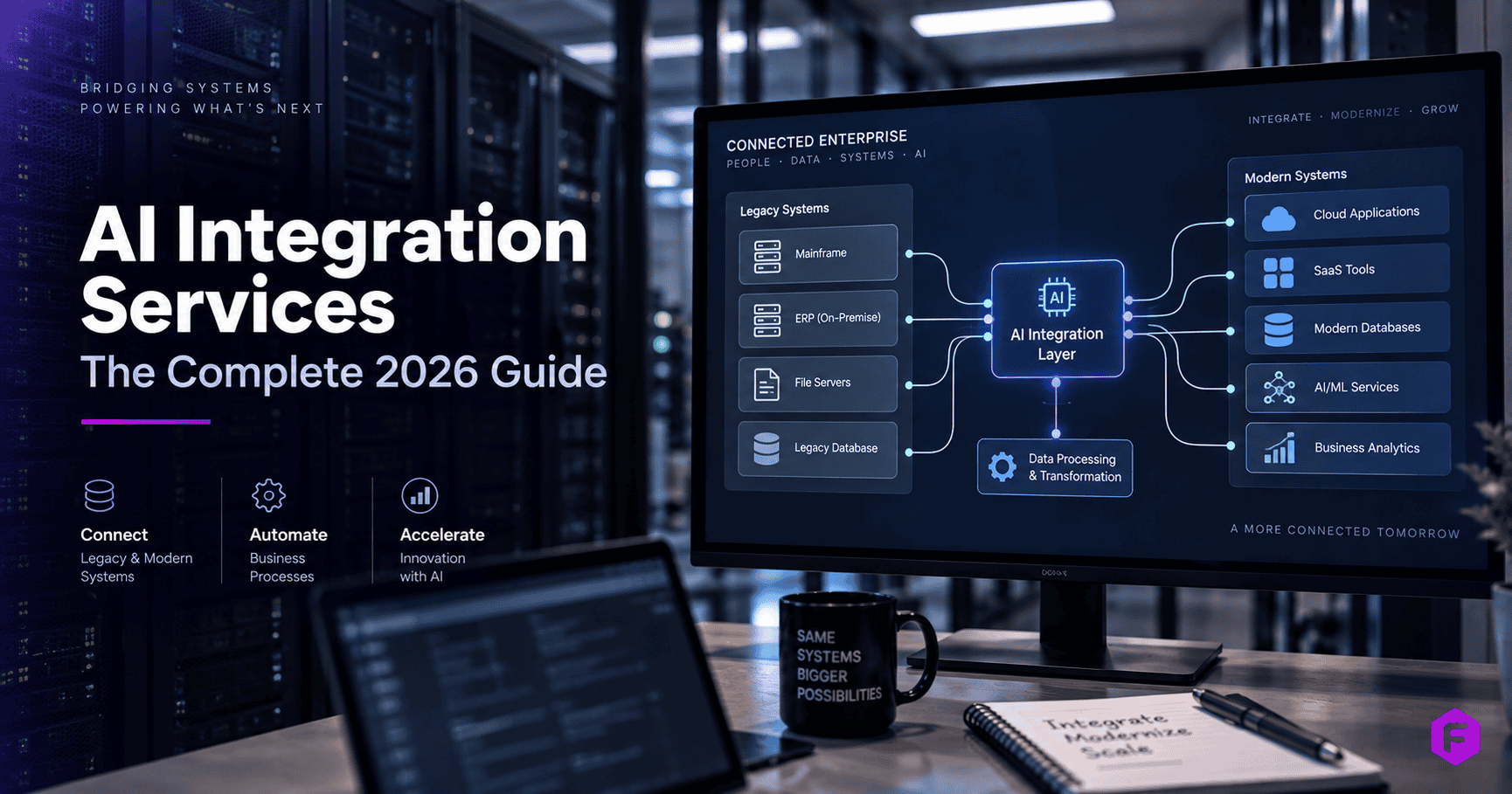
Most businesses don’t need an AI strategy problem solved. They need AI connected to the CRM, the ERP, and the handful of older systems that already run the business day to day — and that turns out to be a meaningfully harder, more specific problem than most “AI integration” content treats it as. It’s also a genuinely different problem from choosing an implementation partner or deciding whether to build an agent yourself — this guide is about what happens technically once you’ve already decided to connect AI to what you already have. Here’s what the real technical and cost data actually shows.
The Real Starting Point: Most Business Software Is Older Than You’d Guess
Roughly 70% of the software running inside Fortune 500 companies was built more than 20 years ago. Core banking platforms, insurance systems, ERPs processing trillions of dollars a year — much of this infrastructure predates the concept of an API, let alone an AI model calling one. Replacing it outright is usually impractical: the cost, the multi-year timeline, and the risk of disrupting business continuity make a full “rip and replace” a non-starter for most organizations. Which means the real, honest starting point for almost every AI integration project isn’t “which model should we use” — it’s “how do we connect modern AI to something that was never built to be connected to anything.”
This isn’t a niche problem confined to a handful of old-economy industries either. It shows up in financial services running core systems from the 1990s, in manufacturing running factory-floor control systems installed decades before anyone considered them a usable data source, and in mid-market businesses running a CRM or ERP that was customized so heavily over the years that even the vendor’s own current documentation no longer fully describes how it actually behaves in production. The specific technology varies. The underlying shape of the problem — valuable business logic and data trapped inside a system that predates modern integration standards — is close to universal across industries.
Why AI Integration Is Harder Than It Looks
Every “top AI integration companies” list treats this as a solved, straightforward category. The actual data, drawn from real enterprise deployments rather than vendor marketing, tells a considerably less tidy story.
The Data Silo Problem
84.3% of organizations encounter real data silo challenges when attempting AI integration, and the average enterprise maintains 6.5 disparate data storage systems — a customer ID in one, an account number in another, an email address in a third, none of them reliably matching. These silos aren’t a minor inconvenience; they’re linked to a measured 31.2% decrease in overall operational efficiency, and separately estimated to cost teams roughly 5.8 hours a week in manual reconciliation work — someone exporting files, renaming columns, resolving duplicate customer names, and explaining why yesterday’s dashboard doesn’t match this morning’s spreadsheet. An AI system layered on top of fragmented, inconsistent data doesn’t fail loudly — it produces confidently wrong outputs, because “garbage in, garbage out” applies just as much to a large language model as it did to every data system before it.
The deeper issue isn’t just that the data lives in different places — it’s that nobody typically owns the question of what a given field actually means across systems, which system should be treated as the source of truth when two disagree, and how fresh each piece of data needs to be for the AI layer depending on it to behave reliably day to day. A pipeline can run successfully and still deliver unusable data if a downstream system interprets a value differently than the source intended — an operational failure that often surfaces only much later, when an automated workflow acts on a conflicting or stale value with real business consequences.
The Missing API Problem
Legacy systems frequently lack the modern API architecture that real-time AI interaction depends on. Where a modern SaaS product exposes a clean, documented API by default, a system built two decades ago often exposes nothing — meaning every integration has to be custom-built, one connector at a time, often against undocumented behavior and fragile dependencies that break in ways nobody predicted. This is precisely why 82% of organizations report struggling with data standardization and system compatibility specifically during the early phases of an integration project — this isn’t a late-stage surprise, it’s the first real obstacle almost everyone hits.
The Security Question Nobody Wants to Own
Opening up a closed legacy system to a new AI tool creates a new attack surface that didn’t exist before, on infrastructure that was often never designed with modern security assumptions in mind. Every new connector is a new potential entry point, and a system that has run unmonitored and largely unchanged for a decade rarely has the access logging or anomaly detection that a newer platform would have by default. This isn’t a reason to avoid integration — it’s a reason to treat access monitoring and permission scoping as part of the integration work itself, not an afterthought bolted on once something goes wrong. Continuous monitoring of access patterns, and deliberately narrow permission scoping for whatever new connector gets built, costs far less than discovering a data exfiltration path after the fact, and it’s a meaningfully cheaper insurance policy than most businesses assume before they ask the question directly.
The Timeline Nobody Quotes Upfront
73.4% of enterprises are actively pursuing AI integration with their ERP systems specifically — and the average implementation timeline for that work runs 26–32 months. That number rarely appears in a sales pitch, because it undercuts the “AI transformation in weeks” framing most marketing leans on. It’s also a direct, predictable consequence of the two problems above: you cannot reliably connect AI to data you haven’t first untangled, and untangling multiple legacy data silos is genuinely slow, careful work.
Worth being explicit about: 26–32 months is an average across a genuinely wide range of starting conditions, not a fixed number every project should expect. A business with a smaller number of systems, cleaner existing data, and a narrower initial scope can realistically move meaningfully faster than that average. A business with more fragmented data, more legacy platforms, and a broader initial ambition should expect to land on the longer end of that range, or beyond it — and a vendor who quotes a fixed, short timeline without first assessing which end of that range your specific situation falls on is quoting a number they can’t actually back.
What AI Integration Actually Costs
Real integration work — connecting AI capabilities into an existing product or system, as distinct from building a new AI feature from scratch — typically runs in a wide range depending on the state of the underlying systems. A single, well-defined integration (one legacy system, one clear data source, a scoped connector) can run $15,000–$50,000 and take four to eight weeks once the data foundation is already reasonably clean. A multi-system integration spanning several legacy platforms, with real data unification work required first, runs considerably higher — often $75,000–$300,000+ — precisely because the bulk of the cost and time isn’t the AI layer itself, it’s the data plumbing underneath it. Enterprises pursuing a full ERP-level integration should expect the 26–32 month timeline noted above to carry a correspondingly larger, multi-phase budget, not a single fixed quote.
The honest way to think about this pricing structure: you’re not really paying for “AI integration” as a single line item. You’re paying for data assessment and mapping, for the connector or middleware layer that lets two systems that were never designed to talk to each other exchange information reliably, for the AI capability itself layered on top of that connection, and for the ongoing monitoring that catches a quiet data-quality regression before it compounds into something expensive. Providers that quote a single flat number without breaking out these components are usually underestimating one of them — most often the data foundation work, since it’s the least visible part of the deliverable and the easiest to shortchange in a competitive proposal.
Integration Architecture: The Three Common Patterns
Most real integration work falls into one of three architectural patterns, and knowing which one fits your situation changes both the cost and the realistic timeline. A direct API integration works when the legacy system already exposes a usable, if imperfect, API — the fastest and cheapest pattern, but only available when the underlying system was built recently enough to have one. A middleware or connector layer sits between the AI capability and a system with no usable API at all, translating between the two — more work to build, and the pattern behind most of the custom, one-off integration work described above, but often the only realistic option for genuinely old infrastructure that predates the concept of a documented interface entirely. A RAG-based approach treats the legacy system’s data as a knowledge source to retrieve from, rather than a live system to transact with directly — often the right fit when the goal is answering questions from existing data rather than triggering actions inside the old system itself, and a natural complement to the data-unification work covered in the phased approach below. This is the same underlying technique behind retrieval-augmented generation as a standalone capability, applied here specifically to legacy data rather than a general knowledge base.
None of these three patterns is inherently better than the others — the right choice depends entirely on what the legacy system actually exposes and what the business goal actually requires, which is precisely why a vendor proposing the same pattern regardless of the system involved is a signal worth noticing rather than dismissing.
Why “Rip and Replace” Is Usually the Wrong Answer
The instinct to solve the legacy-system problem by simply replacing the legacy system is understandable and usually wrong. A full replacement carries its own multi-year timeline, its own high failure risk, and — critically — doesn’t actually solve the underlying data-silo problem unless the migration itself includes real data unification work, which most replacement projects underinvest in for the same reason integration projects do: it’s not the visible, exciting part of the work. The more reliable pattern across real integration work is incremental — connect AI to the systems you have, through a real data and API layer built specifically for that purpose, rather than betting an entire modernization program on a multi-year replacement succeeding on schedule.
This pattern shows up clearly in industries where the cost of delay is easiest to measure directly. In manufacturing specifically, legacy factory and MES (manufacturing execution system) platforms introduce real delays, data gaps, and blind spots that directly affect throughput, quality, and cost — and as agentic AI moves from experimentation into actual factory operations, those weaknesses become far more visible, and far more expensive, than they were when the system was only being used for basic record-keeping. The businesses that get ahead of this don’t wait for a full system replacement — they layer real-time data access onto the existing factory floor systems incrementally, proving value on one production line or one workflow before expanding, which is the same phased pattern that works everywhere else this problem shows up, and it’s a pattern that transfers cleanly to core banking, insurance, and any other industry running critical infrastructure that predates modern integration standards.
The Phased Approach That Actually Works
The pattern that shows up consistently across real, successful integration work is a deliberate sequence, not a single leap:
- Phase one — data foundation and governance (typically 3–6 months): build a unified data model, a data catalog, and clear lineage mapping legacy sources into a coherent structure, before any AI capability gets layered on top. This means deciding, system by system, what each field actually means, which system is the source of truth when two disagree, and how fresh each piece of data needs to be for whatever gets built on top of it. This is unglamorous and it is the actual foundation everything else depends on.
- Phase two — a scoped, real connector (typically 4–8 weeks per system): integrate AI against one well-defined data source or workflow at a time, rather than attempting a single sweeping connection across every system simultaneously. Choosing the pattern (direct API, middleware, or RAG) deliberately for this specific system, rather than defaulting to whatever the last integration used, matters more than it sounds like it should.
- Phase three — expand deliberately: once the first integration is proven in production, extend the same pattern to additional systems, carrying forward the data foundation work from phase one rather than repeating it from scratch each time. Each subsequent system should get faster to integrate than the last, precisely because the foundational data work doesn’t need re-doing — if it isn’t getting faster, that’s a signal the foundation wasn’t built solidly enough the first time.
Skipping phase one is the single most common reason integration projects run over the 26–32 month enterprise average rather than under it — the AI layer gets built against data that turns out to be far messier than assumed, and the resulting rework costs more time than doing the foundation properly would have in the first place. It’s a genuinely tempting shortcut, because phase one produces no visible AI capability on its own — no demo, no headline feature, just cleaner data underneath everything else — which makes it the easiest phase to underfund when a business is eager to show progress.
What Good Integration Looks Like in Practice
A well-executed integration doesn’t try to modernize everything at once. It identifies the single highest-value, most clearly-scoped connection first — the one place where connecting AI to existing data would create real, measurable value — and proves that end to end before expanding. It treats the data layer as the actual deliverable in the early phases, not a footnote to the AI capability. It picks the right architectural pattern deliberately for the specific system involved, rather than forcing every integration through the same template regardless of fit. And it builds monitoring into the connection from day one, since a silent data-quality regression in an integrated system is exactly the kind of failure that goes unnoticed until it’s expensive, the same pattern that shows up in poorly-monitored AI agents generally.
What separates this from the failure pattern isn’t sophistication — it’s sequencing. The same technical components (a data model, a connector, an AI capability, monitoring) show up in both a successful integration and a stalled one. The difference is almost always which order they got built in, and whether the unglamorous data work happened before or after the AI layer was already built on top of an assumption about the underlying data that turned out to be wrong.
A Real Example
Our Email Deliverability Automation Platform is a real, concrete case of exactly this kind of integration: connecting real-time monitoring into a client’s existing marketing infrastructure, rather than replacing it. The result was a 90% reduction in monitoring time (from roughly 15 hours down to 1.5), a shift from a 2–3 day detection delay to real-time issue detection, and zero deliverability-related client churn afterward. Nothing about that engagement required replacing the client’s existing systems — it required connecting real-time intelligence into what was already there, which is the actual shape of most integration work that succeeds.
A different shape of the same discipline: our CoreliaOS engagement connected a multi-agent automation layer across a professional services client’s existing tools rather than replacing them, and now handles more than 500 daily queries at 94% accuracy while cutting search time by 70%. Two different industries, two different integration patterns — one built around real-time monitoring, one around multi-system query routing — but both proved a single, well-scoped connection first rather than attempting to modernize every system simultaneously.
What Makes an Integration Specialist Different From a General AI Vendor
Choosing a partner for integration work specifically is a narrower question than the broader vendor-evaluation criteria that apply to any AI engagement. Two things matter more here than almost anywhere else in AI services: a real, demonstrated track record working with legacy, undocumented systems rather than only modern, API-first platforms, and a concrete data-mapping methodology they can walk through in detail rather than describe in the abstract. Ask a candidate specifically to describe how they’d approach mapping your data landscape in the first two weeks of an engagement — a vendor with real integration experience answers this with specifics (which tools, what a data catalog deliverable actually looks like, how source-of-truth conflicts get resolved when two systems disagree). A vendor without that experience tends to answer in generalities about “AI transformation” instead, which is itself the signal worth noticing more than anything in their capability slide.
It’s also worth asking directly how a candidate handles connector maintenance after launch, since this is where integration work diverges most from a typical software project: a connector built against a legacy system’s undocumented behavior is inherently more fragile than code built against a stable, versioned modern API, and it will need real attention when the underlying system changes. A vendor who hasn’t thought about this, or treats it as out of scope entirely once the initial build ships, is setting up the same kind of quiet, expensive failure described throughout this guide.
This guide has focused specifically on the technical reality of connecting AI to what you already run. If the underlying question is instead whether to build a narrower AI capability yourself versus hiring it out, or how to evaluate a full implementation partner for a broader program, those are related but distinct decisions — see our companion guides on build vs. hire for AI agents and choosing an enterprise AI implementation partner for those adjacent questions.
Questions to Ask Before Any Integration Project Starts
A short, practical list, specific to integration rather than general vendor selection:
- How many separate systems does the data we need actually live in, and does anyone have a current map of that? If the honest answer is “we’re not sure,” that’s phase one of the work, not a detail to skip.
- Does the proposal include real data foundation and governance work, or does it jump straight to the AI layer? A proposal that skips straight to the exciting part is a reliable predictor of the rework described above.
- Which integration pattern is actually being proposed — direct API, middleware, or RAG — and why that one specifically for our systems? A vendor who defaults to the same pattern regardless of what you described is applying a template, not assessing your actual infrastructure.
- What’s the realistic timeline given the actual state of our systems, not a generic industry estimate? 26–32 months is an average across genuinely different starting conditions — a business with cleaner existing data should expect meaningfully faster, and one with more fragmented systems should plan for longer, not the average blindly.
- Is this being scoped as one well-defined connection first, or an attempt to integrate everything simultaneously? The phased pattern above is what separates integrations that ship from ones that stall.
- Who is responsible for monitoring the integrated system once it’s live, and what does that monitoring actually check? A silent data regression in an integrated system is precisely the failure mode that goes unnoticed longest.
- What happens to the connector when the underlying legacy system gets patched, upgraded, or changes a field name? Custom connectors against undocumented legacy behavior break when the system underneath them changes — asking who owns fixing that, and how quickly, matters more once the integration is live than it does during the sales conversation.
- What’s the security and access-scoping plan for the new connection? Every new integration point is a new potential attack surface on infrastructure that may never have been designed with modern security assumptions — this deserves a specific answer, not a general assurance.
Key Takeaways
- Most AI integration challenges aren’t about the AI model — they’re about connecting it to legacy systems: 70% of Fortune 500 software is more than 20 years old, and 84.3% of organizations hit real data silo problems, averaging 6.5 disparate data systems.
- Data silos alone are linked to a measured 31.2% drop in operational efficiency, and enterprise ERP integration projects average 26–32 months precisely because untangling the data comes before any AI capability can work reliably.
- Costs range from $15,000–$50,000 for a single, well-scoped connector to $75,000–$300,000+ for multi-system integrations requiring real data unification first.
- The pattern that actually works is phased: build the data foundation first (3–6 months), prove one scoped connector, then expand deliberately — skipping the data foundation is the single most common reason integration projects run over timeline.
Frequently Asked Questions
How much does AI integration actually cost?
A single, well-scoped integration into one existing system typically runs $15,000–$50,000 over four to eight weeks, once the underlying data is reasonably clean. A multi-system integration requiring real data unification work first typically runs $75,000–$300,000+, and a full enterprise ERP-level integration should be budgeted against the 26–32 month average timeline, not a single fixed quote.
Why does AI integration take so much longer than expected?
Because the real bottleneck usually isn't the AI layer — it's the underlying data. 84.3% of organizations encounter data silo challenges, and 82% struggle with data standardization specifically in the early phases. Untangling that work reliably takes months, which is why the average enterprise ERP integration runs 26–32 months rather than weeks.
Should we replace our legacy systems instead of integrating AI into them?
Usually not as a first move. A full replacement carries its own multi-year timeline and failure risk, and doesn't automatically solve the underlying data-silo problem unless real data unification is built into the migration itself — which most replacement projects underinvest in, for the same reasons integration projects do. Incremental integration against existing systems is typically the more reliable, lower-risk path for most businesses.
What's the biggest technical obstacle to AI integration?
Missing or inadequate APIs on legacy systems, combined with data spread across an average of 6.5 disparate storage systems per enterprise. Both force custom, one-off integration work rather than a straightforward connection to a modern, well-documented interface anyone could build against quickly.
What should the first phase of an AI integration project actually be?
Data foundation and governance — a unified data model, a data catalog, and clear lineage from legacy sources — typically taking 3–6 months before any AI capability gets layered on top. Skipping this phase is the most common reason integration projects run over their expected timeline rather than under it.
What's the difference between a direct API integration, middleware, and a RAG-based approach?
A direct API integration works when the legacy system already has a usable API — fastest and cheapest, but only available on newer infrastructure. Middleware sits between AI and a system with no usable API, translating between the two — more work, but often the only option for genuinely old systems. A RAG-based approach treats the legacy system's data as a knowledge source to retrieve from rather than a live system to transact with directly, and fits well when the goal is answering questions from existing data rather than triggering actions.
Is it safe to connect AI tools to old, legacy systems?
It can be, but it requires deliberate attention — opening a closed legacy system to a new tool creates a new potential attack surface, often on infrastructure that predates modern security assumptions entirely. Treating access monitoring and narrow permission scoping as part of the integration work, rather than an afterthought, is the difference between a safe connection and a genuine new vulnerability nobody notices until it's exploited.
Why do AI integration projects with ERP systems take so long specifically?
73.4% of enterprises pursuing ERP-level AI integration report an average implementation timeline of 26–32 months, largely because ERP systems typically hold the most fragmented, business-critical, and tightly governed data in the organization — meaning the data foundation work alone, before any AI capability is added, is substantial.