This article is part of our complete guide: AI in Cybersecurity: The Complete Guide for Business Leaders.
AI agent governance is the set of policies and controls that define what autonomous AI agents are allowed to do, who approves their actions, and how those actions get reviewed. Search interest in this topic grew from near zero in 2024 to over 200 monthly searches by 2026. Foreignerds builds practical governance for businesses that have not bought a monitoring platform yet.
Why This Is Suddenly a Real Conversation
Three years ago, almost nobody searched for this term. Search volume for “AI agent governance” sat near zero through most of 2024, then climbed steadily through 2025 and into 2026, reaching over 200 searches a month with a $51.65 cost-per-click — a signal of genuine buyer intent behind a still-modest number. That growth curve tells the real story: businesses did not start asking this question because a vendor invented a new problem to sell against. They started asking because AI agents quietly multiplied inside their own operations — a Zapier automation here, a customer-support bot there, a coding assistant with repository access somewhere else — and at some point, someone in the room asked who actually approved all of this.
This pattern repeats across nearly every business we talk to. Agents get adopted individually, department by department, often by whichever employee was comfortable enough with the tool to set it up. A marketing coordinator connects an AI writing tool to the CMS. A support lead turns on an AI chatbot that can issue refunds up to a certain dollar amount. A developer gives a coding assistant write access to a shared repository. Each decision is reasonable in isolation. None of them were made with the others in mind, and in most cases, nobody outside that one team knows the agent exists at all.
The result is what security teams sometimes call “shadow AI” — a layer of autonomous tooling running inside the business that was never centrally reviewed, inventoried, or authorized. It is the direct AI-era descendant of “shadow IT,” the older problem of employees adopting unsanctioned software tools, except the stakes are higher: shadow IT tools mostly stored or displayed data, while shadow AI agents can take real actions — sending money, communicating with customers, modifying systems — without a human confirming each one.
The Vendor-Neutral Gap
We pulled the current top-ranking results for this exact topic and found a consistent pattern worth naming directly. Every single one is either an official platform document — Microsoft publishes its own AI agent governance guidance inside the Azure Cloud Adoption Framework — or a vendor selling a dedicated governance or monitoring product: Zenity, CloudFuze, Airia, OneTrust, and AvePoint all rank with content that leads back to their own platform. That is not a criticism of those companies; a governance platform is a legitimate, sometimes necessary product for the businesses that genuinely need one, and several of them build genuinely useful tools for exactly that audience.
But it means the entire top of the search results is written from one of two vantage points: a cloud platform explaining how to use its own tooling, or a vendor whose content exists to move a reader toward a purchase. Neither vantage point is built to answer the question a smaller business actually has first: not “which platform should I buy,” but “what should I actually be doing right now, before I spend anything.” A business with five AI agents running across two departments does not need the same governance apparatus as an enterprise running hundreds across a regulated industry, and almost none of the current top-ranking content acknowledges that distinction exists at all — every one of them moves quickly toward a platform pitch regardless of the size or maturity of the business reading it.
That gap is exactly what this guide addresses: a starting point that does not assume the reader is already a platform customer, written from the perspective of an agency that builds the agents themselves rather than a company selling a separate tool to monitor someone else’s.
A Practical Starting Framework
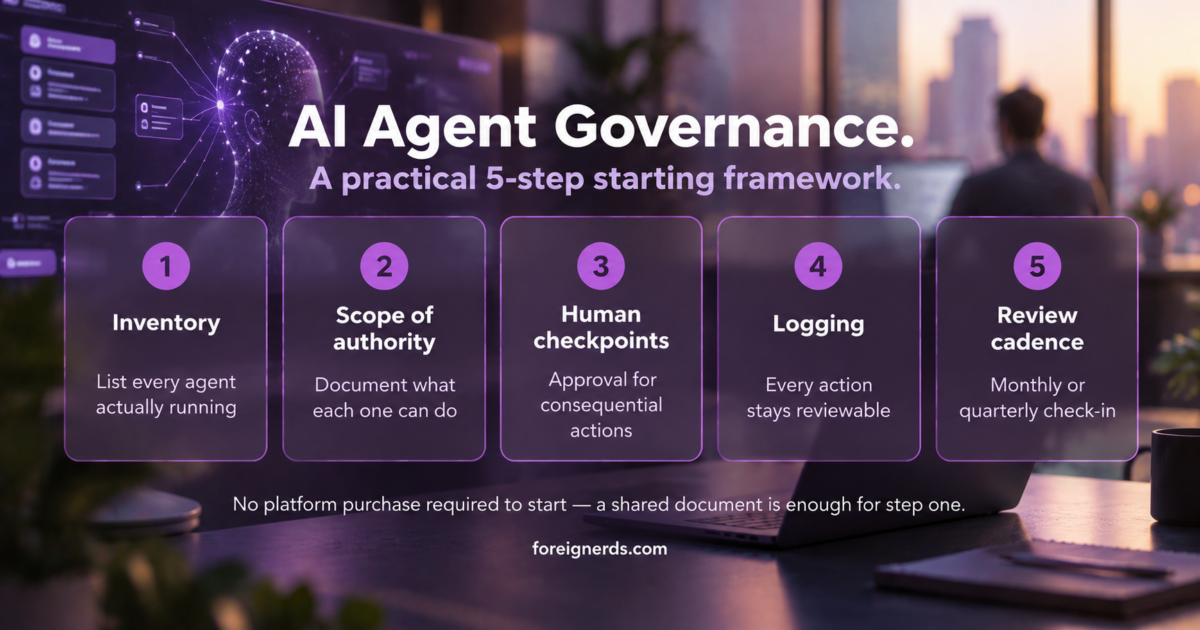
Before any business buys a dedicated governance platform, five things make up a workable AI agent governance framework using tools already on hand — a shared document, a recurring calendar invite, and an honest internal conversation are enough to start.
1. Inventory every agent actually running
Most businesses cannot answer this question accurately on the first try. List every automation, chatbot, coding assistant, and workflow tool with any degree of autonomous action — including the ones individual employees set up on their own without IT involvement. The honest way to do this is to ask every department lead directly, “what AI tools are you currently using that take actions on your behalf, not just ones that generate text or suggestions for you to review.” The distinction matters: a tool that drafts an email for a human to send is a different risk category from one that sends the email itself.
2. Document the scope of authority for each one
For every agent on that list, write down exactly what it is allowed to do: send external emails, spend money, access customer data, modify code, or take any other consequential action. If nobody can answer this for a given agent, that is the first thing to fix — an agent whose permissions nobody can describe is, by definition, ungoverned, regardless of how well it happens to be performing today.
3. Set human-in-the-loop checkpoints where the stakes justify it
Not every action needs human approval, but any action involving money, customer-facing communication, or irreversible system changes should require a sign-off until the agent has a real track record. This does not mean reviewing every single action forever — it means starting with a checkpoint and removing it deliberately once there is enough evidence to justify more autonomy, rather than granting full autonomy by default because removing a checkpoint later feels inconvenient.
4. Make sure every action gets logged somewhere reviewable
An agent that acts without leaving a trace is a liability regardless of how well it performs — logging is not optional even at small scale. This does not require a dedicated logging platform; many AI tools and automation platforms already produce activity logs that simply go unread. The immediate task is often not building new logging infrastructure, but making sure someone actually looks at what already exists on a regular basis.
5. Put a recurring review on the calendar
Governance that gets set up once and never revisited drifts out of date as fast as the agents themselves evolve. A monthly or quarterly review, even a short one, keeps the inventory and scope-of-authority documentation honest, and creates a natural checkpoint for catching new agents before they become another blind spot in next year’s audit.
When You Actually Need a Dedicated Governance Platform
A handful of agents doing well-defined, low-stakes tasks can usually be governed with the framework above and a shared document. The calculus changes once a business meets one or more of these conditions:
- Multiple departments, multiple agents, no single owner. Once governance can no longer live in one person’s head or one shared spreadsheet without becoming unwieldy, a platform’s centralized visibility starts earning its cost.
- Agents touching financial systems or sensitive customer data. The consequence of an ungoverned mistake scales directly with what the agent can access — an agent that can move money or view protected health information needs a materially higher standard of oversight than one drafting marketing copy.
- Operating in a regulated industry. An auditor will eventually ask for documented proof of controls, not just a policy someone can describe verbally. A platform that generates that documentation automatically is often cheaper than the labor cost of manually proving compliance after the fact.
- The agent footprint is growing faster than anyone can track manually. If new agents are appearing faster than the quarterly review can keep up with, that is itself a signal that manual tracking has reached its practical limit.
At that point, a dedicated platform earns its cost by providing the continuous monitoring, access logging, and policy enforcement that a shared spreadsheet cannot realistically sustain. Until that point, the five-step framework above is not a placeholder for “real” governance — it is a legitimate, defensible starting point that many businesses will operate on for years before outgrowing it.
What This Looks Like When It Goes Wrong
The realistic failure mode is rarely a single dramatic incident. It is usually a slow accumulation of small, undocumented decisions — an agent granted broader permissions “temporarily” that nobody ever revisited, a new automation added to an existing workflow without anyone updating the original scope-of-authority notes, a departing employee whose personal AI tool integrations were never audited before their access was revoked. None of these individually looks like a crisis while it is happening. Collectively, they are exactly what an auditor, a regulator, or a genuinely bad incident eventually surfaces all at once, at the worst possible time to discover it for the first time.
The five-step framework above is deliberately unglamorous for this reason. Governance failures are rarely caused by a sophisticated attack on a well-governed system — they are caused by the absence of a basic inventory that would have made an obvious problem visible months earlier.
Common Mistakes We See Businesses Make Here
A few patterns show up repeatedly across businesses figuring this out for the first time, and each one is avoidable once it is named directly.
Treating governance as a one-time setup instead of an ongoing habit
The inventory and scope-of-authority documentation described above are only accurate on the day they are written. Every new automation, every expanded permission, every new hire granted access to an existing AI tool changes the picture. Businesses that treat the initial setup as “done” rather than the first cycle of a recurring process are usually the ones surprised, months later, by an agent nobody remembers approving.
Assuming a low-cost tool means low-stakes authority
The price of an AI tool has no relationship to the consequences of what it is authorized to do. A free automation connecting a support inbox to a refund system can move real money just as easily as an expensive enterprise platform. Governance decisions should follow the scope of what an agent can actually do, not what it costs to set up.
Waiting for a platform to solve a documentation problem
A monitoring platform is genuinely valuable once a business has outgrown manual tracking — but it cannot retroactively tell you what an agent was supposed to be allowed to do if that scope was never documented in the first place. Platforms enforce and monitor policy; they do not invent it. Skipping the documentation step and going straight to a platform purchase often means paying for enforcement of a policy that still does not actually exist.
Only considering security risk, not operational risk
Most conversations about AI agent governance focus on security — unauthorized access, data exposure, malicious misuse. Those risks are real, but the more common failure mode in practice is operational: an agent doing exactly what it was told, at a scale or in a context nobody anticipated, because the original scope-of-authority conversation was too narrow. A refund-approval agent that works fine at ten requests a day can create a real financial exposure at ten thousand, even with zero security compromise involved anywhere in the chain.
Where This Fits Alongside Building the Agents Themselves
Whether you build AI agents in-house or bring in an outside team, governance and AI agent development are not sequential steps where one finishes before the other starts — they need to happen together. An agent built without governance in mind from the outset usually ends up retrofitted later, which is harder and less reliable than designing the scope of authority, logging, and human-in-the-loop checkpoints into the agent from its first version. When Foreignerds builds an agent for a client, the governance questions in this article — what is this allowed to do, who approves consequential actions, where does the activity log live — are part of the initial scoping conversation, not an afterthought addressed after launch.
This is also why a genuinely useful governance framework cannot be entirely generic. The right level of human oversight for an agent that drafts internal reports is different from the right level for one that can issue customer refunds, and a governance policy that treats every agent identically usually ends up either too restrictive for the low-stakes cases or too permissive for the high-stakes ones. The five-step framework in this article works precisely because it asks the scope-of-authority question per agent, not once for the whole business.
Getting Started
The five-step framework in this article is genuinely enough to begin with — none of it requires a purchase, a vendor conversation, or specialized software. What it does require is someone inside the business actually doing it, which is where most good intentions on this topic quietly stall. If the inventory step alone feels daunting, or if the honest answer to “who approves consequential agent actions here” is currently “nobody,” a structured outside review through our AI governance consulting work can get that foundation in place faster than building it internally from a standing start — sized to match where the business actually is today, not to a generic enterprise template — the same scoping conversation that happens before we design an agent in the first place, rather than a separate audit bolted on after the fact.
For a broader look at what these systems actually do beyond governance specifically — including where most first deployments go wrong — see what AI agents actually do and the adoption mistake that sinks most first attempts.
Key Takeaways
- AI agent governance means defining what autonomous agents are allowed to do, who approves their actions, and how those actions get reviewed — demand for this is real, growing from near-zero search volume in 2024 to 200+ searches a month by 2026.
- Most businesses don’t need a governance platform to start — a shared document covering five things (inventory, scope of authority, human checkpoints, logging, and a recurring review) is a legitimate starting point.
- A dedicated platform earns its cost once governance spans multiple departments, touches financial or sensitive data, operates in a regulated industry, or grows faster than a manual review can track.
- The realistic failure mode isn’t a dramatic breach — it’s a slow accumulation of undocumented decisions nobody revisits.
Frequently Asked Questions
What is AI agent governance?
AI agent governance is the set of policies and controls that define what an autonomous AI agent is allowed to do, who approves its actions, and how those actions are reviewed and logged over time.
Why does AI agent governance matter now?
Search interest in this exact topic grew from near zero in 2024 to over 200 monthly searches by 2026, tracking the same period in which AI agents moved from experimental to genuinely deployed inside real businesses — often faster than governance kept pace.
What is the difference between AI governance and AI agent governance specifically?
AI governance broadly covers how an organization manages AI models, data, and outputs. AI agent governance is narrower: it specifically addresses agents that take autonomous action — sending emails, moving money, editing systems — where the risk is not just a wrong output but an unauthorized action.
Do I need a dedicated governance platform, or can I start without one?
Most businesses running a handful of agents on well-defined, low-stakes tasks can start with a practical framework and a shared document. A dedicated platform becomes worth its cost once agents touch financial systems, sensitive data, or multiple departments, or once a regulator will eventually ask for documented proof of controls.
What are the first steps to govern AI agents at a small or mid-sized company?
Start with an honest inventory of every agent actually running, including ones individual employees set up without IT involvement. Then document exactly what each one is allowed to do, add human approval for any consequential action, ensure every action is logged, and put a recurring review on the calendar.
Who should own AI agent governance internally — IT, security, or leadership?
In practice it needs input from all three: IT typically knows which agents technically exist, security understands the risk model, and leadership needs to approve what level of autonomous authority the business is comfortable granting. Governance that lives with only one of these groups usually misses something.
What happens if an AI agent takes an unauthorized action?
The specific consequences depend on what the action was, but the underlying problem is usually the same: no one had documented what that agent was actually authorized to do, so there was no clear line between expected and unauthorized behavior in the first place. That documentation gap is what a governance framework closes.
How is agent governance different from traditional software access control?
Traditional access control governs what a human user can do when they log in. Agent governance has to account for an agent acting continuously and autonomously, often making judgment calls a traditional permission system was never designed to evaluate — which is why simply reusing existing IT access policies is rarely sufficient on its own.
What does the Microsoft Azure governance framework actually require?
Microsoft publishes AI agent governance and security guidance as part of its Cloud Adoption Framework, covering coordinated decisions across security, identity, and operational oversight for organizations running agents on Azure. It is a genuinely useful reference point, though it is written for Azure-specific deployments rather than as a platform-neutral starting point.
How often should an AI agent governance policy be reviewed?
A monthly or quarterly review is a reasonable starting cadence for most small and mid-sized businesses — frequent enough to catch new agents or expanded permissions before they become a blind spot, without turning governance into a full-time job.
Can AI agent governance be outsourced to an agency or consultant?
Yes — the inventory, scope-of-authority documentation, and initial framework setup are exactly the kind of structured, one-time-plus-ongoing-review work an outside team can stand up quickly, though the ongoing internal review cadence still needs an accountable owner inside the business.
What is a realistic timeline to get basic governance in place?
A genuine inventory and scope-of-authority documentation for an existing agent footprint typically takes one to two weeks for a small or mid-sized business, assuming someone can get straight answers about what is actually running — often the slowest part is simply finding every agent, not documenting the ones already known.