
This article is part of our complete guide: Generative Engine Optimization (GEO): The Complete Guide.
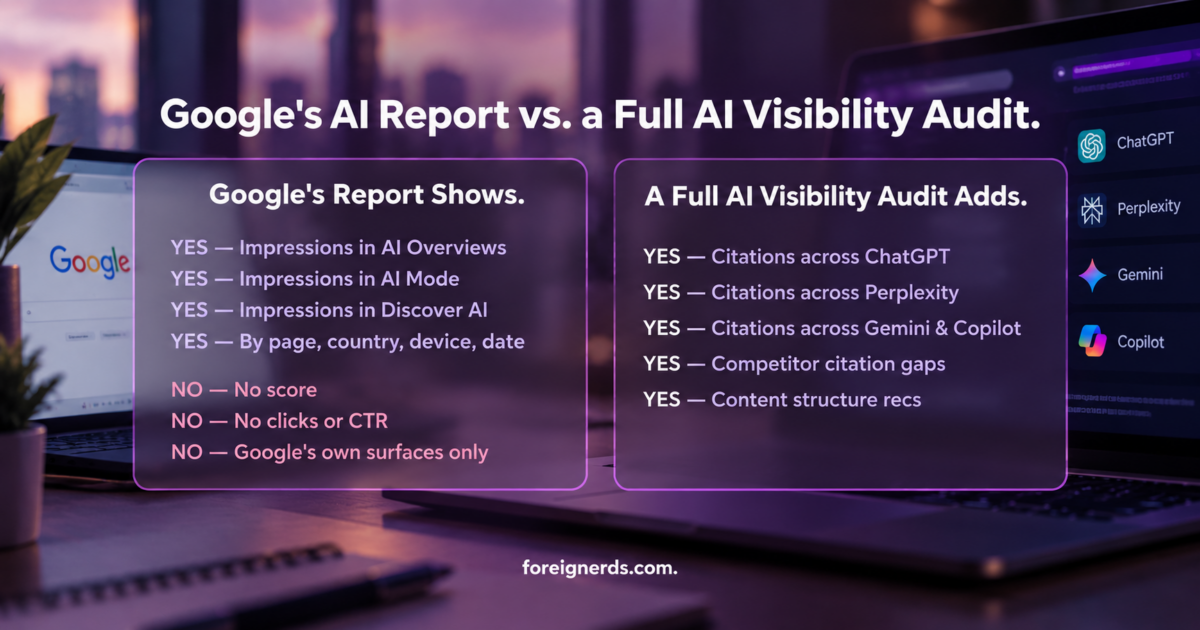
Google’s new Generative AI performance report in Search Console shows how often your pages appear in AI Overviews, AI Mode, and Discover — impressions only, with no score, clicks, or CTR data. Google rolled this out worldwide by August 31, 2026. It is useful, but not the same as the cross-platform “AI visibility audit” most vendors sell.
What Google Actually Launched
On June 3, 2026, Google added a dedicated Generative AI performance report inside Search Console — its own official name for the feature, confirmed directly on Google’s developer blog and its own help documentation. The report isolates how often your site’s pages appeared inside Google’s generative AI features on Search and Discover, breaking that data down by page, country, device, and date, with granularity from hourly to monthly. By August 31, 2026, Google confirmed the rollout had reached every website worldwide, not just the initial test group that saw it first.
The data itself was not new — Google confirmed these AI impressions were already counted inside your overall Search Console performance totals, mixed in with your regular organic search numbers. What changed is visibility: for the first time, that number is broken out into its own dedicated view instead of being buried inside an aggregate figure you could not isolate or act on separately. Before this launch, a site could be earning a meaningful share of its total impressions from AI Overviews and have no way to know it, because that traffic looked identical to a regular search impression in every report Search Console offered.
For the fuller picture of how AI search itself works, see our breakdown of how AI search actually works and what it means for SEO. This new report is also part of a broader shift industry-wide, not a Google-only move. The same week Google’s report rolled out more broadly, Microsoft’s Search team publicly confirmed similar AI performance reporting was coming to Bing Webmaster Tools — a signal that isolating AI-driven visibility from traditional organic visibility is becoming a baseline expectation for search platforms generally, not a one-off Google experiment.
What It Does Not Do
This is the part that gets lost in translation, and it matters more than the launch itself. The report shows impressions only. There is no click data, no click-through rate, and no query-level data in the current version — you can see that your page appeared inside an AI feature, but not whether anyone actually engaged with it once it did, and not which specific search query triggered that appearance. That is a real, meaningful gap for anyone trying to judge whether AI visibility is actually translating into business value.
There is also no score of any kind, despite how this feature gets described informally in some coverage. A business searching for “did Google give my site an AI visibility score” will not find one inside Search Console, because Google has not built one — what exists is a raw count of appearances, not a graded assessment of how well-optimized your content is for AI surfaces.
The report is also scoped narrowly by design: it covers only Google’s own generative AI surfaces — AI Overviews, AI Mode, and generative AI features inside Discover. It says nothing about whether your brand appears when someone asks ChatGPT, Claude, Perplexity, or Gemini the same question, because those are entirely separate systems Google has no visibility into and no reason to report on. Google also introduced a toggle letting site owners opt their content out of appearing in these AI features entirely. Opting out has no effect on standard Search rankings — it only affects eligibility for the AI-specific surfaces this report tracks, which is worth knowing before treating that toggle as a bigger decision than it actually is.
Why This Gets Confused With a Full AI Visibility Audit
Search interest in “AI visibility audit” grew from essentially zero in early 2025 to 390 searches a month by July 2026 — genuine, fast-growing demand for a term that barely existed eighteen months earlier. We checked the current top-ranking results for that exact term, and every one of them — Semrush, Ahrefs, SE Ranking, Amplitude, WhiteLabelIQ — is a vendor selling a tool that tracks brand visibility across ChatGPT, Perplexity, and Gemini, not just Google’s own surfaces. That is a genuinely useful and different thing from what Google’s new report measures, but none of the current top results draw a clear line between the two ideas for a reader encountering both terms in the same week.
A reader searching either term could easily walk away with one of two wrong conclusions: either that Google’s report is the same thing as a full AI visibility audit, or that a paid audit tool is simply repackaging data Google already gives away for free. Neither assumption holds up under scrutiny. Google’s report tells you about Google’s own AI surfaces only, and only in impression-count form. A genuine AI visibility audit checks whether your brand gets cited by name across every major AI assistant a customer might actually ask — a materially broader question Google’s own tooling was never built to answer, because it was built to report on Google Search, not to audit the entire AI assistant landscape a customer might use instead.
What a Real AI Visibility Audit Adds on Top
A proper AI visibility audit picks up exactly where Google’s report stops, and the difference is not incremental — it is a different question entirely. It checks whether your brand is actually named when someone asks ChatGPT, Perplexity, Gemini, or Copilot a question in your category, not just whether Google’s crawler included your page in an AI Overview response. It identifies which competitors are getting cited instead of you, and on which specific questions your category’s buyers are actually asking these assistants — detail no Google-facing tool could ever surface, since Google has no access to what a competitor’s brand looks like inside a ChatGPT conversation.
It also looks at whether your content is structured in a way that makes it easy for any AI system to extract and cite accurately — clear entity naming, direct answers near the top of a page, genuine factual claims an AI model can quote with confidence — rather than optimizing purely for how Google’s own crawler happens to parse a page. None of that visibility exists anywhere inside Search Console, because Search Console is fundamentally a Google product reporting on Google’s own systems. It was never going to cover competitors’ AI systems, and expecting it to is asking a tool to do a job it was never built for.
What To Actually Do With This Data This Month
If the new Search Console report is available on your property, start with something simple: establish a real baseline. Note your current AI impression count by page, and revisit it monthly rather than treating the number as a one-time curiosity to check once and forget. A page with zero AI impressions is itself a genuine signal worth investigating — either the topic isn’t structured in a way AI Overviews can easily extract an answer from, or Google simply isn’t surfacing an AI answer for that particular query yet, which is useful to know either way.
Once that baseline exists, the honest next question is whether Google’s surfaces are actually the only ones that matter to your specific customers. If your buyers are just as likely to ask ChatGPT or Perplexity a question as they are to type it into Google, Google’s report alone will never reveal that gap to you — it structurally cannot, since it only measures what happens on Google’s own systems. That is exactly the point where a full AI visibility audit becomes the genuinely necessary next step rather than a redundant one, because it answers the specific question Google’s own report was never designed to address.
Common Misconceptions Worth Correcting
A few assumptions show up repeatedly once businesses start looking at this new report, and each one is worth addressing directly before it leads to a wasted decision.
“My AI impressions dropped, so my AI visibility is getting worse”
Not necessarily. Because this data was always counted inside your existing performance totals and has simply been broken out separately for the first time, a change in the isolated number can reflect a change in how Google is categorizing existing traffic, not necessarily a real change in how often you’re actually appearing. Compare the isolated AI number against your overall performance trend before drawing a conclusion from either alone.
“Opting out of AI features will protect my traffic”
Google has confirmed the opt-out toggle affects eligibility for AI Overviews, AI Mode, and Discover AI specifically — it does not restore or protect standard organic ranking traffic, because that traffic was never affected by inclusion in AI features in the first place. Opting out trades away the impressions and potential exposure those AI experiences provide, without changing your regular search position at all.
“If Google shows zero AI clicks, AI search isn’t sending me any traffic”
The current report doesn’t measure clicks at all, in either direction — its absence from the report is not evidence of zero AI-driven traffic, it’s simply a metric Google hasn’t built yet. Treating the absence of click data as proof of zero AI traffic value is reading more into the report than it currently supports.
Where This Sits Inside a Broader GEO Strategy
Google’s new report is best understood as one instrument on a dashboard, not the whole dashboard. It is a genuinely useful, free, first-party signal for the narrow question it answers — and it should be checked regularly precisely because it costs nothing to monitor and reflects real, verified Google data rather than a third party’s estimate of what Google might be doing. But treating it as a complete answer to “how visible is my brand in AI search” mistakes one instrument for the whole picture.
The businesses getting genuine value from this moment are the ones using Google’s report as the free baseline it actually is, then layering a proper cross-platform audit on top once that baseline raises real questions — a page with strong traditional rankings but zero AI impressions, a category where competitors are visibly better cited on ChatGPT than the same competitors rank on Google, a customer base that increasingly starts its research inside an AI assistant rather than a search box. Each of those signals points toward a genuine need for broader visibility work, not toward more time spent staring at Google’s own isolated number waiting for it to change on its own.
This is also why the underlying discipline matters more than any single report a platform happens to ship. Structuring content so an AI system — any AI system, Google’s or otherwise — can extract a clear, accurate, citable answer is the actual skill being measured here, whether that gets surfaced through Google’s Search Console report, a third-party audit tool, or simply asking ChatGPT the question yourself and seeing what comes back. The report is useful. The underlying content discipline it’s measuring is what actually matters.
How to Actually Check This on Your Own Site
If you have not looked yet, the report sits inside Search Console under the Search Results section, in its own dedicated panel rather than mixed into the standard performance report. Compare the isolated AI figure against the total impressions figure for the same date range, since neither number means much read entirely on its own — that ratio is a more honest starting metric than either number in isolation, since it tells you what share of your existing visibility is coming specifically from Google’s AI features rather than traditional blue-link results.
Worth checking specifically: which pages show meaningful AI impressions and which show none at all, even among pages with comparable traditional search performance. A page ranking well in standard search but earning zero AI impressions is a genuine, specific signal — often it means the page’s content isn’t structured with a clear, extractable, direct answer near the top, the exact structural pattern AI Overviews tend to favor when selecting which page to summarize from — a fixable, specific gap once it is actually made visible, which is precisely what this new report finally makes possible for any site owner willing to look.
Key Takeaways
- Google’s Generative AI performance report (rolled out worldwide by August 31, 2026) shows only how often your pages appear in AI Overviews, AI Mode, and Discover — impressions only, with no clicks, CTR, query data, or “score” of any kind.
- It’s scoped narrowly to Google’s own AI surfaces — it says nothing about whether your brand appears when someone asks ChatGPT, Claude, Perplexity, or Gemini the same question.
- A full AI visibility audit answers the broader question Google’s report structurally can’t: whether your brand gets cited by name across every major AI assistant, and which competitors are getting cited instead of you.
- The two aren’t competing tools — Google’s report is a useful free baseline; a cross-platform audit is the next step once that baseline raises real questions.
Frequently Asked Questions
What is Google's new AI visibility report in Search Console?
It is the Generative AI performance report, launched June 3, 2026 and rolled out to all websites worldwide by August 31, 2026. It shows how often your pages appeared inside Google's AI Overviews, AI Mode, and generative AI features in Discover, broken down by page, country, device, and date.
Does Google give websites an AI visibility score?
No. The report shows raw impression counts only — how often your pages appeared inside Google's AI features. There is no numerical score, grade, or rating of any kind currently built into this report.
What's the difference between Google's AI report and a full AI visibility audit?
Google's report covers only Google's own AI surfaces and shows impressions only. A full AI visibility audit checks whether your brand is actually cited by name across every major AI assistant — ChatGPT, Perplexity, Gemini, Copilot — a materially broader question Google's own tooling cannot answer.
Which AI surfaces does Google's report actually cover?
AI Overviews and AI Mode within Google Search, plus generative AI features inside Google Discover. It does not cover any AI assistant outside Google's own product ecosystem.
Does the Search Console AI report show clicks or only impressions?
Impressions only, in the current version. There is no click, click-through rate, or query-level data yet, though Google has indicated more metrics may be added over time without committing to a specific date.
Why did my AI impressions suddenly become visible as a separate number?
These impressions were always included in your overall Search Console performance totals. Google simply gave them their own dedicated view for the first time — your aggregate numbers have not changed, only your ability to isolate this specific slice of them.
Do I need a third-party tool if Google already shows AI visibility data?
If your customers only ever search on Google, the native report may be sufficient for now. If your customers are equally likely to ask ChatGPT, Perplexity, or Gemini a question, a third-party or agency-led AI visibility audit is the only way to see that broader picture, since Google's report cannot see outside its own systems.
What does Google's report NOT tell me about my AI visibility?
It cannot tell you whether you're cited on ChatGPT, Perplexity, Gemini, or Copilot, whether competitors are being cited instead of you on specific questions, or whether your content is structured well enough for any AI system besides Google's own to extract and cite accurately.
Can I opt out of appearing in Google's AI features?
Yes, Google has introduced a toggle for this. Opting out removes your content's eligibility for AI Overviews, AI Mode, and Discover AI specifically, but has no effect on your standard organic Search rankings either way.
How is this different from tracking visibility on ChatGPT or Perplexity?
Entirely different systems with no data crossover. Google's report only has visibility into Google's own AI features. Tracking presence on ChatGPT or Perplexity requires tools or audits built specifically to query those platforms directly, which Search Console was never designed to do.
Is a high number of AI impressions from Google actually good news?
It's a genuinely positive signal that your content is being surfaced inside Google's AI features, but without click or engagement data alongside it, a high impression count alone doesn't yet confirm that visibility is translating into actual traffic or business value.
What should a business actually do with this new data?
Establish a monthly baseline of AI impressions by page rather than checking once and forgetting it, investigate pages showing zero AI impressions to understand why, and honestly assess whether your customers search Google exclusively or also use other AI assistants before deciding whether a broader audit is worth the investment.