Several agencies and software vendors now offer a free AI visibility audit, and they are not the same product. Some are self-serve tools that return a preview in seconds. Some are manual reviews run by a strategist. Some are checklists built around a local business. Foreignerds offers one too, and we describe it below. Because the offers differ so much in scope, speed, and who they suit, the most useful thing we can do is explain what a good audit should measure and how to compare the ones you find.
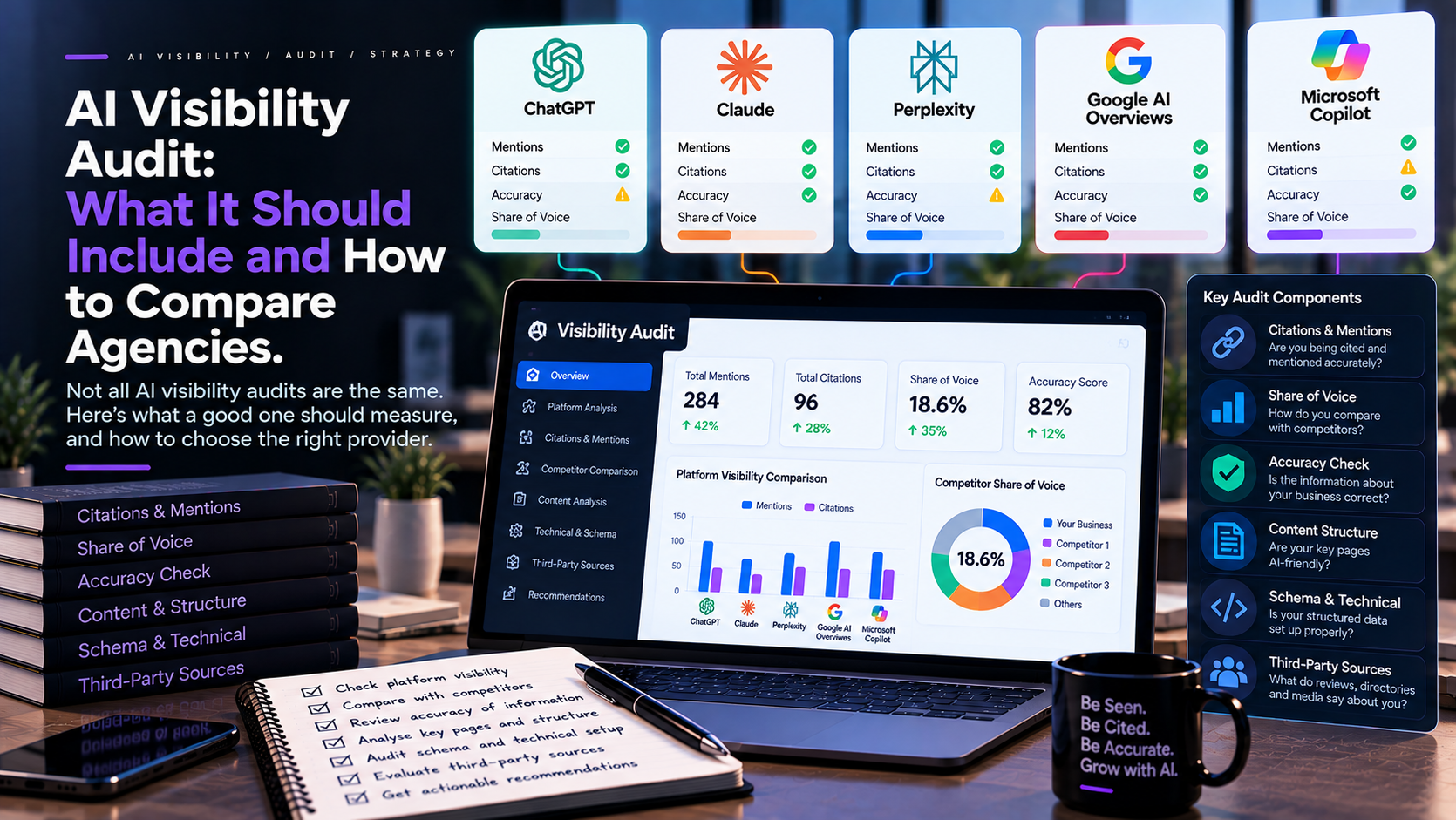
An AI visibility audit tests whether AI answer engines such as ChatGPT, Claude, Perplexity, Google AI Overviews, and Microsoft Copilot mention, cite, and describe your business accurately when someone asks a question you would want to answer. It is different from a traditional search engine optimization audit, which checks how you rank in a list of links. A site can rank well on Google and still be absent from the answers people read in an AI assistant.
What a free AI visibility audit is, and what it is not
An audit is a snapshot. It records how AI systems treat your business for a defined set of questions at a defined moment. It is useful for finding gaps, prioritizing work, and setting a baseline. It is not a ranking guarantee, and it is not a substitute for ongoing measurement.
Free audits are also a way for a provider to start a conversation. That is a fair exchange, provided you know what you are receiving. Before you request one, it helps to know what the findings should contain and whether you keep them regardless of whether you hire the provider.
One caution applies to any audit, free or paid. AI answers can differ from one run to the next and from one platform to the next. A single screenshot of one prompt is weak evidence. A credible audit uses a set of prompts, tests each platform separately, and reports patterns.
What a useful audit should measure
Whatever the provider, a useful audit covers a handful of things.
Citations and mentions. A citation is a link to your site inside an AI answer. A mention is your business name appearing without a link. They are different signals, and a business can have one without the other.
Share of voice against competitors. Knowing that you appear is less useful than knowing who appears instead of you for the same question.
Accuracy. AI systems sometimes state wrong facts about a business, such as outdated services, incorrect locations, or invented details. An audit should check what is being said, not only whether you are named.
Content structure. Pages that answer questions clearly, with direct answers, headings, and lists, are easier for AI systems to extract from. An audit should review the pages that matter most to revenue.
Structured data. Schema markup helps machines understand who you are and what you offer, so gaps here are worth listing.
Third-party footprint. Reviews, directories, press coverage, and community discussion shape what AI systems say about you. This is often the most overlooked part, and the research below explains why it matters.
Why each platform has to be tested separately
If one provider tells you that you are visible in AI search, ask which platforms they tested. The evidence suggests platforms behave differently enough that a single result does not transfer.
Averi’s benchmark report, citing a Profound analysis of 680 million citations collected between August 2024 and June 2025, states that only 11% of domains are cited by both ChatGPT and Perplexity. That is a domain-level figure across the whole citation landscape, not a statement about your own brand, and different studies define overlap differently. The direction is consistent, though: the two platforms draw on different sources.
Ahrefs found a similar divergence from another angle. In an analysis of 15,000 long-tail queries published on August 11, 2025, only 12% of URLs cited by ChatGPT, Gemini, and Copilot also ranked in Google’s top 10 for the same prompt. Perplexity was the exception, with 28.6% overlap. Ranking on Google is not the same as being cited in an AI answer.
Slate HQ’s 90-day study of six B2B software brands shows the same spread at brand level. For one email security client, brand-owned citation share ranged from 4.5% on ChatGPT to 10.2% on Google AI Mode. That is a single client’s result and not an average, but the gap between platforms for the same brand is the point.
The practical consequence is simple. An audit that tests only one platform, or blends all platforms into a single score, hides the variation you most need to see.
Why third-party sources belong in the audit
A research paper by Chen, Wang, Chen, and Koudas, submitted in September 2025, classified the sources AI systems cite as earned media, brand-owned, or social. In its consumer electronics tests, about 93.6% of ChatGPT’s citations and 93.7% of Claude’s came from earned media, meaning third-party sources. Perplexity and Gemini drew a smaller share from earned media and more from brand-owned and social sources. The paper is a preprint and covers consumer product queries, so it does not guarantee the same mix for a services business.
Slate HQ’s study adds context: it found that 76.3% of citations across its tracked brands went to domains that were neither the brand nor its direct competitors. Together, these findings mean an audit that reviews only your own website misses a large part of the picture. What others publish about you matters, which is why generative engine optimization work reaches beyond your own site, and an audit should say where you appear, where you do not, and which third-party sources AI systems already trust in your category.
Three kinds of free audit you will find
Descriptions below come from each provider’s own website at the time of writing. Offers change, so confirm the details before you request one.
Self-serve tools. Ahrefs offers a free AI visibility checker that needs no signup. It queries ChatGPT, Gemini, Perplexity, Copilot, and Google AI Overviews and returns total mentions, a platform breakdown, top associated topics, and top cited domains. The free version is a limited preview, with results capped at five items per section, and historical tracking and competitor benchmarking sit in a paid product. It is a quick way to see whether you register at all.
Manual agency audits. DerivateX runs a free audit by hand through a senior strategist, covering ChatGPT, Perplexity, Gemini, Claude, Google AI Overviews, and AI Mode. It says results arrive within 48 business hours of confirming fit, and that findings remain with you whether or not you hire the agency. It states the audit suits B2B software companies with roughly $5 million to $50 million in annual recurring revenue and is not suited to e-commerce, local, or consumer businesses.
Business-type checklists. LocalFi offers a free audit built around local search signals. It reviews website structure, service pages, location pages, Google Business Profile, content clarity, entity signals, reputation markers, and search presence across ChatGPT, Gemini, Perplexity, and Google AI Overviews. It describes timing as dependent on the website and scope.
These are different tools for different jobs. A quick self-serve check tells you whether to worry. A manual audit tells you what is being said and who is being recommended instead. A local checklist focuses on the signals local searchers rely on.
What the Foreignerds free AI Visibility Audit covers
Our free AI Visibility Audit tests five platforms individually: ChatGPT, Claude, Google AI Overviews and AI Mode, Perplexity, and Microsoft Copilot. It measures seven things: citation rate, brand mention rate, AI share of voice against named competitors, sentiment and accuracy of what AI says about you, content extractability, structured data coverage, and third-party brand footprint.
The deliverables are an overall visibility score benchmarked against three to five competitors, a custom test set of 20 to 30 buyer prompts, a platform-by-platform breakdown, a check for inaccurate statements, a schema and structured data gap report, a prioritized 90-day action plan ranked by revenue impact, and a live dashboard for tracking citation rate and share of voice over time.
It runs over four weeks. In week one we set the baseline and map the prompts. In week two we audit five to ten of your highest-priority revenue pages. In week three we review schema, entity consistency, and third-party footprint. In week four we deliver the report and a live walkthrough. It is free with no obligation.
The trade-off is time against depth. Four weeks is slower than a tool that answers in seconds or a review that returns in two days. It covers more dimensions than a quick preview, and it is built around your own buyer questions and competitors. Which fits depends on how much detail you need and how soon.
How to compare offers
Whichever provider you consider, these questions separate a useful audit from a sales form.
Who chooses the prompts? Strong prompts come from real buyer questions in your market, not generic ones.
How many platforms are tested, and are they reported separately? Blended scores hide the differences described above.
Are competitors benchmarked? Visibility is relative.
Does the audit check accuracy? Being mentioned incorrectly can be worse than not being mentioned.
Does it look beyond your website? Third-party footprint should be part of the review.
What do you keep? Confirm that you receive the findings without a commitment.
Who runs it, and how long does it take? Automated, manual, and hybrid audits differ in speed and judgment.
Is there a sample or a clear description of the report? If a provider cannot describe what you will receive, treat that as a warning.
Where this leaves you
A free AI visibility audit is a reasonable first step if you treat it as a baseline. Pick one that tests platforms separately, uses your own buyer questions, benchmarks competitors, checks accuracy, and looks past your own site. Then use the results to decide where to invest, whether that is content structure, third-party coverage, or wider generative engine optimization and answer engine optimization work. Repeat the check on a schedule, because the answers change.
Frequently Asked Questions
1. Which agencies offer a free AI visibility audit?
Answer: Several do, along with software vendors. They differ in scope: some are self-serve tools, some are manual reviews, and some are aimed at specific business types. Foreignerds offers a free AI Visibility Audit covering five platforms and seven measures over four weeks.
2. What does an AI visibility audit measure?
Answer: A useful audit measures citations, brand mentions, share of voice against competitors, accuracy of what AI says about you, content structure, structured data, and your third-party footprint.
3. How is it different from an SEO audit?
Answer: A traditional search engine optimization audit checks how you rank and perform in search results. An AI visibility audit checks whether AI systems mention, cite, and accurately describe you in their answers, which makes it a core input to answer engine optimization.
4. Why test each AI platform separately?
Answer: Platforms cite different sources. One study found only 11% of domains were cited by both ChatGPT and Perplexity, so a result on one platform does not predict another.
5. Is a free audit really free?
Answer: Offers vary, so confirm what you keep and whether there is any obligation. Foreignerds’ audit is free with no obligation.
6. How often should I repeat an audit?
Answer: AI answers change, so a periodic check against your original baseline is sensible. A quarterly review is a reasonable starting cadence, and a tracking dashboard can help between audits.
If you want to see how ChatGPT, Claude, Perplexity, and Google describe your business today, request your free AI Visibility Audit from Foreignerds.

Related Reading

Related Case Studies
Recent Posts
 Google’s September Spam Update Has a Two-Week Rollout Window, the Longest of 2026. Here Is What to Do While It Rolls Out.
 Salesforce Just Gave Its AI Agents Names, Job Titles and Goals That Run for Weeks
 AI Agents May Be Running Inside Your Company Without Approval. CrowdStrike Just Built a Product to Find Them.