
See also our related guide: AI Integration Services: The Complete Guide.
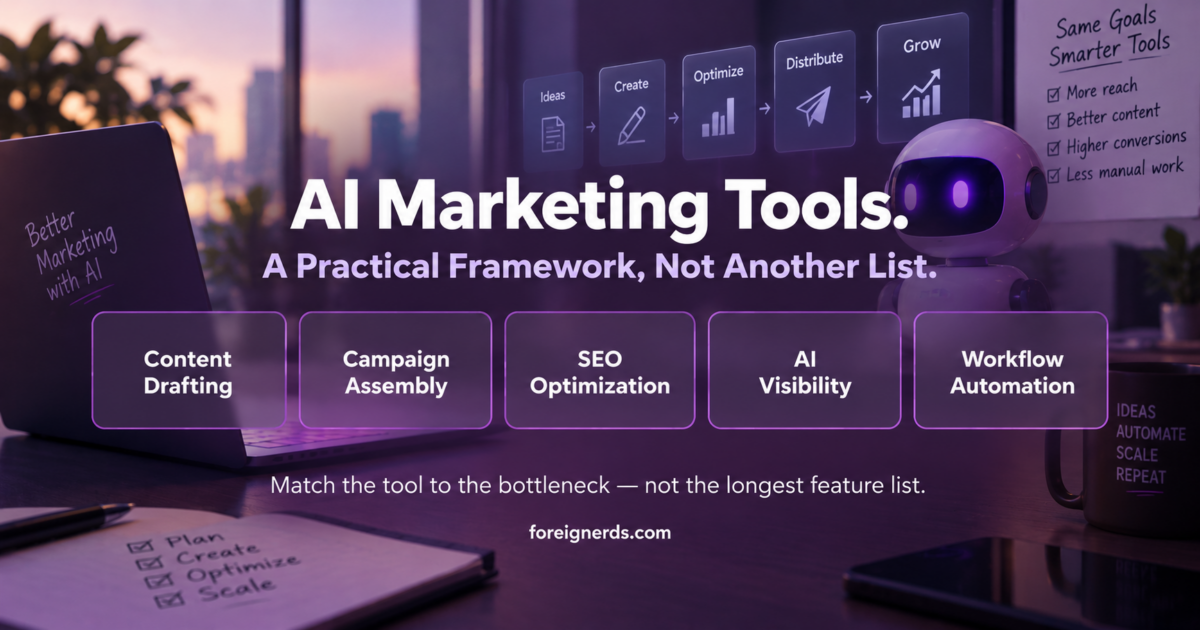
AI marketing tools are software products that use machine learning to automate marketing tasks — writing copy, analyzing audience data, optimizing ad spend, and generating creative assets — rather than doing them manually. Dozens of new tools launch every month, and by mid-2026 most marketing teams use at least five of them without a coordinated strategy connecting them.
The Problem With Every “Best AI Marketing Tools” List You’ve Already Read
Search for this exact topic and you’ll find the same article eight different ways: a numbered list of 17, 25, 30, or 36 tools, usually grouped by category, usually including the same five or six names — ChatGPT, Jasper, Canva, HubSpot’s Campaign Assistant, Surfer SEO. Every one of these lists is accurate. None of them answer the question that actually matters once you’ve read the list: which of these should your specific business actually use, in what order, and how do they work together instead of creating five disconnected subscriptions nobody remembers to check?
That’s the real gap. A list of tools is not a strategy. Most businesses that “adopt AI marketing tools” end up with a pile of underused software licenses and no measurable change in output, because nobody thought through integration before signing up for the free trial.
What These Tools Actually Do, Grouped by the Job, Not the Brand Name
Rather than another tool-by-tool rundown, it’s more useful to think in terms of the actual jobs AI marketing tools handle, since that’s the decision that matters before any specific product gets chosen:
- Content drafting and copy generation — tools like ChatGPT, Claude, and Jasper turn a rough brief into a first draft across blog posts, ad copy, and email. The realistic value here is speed on the first 70% of a draft, not a finished, publish-ready asset.
- Multi-channel campaign assembly — tools like HubSpot’s Campaign Assistant take one input and generate matching assets across email, social, and landing pages simultaneously, which matters more for consistency than for any single asset’s quality.
- SEO and content optimization — tools like Surfer SEO analyze what’s already ranking and suggest structural changes, which is genuinely useful but assumes someone is still making the actual editorial judgment calls.
- AI visibility and brand monitoring — a newer category (Similarweb’s AI Brand Visibility feature is a recent example) that tracks how often a brand gets mentioned inside AI-generated chat responses, not just traditional search results.
- Marketing automation and workflow orchestration — platforms that connect the other categories together so a lead’s behavior actually triggers the right next action, rather than living in five separate dashboards.
Most businesses only ever adopt tools from the first two categories, because they’re the most visible and the easiest to demo. The last category — actual orchestration — is where the real return sits, and it’s the one most listicles skip entirely because it’s harder to screenshot.
The Real Decision: Point Tools vs. an Integrated Stack
Every business adopting AI marketing tools eventually hits the same fork: keep adding individual point tools as needs arise, or invest in a smaller number of tools that are actually wired together. Both are legitimate, and the right answer depends on scale, not preference.
Point tools make sense when: the team is small, the use case is narrow (one person needs faster first-draft copy), and there’s no one dedicated to managing integrations. This is the right starting point for most businesses under 20 people, and it’s genuinely fine to stay there.
An integrated stack makes sense when: multiple people touch the same campaigns, data needs to flow between tools without manual re-entry, and the business has enough volume that a 10% efficiency gain across the whole funnel is worth more than a faster first draft on any single piece of content. This is where marketing automation platforms genuinely earn their cost — not by writing better copy than ChatGPT, but by making sure the right message reaches the right person at the right moment without someone manually checking five dashboards.
What Every Listicle Gets Wrong: Tool Sprawl Is the Actual Failure Mode
The pattern that shows up repeatedly in real implementations, not in vendor marketing: a business adopts three or four AI marketing tools independently, over a period of months, each solving one immediate problem. Six months later, nobody can say definitively which tool is actually driving results, because none of them talk to each other and the data lives in separate silos. The tools aren’t the problem — the lack of a decision about how they connect is.
This is a genuinely common and avoidable failure. Before adding a third or fourth AI tool to an existing stack, the more valuable question is usually not “which tool is best” but “does this tool need to talk to the tools I already have, and if so, does it actually do that, or will I be manually copying data between them in three months.”
A Practical Starting Framework
Before evaluating any specific product, four questions genuinely change the outcome:
- What’s the one bottleneck this needs to solve? Not “we want to use AI” — a specific, named bottleneck (slow first drafts, inconsistent campaign assets, no visibility into AI-search brand mentions).
- Who owns it once it’s live? A tool with no clear owner becomes the unused subscription six months later. This should be a named person, not “the marketing team.”
- Does it need to connect to anything you already use? If yes, verify the actual integration exists and works before buying — a listed “integration” on a pricing page is not the same as a tested, working connection.
- What does success look like in 90 days, specifically? A measurable outcome, not “see how it goes.”
Answering these four honestly before evaluating any specific tool eliminates most of the tool-sprawl problem before it starts.
How to Actually Evaluate a Specific Tool Before Buying
Once the four questions above point toward a genuine need, the actual evaluation of a specific product benefits from a short, consistent checklist rather than a fresh judgment call each time:
- Ask for the actual output on your own content, not the demo example. Every AI marketing tool demo is tuned to look impressive on a curated sample. Run it on a real, slightly awkward piece of your own brand’s content before deciding anything.
- Check what happens to your data. Marketing content often includes customer information, pricing details, or unreleased campaign plans. Understand explicitly whether the tool trains on your inputs, and whether that’s acceptable for your specific content.
- Test the free tier or trial with a real deadline, not a sandbox exercise. Tools behave differently under real time pressure than in a leisurely evaluation — that’s often where genuine gaps between the marketing pitch and daily reality show up.
- Confirm the integration claim with the tool actually connected, not just listed. “Integrates with HubSpot” on a pricing page and a working, tested connection between your specific accounts are two different things — verify the second before committing budget.
Common Mistakes Worth Naming Directly
Buying the tool before defining the workflow
The most common failure pattern: a business sees a demo, gets excited, buys the tool, and only then tries to figure out how it fits into existing work. The fix is genuinely simple — write down the current workflow first, then look for the specific step an AI tool would improve, rather than starting from the tool.
Treating AI-generated output as finished, not a first draft
Every current AI marketing tool, including the well-known ones, produces output that needs a human editorial pass before it goes out under a real brand’s name. Skipping that step is the single most common cause of AI-generated content reading as generic — not because the tool is bad, but because the editing step got skipped.
Ignoring where AI search visibility fits
Most businesses still measure marketing tool success purely by traditional search and social metrics, missing the newer AI Brand Visibility category entirely — a genuine blind spot given how much research now happens inside AI chat assistants before it ever reaches a traditional search engine.
The Honest Timeline for Seeing Real Value
A realistic expectation matters here, because AI marketing tool vendors routinely imply immediate transformation. In practice, the pattern that shows up across real implementations looks more like this: the first month is mostly setup and workflow adjustment, with output quality often lower than the pre-AI baseline while the team learns what the tool is actually good at. Months two and three typically show the first genuine efficiency gains, once the team has learned which tasks to hand to the tool and which still need a human starting point. Meaningful, measurable time savings usually don’t show up clearly until month three or four — not because the tools are slow, but because the human workflow around them takes that long to actually change.
Any vendor or case study promising a dramatically faster timeline than this is either describing an unusually simple use case, or measuring something narrower than genuine team-wide output. Setting this expectation upfront — with whoever owns the tool internally, per the framework above — avoids the common outcome where a genuinely useful tool gets abandoned in month two because it hasn’t yet delivered results that were never realistic to expect that early.
Where This Fits Alongside a Broader Marketing Automation Strategy
Individual AI marketing tools solve individual problems well. The businesses getting compounding value from this moment aren’t the ones with the most tools — they’re the ones who’ve connected a smaller number of tools into one working system, which is exactly what a genuine marketing automation strategy is built to do. If the four-question framework above surfaces a real integration need rather than just a single-task fix, that’s the point where point tools stop being sufficient on their own.
This also connects directly to how AI integration actually works in practice — the same principles apply just as directly to marketing tools specifically. If the agency side of this decision is also on the table, choosing an AI marketing agency runs into the exact same evaluation problem: too many self-promotional rankings, not enough vendor-neutral criteria.
What “Good” Actually Looks Like Six Months In
The businesses that get this right share a specific, recognizable pattern. There are usually two to four AI marketing tools in active use, not eight or ten — each one tied to a specific bottleneck someone identified before buying, not adopted because a competitor mentioned it. Someone can name, without checking a spreadsheet, exactly which tool handles which job and who owns it. When a tool stops earning its subscription cost, it gets cancelled rather than quietly forgotten, because someone is actually accountable for it. And critically, the tools that need to share data actually do, tested and confirmed, not just claimed on a pricing page.
None of this requires picking the single best tool from any list. It requires treating tool adoption as a decision with an owner and a measurable outcome, rather than a purchase made because a demo looked impressive. That discipline, more than any specific product choice, is what separates businesses seeing genuine efficiency gains from AI marketing tools six months in from the ones still paying for licenses nobody opens.
Point Tools vs. Integrated Stack: A Quick Comparison
| Factor | Point Tools | Integrated Stack |
|---|---|---|
| Team size | Under 20 people | 20+ people, multiple hands on the same campaigns |
| Setup effort | Low — sign up and start using | Higher — requires actual integration work upfront |
| Data flow | Manual, tool-to-tool | Automated, shared across the stack |
| Best for | One narrow, specific bottleneck | Coordinated, multi-channel campaigns at volume |
| Ongoing management | Minimal — mostly self-serve | Needs a named owner tracking the whole system |
| Risk if unmanaged | One underused subscription | Multiple disconnected tools and siloed data |
Most businesses starting out should default to the left column and only move right once the specific triggers described earlier — multiple people, real data-sharing needs, meaningful volume — actually show up.
Worth noting too: if the bottleneck your team is actually facing looks more like disorganized social content than disorganized marketing copy generally, choosing a social media management tool is a narrower, related version of this exact same evaluation problem — different tools, same underlying discipline.
Key Takeaways
- By mid-2026 most marketing teams already use five or more AI marketing tools without a coordinated strategy connecting them — tool sprawl, not lack of tools, is the actual failure mode.
- Before evaluating any specific product, four questions matter more than any feature list: what specific bottleneck this solves, who owns it once it’s live, whether it actually needs to connect to existing tools, and what success looks like in 90 days.
- Real value takes longer than vendors imply — month one is mostly setup, months two and three bring the first genuine efficiency gains, and measurable time savings typically don’t show up until month three or four.
- Point tools (under 20 people, one narrow bottleneck) and an integrated stack (multiple people, shared data, real volume) solve different problems — the right choice depends on scale, not preference.
Frequently Asked Questions
What are AI marketing tools?
Software products that use machine learning to automate marketing tasks — writing copy, analyzing audience data, optimizing ad spend, and generating creative assets — rather than requiring a person to do each step manually.
What is the best AI marketing tool?
There is no single best tool — the right choice depends on which specific bottleneck you are solving. ChatGPT and Claude are strong for content drafting, Surfer SEO for content optimization, and dedicated marketing automation platforms for connecting multiple tools together at scale.
Do I need multiple AI marketing tools or just one?
Most small teams do fine with one or two point tools solving specific, named bottlenecks. An integrated stack of connected tools only becomes worthwhile once multiple people touch the same campaigns and manual data re-entry between tools becomes a real time cost.
Why do so many AI marketing tool adoptions fail to show results?
The most common cause is tool sprawl — adopting several tools independently over time with no plan for how they connect, so data ends up siloed and nobody can say which tool is actually driving results.
How long does it take to see real value from an AI marketing tool?
Realistically, the first month is mostly setup and adjustment, often with a temporary dip in output quality. Genuine efficiency gains typically appear in months two and three, with measurable time savings usually visible by month three or four.
Is AI-generated marketing content ready to publish as-is?
No. Current AI marketing tools produce strong first drafts that still need a human editorial pass before publishing under a real brand — skipping that step is the most common reason AI content reads as generic.
What is AI brand visibility, and do I need to track it?
It is a newer metric tracking how often your brand gets mentioned inside AI-generated chat responses (ChatGPT, Perplexity, Gemini), not just traditional search results. It is worth tracking given how much research now starts inside AI assistants rather than a search engine.
Should a small business buy an AI marketing tool or a full marketing automation platform?
Small teams with a narrow, specific need are usually better served by a single point tool. A full automation platform earns its cost once campaign volume and team size make manual coordination between tools a genuine bottleneck.
How do I evaluate an AI marketing tool before buying it?
Test it on your own real content rather than a curated demo, confirm what happens to your data, run the trial under a real deadline, and verify any claimed integration is actually connected and working, not just listed on the pricing page.
What happens if an AI marketing tool does not integrate with tools I already use?
You will likely end up manually copying data between systems, which erodes most of the efficiency gain the tool was meant to provide. Confirm real integration before purchasing if the tool needs to work alongside your existing stack.
Who should be responsible for an AI marketing tool once it is adopted?
A specific, named person — not "the marketing team" in general. Tools without a clear owner are the ones most likely to become an unused subscription within six months.
How is AI marketing tool adoption different from marketing automation?
Individual AI tools solve individual tasks — drafting copy, optimizing one page. Marketing automation connects multiple tools and channels into one coordinated system so a lead's behavior actually triggers the right next action automatically.