Our earlier piece on MCP and A2A governance looked at the open standards that decide how agents connect to tools and to each other. This one looks at the layer underneath those standards, which is the model itself, and at a recent event that shows how quickly access to that layer can change for reasons that have nothing to do with your product.
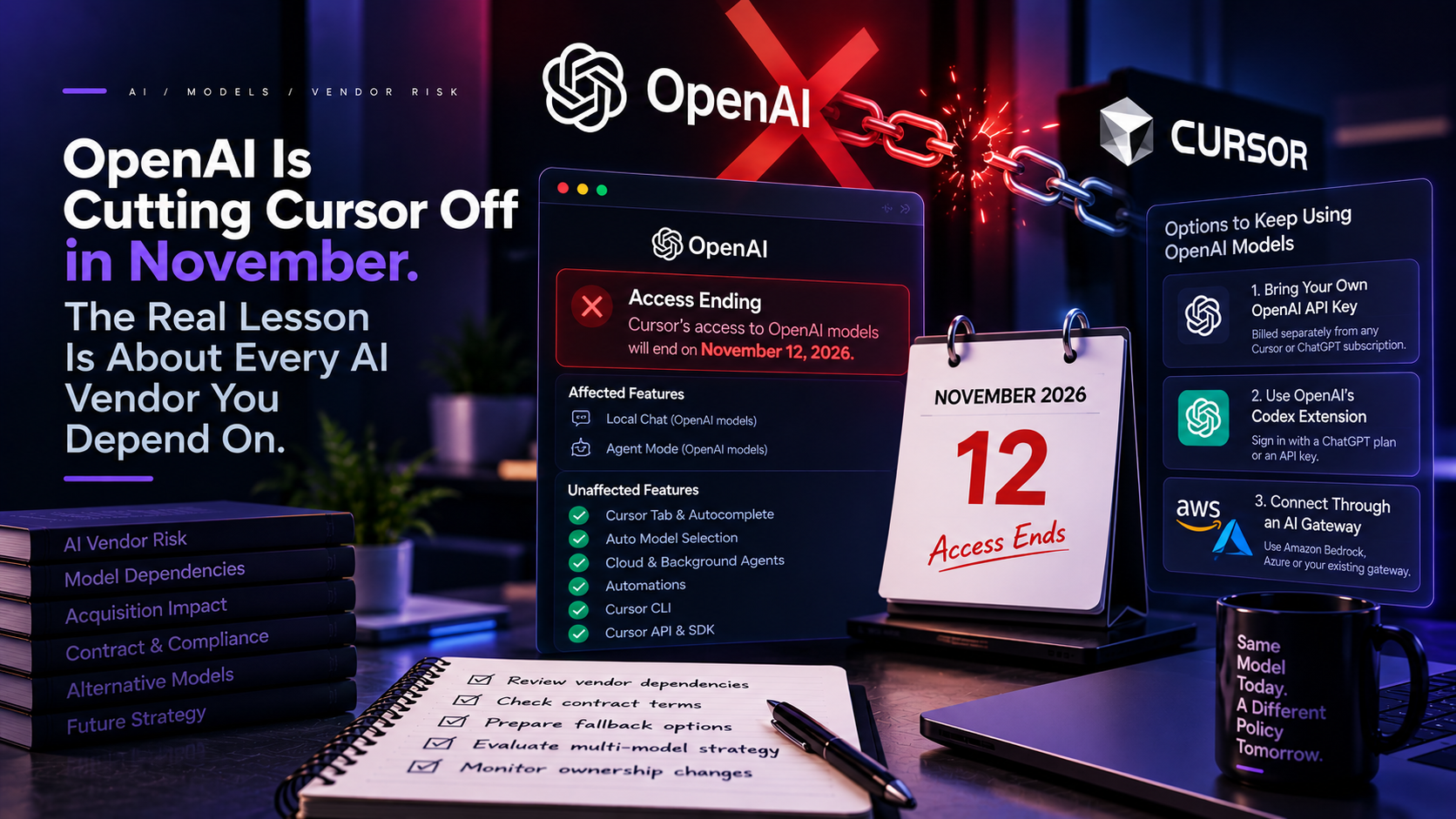
On August 28, 2026, OpenAI announced that it will end Cursor’s access to its models on November 12. The immediate story is about two companies and an acquisition. The lasting story is about every business that has built a workflow on top of someone else’s model. Here is what is confirmed, what is disputed, and what a sensible response looks like.
What is confirmed
The sequence is short. SpaceX acquired Anysphere, the company behind the Cursor coding editor, in an all-stock deal reported at $60 billion, which closed on August 14, 2026. Two weeks later, on August 28, OpenAI published a post explaining its decision to end Cursor’s access to OpenAI models, with November 12, 2026 as the date.
OpenAI’s stated reason is trust. It said it cannot be confident that SpaceX will use its technology within OpenAI’s terms of service, and it pointed to a history of contract disputes involving Elon Musk’s companies, including, in OpenAI’s account, xAI’s violation of OpenAI’s own service terms. OpenAI also said it was giving the maximum notice its agreement allowed, which works out to a little over ten weeks, and that its contract included a limited window to cancel after a change of control.
OpenAI’s help center article adds practical detail. It describes November 12 as the end of a transition period and says the formal termination date will be confirmed later. The affected features are the local Chat and Agent modes that currently offer OpenAI models. The unaffected features are Cursor Tab and autocomplete, Auto model selection, Cloud and Background Agents, Automations, the Cursor CLI, and the Cursor API and SDK, all of which continue to use models supplied by Cursor.
Users who want to keep using OpenAI models have three routes. They can bring their own OpenAI API key, which is billed separately from any Cursor or ChatGPT subscription. They can install OpenAI’s Codex extension and sign in with a ChatGPT plan or an API key. Or they can connect through an AI gateway their organization already manages, such as Amazon Bedrock or Azure. One detail matters for budgets: a ChatGPT subscription does not include API usage, so a team that switches routes may see a new line item.
Anthropic responded quickly. Co-founder and Chief Compute Officer Tom Brown said the company will keep increasing compute to support Claude models in Cursor.
What is disputed or still unclear
Several points are less settled than the headlines suggest, and they are worth separating from the confirmed facts.
Cursor CEO Michael Truell said OpenAI models account for only about 5% of Cursor’s traffic. That is Cursor’s own claim, not an independent measurement, and DevOps.com reported that it was widely questioned on social media. Treat it as Cursor’s position, not as an established number.
Truell also said Cursor was in talks with OpenAI to find a solution. Nothing in the sources reviewed shows that those talks have produced an outcome, and no response from SpaceX appears in the coverage we could verify. The November 12 date could still change, either through negotiation or through the formal notice OpenAI’s help article mentions.
The $60 billion price and the August 14 closing date come from reporting on the deal. The OpenAI post and the help article do not discuss the price. So the accurate framing is that the deal was reported at that value.
None of this changes the central lesson. Even if OpenAI models are a small share of Cursor’s traffic, the event shows how a change of ownership can turn a supplier into a gatekeeper overnight.
Why this is not really a Cursor story
Every company that builds on a third-party model has the same exposure Cursor just discovered. The contract you signed can be ended by the supplier under conditions you do not control, and an acquisition, on either side, is one of the most common triggers. In this case the acquired party was the customer. It could as easily be the supplier, whose new owner may reprice, restrict, or retire the product you rely on.
There is also a competitive dimension. Within hours of OpenAI’s announcement, a rival lab publicly reaffirmed its support for Cursor. That is good news for the customer in the short term, but it moves the dependency instead of removing it. A team that swaps one model vendor for another is still exposed to the same category of risk, only with a different counterparty.
Treat model access the way finance teams treat any critical supplier. Ask who owns the vendor, what happens if that changes, how much notice the contract requires, and what your fallback is. Most engineering roadmaps never ask these questions, because the model feels like infrastructure. It is closer to a contract that can be ended.
Switching models is not a configuration change
The technical half of the risk is easy to underestimate. Standards like MCP and A2A make it easier to connect an agent to tools and to other agents. They do not make one model behave like another.
Analysts quoted by CIO made this point directly. Manoj Chandra Jha of Nord-IQ Research said prompts and agent instructions that work well with OpenAI models can produce different results with another model, which forces enterprises to retune both prompts and evaluations. Abhishek Satapathy of Avasant listed where the differences show up in coding agents: repository-level work, debugging, refactoring, test generation, multi-file changes, and tasks where an agent must inspect a codebase, make changes, run tests, and correct its own errors.
That list should look familiar to anyone doing AI agent development. Agents chain many steps together, so a small difference in how a model interprets an instruction can compound across a workflow. A prompt that produced clean output on one model can drift on another, with tool calls made in a different order, formats interpreted differently, or errors handled in a different way.
CIO also quoted Pareekh Jain, who advised enterprises to support multiple models, test alternatives regularly, and “avoid making important workflows too dependent on one model.” The word regularly matters. A fallback model that has never been tested is only a hope.
What resilience looks like
Cursor itself offers a useful example of preparation. Most of its product does not depend on OpenAI’s models at all. Tab completion, Auto selection, cloud agents, automations, the CLI, and the API all continue on Cursor-supplied models. A Forbes analysis argued that this reflects deliberate investment in its own coding model, Composer 2.5, built on open-source checkpoints, which lets Cursor treat frontier model access as something it can substitute. That is an analyst’s interpretation rather than a confirmed account of Cursor’s strategy, but the product structure supports the point. The features most exposed are the ones where users chose an OpenAI model by name.
Very few companies can train their own model. The principle still applies at smaller scale: keep the part of your product that users experience separate from the part that depends on a single supplier. For teams working on AI agent development, that usually means keeping business logic, tool definitions, and evaluation data in your own repository, and treating the model as a component you can replace. Prompts written for one model should be documented as model-specific, so nobody assumes they will transfer.
A practical checklist for model dependency
Whether you are building internal tools, customer-facing agents, or a full product, the same steps reduce the risk. This is the kind of work that belongs in any serious AI development plan from the start.
Inventory every model dependency. List each workflow, which model it calls, through which route, and under which contract. Include shadow usage, such as teams running personal API keys.
Put an abstraction layer between your application and the model. Route calls through one internal interface so that changing the model is a change in one place, not a rewrite.
Build an evaluation suite before you need it. A set of representative tasks with expected outcomes lets you compare a replacement model on evidence instead of impressions. This is the piece Jha’s comment points to, and it is the one teams most often skip.
Test a fallback model on a schedule. Run the evaluation suite against at least one alternative every quarter, and keep prompts tuned for it, not only for your primary.
Read the contracts. Look for change-of-control clauses, notice periods, usage restrictions, and pricing terms. Note who can end the agreement and under what conditions.
Understand the billing routes. As the Cursor case shows, subscriptions and API access are often billed separately. Know which one each workflow actually uses.
Assign an owner. Model dependency is a business risk, so it needs an owner outside the engineering team who reviews it alongside other supplier risks.
Where this leaves you
OpenAI’s decision on Cursor is confirmed, with November 12 as the announced end date, though the formal termination date and the outcome of talks remain open. The claim that OpenAI models are 5% of Cursor’s traffic is Cursor’s own. The wider point does not depend on either detail. Access to a model is a supplier relationship, and supplier relationships change when ownership changes.
For teams investing in generative AI development and agent workflows, the response is measured, not alarmed. Inventory the dependencies, build the evaluation suite, test the fallback, and review the contracts. The cost is a few weeks of engineering time. The alternative is discovering your dependency on a Tuesday afternoon with a ten week clock running.
Frequently Asked Questions
1. When does OpenAI stop providing models to Cursor?
Answer: OpenAI announced on August 28, 2026 that access ends on November 12, 2026. Its help center describes that date as the end of a transition period and says the formal termination date will be confirmed later.
2. Why did OpenAI end the agreement?
Answer: OpenAI said it cannot be confident SpaceX will use its technology within its terms of service, following SpaceX’s acquisition of Cursor’s parent company. It cited a history of contract disputes involving Elon Musk’s companies.
3. What still works in Cursor after the cutoff?
Answer: Cursor Tab, Auto model selection, Cloud and Background Agents, Automations, the CLI, and the API and SDK continue on Cursor-supplied models. The affected features are local Chat and Agent modes that offer OpenAI models.
4. Can developers keep using OpenAI models in Cursor?
Answer: Through other routes, yes. OpenAI lists bringing your own API key, using the Codex extension, or connecting through an AI gateway such as Amazon Bedrock or Azure. API usage is billed separately from a ChatGPT subscription.
5. Is it true that OpenAI models are only 5% of Cursor’s traffic?
Answer: That is what Cursor CEO Michael Truell said, but it is Cursor’s own figure and was questioned publicly. It has not been independently verified.
6. How can my business reduce model dependency risk?
Answer: Inventory every model dependency, put an abstraction layer between your application and the model, build an evaluation suite, test a fallback model regularly, and review supplier contracts for change-of-control terms.
If you want to know how exposed your own workflows are to a single vendor, that is exactly what we look at in a free AI Readiness Audit.
Related Reading
 Salesforce Just Gave Its AI Agents Names, Job Titles and Goals That Run for Weeks
 AI Agents May Be Running Inside Your Company Without Approval. CrowdStrike Just Built a Product to Find Them.
 ChatGPT and Claude Cite Earned Media About 93% of the Time in Product Research. Your Own Website Barely Registers.