
Every marketer working on AI visibility has the same suspicion: if AI assistants lean on third-party sources, the shortest route to a mention is to create those sources. A policy update from Anthropic, the company behind Claude, puts a line through part of that idea. Announced on October 8, 2026 and effective November 12, it prohibits using Anthropic’s products to seed the sources AI systems draw answers from with content that misrepresents who is behind it.
The wording is narrower than some headlines suggest, and the policy binds users of Anthropic’s products, not the web at large. This piece sets out what the text says, what it does not say, and the practical test it offers brands deciding between earned mentions and planted ones. It is written for teams planning generative engine optimization and digital PR programs.
What the policy says
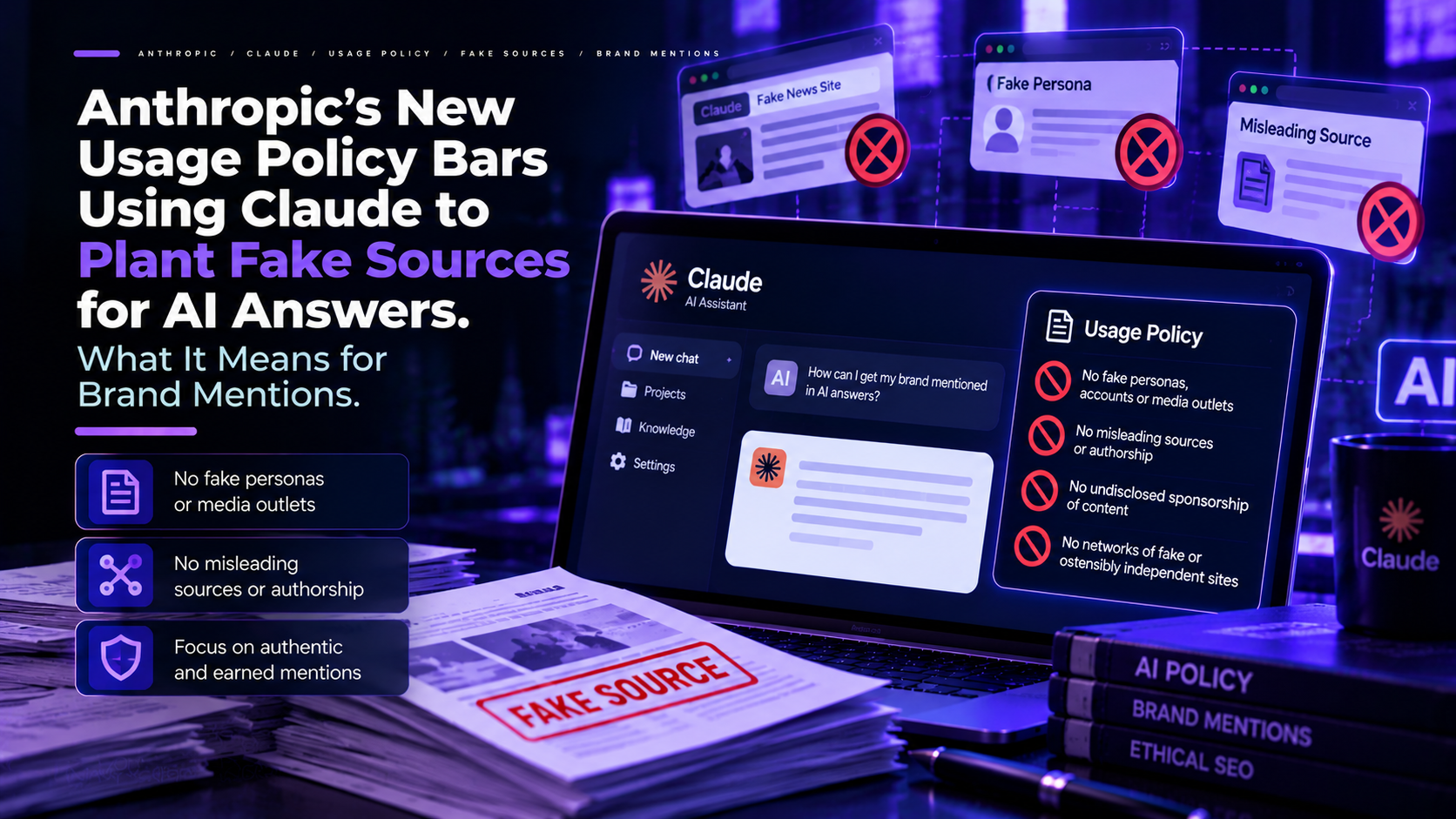
The change sits in a new section of Anthropic’s usage policy on deceptive campaigns and artificial activity. Read from the policy page, it prohibits using Anthropic’s products to create fake personas, accounts, media outlets or organizations, or to impersonate real ones. It prohibits hiding the sponsorship of content meant to influence opinion or decision-makers, and spreading content through networks of fake or ostensibly independent sites that share a common source. It also covers building tools for deceptive campaigns and marketing any of these activities.
The clause that matters here prohibits manipulating the sources from which search engines or AI systems draw answers, by “seeding them with content that misrepresents its origin, authorship, or independence.” The policy’s own example is a network of sites posing as unaffiliated sources that corroborate the same claims.
Notice what triggers the rule. It is not seeding, volume or the use of AI. It is misrepresentation: content that hides its origin, its author or its lack of independence.
Who it binds, and who it does not
The policy applies to anyone who submits inputs to Anthropic’s products. That covers individuals using Claude.ai or Claude Code, businesses using the API, customers who reach Claude through cloud providers or resellers, and end users of products built on Claude. A marketing tool built on Claude puts its own users under the same rules, as Relevant Audience points out.
It does not bind search engines, other AI companies or the open web, and it does not govern how Claude ranks or cites content. Mike King of the GEO consultancy iPullRank makes the same point in his analysis: the policy is about how people use Claude.
Enforcement works against the account, not the website. Anthropic’s Safeguards Team monitors for violations, and if one is suspected Anthropic may warn, throttle, limit, suspend or terminate access to its products. That differs from Google’s spam policies, which act on sites.
A new rule, or a clearer one?
Search Engine Journal reads the update as a clarification, not a brand-new ban. The 2025 policy did not mention search engines or AI answers, but Anthropic says it already prohibited fake-account networks and fake news sites, spread across other sections. The new text states the principle directly and applies it to the sources AI draws on.
Search Engine Journal also describes the case Anthropic linked to the section. According to that report, Anthropic found a network of around 70 sites posing as independent local news outlets, tied to a France-based advertising agency. The network used Claude to produce articles designed to “boost their site’s authority rankings on search engines.” It published at least 8,913 articles in about 20 languages, though most got little engagement. Anthropic removed the account and banned the organization.
Two cautions apply. The coverage does not say whether those sites improved their rankings or appeared in AI answers, so the case shows the tactic being attempted, not working. And Search Engine Journal does not link the full text of Anthropic’s report, so its details rest on that outlet’s summary.
Where the line sits
Relevant Audience reads the clause as aimed at deception about who is behind content, not at producing content for AI visibility. In its reading, the policy does not ban using Claude to write content, structure pages for AI answers or publish at volume. That is the publication’s interpretation of the text, which Anthropic has not spelled out for edge cases. For example, Anthropic has not said how it would treat several openly branded sites run by one company, and the policy text points to misrepresented independence as the trigger.
Read together, the sources suggest a useful test, which Relevant Audience frames as its own and not Anthropic’s: would the tactic still work if every reader knew who wrote the content and who paid for it? King puts a similar idea in terms of durability, arguing that manufactured independence has “an expiration date.”
Earned versus planted mentions
That test separates two things that can look alike from outside.
An earned mention exists because someone independent chose to write it. A journalist cites your original research. An expert quotes you. A customer reviews your product. A publisher runs a contributed article under a real byline. A sponsored placement is labeled as sponsored.
A planted mention only looks independent. A network of sites that recommend the same brand while hiding common ownership. Reviews from fake personas. Undisclosed paid listicles. Forum answers posted by accounts that conceal their affiliation. iPullRank, which sells GEO services and so has an interest in the framing, lists these among the tactics to avoid. The policy text itself names fake personas, hidden sponsorship and networks of ostensibly independent sites.
This is the distinction our earlier piece on why third-party mentions matter for AI search turns on. The reason independent sources carry weight in AI answers is that they are independent. Faking independence takes away the thing that made the mention valuable, and it now carries account-level risk for anyone doing it with Claude.
What to do before November 12
None of this requires a strategy rewrite. It asks for a short audit.
Check your own content network. If you or an agency have used Claude to produce content for several sites that appear independent but share an owner or a sponsor, review it now. Search Engine Journal suggests this audit.
Ask vendors direct questions. Relevant Audience recommends asking agencies and tools how they build AI visibility and whether any sites in their plans are owned by them without saying so. A vague answer is information.
Label sponsorship. Where a placement is paid, say so on the page. Where a comparison page is brand-owned, make that obvious.
Use real bylines and real experts. Contributed content should carry the name of the person who wrote it and a verifiable role.
Fund the earned route. Original data, expert commentary and useful tools give journalists and publishers a reason to cite you. That is the work behind digital PR and ethical link building, and the slower route is the durable one.
Measure what you earn. Track whether your brand is mentioned and cited across AI platforms, and which sources drive the mentions. A free AI Visibility Audit does this across platforms and shows where earned coverage is missing.
What this does not tell you
The policy is not evidence that seeding works, or that it fails. The reporting does not show whether the network Anthropic banned gained rankings or appeared in AI answers.
It does not describe how detection works beyond general monitoring, and it does not cover other AI companies. ChatGPT, Gemini and Perplexity have their own terms, and Google has its own spam policies. Do not read this one document as a rule for all of GEO.
It also does not tell you that AI-written content is off limits. The text turns on misrepresentation, though edge cases remain untested. If you use AI tools to draft, the safe course is the same as it has always been: a real author, accurate claims and no pretense about who is speaking.
Why this matters for AI search visibility
AI assistants increasingly shape which brands get recommended, so the temptation to manufacture sources will not disappear. What this update does is move one major provider’s rules in the opposite direction, and mark provenance as the thing platforms are watching. For answer engine optimization, the safest assets are the ones that can survive scrutiny: clear answers, original information, real authors and accurate facts. Our full guide to optimizing for AI search covers that groundwork, and sound search engine optimization supports all of it.
Where this leaves you
The confirmed facts are these. Anthropic announced an updated usage policy on October 8, 2026, effective November 12. A new section prohibits using its products to seed the sources search engines and AI systems draw answers from with content that misrepresents its origin, authorship or independence. Enforcement is against accounts. The policy binds users of Anthropic’s products, not other companies or the open web.
The practical response is to build mentions that would still work if everyone knew who was behind them. That favors original research, real experts, labeled sponsorship and honest digital PR and link building, backed by measurement of what AI platforms actually say about you. Whether the aim is generative engine optimization, answer engine optimization or plain search engine optimization, the same provenance rules apply.
Frequently Asked Questions
1. What did Anthropic’s updated usage policy change?
It added a section on deceptive campaigns and artificial activity, which prohibits using Anthropic’s products to seed the sources search engines and AI systems draw answers from with content that misrepresents its origin, authorship or independence. It takes effect November 12, 2026.
2. Does it ban GEO?
No. The trigger is misrepresentation, not optimization. Writing clear content, structuring pages for AI answers and earning mentions are not what the clause describes, though Anthropic has not addressed every edge case.
3. Who does the policy apply to?
Anyone who submits inputs to Anthropic’s products, including individuals, API developers, customers using Claude through cloud providers and end users of products built on Claude. It does not bind search engines or other AI companies.
4. What happens if someone violates it?
Anthropic may warn, throttle, limit, suspend or terminate access to its products. In the case Search Engine Journal describes, Anthropic removed the account and banned the organization.
5. Is it a new rule?
Search Engine Journal reads it as a clarification. Anthropic says fake-account networks and fake news sites were already prohibited under other sections, and the update names the search and AI answer context directly.
6. How do I tell an earned mention from a planted one?
Ask whether the tactic would still work if readers knew who wrote and paid for the content. Independent coverage, real reviews, labeled sponsorships and bylined expert content pass. Fake personas, hidden-owner site networks and undisclosed paid listicles do not.
7. What should I do before November 12?
Audit any Claude-made content running across sites that appear independent, ask agencies and tools how they build AI visibility, label sponsored content and use real bylines. Then measure your actual mentions across AI platforms.
If you want to know where your brand is mentioned and cited across Google and AI answer engines today, and which sources are driving it, that is exactly what we look at in a free AI Visibility Audit

Related Reading
 Google Appears to Be Serving Altered Results to Rank Trackers. How to Tell a Real Ranking Drop from a Fake One.
 The UK Regulator Wants AI Assistants Like ChatGPT on Google’s Search Choice Screens, With One Condition for Publishers.
 96% of IT Leaders Say Their AI Agent Inventory Is Complete. Two in Three Had an Agent Incident Anyway.
Recent Posts
 Google Is Testing AI Overviews Inside Local Business Profiles. What Local Businesses Should Check Now.
 Google Switched On Checkout Inside AI Mode for Eligible Shopify Stores. Here Is What It Changes for Your Measurement.
 Google’s September Spam Update Has a Two-Week Rollout Window, the Longest of 2026. Here Is What to Do While It Rolls Out.